This is a new series on my blog, I'll call it "Florida". I'm not sure how many posts it will be yet, but it will be at least several. Recently, I got to go to Florida for the first time in my life for a week and it was awesome. My friend Caleb Strand made plans back in November to house sit for our friend, Sean Fitzgerald who lives in Florida (previously in Arizona). When I found out about the plans I asked Caleb if I could team up with him for some of the time he would be there for (three weeks), and he and Sean said yes and gave me the go. I booked my trip shortly after in mid-November and my recent trip had me landing in Orlando on the afternoon of December 30th and flying out of Orlando to conclude the trip on January 6th. The birding treks I knew we would be going on before the trip started had me stoked, and we were going to be birding much of the southern half of Florida. This southern half hosts an awesome diversity of birds, and I would have a chance at many lifers. The three birds I was most stoked about were three birds that really bring Florida to mind: Snail Kite, Anhinga, and Limpkin. Being in Florida also gives one that chance at chasing or finding Caribbean vagrants such as La Sagra's Flycatcher, Cuban Pewee, or Red-legged Thrush. Caleb had already been in Florida for over a week, and not only did he have great ideas for itineraries, but he also had some awesome places staked out where we would visit.
On December 30th, I got to Orlando later in the afternoon, and Caleb picked me up from the airport. While landing on the plane my first three birds for Florida were Great Egret, Osprey, and Turkey Vulture We were about 1.5 hours north of Sean's house in Port Saint Lucie where we were based for Caleb's house sitting. As the day was getting late, we did have a short amount of time for birding. Driving south in the direction toward Port St. Lucie, we noted many birds along ponds and numerous roadside habitats and locations. My first life bird of the trip, Muscovy Duck, didn't take long at all. It was an immediate reminder that we were in Florida, a state that has many exotic bird populations that are established and are considered countable by the American Birding Association. The Muscovies in Florida have a wide range of appearances, and their feral population really smacks the truly wild birds of extreme south Texas in the face. Back in 2019, we struck out on those Wild Muscovies during our Texas trip (unfortunately), and if I get to go to south Texas again, I might give them another shot. Aside from Muscovy Ducks, the highways were lined with characteristic birds that one would see in Florida and the southeastern United States: White Ibis, Glossy Ibis, Red-shouldered Hawk, Fish Crow, Crested Caracara, and Little Blue Heron.
As we made our way to Sean's, our first real stop of the trip came from a big area called Three Lakes Wildlife Management Area. Once off the main highway, we took a dirt road for close to 10 miles to a boat ramp, which overlooks a big marsh area. This was my first taste of Florida. From an observation dock, we ran into two guys who pointed out a group of Wild Turkey to us. Not long into scanning we found a few Limpkin, which was one of my most wanted birds for the trip. The bird gave it's call a few times, which sounds like a mix between a dinosaur and a Sandhill Crane. The Limpkin is a distinctive bird in North America, where most of it's range is in Florida. Over recent years, it has made drastic movements further north and is expanding it's range as it's favorite food in Apple Snails are becoming more available than before. Limpkins are the only bird of their family in the world, and resemble something in the mixed with an Ibis, Crane, and Rail. Some of the oddest birds out there are some of the coolest to observe. From the boatramp area we tallied 6 Limpkins in our 30 minute, stationary observation in fading light until it was hard to see. A few of them came in close for favorable views. The marsh was also alive with an abundance of birds. A low grunting but loud enough sound to be heard from a distance was another highly wanted lifer of mine in Anhinga, a species I knew would be abundant on the trip. The marsh also held 32 Common Gallinule, 2 Purple Gallinule, Little Blue and Tricolored Herons, 140 Sandhill Cranes flying overhead, White and Glossy Ibis, and a few flyover White-throated Sparrows and more among 37 species recorded in our first complete eBird list for Florida. We went to Port St. Lucie to eat Chipotle before going to Sean's. The next day, December 31st, the plan was to go to the massive Lake Okeechobee for an entire day of sun-up to sun-down birding.
 |
My first Limpkin
|
December 31st was a day I'll always remember as a great one, and the birding at Lake Okeechobee was awesome with a high abundance of different birds. I quickly learned that throughout most of the southern half of Florida that warm clothes weren't needed most of the time, and that the humidity levels made the temperatures seem like they were 10-15 degrees higher than they actually were. The lake is about 45 minutes from Sean's house, and is actually wider and longer than the Salton Sea in California. Four different Florida counties are within this lake, and Caleb had a handfull of locations where we would stop at. Included in those stops were good locations for potential lifers for me in Smooth-billed Ani, Anhinga, Snail Kite, Gray-headed Swamphen, and Gray Kingbird. I was stoked with the lifer chances, especially with chance of seeing Snail Kite. Aside from lifers, Florida was filled with numbers of eastern songbirds. Palm Warblers are everywhere you step in much of Florida, except the edge of beaches. Pishing around any trees will bring in a variety of eastern warblers, Blue-headed Vireos, White-eyed Vireos, Great-crested Flycatchers, and an abundance of Blue-gray Gnatcatchers. I loved the tropical woodlands of Florida and all the birds that were in those woodlands. Caleb and I were joined for the first half of the Okeechobee birding day by Alec Hopping, who is a great birder and is very well traveled around the world. "Hopper" joked that he still needed Palm Warbler as a lifer when he joined us, and it took us a few seconds to find him many Palm Warblers. Our first stop at the lake was a place called Port Myaca Lock. It is a great spot that has awesome habitat diversity that included the open water of Okeechobee, an area with thick marsh and grass, and some nearby tropical deciduous woodland. The marshy stuff at this spot was hosting a great life bird for me in the Smooth-billed Ani. Before we started looking for Anis, I looked over in the marsh to get my first look at an Anhinga. Although this was knowingly the first of hundreds on the trip that I would see, it was still freaking awesome to me. Anhingas belong to a family of birds known as Darters. There are 4 of them worldwide, and Anhinga is the one representative for North America. The nicknames "Water Turkey" and "Snake Bird" fit Anhinga perfectly, as it's long and skinny neck often peers out of the water while the rest of it's body remains underwater. It's sharp bill is used to spear fish. Anhingas perch and characteristically hold their wings open to dry after swimming to reveal a striking wing pattern, and they also soar often. The Anhinga had it's head down for much of the time, and we worked our way down the marshy area to look for the Anis. While we were looking, we saw a Tropical Kingbird, which is scarce and local in Florida with a few being present in the state. After about 20 minutes, Caleb spied a Smooth-billed Ani, which was closely followed by a second Smooth-billed Ani. It was cool to see them, and it became great when the birds started calling with their call that sounds like an ascending whistle and much different than "PEET-uaay" calls of the very-similar Groove-billed Ani. Smooth-billed Anis are much more likely in Florida, but Groove-billeds are found at times too. Smooth-billed Ani in Florida used to be an uncommon and local resident in wet marshy and weedy areas before declining and becoming more rare. Seeing these birds was awesome, and one of them had a culmen that raised up pretty high, a good visual indicator of Smooth-billed Ani (but one that is shown by only a minority of individuals). Aside from life birds, this stop was filled with awesomeness and lots of bird diversity. The list also included many gulls out on the lake (Laughing, Herring), Forster's and Caspian Terns, Least Bittern, Little Blue and Tricolored Herons, White Ibis, stunning looks at a Pileated Woodpecker, and a stellar assortment of passerines that included Blue-headed Vireo, Carolina Wren, Grasshopper Sparrow, Black-and-white Warbler, Yellow-throated Warbler, and both Indigo and Painted Buntings.
 |
Smooth-billed Ani
|
 |
The first visual of Anhinga
|
 |
Yellow-throated Warbler
|
 |
Tropical Kingbird
|
 |
| Osprey |
 |
Laughing Gull
|
 |
White Ibis
|
 |
Palm Warber
|
 |
Amazing view of Pileated Woodpecker
|
 |
Channel flowing into Lake Okeechobee, marshy area where Smooth-billed Anis were straight ahead and on right side of water
|
As the day went on we made numerous stops along the east side of Lake Okeechobee while heading southward. Birds continued to be everywhere and it was awesome.
 |
| Ovenbird |
 |
Northern Waterthrush
|
 |
soaring Anhinga
|
 |
Little Blue Heron
|
 |
Focus: Black Vulture
|
 |
Focus: Belted Kingfisher
|
 |
One of many ponds. A Gator was in this one
|
 |
White-eyed Vireo
|
The next big stop we made came mid-morning at a place called Belle Glade Marina and Torry Island. This location held numerous aquatic habitats such as open water and extensive marshes. Trees in the area were great for passerines. Before we got to this location it was one that I was anticipating, because Caleb had multiple Snail Kites while birding here several days earlier. Snail Kite was my most wanted bird of the trip, and it has been a bird I had always wanted to see when I first got into birding. We made our way to a lookout tower that gives people an excellent overview of the extensive marsh of Torry Island. Before we could get there, an adult male Snail Kite flew right past the tower. Had we had been there a few minutes earlier, the views of the Snail Kite would've been great. Once on the tower, it didn't take us long to find several Snail Kites. There were a few adult males and a few juvenile birds, which look different from each other in plumage. Snail Kites are odd, well-named raptors that feed almost entirely on apple snails. Although they have wondered north a few times to considerable distances, the range of this Kite barely reaches the United States in roughly the central to southern part of Florida in inland habitats, where they are an endangered species. The young birds were close to us while we scanned from the lookout tower, and then Caleb spied an adult male who was sitting very close too. Looking through Alec's scope resulted in awesome views, but the birds were out of range for my camera. It was also cool because I could look around and see Limpkin and Anhinga nearby too, all three of those most wanted Florida birds of mind all in one spot. On the lookout tower we also saw a scarce bird for Florida in a Vermilion Flycatcher, which several other groups of Florida birders were looking for while we were there. While walking along the paths, Caleb pointed out the calls of another lifebird, which was the Gray-headed Swamphen. This bird, related to Gallinules and such, is another established exotic in Florida. They are native to Eurasia, but was introduced to Florida in 1996 and it has spread plentifully since to become an established exotic. While getting close looks at a small group of Swamphens, it was really awesome to get close and within feet of a Limpkin. We tallied 68 species while spending about 2 hours at this location. Caleb called 10 different species of warblers in by pishing at one tree, and it was awesome.
 |
Anhinga over the marsh
|
 |
young Snail Kite
|
 |
adult male Snail Kite
|
 |
male Snail Kite over marsh
|
 |
Snail Kite over marsh
|
 |
| Vermilion! |
 |
Tree Swallow
|
 |
Northern Rough-winged Swallows
|
 |
Palm Warbler
|
 |
Gray-headed Swamphens
|
 |
an awesome experience with a Limpkin
|
 |
Tricolored Heron
|
 |
White Ibis
|
After Torry Island, Alec went on his way to northern Florida and Caleb and I birded the south side of Okeechobee and then worked our way up the west side. Among the many stops we made included John Stretch Park and Harney Pond Canal Recreation Area. Passerines continued to be abundant in trees and deciduous woodland, and waterbirds were abundant in any aquatic habitats.
 |
Prairie Warbler
|
 |
Black-and-white Warbler
|
 |
American Redstart
|
 |
Downy Woodpecker
|
 |
Blue-headed Vireo
|
 |
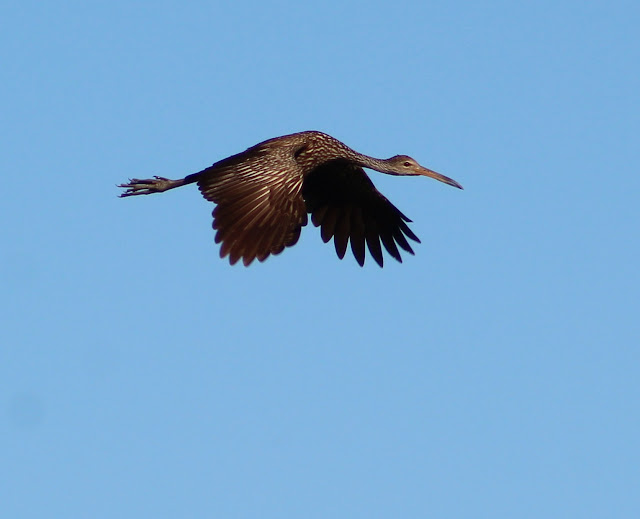
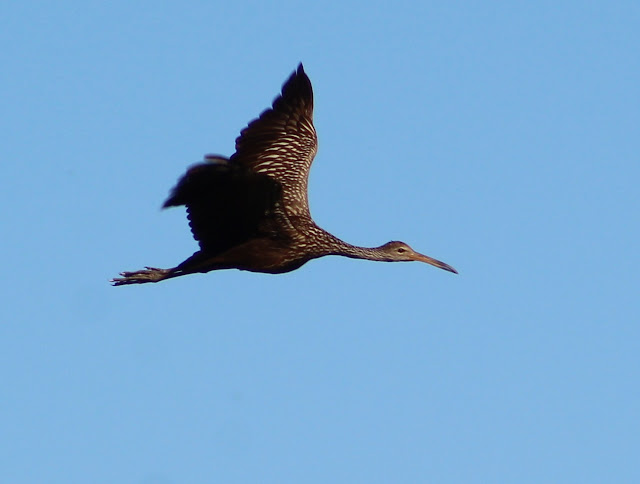
Limpkin in flight
|
 |
| Anhinga |
 |
Blue-headed Vireo
|
 |
size comparison of Great Blue and Little Blue Herons
|
 |
Palm Warbler
|
 |
Little Blue Heron
|
 |
Black Vultures
|
 |
marsh meets lake
|
 |
A Florida Bald Eagle
|
 |
Fish Crow
|
The last birding stop we would make for the day, and the last birding stop of the year 2021 was at a place called Okee-Tantie Recreation Area. This stop was at the northwestern section of Okeechobee. It had marshes and open water, but it was dominated by oak and deciduous habitats. We got to the spot at about 4:30 P.M., and birded for a little over an hour until it was about dark outside. This spot was a great way to close out 2021, as it had 57 different species of birds in front of us. Our main target was what was another lifer for me in the Gray Kingbird. Most of the United States breeding range for Gray Kingbird is along the coasts of Florida, which does extend west to the coast of Alabama and Mississippi. Some birds are found in inland Florida, but are more local. It is a common breeder in the Florida Keys. Fortunately for us, three of these birds were wintering in this recreation area. It was only minutes into our search where we heard a bird call, and we tracked it down for good views. The original bird was joined by another Gray Kingbird, and there ended up being a third one in sight nearby. A black mask and a long bill gave this bird a neat look to it. More wintering kingbirds in 4 Western Kingbirds and 2 Scissor-tailed Flycatchers nearby made it a Tyrannus show. Right when it was close to dusk, I went to enjoy an Anhinga up close. It was later 2021, and what's up 2022 was around the corner to explore the Everglades area.
 |
Gray Kingbird
|
 |
Gray Kingbirds
|
 |
Gray Kingbird and Loggerhead Shrike-a few similarities
|
 |
Gray Kingbird with a meal
|
 |
Red-bellied Woodpecker
|
 |
Scissor-tailed Flycatcher
|
 |
Baltimore Oriole
|
 |
One last Anhinga for the first day...
|
 |
Scissor-tailed Flycatcher
|
More Florida posts coming soon...