On November 5th, I came went home from a morning of birding at Morgan City Wash. I was hoping to relocate a Bay-breasted Warbler that had been found nearby. The bird was no doubt a long shot and I knew it, but I still tried and didn't come up with it. When I got home I was tired and started to take a nap. My phone ringing woke me up and I saw that it was Caleb calling. Caleb said, "I've got a juvenile Laughing Gull at Hidden Lake!". I woke up very quick and was out the door, on my first Laughing Gull chase in Maricopa County.
Caleb told me how to access the where he discovered the bird. I drove to the spot and it wasn't long before I got to see the gull. It became a Maricopa County life bird for me, and I was pumped. Mary was right behind me and we enjoyed it together for awhile and Mary captured great photographs as she usually does. It was awesome to watch this rarity for awhile and observe it flying over Hidden Lake with views of the desert in the background.
Caleb found the Laughing Gull when he didn't have binoculars and made the call with his naked eye. Awesome story! Caleb joined Mary and I, and then Ronnie, Dara, and Ryan joined us shortly after. Sadly, the Gull seemingly flew off right before Ronnie, Dara, and Ryan came. We had fun together and hung out at Hidden Lake for awhile. Hidden Lake is an awesome place, and it is a place Caleb has worked at full time and part time. They were getting ready for a busy event that they were hosting when the gull showed up, and thanks to Caleb and his boss, Jennifer Mladik, we were able to go. It was awesome of Jen to open her property up to us, and I'm thankful to her and Caleb for being able to see this rare bird.
And not locating the gull that night turned out to be beneficial for Ronnie, Dara, and Ryan. It was back at Hidden Lake the next day, and they were all able to not only get the Laughing Gull, but their county Heerman's Gulls too! HEEG was a county lifer for Caleb too, and it was awesome that he found both of those rare birds (both county lifers for him) while working.
Other than the Laughing Gull, here are a few more cool birds I've seen lately. 2020's birding continues as being awesome!
The third full day of my trip fell in place on May 30th. I woke up pretty early after another late night of dinner, having fun, and having smores over a fire. Gretchen and I were going to go kyacking later in the morning, followed by fishing via a boat with Tabby near Shell Lake after kyacking. When I woke up, I had a few hours for some birding before we would get around, and rather than driving anywhere, I opted to hike on roads right around the cabin. This day would solely be birded from Washburn County! These roads have excellent birding themselves, and during the summer of 2017, I walked and hiked them every morning before our workload for the day took place. I had my lifer Mourning Warbler and Black-billed Cuckoo (heard only) on these roads by the cabin, as well as an awesome assortment of eastern songbirds.
What was really running through my mind when I first got around in the morning was May 31st, the next day. I had plans and reservations to drive all the way from Spooner, Wisconsin, to Grayling, Michigan. The drive's time would take close to nine hours, and the distance of the drive would be over 500 miles. Yeah, this all was one way. I had a two night reservation in Grayling. The effort would be to try and see the highly coveted, famous, and range-restricted Kirtland's Warbler, which are in numbers around the Grayling area. Thinking of the drive I was a bit anxious, because I had never driven that far one way before. At the same time, I was pumped up about it. For the time being, I decided to think about the Kirtland's Warbler trek at dawn the next day when I would leave, and focus on the epic day that I'd have in front of me on May 30th.
I walked down a road called Hector Dam Road, which is nearby to the cabin. A variety of songbirds were present. Rose-breasted Grosbeaks were heard in high numbers, and this male was very cooperative and helped me out with some snapshots!
A Wood Thrush, Mourning Warbler, and Golden-winged Warbler were among the many songbirds that were present. I photographed the Golden-winged Warbler.
And with the Golden-winged, I also recorded it's song. While Gretchen and I ran errands in the morning during the previous day, I heard a Blue-winged Warbler nearby. Here is the song recording of Golden-winged Warbler.
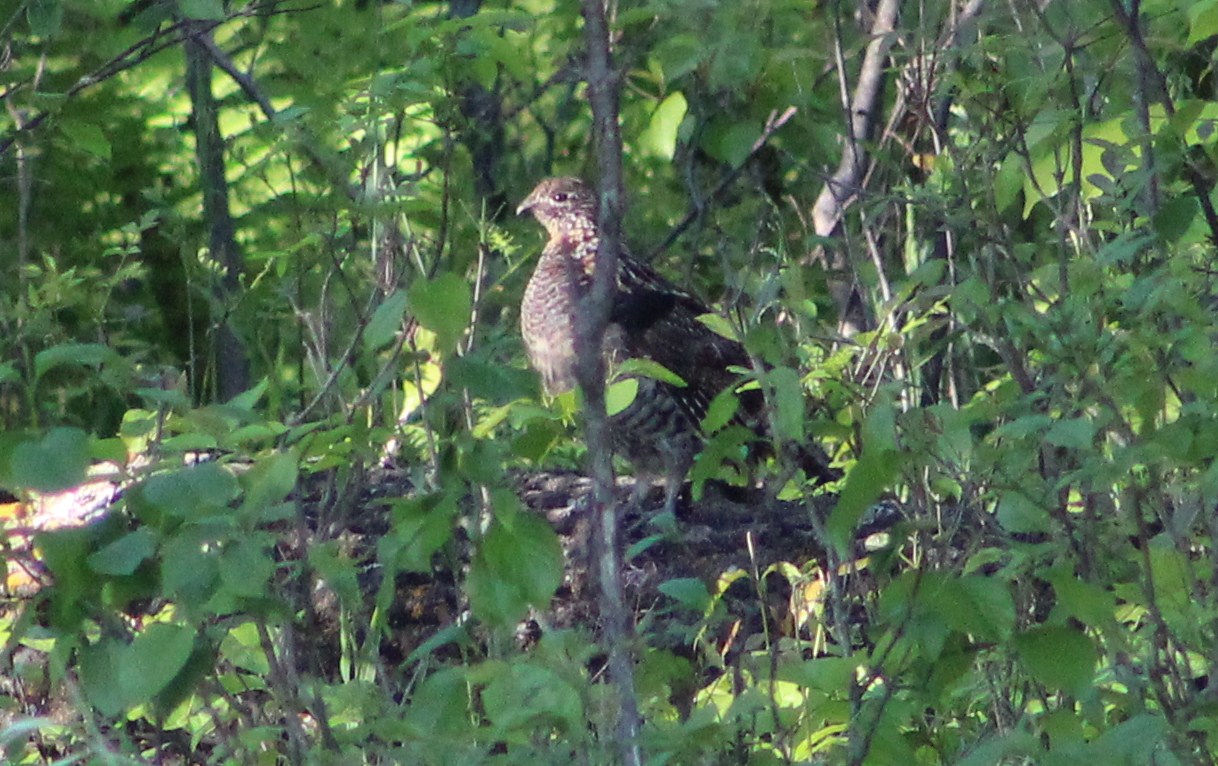
A Ruffed Grouse "drummed" at a location that was very close to the road. I ran back through a trail that went right through the woods where it was close to. I thought I had a decent chance to see it when I went into the woods, but grouse can sure be difficult, and this one was no exception. After enjoying the cabin's surroundings, I went to the cabin and had breakfast with Aunt Gretchen until we would go kyacking. Here are a few more birds that I photographed.
Red-eyed Vireo
Common Yellowthroat
Chestnut-sided Warbler
Eastern Phoebe
It was mid-morning when the time came around for us to go kyacking. For me, it would be my first time ever of participation with this activity, and I was stoked to try it. Gretchen is a good teacher, and I knew that I was in good hands for learning how to kyack. She said that our course would be up a northwest direction up the Yellow River, and we would depart at the river from the cabin and then go up river for a time that would last for over two hours. We caravan-ed, parked my truck at the ending route, and drove back to the cabin to start on our route. I left my camera and phone back at the cabin just in case they'd get wet, and I really wish now that I would've had them with me. The route was incredible, beautiful, and was also full of birds.
My first mile of kyacking was a lot of me learning, but before I knew it, I was calling it easy, epic, and fun. I loved it, and birds were to be seen and heard everywhere. After getting used to it, it was easy going other than a few fast flowing parts of the river, and a few narrow spots where we would have to pass through. Gretchen took these pictures of my first time of kyacking.
I kept a mental note of the birds that were detected, and birding along a river via kyack certainly has productive results. For a third consecutive day in a row, I got a lifebird. This time, it was an Alder Flycatcher, another flycatcher of the empidonax genus, calling from alder groves along the Yellow River. While the bird was a heard only lifer, it was awesome to get this species as a heard only lifer. Alder Flycatcher is very closely related to Willow Flycatcher and is nearly identical to Willow Flycatcher. It is said that the two species can't be told apart visually, and they could only be told apart by voice, which is a huge difference. The two species used to be the conspecific Trail's Flycatcher before they were split into two. Willow sings, "Fitz-biew" and Alder sings, "Rhee-bier". In this case in it being my lifer, it sang "Rieeght heierre!". I was pumped and pointed the call out to Gretchen.
The kyacking was a great experience, and after two hours and probably about an eight mile trek up the Yellow River, Gretchen and I made it back to our landing spot and drove back to the cabin for lunch. Other birds that highlighted our trip visually were Bald Eagles and Ospreys, Wood Ducks, and a group of 4 Trumpeter Swans. I also heard most of the birds that were around as opposed to seeing them visually. My species count was 57 species and I was impressed with the bird diversity that could be detected by kyacking. Overall, the Yellow River was slow-moving. It would've been easy to find a calm current and sit there to bird, and the kyack would serve as a blind at times too I'm sure. While the birding was largely secondary, it sure was awesome too. Here is an eBird checklist from the kyacking adventure!
After we had lunch, we got Gretchen's boat ready and drove to pick up Tabby at nearby Shell Lake to go fishing. We went to a smaller lake near Shell Lake, which was a peaceful and less human-inhabited lake called Round Lake. Once out on the water, I could tell that Round Lake would have some good birding potential. Tabby told me that there was even a Common Loon nest at the lake. As we went to a quieter part of the lake, we caught sight of the loons. A pair of them were swimming near each other, and eventually, the male went further out onto the lake in the opposite direction of us. The female swam close to our boat for a few minutes, and then went to her nest, which was a small mudflat on the lake. I could see one egg on the nest as I looked through binoculars. There may have been another, I did just read that the usual egg clutch with loons is two eggs. From the time that the loon swam close to us until the times that it sat on the nest, it was an awesome experience. It would be really neat to see adults with young sometime. Both adults will carry their babies on their backs, and will take turns feeding their young.
While taking occasional looks at loons, I watched Gretchen and Tabby fish. It was an awesome thing to spectate. Fishing sounded fun to me, but then I didn't want to spend the money to buy a license for only one day of the trip. Gretchen caught a lot of Panfish, and Tabby had a classic and big Largemouth Bass on her line that barely got away.
A Red-headed Woodpecker, a species I haven't seen often, was a welcome sight at the lake. I also heard the "drumming" again of the Ruffed Grouse. I pointed it out to Gretchen and Tabby, and Gretchen immediately remembered it from the previous day at Rock Lake. And then I happened to look in just the exact right direction to see wings going up and down rapidly in movement. It was the Ruffed Grouse sitting on top of a log. Although we couldn't get very close, I got to watch this bird in amazement through binoculars for some time, and I managed to get some rather distant photographs of it. Something amazing about hearing Ruffed Grouse drumming is that it can be heard up to a half-mile away.
After several hours, we called it a day on the fishing. Tabby went home after the fishing, and Gretchen and I got a pizza and took it back to the cabin. At this point of the day, it was getting late and I realized it was getting to be that time that I'd need to prepare for the Kirtland's Warbler trek. The pizza was great and we had time for more smores after dinner. An Eastern Whip-poor-will called by the Yellow River near the cabin. The time was great with my wonderful and generous Aunt Gretchen, and it was weird to give her an "air hug" rather than a normal hug. She would stay at her cabin for another day before going back to South Dakota. Up next on Northerly Treks is a big quest, one for that awesome bird that I keep mentioning!
Once birding our way in and around Sakatah State Park, Falls Creek State Natural Area, and Carver Park Reserve, Josh headed back to his home in Kandiyohi County later that day on June 9th, 2016. This is where I would spend most of my time on my vacation with Josh and his awesome family. Kandiyohi County has a lot of neat places to bird at and a diversity of habitats to make the birding interesting. Once getting settled in, it was already time for some more birding. Josh and his wife Melissa were participating in Vacation Bible School at their nearby church, where Evan and their daughter Marin were a part of. As the VBS would last for about three hours, Josh asked his birding buddy Steve Gardner if he would take me birding around the local Kandiyohi hotspots. Steve was very kind to take me birding, and Steve met us at the church parking lot before we would leave to go birding.
Birding can be funny sometimes when your birding in a new section of the United States for the first time. Josh informed me that Chimney Swifts, a potential life bird for me for this area, could be seen very often flying over the church parking lot. Sure enough, when we were all talking in the parking lot, Steve look up and said, "Swifts!". Right when he said swifts, I could hear the chattering notes of Chimney Swifts and I looked up to see my 11th lifer of the trip and still on the first day and so early into the trip.
Chimney Swifts, along with other swifts, are remarkable birds. Chimney Swifts spend most of their time during the day in the air and only perch when they are roosting for the night or are on their nest. These birds technically don't perch either, put they "cling" to walls of surfaces such as chimneys, where they get their names from. This is the fourth and final regularly occurring swift I needed for North America.
Josh, Steve, Melissa, and I looked up and enjoyed the views of these neat flyers. Chimney Swifts are very similar looking to the Pacific Northwest Vaux's Swift, but cover eastern North American in much higher quantities. I've only seen Vaux's Swift in migration in Arizona and never elsewhere. The chatter of the Chimney Swift most often came in multiple notes, but at times they would give single notes throughout this trip. I would compare it to the sound of a bat.
From the church parking lot, Steve and I were on our way to various places around Kandiyohi County, with a central stop for the exploration being at Sibley State Park. In this time I got to see a lot of the County's birding spots that Josh and Steve call home for a solid introduction to Kandiyohi. We started to bird some grasslands areas near the town of Willmar, and we came away with birds like Grasshopper Sparrow. As Steve was trying to find a Bobolink, the Bobolinks decided not to show up for us. The trek then went to Sibley State Park, which ended up being one of my favorite birding places during the entire trip. Sibley hosted a variety of habitats from open pond and lake, marsh, meadows and lush fields, oak savannah, and a cluster of deciduous woodlands to explore. The previous day saw Josh get a singing Wood Thrush and a flyover Broad-winged Hawk for some of his highlights. For me a big highlight came immediately upon pulling into Sibley, a Common Loon swimming out on a small lake by the entrance to the Park!
Once we started birding the park, some cool things started to show up. One was my first look at a Great-crested Flycatcher after hearing several of them throughout our stops earlier in the day. This is the Myiarchus flycatcher of the east, and it is very common despite being a rather secretive flycatcher.
Up next, Steve took me to an area with grassy clearings that he said was a good stop and bet for Field Sparrows. Before we got out of Steve's vehicle, we could hear the singing of the Field Sparrow. This song is a beautiful one, and it sounds like a bouncing ball at times, which is similar to my Black-chinned Sparrow in Arizona.
In an area with an interpretive trail that we walked, we encountered this Eastern Phoebe. Eastern Phoebe is one I see in Arizona annually, where it is rare but shows up in small numbers. This was my first day to see them on their breeding grounds and to hear them singing out, "Phoe-be!".
This pair of Blue-winged Teal sat along a marshy pond edge.
And so did these young ducks. What are these anyways? Are they mergansers? In Arizona, I don't have a lot of experience with growing hatch year ducks. Chime in folks :)
I've Got An Answer: Young Hooded Mergansers. Hooded Mergansers are the only merganser that breeds in Kandiyohi County, MN. Thanks Josh Wallestad for chiming in!
We then heard the song "che-bek" of the small Least Flycatcher coming from some oak woodlands. After only hearing this bird earlier in the day as my life bird, I went and was able to get a visual of it along with some photographs. Least Flycatchers have a distinct song and call note, and the call note is one that strikes me more as a warbler call more so than an empid Flycatcher call.
In Minnesota, the times are interesting throughout the day. It doesn't get dark out until after 9 P.M., and in most cases throughout the state, until 10 P.M. I took the photo of the Least Flycatcher right about 8 P.M. that night, and you can see how much light is still left! Steve wanted to show me my first ever Ring-necked Pheasants, and we left Sibley close to 8:30 to leave our remaining hour to search for Pheasants. Steve took me on some back roads to search for the birds, which is a common gamebird in North America in many locations. Ring-necked Pheasants were introduced into North America from Asia for hunting purposes, and they are neat birds for the birder and from what Steve was telling me, are hard to miss in the fields they inhabit (especially at dawn and dusk). We weren't driving for very long when Steve spied a female Pheasant standing at the edge of a tall row of grass within a field.
I was thrilled at the sight of the female Ring-necked Pheasant, and then Steve said, "Wait till you see a Rooster, the female doesn't even compare to the Rooster". Steve was of course talking about a male Ring-necked Pheasant. And minutes later, I was looking elsewhere up the road and not roadside on my side of the vehicle when Steve picked up for my slack and spied a male and female Ring-necked Pheasant on my side of the road. Both of them ran away, almost in a sprint like way! It was impressive how fast they were. The pair didn't go very far, and Rooster allowed me to get some photographs when he turned the right way.
It was cool to see the pair side-by-side in their favored habitat.
After enjoying the Pheasants, Steve and I stopped at a marshy area and found this Willow Flycatcher, which can be pretty scarce in Kandiyohi County.
The entire day of June 9th was one to remember, with this being the third and final post of that one day. The day ended with 12 lifers being added to my life list to bring that grand total up to 510 species. Passing 500 was a huge accomplishment for me. Thanks to Steve Gardner for being very generous to take me out birding for the final hours of light during June 9th and to Josh for the grand day of birding!