After South Padre Island, we were still close to the eastern side of the Rio Grande Valley. And after South Padre Island, we still had one more adventure we wanted to attempt in the Rio Grande Valley...
The Rio Grande Valley is one birders can't get enough of, especially in the sections of three full days that we birded in and around it. It's a place that I would love to spend a week or more in and to simply take my time while slowly birding all of the Valley. There is much to see and much to discover at all times of the year. This last expedition was on the shorter side, and it took us into the grounds of the Lower Rio Grande Valley National Wildlife Refuge. True to the other locations in the Valley we had visited, this area hosts the usual bird suspects and a plethora of exploring that can be done. It is also known to be home to the endangered Ocelot, the small wildcat that is a ghost to most visitors in the region. In the short time that we had, we were after Ferruginous Pygmy-Owls.
Ferruginous Pygmy-Owl is arguably the most wanted and toughest owl to get in the United States. It has the smallest range of any owl in the family, and it has to talk in order for birders to land it. I've had my fair share of Ferruginous Pygmy-Owls in Arizona and so has Caleb. David had seen the owl in Arizona on a trip he took and Liam had them previously in Texas. For Josh, it would be a highly wanted lifer, and we made a point to make an attempt for it. During the trip, we were also closing in on 300 species for Texas, and we all wanted to have a Texas Ferruginous Pygmy on there too!
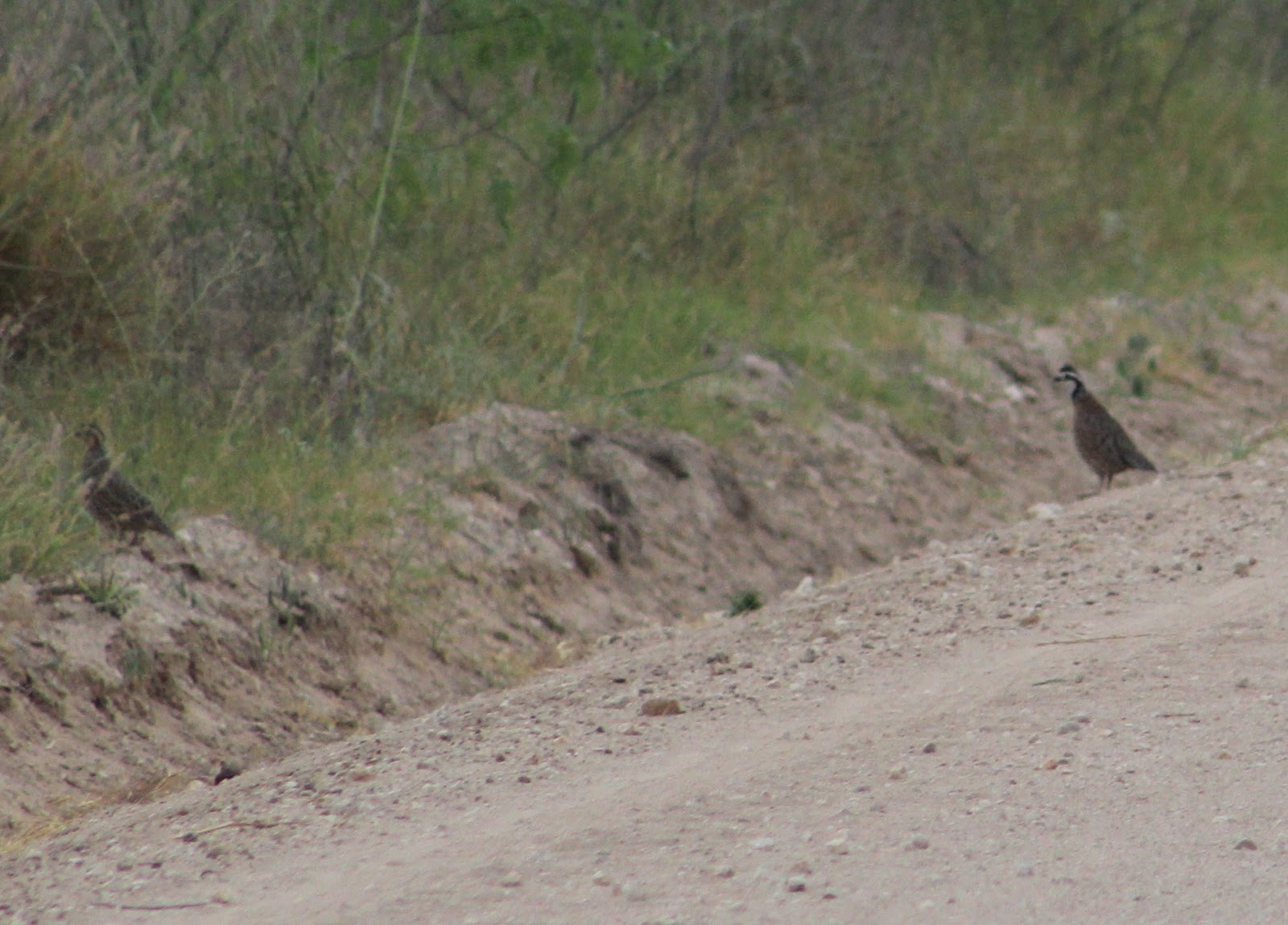
David, Josh, and I took one car to a location on the Refuge to look for owls and Caleb and Liam took another one. The day had become overcast and I thought that could boost our chances for the owl. At one point, Josh mis-read the directions for one spot that we were going to visit. We had to forget about the spot because we had already driven too far out of the way to go back, and it left us with one other spot that we were supposed to check. Liam and Caleb were searching a spot about forty minutes away from our spot. Josh had David go onto a dirt road, where we stopped at a spot that was said to be good for our target. We saw a few birds walking across the road, and I was thrilled that we chose this spot because these birds were my first ever real views of two Northern Bobwhite.
In eastern North America across farmlands, fields, brushy habitats, and grasslands, the call "Bob-Wheeiiit!" is a common sound. The second note of the call is much higher pitched and exclaimed than the first note, and it is clear that this is where this quail gets it's name from.
Northern Bobwhites are secretive birds, but their common numbers give birders good chances for observations. They travel together in flocks or "coveys" and try to find as much cover as possible. These coveys may have numbers that go from anywhere from three to fifteen birds, and they roost on the ground at night in groups that sometimes number thirty. The Bobwhite feeds mostly on seeds and leaves, as well as insects.
There are several subspecies of Northern Bobwhite in North America, including the endangered and southwestern race known as "Masked Bobwhite", which is being re-introduced into southeastern Arizona. For the common Bobwhites of the east, they are an important species to have habitat managed for and they are also a very popular game bird.
While pursuing the Bobwhites further, I lost track of them as they blended into their environment perfectly at a close range. I didn't realize how close I was until they flushed. At that time, I thought I heard a few "toot" calls that sounded like a Ferruginous Pygmy-Owl. They were immediately followed by a selection of notes from a Northern Mockingbird. The same thing happened again, and again. I was confused, and thought the owl-like notes had to have been coming from the Mockingbird. I looked down the road and it didn't seem to have caught David and Josh's attention.
As I continued to listen, I heard the owl-like notes again and this time a Mockingbird didn't immediately follow the notes. Just like that I knew we had a Ferruginous Pygmy-Owl and I keyed David and Josh into the calls. We walked up the road towards the calls, and luckily, it was an active owl who was delivering notes on a regular basis. On another lucky note, the calls were coming close to the road when the property of the Wildlife Refuge was a barbwire fenced-off on both sides and it would've been interesting to slide under the fence (and trespass). This owl was awesome, and didn't give us too much trouble.
The FEPO switched perches a few times, but for the most part it stayed put and was cooperative for us right along the road.
Those of you who know me well know that owls are my favorite family of birds. Ferruginous Pygmy-Owl is one that I'll want to see anytime, and this was only the fifth sighting that I've had of the species. I also love to see people get owls as life birds. As I said earlier, this was Josh's first ever FEPO!
The Cactus Ferruginous Pygmy-Owl, subspecies cactorum, is the subspecies that is found in Arizona. It is paler than the Texas subspecies of FEPO, which is called ridgwayi. The Texas subspecies of the owl is more rufous and brighter than the Arizona subspecies, and this Texas bird gave me some of the best views I've had.
Here is a picture of what the general Ferruginous Pygmy-Owl habitat looks like in the Rio Grande Valley.
Meanwhile, as Josh, David, and I were enjoying the heck out of an owl, Liam and Caleb were at a spot that was said to be much better for the bird than the one we were at. When we checked in on them to see how they were doing, they weren't having any luck. The overcast conditions that were common on our trip was something I wasn't fond of, but in this case, I think it may have contributed to the owl calling in the middle of the afternoon. Show us both sets of eyes, Mr. FEPO..
Pygmy-Owls are small owls that are fierce and will prey on birds that are larger than themselves. Due to their diurnal nature, they would also be prey for other owls and raptors. The Creator gave them false "eyes" on the back of their head to ensure their survival. When a predator sees a Pygmy-Owl, most of the time it will consider the chase a lost cause because it thinks the owl is already looking in their direction and will likely escape. Because of those false "eye spots", Pygmy-Owls remain as a heavy force in Mother Nature's balance.
The word "Ferruginous" means rusty in coloration, and it's where this small owl gets it's obvious name from. Because I'm obsessed with owls, here's a series of closing photographs to close out this FEPO observation.
With a productive smaller adventure going down as a success for our trio, it was a great to succeed on Ferruginous Pygmy-Owl like we did. This bird was brighter than the ones I have seen in Arizona, and I have to say I liked it better than the Arizona birds. We were about to head off and go further northeast along the Gulf Coast in Texas, and leave the Rio Grande Valley for the final time on the trip. Every location we visited and birded within this Valley was spectacular, and I know that I want to go back again in the years that are soon to come. I said bye to the Rio Grande Valley for the time being and when a Green Jay popped up as we were leaving, it was the perfect way to say, "till next time".
Showing posts with label Ferruginous Pygmy-Owl. Show all posts
Tuesday, June 4, 2019
Sunday, March 3, 2019
To Witness A Road Conquered
2016 was a year that I really grew a lot as a person, and the reason for that was because I wanted to see and photograph all nineteen owl species that breed in the United States and Canada. Before that year began, my mind never crossed paths with that specific possibility of even having a remote chance of occurring. A trip to Minnesota sparked the idea due to the fact that I landed four new owl lifers on that trip. The owls seen were ones that were at the top of my list for birds I wanted to see in North America, and to finally see them after wanting them for years was spell binding. My goal of doing an Owl Big Year was born after that spark. I took my own journey, and although it lasted until August, it had more depth to it than an eight month time span. Completing Tommy's Owl Big Year (TOBY) wasn't just about owls, but it was about the adventure, which was a long road with construction, traffic, twists, turns, and perfect pavement along the way. At the end of it, I was thrilled as I came face-to-face with Boreal Owls in a Washington spruce-fir forest. As I traveled to the end of that road, I challenged myself and did many things I had never done in my life or never thought I would do in my life. Birding takes us places, there's no doubt about that.
My great buddy, Josh Wallestad, was the biggest one to thank for completing my Owl Big Year in 2016. We've seen many owls together throughout the years, starting in 2016 when Josh came to Arizona for a birding trip. During this time, Josh has become just as passionate about owls as I've been. There's no need to explain that, owls are simply the best bird family. While Josh hasn't attempted an owl big year for all nineteen species, his road to see the United States owls has been just as extreme and long. His owl list grew pretty fast over the years until some of the tougher owls came into play. Ironically, Josh's Whiskered Screech-Owl, his 16th owl came in 2016. His Flammulated Owl came in 2017 as his 17th owl. Boreal Owl, his favorite owl, came as his 18th owl in 2018. What was saved for last was the rarest owl in the United States. Could Josh land his 19th owl in 2019? While Josh missed this particular owl, the Ferruginous Pygmy-Owl to be specific, in 2018, we were hoping that we would land it in 2019.
Josh enlisted my help as he and buddy Steve Gardner came down from Minnesota last year for a trip that was in a primary pursuit of Ferruginous Pygmy-Owl. After detailed plans were made to focus on the owl for most of the trip, the itinerary went sideways at the hands of southeastern Arizona specialties and ABA rarities in Fan-tailed Warbler and Slate-throated Redstart. The owl had become tough in the places where I had had success in previous outings. Recently in Arizona, Ferruginous Pygmy-Owls have surfaced in more under-birded areas in quite amazing numbers. Tim Helentjaris has set out on many missions, and one of his finds happened to be Ferruginous Pygmy-Owls in an area somewhere in southern Arizona. This has given dozens of Arizona birders that chance to lock up "FEPO" as a life, state, or ABA bird. As Josh was planning on getting the small owl in Texas's well-known King Ranch, that plan of his went sideways again when I told him of the bird's Arizona resurrection. For his annual vacation in February to Arizona, Josh and I usually bird together and go after species that he needs for his life list. FEPO took the reigns for this trip, and after some planning, it became our primary target.
A lot of research was done by Josh before the start of the trip. We added great buddies in Gordon Karre and Caleb "The Boy" Strand to join forces with us for the search. When I presented the idea of the trip to Caleb, he gladly committed to the pursuit. At the realization of Caleb joining, I knew that I could relax. Caleb would be the leader for the expedition. With finding Ferruginous Pygmy-Owls, I haven't seen anybody better at it than Caleb. To be completely honest, I didn't do any research before we picked up Josh on an early February morning. Josh had everything researched thanks to a conversation he had with Tim, and because we had Caleb, The Boy and FEPO master, I was on cruise control. Josh, Gordon, Caleb and I all headed over to a mountain range in southern Arizona to execute our search, and it was quite the drive. Good news did hit as two of Caleb's birding friends were camped out in the area and had heard and seen an owl the night before. As Josh had several spots glued into his GPS already, we opted to go with a sighting that had been recent and twelve hours prior to our trip. The trip down was fun, and as we took dirt roads for a long distance off of the main highway to get into remote FEPO country, I wondered for Josh if this was the time for him to get his final 19th owl.
The desert valley we entered was a scenic one, and was surrounded by tall slopes and cliffs. Tunes of Rufous-winged Sparrows filled the picture alongside a cast of common desert birds. We met up with Caleb's friends Matt and Nick, and they led us in the direction where they had heard and seen the owl. The walk in the FEPO's direction was quite simple, we would walk down a dirt road and listen for the bird, and the walk was no more than a half mile. We would stop and listen quite often between intervals of walking, with the first few stops resulting in desert song birds. For Josh, every step would possibly bring him closer to the end of his journey. About twenty minutes into our search, a series of rather high-pitched notes confirmed the presence of a Ferruginous Pygmy-Owl. It was close to us, and was sticking close to a wash that paralleled the road that we were walking on. After some walking towards the bird slowly, Caleb and I spied the bird in flight as it flew to a different perch nearby. Once landing, the owl continued to sound off. We reached a point where we got on the bird, and everyone had good views. For a pumped up Josh Wallestad, there was his 19th North American Owl right in front of him. He had reached the end of his road and conquered his biggest birding goal, and I was grateful to be alongside as a part of it.
Ferruginous Pygmy-Owl is an awesome owl. Not only was I happy for Josh, but I was pumped up to see the bird for myself too. Gordon had seen the bird in Mexico, which this bird was his ABA/AZ lifer. At times, the bird had it's back turned to us and we had great looks at it's rusty tail which gives the bird it's accurate name. We watched the bird for about an hour from a respectable distance and at times, even had views of it through a scope. Thanks to Matt and Nick, they gave our group of four a good FEPO to go after and give Josh his holy grail. We left the FEPO area on a good note with a few more scope views of the bird after it eventually dropped down into a more distant wash.
Plans continued to be fun as we headed straight for Madera Canyon following the time in FEPO country. With Josh's most wanted bird in North America now out of the way, it was time to see a few other cool birds, such as that White-throated Thrush. The four of us entered Madera Canyon, and started to look for the thrush. After getting interrupted by birders looking at a day-roosting Whiskered Screech-Owl, we had Caleb run up to us to state that the White-throated Thrush had been located. It didn't take us long to see it for ourselves. The Thrush put on a show for us while foraging on the ground as we walked up and eventually sitting up in junipers for most of the observation. As contentment set in for the Thrush, we walked back to the parking lot to continue further south into Madera Canyon. It was there were we got to meet Linda Grant and her husband and I got to talk about her discovery with her in person after talking with her over email for that recent blog post I wrote. An epic serendipity.
More serendipity struck as Caleb, Gordon, Josh, and I had killer looks at the Elegant Trogon in Madera. Josh had only seen this bird once, and for most of the original observation back in 2015, the Trogon had it's back to us. In 2019, this Trogon made sure to give his all!
A stop in Green Valley gave us a flock of Lawrence's Goldfinches, another lifer for Josh. We concluded our day there and extended the fun with dinner at the Wallestad's house. Thanks to Caleb for driving us all to the FEPO spot.
The following day, Josh, Josh's dad Rick, Gordon, and I went birding at the well-known Thrasher spot in Maricopa County. In all of Josh's trips to Arizona, he had put off Thrashers and Sage Sparrows for the longest time. We've always joked with each other on how long it's taken Josh to drive towards this particular road. The Thrasher spot proved to be productive, as Gordon and I guided Josh into getting lifers of Le Conte's and Bendire's Thrashers, and both Sage Sparrows in Bell's and Sagebrush. It had been over a year since I had been to this spot, and I enjoyed it.
Gordon and I also helped Josh lifer on Crissal Thrasher further down the road, as well as a few Common Ground-Doves. Josh even spied a Maricopa County rarity in a Crested Caracara that was flying through the extensive fields in the area. For those reading and looking for a birding guide in Phoenix, Gordon gives tours and he is awesome at it!
Josh lifered ten times on his trip total, but none mattered more than the epic Ferruginous Pygmy-Owl. The journey Josh went on to see all nineteen owl species for himself was epic, and to actually see him complete it was great. The road had been conquered. Congratulations Josh! The only two Owls Josh and I haven't seen together out of the nineteen are Northern Saw-whet and Short-eared Owls.
Josh's write up on the FEPO adventure on his blog at the link here:
http://www.aboywhocriedheron.com/2019/02/27/joining-the-19-owl-club/
Birding takes us places, there's no doubt about that. Makes us tired too, but it's worth it..
My great buddy, Josh Wallestad, was the biggest one to thank for completing my Owl Big Year in 2016. We've seen many owls together throughout the years, starting in 2016 when Josh came to Arizona for a birding trip. During this time, Josh has become just as passionate about owls as I've been. There's no need to explain that, owls are simply the best bird family. While Josh hasn't attempted an owl big year for all nineteen species, his road to see the United States owls has been just as extreme and long. His owl list grew pretty fast over the years until some of the tougher owls came into play. Ironically, Josh's Whiskered Screech-Owl, his 16th owl came in 2016. His Flammulated Owl came in 2017 as his 17th owl. Boreal Owl, his favorite owl, came as his 18th owl in 2018. What was saved for last was the rarest owl in the United States. Could Josh land his 19th owl in 2019? While Josh missed this particular owl, the Ferruginous Pygmy-Owl to be specific, in 2018, we were hoping that we would land it in 2019.
Josh enlisted my help as he and buddy Steve Gardner came down from Minnesota last year for a trip that was in a primary pursuit of Ferruginous Pygmy-Owl. After detailed plans were made to focus on the owl for most of the trip, the itinerary went sideways at the hands of southeastern Arizona specialties and ABA rarities in Fan-tailed Warbler and Slate-throated Redstart. The owl had become tough in the places where I had had success in previous outings. Recently in Arizona, Ferruginous Pygmy-Owls have surfaced in more under-birded areas in quite amazing numbers. Tim Helentjaris has set out on many missions, and one of his finds happened to be Ferruginous Pygmy-Owls in an area somewhere in southern Arizona. This has given dozens of Arizona birders that chance to lock up "FEPO" as a life, state, or ABA bird. As Josh was planning on getting the small owl in Texas's well-known King Ranch, that plan of his went sideways again when I told him of the bird's Arizona resurrection. For his annual vacation in February to Arizona, Josh and I usually bird together and go after species that he needs for his life list. FEPO took the reigns for this trip, and after some planning, it became our primary target.
A lot of research was done by Josh before the start of the trip. We added great buddies in Gordon Karre and Caleb "The Boy" Strand to join forces with us for the search. When I presented the idea of the trip to Caleb, he gladly committed to the pursuit. At the realization of Caleb joining, I knew that I could relax. Caleb would be the leader for the expedition. With finding Ferruginous Pygmy-Owls, I haven't seen anybody better at it than Caleb. To be completely honest, I didn't do any research before we picked up Josh on an early February morning. Josh had everything researched thanks to a conversation he had with Tim, and because we had Caleb, The Boy and FEPO master, I was on cruise control. Josh, Gordon, Caleb and I all headed over to a mountain range in southern Arizona to execute our search, and it was quite the drive. Good news did hit as two of Caleb's birding friends were camped out in the area and had heard and seen an owl the night before. As Josh had several spots glued into his GPS already, we opted to go with a sighting that had been recent and twelve hours prior to our trip. The trip down was fun, and as we took dirt roads for a long distance off of the main highway to get into remote FEPO country, I wondered for Josh if this was the time for him to get his final 19th owl.
The desert valley we entered was a scenic one, and was surrounded by tall slopes and cliffs. Tunes of Rufous-winged Sparrows filled the picture alongside a cast of common desert birds. We met up with Caleb's friends Matt and Nick, and they led us in the direction where they had heard and seen the owl. The walk in the FEPO's direction was quite simple, we would walk down a dirt road and listen for the bird, and the walk was no more than a half mile. We would stop and listen quite often between intervals of walking, with the first few stops resulting in desert song birds. For Josh, every step would possibly bring him closer to the end of his journey. About twenty minutes into our search, a series of rather high-pitched notes confirmed the presence of a Ferruginous Pygmy-Owl. It was close to us, and was sticking close to a wash that paralleled the road that we were walking on. After some walking towards the bird slowly, Caleb and I spied the bird in flight as it flew to a different perch nearby. Once landing, the owl continued to sound off. We reached a point where we got on the bird, and everyone had good views. For a pumped up Josh Wallestad, there was his 19th North American Owl right in front of him. He had reached the end of his road and conquered his biggest birding goal, and I was grateful to be alongside as a part of it.
Ferruginous Pygmy-Owl is an awesome owl. Not only was I happy for Josh, but I was pumped up to see the bird for myself too. Gordon had seen the bird in Mexico, which this bird was his ABA/AZ lifer. At times, the bird had it's back turned to us and we had great looks at it's rusty tail which gives the bird it's accurate name. We watched the bird for about an hour from a respectable distance and at times, even had views of it through a scope. Thanks to Matt and Nick, they gave our group of four a good FEPO to go after and give Josh his holy grail. We left the FEPO area on a good note with a few more scope views of the bird after it eventually dropped down into a more distant wash.
Plans continued to be fun as we headed straight for Madera Canyon following the time in FEPO country. With Josh's most wanted bird in North America now out of the way, it was time to see a few other cool birds, such as that White-throated Thrush. The four of us entered Madera Canyon, and started to look for the thrush. After getting interrupted by birders looking at a day-roosting Whiskered Screech-Owl, we had Caleb run up to us to state that the White-throated Thrush had been located. It didn't take us long to see it for ourselves. The Thrush put on a show for us while foraging on the ground as we walked up and eventually sitting up in junipers for most of the observation. As contentment set in for the Thrush, we walked back to the parking lot to continue further south into Madera Canyon. It was there were we got to meet Linda Grant and her husband and I got to talk about her discovery with her in person after talking with her over email for that recent blog post I wrote. An epic serendipity.
More serendipity struck as Caleb, Gordon, Josh, and I had killer looks at the Elegant Trogon in Madera. Josh had only seen this bird once, and for most of the original observation back in 2015, the Trogon had it's back to us. In 2019, this Trogon made sure to give his all!
![]() |
| Josh, Yours Truly, Caleb enjoying the Trogon. Photo by Gordon Karre |
![]() |
| Our FEPO team. Gordon, Caleb, Josh, Me |
| Sagebrush Sparrow |
| Bell's Sparrow |
![]() |
| Gordon, Rick, and Josh enjoying a Le Conte's Thrasher |
Josh lifered ten times on his trip total, but none mattered more than the epic Ferruginous Pygmy-Owl. The journey Josh went on to see all nineteen owl species for himself was epic, and to actually see him complete it was great. The road had been conquered. Congratulations Josh! The only two Owls Josh and I haven't seen together out of the nineteen are Northern Saw-whet and Short-eared Owls.
Josh's write up on the FEPO adventure on his blog at the link here:
http://www.aboywhocriedheron.com/2019/02/27/joining-the-19-owl-club/
![]() |
| This is a picture of Josh only seconds after his first ever glance at his 19th owl, the FEPO! You can see Josh's intensity in this photo. |
Birding takes us places, there's no doubt about that. Makes us tired too, but it's worth it..
Subscribe to:
Posts (Atom)


