Today on December 1st, 2013, I set out to bird with my two friends, Mark Ochs and Gordon Karre. We decided to go up to the area of the Lower Colorado River and bird the areas of the Bill Williams National Wildlife Refuge and Lake Havasu. There are fantastic birds found in this area on an annual basis, and the three of us were determined to find those special species. The three of us are also known as the Phoenician Kingbirds.
Our morning started out at the overlooks of the Bill Williams National Wildife Refuge that overlook the Colorado River. Waterbirds are abundant here. Gulls...Waterfowl....Loons....Grebes....just to name a few. The ABA rare Blue-footed Booby has even been here for a few months, which we all saw earlier this year. While we were looking for a few key ducks that we were after for our year and life lists, that Blue-footed Booby happened to fly right by us. It flew by before I could get my camera out, but it was sure awesome to see the species for the second time this year!
One of our main birds was the stunning Barrow's Goldeneye. This was a lifer for Gordon and a year bird for Mark and me. Also, this was only my second time ever of seeing this species, so it was a thrill. This is the one area in Arizona where Barrow's Goldenye is reliably found in the state. It is rare elsewhere, and I don't expect to find a stray in Maricopa anytime soon!
Barrow's Goldeneye
And also, there are plenty of Common Goldeneyes around too! It's a common sight here to see both drakes of the two species side-by-side.
This area is also the best place in the state to see flocks of Greater Scaup, which are rare but also annual throughout the rest of Arizona. But at the Bill Williams, the Greaters are a guarantee at this time of the year!
Greater Scaup
At the Bill Williams, we also found two White-winged Scoters as well as four Surf Scoters. The Scoters were very distant and way too distant for pictures, but it was awesome being able to see them. The group of four Surf Scoters had two stunning adult males in the group, which was the first time I've seen an adult male Surf Scoter! And here are two of the Phoenician Kingbirds...

After scanning the river and coming away with a flashy booby and ducks, we drove back on a rough road called Planet Ranch Road. Mark forgot the name of the road, and commonly called it the Planet of the Apes Road. The road and massive riparian and wetland habitat in the area is part of the Wildlife Refuge also. After two miles of driving on the road, we came to a stop and got out at a location that is named Mosquito Flats. It is appropriately named, as the horrible insect terrors are abundant and fiercely aggressive to the worst degree. We kept our distance by staying on the road, but sometimes at the Flats, that simply isn't enough. As we got out of the car, we listened for a very rare bird we were hoping to see and hear during our time on Planet Ranch.

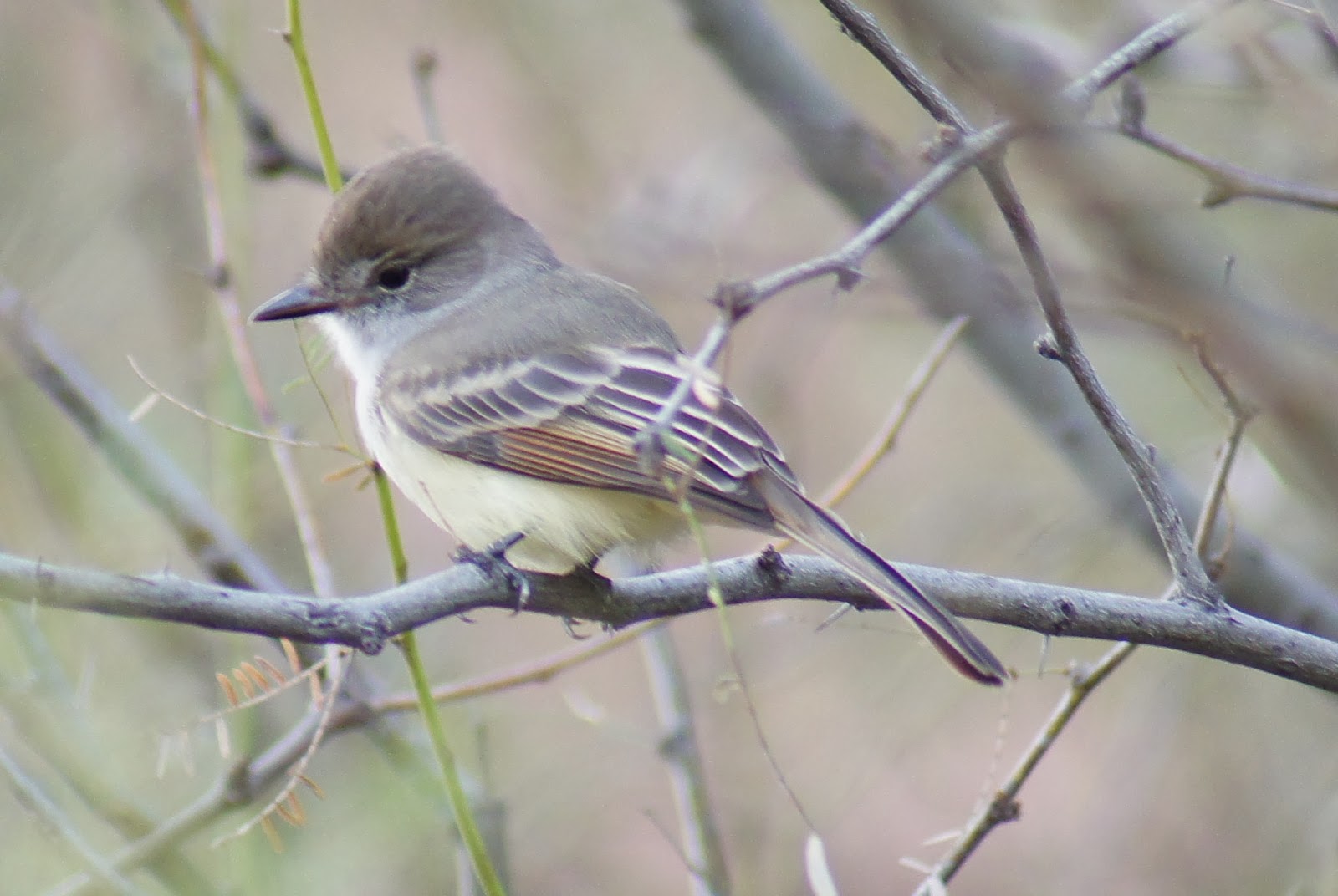
This rare bird is a Flycatcher, a Mexican Flycatcher named Nutting's. My friends Lauren Harter and David Vander Pluym were wandering around one day in 2011 when they heard the distinctive "wheep" call of the Nutting's Flycatcher. They tracked down this bird, and were able to record it's song, as well as get a few great snapshots. The Nutting's Flycatcher then became a cooperative celebrity for many birders for months. Then, David and Lauren discovered a second Nutting's, and then, found a few young Nutting's to confirm that the birds have taken residence here and have bred! It was a remarkable find, one of the best in the history of Arizona Birding. Since the fall of 2011, there has been a Nutting's Flycatcher here. Mark, Gordon, and I came today, hoping to hear and see the bird. Mark and I have seen it before (me once), and Gordon was hoping to get it for his life bird. We quickly heard the loud "wheep" call from the Nutting's, but weren't able to get on the bird because it stayed though in it's thick habitat. After searching and hearing it call a few times, Gordon then turned around only to see the Nutting's Flycatcher right behind us on the opposite side of the road we were thinking that it was going to be on. The Flycatcher gave us a great show, one that we thought was too good to hope for!
Nutting's Flycatcher
Now, the Nutting's Flycatcher is considered to be a Code 5 for the ABA, which is the rarest of birds for North America. It is part of the genus of flycatchers known as Myiarchus, which it is very similar in appearance to other flycatchers in the genus, such as the Ash-throated Flycatcher. Although the flycatchers in this genus are very similar visually, they all differ significantly in their voice. The Nutting's is no different, which voice is the best clue to it's identification. With careful study, most Myiarchus flycatchers can be identified visually. For the Nutting's, other than voice, it is smaller than the similar Ash-throated Flycatcher. It has a brighter yellow on it's belly, yellowish coloring on it's secondaries, brown face, small bill, and no dark bottom "hook" on the bottom of it's tail feathers (which an Ash-throated Flycatcher would have).
This is just the first half of the day of birding in this area! Stay tuned for part 2!