Showing posts with label Painted Redstart. Show all posts

Saturday, September 19, 2020

What Can Happen In A Week Of Birding: Part 2

After the excitement with the Northern Jacana, I knew that it was a good way to kick off my "Friday" and prepare for my "weekend" of having Thursday and Friday off, which was September 10th and 11th, 2020.  I planned to go birding in the first half of the day and wanted to be home earlier in the afternoon.  On the 10th, I opted for Phon D. Sutton and Granite Reef Recreation Sites of the Lower Salt River.  On the 11th, I birded Seven Springs Wash and Camp Creek.  The mornings were fun but didn't have anything too noteworthy.  The Salt River locations were loaded with birds, especially Granite Reef.  At Granite Reef I had close to 70 species right about noon-time, which included Black-and-white Warbler, Dickcissel, Wood Duck, and this showy Painted Redstart.


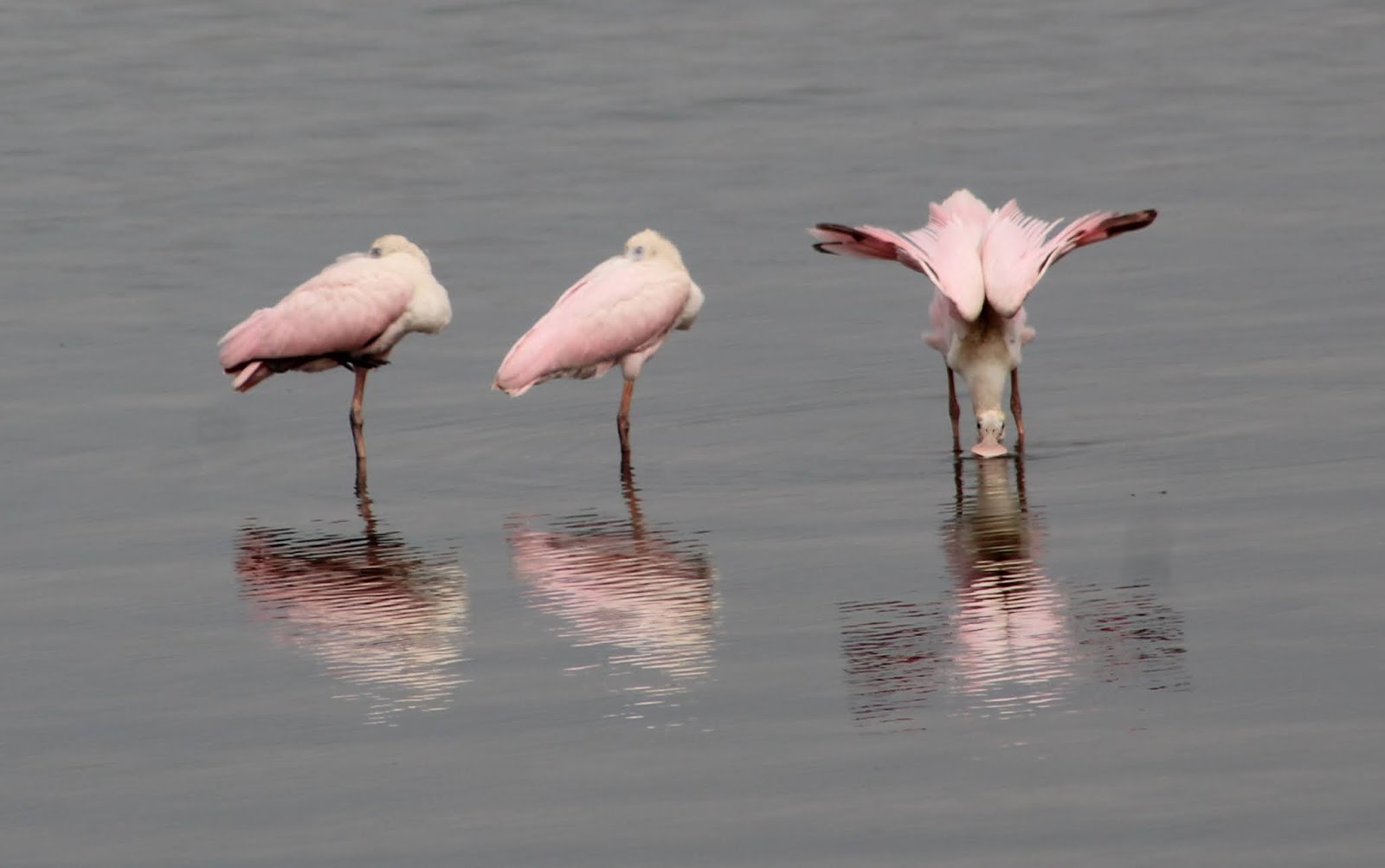
When I got back from the Seven Springs/Camp Creek area on September 11th, reports came into the birding community from Jennie McFarland and Richard Fray that Jennie had found three Roseate Spoonbills at the Glendale Recharge Ponds.  I knew I wouldn't mind seeing these awesome birds, and it's only a ten minute drive from my home in Peoria to the ponds.  When I got there I joined Caleb, Jeff, Levi, Louis, and Pierre.  We all enjoyed the Spoonbills, and we also looked for birds in other five ponds. 


Then, something really awesome happened for my Maricopa County birding, and everyone else's Maricopa County birding.  Caleb spied a Common Nighthawk flying over the basin, and it foraged and dove down at prey a few times.  In Maricopa County, Common Nighthawk isn't "Common" at all.  Back in the day, I had my first Common Nighthawk sighting near my Grandfather's house in mid-November of 2002.  We were walking through the neighborhood, and I flushed a bird that I described as having, "boomerang shape wings with white bars near the end of the wing".  I also noted the bird giving a loud call, and that call stuck with me.  When I got home, I listened to Common Nighthawk calls and it was the match.  As time went on, I realized that a Common Nighthawk in November is freaking rare.  I know I had a nighthawk, but could a Lesser Nighthawk pull something off that is loud like a Common on rare occasions?  In recent days, the record has had me wondering if I really saw that bird, even though I identified it right.  When Caleb spied this Common Nighthawk while we were Spoonbill watching, it became the first Common Nighthawk documented in Maricopa County by photograph.  We were all stoked at the sighting.  With Common Nighthawks in visual comparison to Lesser Nighthawks, they have the white bar further down on the wing and closer to the wrist than Lesser does, a tern-like flight, and darker primaries.  We watched the bird for about a minute before it went off.  What a huge highlight and bird it was for me, thank you Caleb!


The Common Nighthawk was one that turned out to be reliable.  As I write this now, it has been present and chasable at Glendale for a week now.  Birders have been finding it in the evening and early morning.  On September 12th, I was driving home from work and was planning to go grocery shopping and then spend the rest of the day at home.  When I was about to get to the store, Caleb texted me saying, "Chris Benesh has a Canada Warbler at Gilbert Water Ranch".  I forgot about everything else and took a 45 minute drive to Gilbert to for a bird chase.  In Arizona, Canada Warbler is a very rare bird.  Really freaking rare.  Once getting to Gilbert, I made my way to the spot that Benesh had indicated where the warbler was.  There were already plenty of birders there, including Chris and Holly Thomas.  Holly was the one who identified it first, and she and Chris had the local birding community in a search after their awesome find.  Despite many many pairs of eyes looking for the Canada Warbler, it wasn't to be re-found for the rest of the day.  Caleb got there and had two shorebirds flying around while calling.  He felt like they were Buff-breasted Sandpipers.  However, Chrissy Smith had an awesome detection when she was birding around and she found an Eastern Kingbird in Pond 5 of the ranch.  Many birders flocked over to see the Kingbird.  This was only the second time I've seen this species in Maricopa County (as well as in Arizona), and it was fun to see it and watch it forage alongside a Western Kingbird.


September 13th was a day that birders were hoping the Canada Warbler would be re-found.  It is one that is a very challenging statebird to land.  Troy Corman was saying that in his years of birding Arizona, he has never been able to get a Canada Warbler in Arizona.  Ronnie and Caleb were teaming up, and would be at Gilbert.  Scads of birders were there for the day, and the Eastern Kingbird was a big reason for the turnout.  Luckily, Caleb worked up some magic and relocated the Canada Warbler!  It was along the same path in between ponds 3 and 4 of Water Ranch.  I was already prepared to chase the bird after work, and 1 P.M. couldn't have come around sooner.  At about 1:45 when I was pulling up to the ranch, birder Alex Grant had relocated the Canada Warbler along the path between ponds 4 and 5.  I was hoping that this would be an easier spot to see the bird.  In the previous and limited viewing haunts of this Canada Warbler, the vegetation was dense and the bird would be seen with quick, fleeting glimpses.  Earlier in the morning, many were able to see it, but not many were able to photograph it.  I walked up to the new spot and there was a crowd of about 15 birders there.  Luckily, it had been seen about 5 minutes before I got there.  After about 5 more minutes of waiting, I heard the phrase I wanted to hear that goes, "here it is".  I got over to the spot where it was being pointed out and there it was, my first Arizona Canada Warbler, and my 396th bird for Maricopa County!


Canada Warbler is a bird I've dreamed about getting for Maricopa County for a long time, and of course for Arizona as a whole too.  It's one that doesn't usually stick for very long once discovered, and many birders at Gilbert Water Ranch on the 13th got to see this bird and it stuck around for several more days to come.  It ended up being obliging a few times while I was there watching it, and it would behave well in the following days for more birders to get awesome views.  When it was found earlier in the day, I thought it was going to be the elusive bird that it was as Holly and Chris found it. 


It was fun to run into many birders while viewing the Canada Warbler and searching for the Canada Warbler.  After the fun, I realized the fun was only getting started.  I was off of work for three days from September 14th through September 16th.  Caleb and I had conversations at Gilbert about birding, and once I finished up with viewing the Canada Warbler, we made plans to bird together the following day.  After landing an epic rarity, we were feeling lucky.  We decided to go to the southwest part of Maricopa County to see if we could turn up any good birds at Arlington Wildlife Area, several ponds, and at Paloma Ranch.  When September 14th came, I picked up Caleb early and we went down to Arlington Wildlife Area.  We had vagrants on our mind, and Field Sparrow was one of them as we knew it hasn't shown up in Maricopa County yet.  We didn't find anything like that, but scanning a field I found a Roseate Spoonbill.  Can you find it in this picture???


Yeah, yeah, the picture is horrible, but we didn't need to hike out to that bird.  Arlington Wildlife Area is a birdy place, and it has great potential for a lot of birds.  I particularly like a tamarisk treeline that is inviting to migrants.  Caleb and I made our way south to Gila Bend after Arlington.  As we were just a few miles north of Gila Bend, something caught Caleb's attention.  "It was a light-looking Kingbird perched with Western Kingbirds", he said, "can you turn around, it might've been a Scissor-tailed Flycatcher".  I turned around and drove to the spot.  Caleb quickly scanned and said, "Yes!  Scissor-tailed Flycatcher!".


We both started screaming our heads off.  I couldn't believe that I was looking at a Maricopa County Scissor-tailed, and it became back-to-back days of getting lifers in Maricopa.  Scissor-tailed was #397.  Caleb and I got out and got closer to the bird before it flew further off and into farm fields.  We had great looks at it perched and in flight.  On another good note, this bird has entertained many other birds and has been present as I write since Caleb spied the bird.  Scissor-tailed Flycatcher is a bird I've kept in mind a lot for Maricopa County, and is one that I've dipped twice on in the county in the Arlington area.  Thank goodness Caleb was there to look out the window.


Caleb and I were stoked after the Scissor-tailed sighting.  A mesquite tree was along the road we were driving on.  Caleb said, "Tommy, I feel like I can go up to that mesquite tree and find a Philadelphia Vireo in it".  We were both pumped up.  After stopping at ponds and Paloma Ranch, the Scissor-tailed Flycatcher remained as our best highlight of the day.  To conclude our day, Caleb and I decided that we would bird together again on September 15th, which would be Caleb's 21st birthday.  Because of that, it was bound to be a great birding day, right?!.......  Look at this Barn Owl from Paloma Ranch, cool huh...

For his birthday on the 15th, Caleb opted to bird and hike south from the Kerkes Trailhead along the Hassayampa River.  This is a location that is in the town of Wickenburg, and is a few miles north of the famous Hassayampa River Preserve.  From the Kerkes Trailhead, the Hassayampa River has impressive stands of cottonwood and willow forest.  Caleb and I figured that it would hold something awesome and rare.  

At one of our first stops of the day, barely south from the trailhead, we stopped at a spot that had good bird activity and one that looked good for birds.   We started pishing and carefully watched for any birds to come in.  As we looked above us, we saw that a vireo flew in to a big cottonwood that we were standing in front of.  After a minute of more pishing, the vireo emerged and we immediately thought in the initial second that it was a Red-eyed Vireo.  And the bird was very bright...

Caleb got some better pictures than I did, and as the vireo foraged, he questioned why it wasn't the much more rare Yellow-green Vireo.  I looked at the picture above, and it according to the horrible picture I took, it almost resembled more of a Red-eyed Vireo face pattern.  But then I looked at the next picture, and the yellow sides on the bird were a bit striking for a Red-eyed Vireo. 

Looking at the bird closer live, it started to look more and more like a Yellow-green Vireo.  The bird came closer and gave Caleb and I some excellent views.  It was a Yellow-green Vireo, and became a life bird for both of us and an incredible find on Caleb's birthday.


You know what's incredible?!  The Hassayampa River corridor and some of the rarities it gets.  This was a welcome surprise and joined rarities like Green Kingfisher and Streak-backed Oriole.  It was only the second Yellow-green Vireo that's ever been found in Maricopa County, and the first was found by Gary Rosenberg at Paloma Ranch in the 1980's.  But here we were at the northwestern section of Maricopa County in September, documenting this remarkable bird.  Most records from Arizona out of the 14 previous records have come from southeastern Arizona in summer.  This bird is very similar Red-eyed Vireo in many ways, but it has a muted face pattern (one that's not sharply defined like a Red-eyed), a larger pale bill, and extensive yellow from it's underparts to it's ariculars.  Wow, this bird...


Once we reported it to the birding community, it got a good response, and Caleb got an outpour of birthday wishes.  For Caleb and I it was an epic lifebird.  For me personally, it was almost a nemesis.  It was a bird I had chased four times, and struck out each time.  Each of those times came with narrow misses:  one by a few minutes because I was photographing a Varied Bunting, one by a few seconds when I couldn't get on it while others in my birding party were a few feet luckier in their standing place than I was, one by 12 hours (it had been present all day the previous day, and it came right back the next day), and then another one by 15 minutes.  It was great to finally be on the lucky end!  Yellow-green Vireos can be quick wonders a lot of times when they do show up.  It was present when Caleb and I got back from a long hike further down into the Hassayampa River corridor.  Chrissy, Ryan, and Dara were able to get looks at it.  The following days resulted in empty searches by birders, although Erin and Derek Bowen probably saw the bird.

The Yellow-green Vireo's range consists of it breeding in tropical woodland and forest of Mexico and Central America.  Most United States records come from Texas, where it can be fairly reliable.  The bird winters in the Amazon.  Caleb's birthday was fun and had about 80 other species of birds, but none of them are really worth talking about after we found the Vireo!

 
 As I took Caleb home, we decided that we would bird again for a third straight day on September 16th.  After toggling back and fourth and back and fourth for a long time about where we should go, we decided to go to the Verde River to bird at the Box Bar and Needle Rock Recreation sites in northeast Maricopa County.  We felt like we were on a serious roll and wanted it to continue.  Box Bar and Needle Rock are two sites that are close to each other that have impressive riparian stands of willow and cottonwood.  We wanted to try our luck there.  Box Bar was our first stop, and would be our main stop of the day.  Birds were numerous to start things off.  I got to see my first Vaux's Swift of the year.  This Hermit Warbler was also cooperative.  
 

Caleb and I got to an impressive stretch along the Verde after awhile, and it was one were I found my first Red-eyed Vireo about five years ago.  We stood at this one spot that had a dense clump of awesome habitat.  A call note emerged from the surrounding habitat, and we looked up to see this.


The white undertail coverts, smoky gray upperparts, yellow underparts, eyering, and as it turned it's body to reveal a streaked "necklace" across it's breast it resulted in us finding our own Canada Warbler.  We were shocked again, and with this discovery, I couldn't help but burst out laughing after I got a better shot.


A few days prior to this, Caleb and I were both searching in high hopes of a Canada Warbler that we were chasing.  And then we find our own!  The Gilbert Water Ranch bird was one that had me freaking out and when I got to see it, I was relieved.  Funny enough, the Gilbert bird wasn't seen on the 16th, as the 15th was the last day it was seen.  Caleb and my Canada Warbler stuck around for a few days, and allowed several birders who missed the Gilbert bird, to get on this one!  Erin and Derek Bowen are big year birding Arizona, and they were in Texas while the Eastern Kingbird and Canada Warbler were at Gilbert.  Our Canada ended up being Erin's 400th Arizona year bird on September 18th.  After our first minute of watching the Canada, we lost it and came back to find it foraging around, where it gave us great views.  


I also enjoyed these two birds a lot, as always!


At Needle Rock, I spied this Northern Beardless-Tyrannulet in midst of a bird flock.  It was only my 3rd of this species for Maricopa County, and Caleb's second.


After the Ty, we headed back.  At about 3 P.M. that day on September 16th, I dropped Caleb off at his house.  It was almost exactly a week after I had arrived at Canoa Ranch at 3:15 P.M. on September 9th, a tad less than a week.  What exactly happened in that one week?

-Two lifers were obtained:  Northern Jacana and Yellow-green Vireo
-I got three Maricopa County lifers on three straight days:  Canada Warbler, Scissor-tailed Flycatcher, and Yellow-green Vireo (Caleb got those plus Eastern Kingbird, so he had four straight days)
-Common Nighthawk was practically in the Maricopa lifer department, it was incredible.
-Eastern Kingbird was a second time only in Maricopa County for me.
-Aside from these highlights, the birding was awesome too.  I don't wanna write too much.

Thanks Caleb for the fun days.  Speaking of Caleb, on September 17th, he had Maricopa County's first Chimney Swift fly through his yard, and he documented it well.  Today he had a Least Flycatcher at the famous Dateland vagrant trap in Yuma County.  

For me, Maricopa County life birds are a huge deal.  In three days, my list went from 395 to 398.  It was something I didn't see coming, and the action kept coming.  The Canada Warbler was good enough to last for awhile, and the Scissor-tailed Flycatcher and Yellow-green Vireo blew things up.  Getting our own Canada Warbler was freaking crazy.  As I'm getting close to hitting my dream of 400 birds for Maricopa County, I'm hoping it'll get here soon.  It may happen soon, but it may not happen for a long time.  Who knows, time will tell and birding hardcore will tell too.  Till next time...

Friday, July 10, 2020

The Quest For A Quetzal

I can't believe that the Northerly Treks series is complete.  It seemed like it took forever to get it done.  What a great trip it was, and it was fun to relive it again by writing about it.  I've been back in Arizona now for the last month, and there have been some awesome birds in Arizona.  Actually, some really awesome birds!  I had mentioned an Eared Quetzal showing up in the Chiricahua Mountains of Arizona on June 8th and hitting public knowledge on June 9th.  When I heard the news I was driving through the middle of Wisconsin, and I wouldn't be able to look for the Quetzal until June 12th after I returned home.  On June 11th, there were negative reports of the Quetzal and I didn't go for it on the 12th.  My choice not to go was a good one, as reports remained negative.  In some ways, I was glad that I didn't have to go for another long trip because I was exhausted after my long vacation.


An Eared Quetzal showing up in southeastern Arizona and being present for a few days and then going missing-in-action is typical for the species.  In cases on average, perhaps it was more than typical.  The bird is usually secretive and hard to see and detect in the mountains and forests where the bulk of it's range is in Mexico.  During the days of June 9th and 10th, the sub-adult male Eared Quetzal that showed up on Forest Road 42-A of the Chiricahua Mountains in Cave Creek Canyon, was accommodating for the hopeful birders who chased it.  On the 11th and 12th, it couldn't be found.  Perhaps two days of this species showing well was a bit under-average.  In recent years, most observations have been limited to a birder or two seeing a fleeting a glimpse of a bird or hearing one calling for a few minutes.  Those observers have reported birds to the birding community, and dozens and dozens of birders have made the chase for a mythical-seeming Quetzal and will come up empty.  For two days, this bird in Cave Creek Canyon had been thrilling and gave generous views to the birders who chased it.  There have been a few examples Eared Quetzals who have shown up in Arizona and have stayed for extended periods of time and have allowed birders to have good looks.  They have nested in the past before in Ramsey Canyon of the Huachuca Mountains and on another note, they have been found in winter on the Mogollon Rim.  One individual wintered in Haunted Canyon of Gila County a long time ago, and it was extremely cooperative for many birders who wanted to see it.  I wanted to see this recent Eared Quetzal, and as it disappeared from the detection of birders, I figured that I would have to wait for a future discovery of the species, or maybe find one of my own in some mountain range in central Arizona or along the Mogollon Rim somewhere in winter in similar locations to where they have been found at in the past.

I went back to work on Saturday, June 13th, after what was an 18 day absence put aside for my vacation and for me to use up more of the earned off I have accumulated over the years.  It wasn't long into my work shift that I saw reports come into the birding community that the Eared Quetzal was found at Pinery Canyon in the Chiricahuas and then also decided to fly back a distance and return to road 42-A in Cave Creek Canyon.  People were stunned, and when the pictures from Pinery Canyon came in, it appeared to be the same bird.  These birds are known to fly long distances in a short time span.  In it's return to the "main ground", it hung around some cabins along the road and down the road to a campground called John Hands Campground to equal up to about a half-mile stretch where it was being seen along.  I was glad it returned, but after being present for two days and then absent for two days, I wondered how long it would stick this time.  Looking over my work schedule, I realized I wouldn't be able to chase it until after work on Tuesday, June 16th.  Amazingly, the bird continued through the 15th and put on a show for many happy birders each day.  Most of the time, the bird would give birders scattered sightings throughout the day and would be very cooperative in the late afternoon and evening.  It was then thought of as setting up camp near John Hands Campground for the night to roost.

Because the bird stayed put through June 15th, I woke up very early on Tuesday the 16th before work, put a lot of camping supplies in my truck and packed what I would need for an overnight trip.  I made up my mind that if the bird was still being seen on the 16th, that I would leave for the Chiricahuas right after work and would get to the Quetzal spot at about 6 P.M.  That plan would give me about an hour to work with on that day, and by camping overnight, I would have a portion of June 17th to look for the bird too if I wouldn't have quick luck.  As I kept my eyes on reports on the 16th, they were coming in positively on the 16th.  With something like an Eared Quetzal, a good strategy for the bird would be to chase it during the same day it is being reported.  When 1 P.M. came around to conclude my work shift, I was out that door and quickly on my way to the Chiricahuas..

The driving time was about 4.5 hours.  A drive like that used to seem like a long time to me, but after driving 9 hours one way for awesome birds like Kirtland's Warbler, 4.5 hours didn't seem like anything for a bird with the magnitude of an Eared Quetzal.  With the exception of fueling up on gas and getting a drive through McDonald's dinner, I drove straight from work in Phoenix to Cave Creek Canyon by the small town of Portal.  I found Forest Road 42-A and drove by the cabins and up FR 42-A a short distance to where I saw many many birders along the road.  I grabbed my camera and binoculars, and parked my truck by the others, and was ready to go.  A few birders were right by me, and I asked if they were on the bird.  One birder was sarcastic and bored-acting, and she said to me, "Well everyone here has seen it, maybe you should just go walk the trail down there".  What she said was of no help, but not even a minute later, I heard a loud double-noted call, "Quee-CHUK", with the first note high-pitched and the second one more exclamatory but lower-pitched than the first note.  It was the Eared Quetzal, and I, along with plenty of other birders, started to speed-demon-walk up canyon!  Maybe I was seeing things, but it seemed to me that with the way the others were walking just as fast as I was, there were just a few more folks who hadn't seen the bird yet either...

The calls were faint with the first call, but the bird kept calling as I walked up 42-A, and the calls got closer.  I looked ahead to see two birders who had a close eye in the pine and oak forest that surrounded the road, and it turned out to be Bryan Holliday and Ben Knoot.  As I was walking up, the calls got a lot louder and I knew the Quetzal was close.  Ben then got sight of it and pointed it out to a birder, and then he pointed it out to me.  Right there in front of me was an insane sight, and after driving nearly five hours, I wasn't even out of my truck for a total of two minutes before I got my first look at the Eared Quetzal.


I said a huge thanks to Ben for pointing the bird out to me, which the bird became one of the smoother southeastern Arizona mega-rare bird chases I have had.  The smoothest chase was the Fan-tailed Warbler that hung out in Rick Taylor's yard.  Josh Wallestad, Steve Gardner, and I saw it walking around in his yard before we even got out of the vehicle.  "Wow, there it is", I think we all said at the same time.  Not many birds that are coveted so highly make life that easy on birders.  As I looked at my first Eared Quetzal, it was in midst of thick limbs and branches of oak trees, but seeing it's bluish-greenish back and size and shape was truly epic.


The bird got very vocal and started to fly around for short distances in between perches.  It gave it's "queee-CHUK" call many times, as well as series of clucking sounds on similar pitch.  As the birding crowd followed, the Eared Quetzal did not disappoint.


It would raise it's tail up-and-down as it would land and call, and it would sit still on the branches it would perch on until it would fly to another perch.  Most perches would last for a minute or two until it would go to it's next perch.


Ben ended up pointing the Quetzal out to a lot of people, becoming the "Quetzal Ninja".  Bryan, Ben, and I got ahead of the crowd after awhile and Bryan got the awesome and super quality shots he usually gets with his camera.  With a bird like an Eared Quetzal, it was easy to not stop and think what was really going on.  When an Eared Quetzal is in front of you, it's hard to stop and say in a believing tone, "I'm looking at an Eared Quetzal right now".  I tried it once out there in the field, and it didn't work very long.


In Arizona, the Eared Quetzal is a review species, and it is a Code 4 in the ABA.  There have been about 25 accepted records of Eared Quetzal by the Arizona Bird Committee.   A majority of those records have come from the 80's and early 90's, and since that time period, the Eared Quetzal has declined in it's visits to Arizona.  As most of the records come from southeastern Arizona with the majority of them being within the Chiricahua, Santa Rita, and Huachuca Mountains, some records have come from Gila County in central Arizona and one came from the Black River in Apache County.  1977 was the first year that Eared Quetzals were found in the United States.  Rick Taylor, who is the foremost expert on Elegant Trogons, found Eared Quetzals in South Fork of Cave Creek Canyon, where there was a pair of birds who ended up having two more birds with them, indicating that breeding may have taken place that year.  The bird has nested a few times in southeastern Arizona since.  There is also a record from southwestern New Mexico's Animas Mountains.


As I mentioned earlier, the Eared Quetzal (which is actually formerly known as Eared Trogon), is referred to as being extremely elusive and mystical in it's main haunts within mountain canyons in northwestern Mexico.  Birders who cover Mexico often have a very hard time finding this species when they are in the best of places for them.  Some of the birds who have shown up in Arizona have presented birders with great chances of seeing them, such as this one that I and many others were fortunate to see.  Eared Quetzals are typically found in higher elevations than Elegant Trogon, and prefer pine-oak or pine-fir forests.  Winter months have seen them drop down to lower elevations that are dominated more by oak.  Something fun about Eared Quetzal is that they are more closely related to other Trogons that are found further south into Mexico/Central America than the Elegant Trogon.


It's epic to me that I now have both Trogon species for the United States/ABA area.  There is also high speculation that another Mexican trogon called the Mountain Trogon (closely related to Elegant Trogon) is going to show up in southeastern Arizona.  The Eared Quetzal is one that is hard to detect, and perhaps the 25 accepted records of the Arizona Bird Committee only represent a handful of the birds that have really showed up and haven't been detected.  If Mountain Trogon eventually treks and becomes a vagrant to Arizona, perhaps it will be hard to discover.  Maybe it has already shown up and no one has found it yet.  It's on every serious birder's mind in Arizona.  With trogons, vocalizations are usually the key for detection, and if the Eared Quetzal didn't vocalize, they would sure be hard to find!


Switching back to being in the field along Forest Road 42, I kept following the Quetzal around with many other birders.  It wouldn't stop vocalizing, and it really put on a show for people.  Bryan and I got lucky and had it land at a spot very close to us.  With this bird, I don't think I could've asked for a better look and view.  I grabbed a binocular view, and then these pictures.


Here is the classic call of the Eared Quetzal, the one that most-often gives away it's presence.


Trogon species always have something neat about them.  Their stunning colors always stand out and are mind-blowing, but something else cool that I like are their tail patterns.  The Eared Quetzal is pretty distinctive, and the only bird it could be confused with is Elegant Trogon.  By comparing the two, they are very different from one another not only in size, but especially structure.  The voices of the two species are also very different.


After the Quetzal was really the one who got close to me, I was content.  I had a few more times where I snapped photographs, but for the second half of the observation, I wanted to watch it a lot more rather than photograph.


From about 6 P.M. to about 7:15 P.M., I, along with many other birders from many different parts of the United States followed the Trogon up the road.  For a good 40 minutes, he gave us great views and vocalized often.  He eventually moved up to John Hands Campground and seemingly settled down for the night near there.  When out of sight, we could hear him vocalizing often.  It was awesome to look up and around at my surroundings and listen to an Eared Quetzal for awhile!


I decided to camp out at the Chiricahuas near Cave Creek Canyon the night of June 16th, and I would spend the morning of the 17th trying to see the Quetzal again, as well as some other good birds that had been seen in the area.  There were many Whiskered Screech-Owls calling around camp, a great sound to listen to while drifting off to sleep.  I also heard Elf Owls, Whip-poor-will, Common Poorwill, and a Mountain Pygmy-Owl.

On the morning of the 17th, I went back to Forest Road 42 and joined many birders to look and listen for the Quetzal.  Unfortunately, it wasn't seen or heard.  There were also several other awesome birds that I wanted to see in Cave Creek Canyon as well as in Pinery Canyon.  It was fun to join Dara Vazquez, Jeff Ritz, and Rachel Stringham for a good portion of the time in both these canyons.  We heard a Montezuma Quail calling close to the road, but weren't able to find it visually.  One of the big target birds I wanted to see was a Berylline Hummingbird that was being seen in the beginning stretches of FR 42, not far south of Southwestern Research Station.  It was coming to an area reliably, and birders would bring feeders to bring it in.  I had seen this neat hummingbird only twice prior to this attempt.  It didn't take long for the Berylline to show up this time, and it had even built a nest nearby.  Freaking awesome.


This Western Wood-Pewee on a nest was cool, it was a lifer nest for me.


This Painted Redstart didn't care about the fact that we were only ten feet away from it.


Blue-throated Mountain-Gem was fun too!


We went up to Pinery Canyon next.  It was kept in mind that the Eared Quetzal had been seen here, and we certainly had ears out for it.  We also wanted to see a pair of Spotted Owls somewhere within the canyon.  It was awesome when Jeff found the pair!  Spotted Owls are always awesome to see, and are one of the best.


Red-faced Warblers were another fun highlight-adults and birds who had just fledged.  Some of the young birds look really weird at times in their coloration.  I could see people not even knowing some of the really young birds are Red-faced Warblers.


It was really awesome when Dara spied another young Red-faced Warbler, and this one was really young and seemed like it just left the nest.  In the second photo, it looks as if the nest of the ground-nesting Red-faced Warbler is on the ground and up and just to the right of this young bird.


Although a terrible shot, it's always good to see those Mexican Chickadees too!


Right around noon, I headed back home to conclude the birding on the trip.  It was an awesome Arizona Trek, one much further south than the previous posts here on the blog.  Thanks to Ben, Bryan, Dara, Jeff, and Rachel for pointing out some cool birds to me!

The Eared Quetzal went missing for quite a few days after the night of the 16th.  It would be detected again in the same area, but sightings became much more challenging to find and the bird became a lot more mysterious.  On top of that, a female Eared Quetzal, yes, a second one, was eventually found in the same area.  Perhaps they are breeding!  I'm grateful I got to see the Eared Quetzal when I did, or otherwise I probably wouldn't have it for a life bird right now.  It truly is an awesome bird, one of wonder and mystery.  Who knows how many Eared Quetzals have been in Arizona that have never been detected over the years.  It would be impossible to know, especially if they are sitting quietly in a nearby Arizona forest.