Showing posts with label Canyon Towhee. Show all posts

Monday, February 24, 2014

Birding The White Tanks

I love the White Tank Mountains Regional Park.  It is a great place for hiking, talking, biking, picnicking, parking lot football, parties, family gatherings, water balloon fights, camping, wilderness exploration, and desert birding.  The very latter end of the list was why I was here today.  Take a look at a scene from the White Tanks, neat huh?


The White Tanks are in my opinion one of the best locations to see the usual desert birds in their entirety as well as several other western species up close such as Canyon and Rock Wrens as well as White-throated Swifts.  There is a very nice trail system in the White Tanks with many neat trails to hike.  Perhaps the most popular for sure is the one mile long Waterfall Trail.  I find this trail to be awesome for birding for several reasons.  I'll cover that in this post.  Today at the White Tanks, I was joined by my friend Dominic Sherony.  We wanted to photograph one swift flying bird as well as any other avian creatures who wanted to come close.  We started at the Waterfall Trail, which has a "trickle" drop at the end of the hike in a shady canyon.  The trickle is a what the poorly named trail is named after, and it drops only one day out of the year.  This Costa's Hummingbird started the hike off on our way up the Waterfall Trail.


The Canyon Towhee was common around the trail edges also, and they could be heard singing all throughout the desert.  Oddly, we saw a group of three Spotted Towhees in the trail side wash, but we didn't see any Abert's Towhees.  This particular Canyon Towhee had a feast going for itself.


A single Curve-billed Thrasher also found this side of the trail, and it didn't seem to care about the fact that we were very close.  The Curve-billed Thrasher is a lot more tolerant of people by far as compared to any of the other thrashers.


The Waterfall Trail and surrounding desert was filled with the high pitched songs and calls of the Black-throated Sparrow.  This sparrow lives completely in the desert and loves this habitat.  It's a very striking bird, one that I always find myself staring at when it pops up.


We then headed up to the end of the trail.  The end is cool, and is engulfed by large cliffs and a shady canyon.  This makes the perfect habitat sequence for a very cool wren that likes canyons.  It's song commonly haunts western cliff edges and canyons.


Everyone likes to see the Canyon Wren, and Dominic and I were pleased when this long-billed bird made his epic appearance.  


I've come up the Waterfall Trail many times, and the ending stretches of the trail have always been good for Canyon Wren.  And today, he did not dissapoint.  Perhaps this particular Canyon Wren is the same one I've always seen.  That would make him at least 8 years old.


Dominic and I then focused our attention on the cliffs, for a swift of a bird was our main reason for coming up here.  The Canyon Wren made the day, but our main target is one that is a pain in the rear to photograph.  The cliffs are pretty cool to look at also while waiting....


While we waited, several hikers who were non-birders asked us what we were doing.  Dominic said, "Well, we are attempting to photograph a bird called a White-throated Swift.  Photographing them is equivalent to attempting to photograph a mosquito with a point-and-shoot camera".  The hikers and I laughed what Dominic said, and when the White-throated Swifts came into view, they could see what Dominic was talking about.  White-throated Swifts, as any swift, are too swift and fast for most cameras to get killer shots.  But with the persistant efforts from Dominic and I, we managed to get several decent shots of the swifts.


As the hikers were saying goodbye, Dominic also added, "they also look like a flying cigar with wings".  And that is also true, most swifts do look like flying cigars with wings.  These spectacular flyers nest on at the end of the Waterfall Trail on the tops of the cliffs.  For anyone wanting to photograph this bird, it would be a good bet to try here.  But the birds are swifts, and they are very challenging for that wanted picture.


A morning at these wonderful White Tanks Mountains is a great way to go birding!

Thursday, December 12, 2013

Oak Flats-A Great Birding Location

Oak Flats is only 8 miles east of Boyce Thompson Arboretum.  Just like Boyce, I've had only been to Oak Flats once prior to December 6th, 2013.  It was the same day Troy Corman and I went to Boyce for the Rufous-backed Robin, and we made a quick stop at the flats.  On this most recent visit to the area, I had planned to visit Oak Flats after Boyce, especially to look for Fox Sparrows, which I didn't have one for 2013 yet.  I didn't find that Fox Sparrow, but the location was great and so were the birds.  Fellow birder John Saba joined me for the expedition, and we birded Oak Flats for over two hours, and the birding was awesome!

John and I phished a lot and had a lot of birds come in close.  If the Ruby-crowned Kinglet was bigger, I think I would have a good reason to be scared of him.  The more his red shows, the madder he is.


Canyon Towhees come into phishing a lot too, but they tend to keep their distance.  As you can see, this Canyon Towhee is very passive, but also very curious.  I guess curiosity though will never kill the Canyon Towhee.


We also found this loner Say's Phoebe.  They do have a sad sounding song don't they?  It probably doesn't help the bird much if it's a loner.


John and I were having a lot of luck, despite there not being any Fox Sparrows.  We heard Crissal Thrashers calling in the area, and large flocks of Bushtits made their way close to the road.  A Townsend's Solitaire also made an appearance.  John then started to play his Screech-Owl tape in an attempt to bring numbers of birds in.  It worked out really well, and some birds I wasn't expecting to show up gradually made there way into the area of the "Screech-Owl". 


I was glad to see that a Canyon Wren was coming in to the call!  Canyon Wrens are always fun to see, and this particular wren was extra curious.  He literally came roadside to where John and I were standing.


Things got even better when he perched on man made items, such as signs..


After the Wren finished up with the sign, he then started hopping on the ground again and eventually made his way over to where an underground pipe was.  He went down into the area.  I walked over expecting him to be sitting by the entrance of the pipe, but I didn't see him.  I was confused and then thought, "does he live down there sometimes, in the underground pipe?".  My I-pod then went down the pipe and I played the call of the wren.  A few seconds later, the wren came hopping out of the pipe, and sat two feet in front of my face.  My hand could have reached over and grabbed the bird it was so close.  The wren sat there curiously, and my camera wouldn't focus on it because it was so close.  I had to shrink the 300 mm to 75 mm.  


The wren then got a little upset and told Saba and I to get lost.  And we then called it a day at Oak Flats.


There was also great scenery at Oak Flats to be enjoyed!


Tuesday, July 23, 2013

Birding in White Mountain Grasslands, Riparian Zones, and Forests

The fourth day of my White Mountain trip resulted in a morning finally starting outside of Greer.  I went to two of my favorite places in the White Mountains, the Grassland Wildlife Area and the South Fork of the Little Colorado River.  Birding is amazing at these two locations.

My first stop was at the Grasslands Wildlife Area.  This area features mostly open grassland as the main habitat makeup, but there is also good pinyon-juniper habitat, rocky slopes, a few ponds, and several stands of cottonwood trees.  There is also a neat old homestead in the wildlife area.  This is a great location to find and hear birds of the grasslands, and it also has potential for different songbird and shorebird migrants.  A few years ago, I had a Solitary Sandpiper in one of the ponds.  Most interestingly, this area is breeding home to the Mountain Plover and Long-billed Curlew.  Both are hard to find, but it is nice to know they breed in this area.  I birded at 2.6 mile loop trail that goes through the area.

Here are a few scenes from the Grasslands Wildlife Area.  Peaceful-looking place huh?


I didn't find any Mountain Plovers or Long-billed Curlews, but I did find a new Apache County and White Mountain bird for my personnel list, the Juniper Titmouse.  They were calling in adjacent pinyon-juniper stands from the grasslands and I wasn't able to get a photograph.  I also had a few Gray Flycatchers, who also breed in the pinyon and juniper habitat.  They are often shy and hard to follow closely on their breeding grounds.  I decided not to chase them around.  The grasslands were full of the songs of both Eastern and Western Meadowlarks and Vesper Sparrows.

Here are some of the neat birds I was able to capture on camera:

Canyon Towhee

 Townsend's Solitaires (adult and juvenile)


 Blue Grosbeak

 Red-tailed Hawk

 Say's Phoebe

After the Grasslands, I went to the South Fork area of the Little Colorado River.  This is an awesome area, with an amazing habitat variety in a very short distance.  When accessing this area from the 260, one goes through grassland to start off the drive into South Fork.  The road drops down into rocky bluffs, riparian habitat lining the Little Colorado River, pinyon-juniper habitat, high elevation riparian that has cottonwood trees in midst of the transition zone along the River, and ponderosa pine and fir forest.  This is a wonderful birding area, and I had nearly 40 species in a few hours.  It is one of the better places in Arizona to view Gray Catbird, which one crossed my path today.  South Fork has even hosted breeding American Redstart and Veery in the past, and the Arizona's only ever known vagrant Swainson's Warbler.  I didn't find anything that rare today, but the birding was beyond awesome.

The photos below show the habitats of South Fork.  Cool huh?


Down by the lower elevations along the River, the gregarious Bushtit can be found in large flocks.  If you phish once, they came flying in.  I had one of those such cases today.

Bushtits


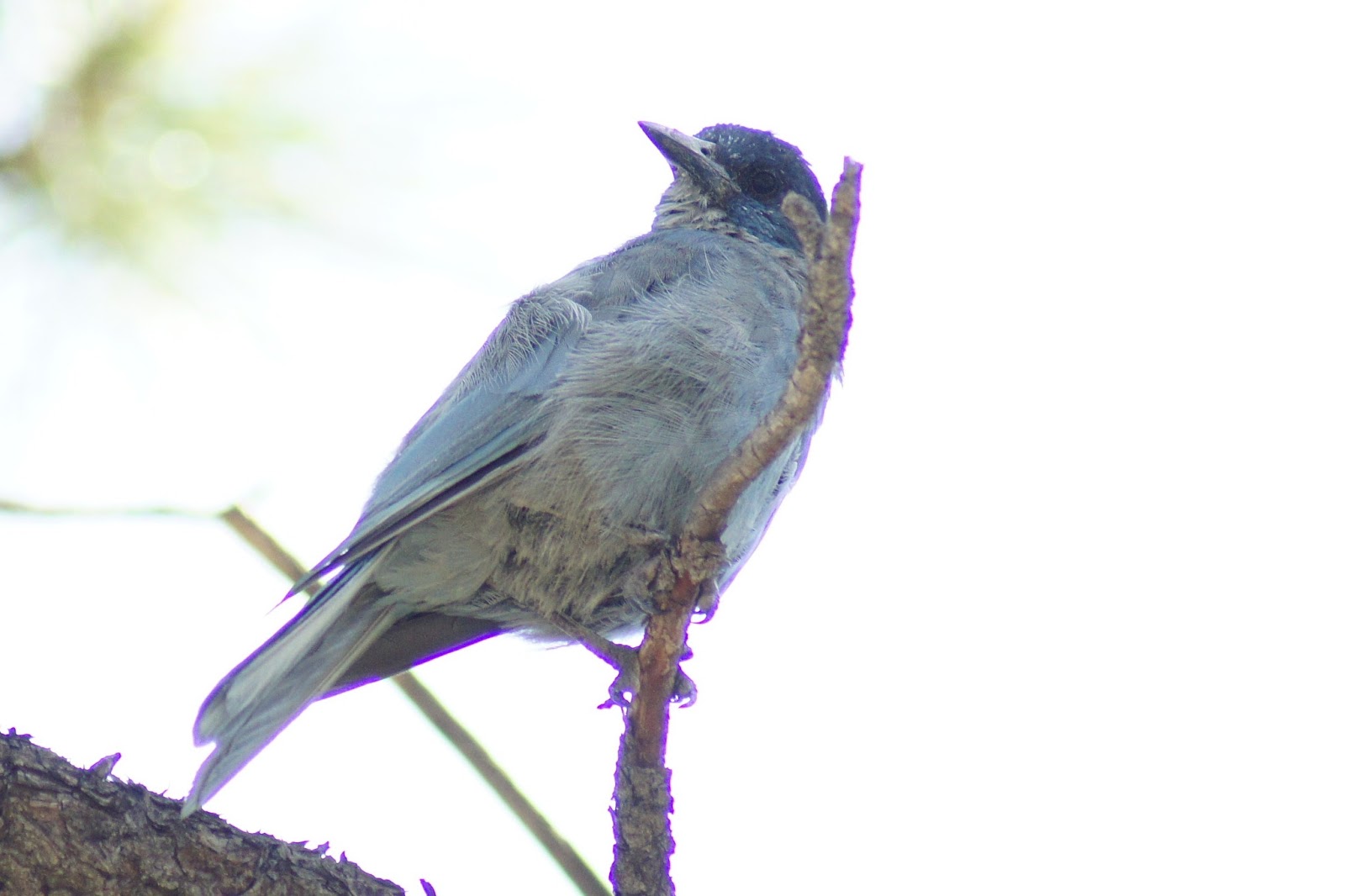
When I worked by way up into the higher forested elevations, I heard the calls of a large flock of Pinyon Jays.  I immediately went up a slope hoping to see this bird.  These Jays move around constantly in family flocks, and they rarely sit still.  They are also very noisy and can't be missed if they are nearby.  As I worked my way up a steep slope, I caught a glimpse of a Pinyon Jay.

Pinyon Jay

It was calling noisily to other Pinyon Jays.  As I was taking it's picture, I was then surrounded by the huge flock of Pinyon Jays.  They really came in quick, and were louder than ever.  I almost wondered if they were gonna slaughter me.  But as I observed their behavior, they didn't seem to care that I was around.  As I was walking around observing the flock, there was only one Pinyon Jay who looked like it wanted to hurt me.

The angry Pinyon Jay

Besides the one hateful Pinyon Jay, the others were doing a variety of different things.  Feeding young, searching for food on the ground, sticking their head in holes, and constantly hopping from one branch to the next.  This bird has Attention Deficit Disorder, they are never happy unless they are moving around.  

What next?


All jokes aside, the Pinyon Jay is one I haven't gotten to observe much and really get close too in my time birding.  Today was a treat with getting to see them up close and observe their behavior and get photographs.  Here are a few of my favorite photos I got of the Pinyon Jays.


Even other birds like to enjoy the Pinyon Jay flocks.  As I was observing the flock, a Clark's Nutcracker flew in to see what was going on, and a majestic Golden Eagle even soared overhead to see the flock.  Not really about the eagle, just kidding.  I rarely get good looks at Golden Eagles, so this was another big treat.

Clark's Nutcracker

Golden Eagle


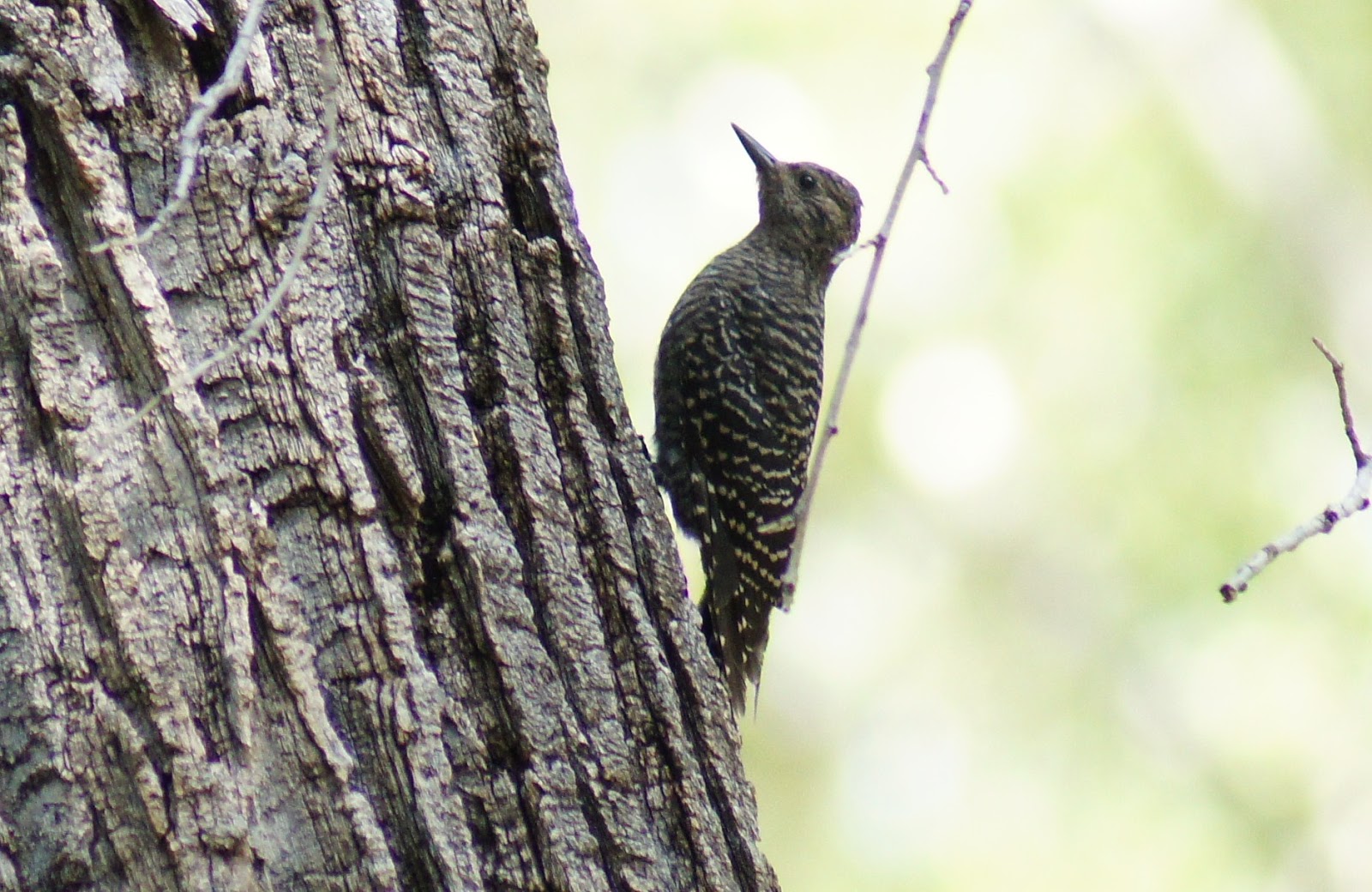
After coming down from Pinyon Jay Point, I birded with Tucson birders Peter and Betty Bengtson for awhile.  We saw several cool birds, including this young female Williamson's Sapsucker.

Williamson's Sapsucker-juvenile female

A Townsend's Solitaire was also nearby


And here's the daily installment of what's been around Acorn Lodge....

Williamson's Sapsucker-juvenile male


Band-tailed Pigeon

Later in the afternoon, my buddy Laurence Butler joined me to explore Greer.  Laurence was wanting to see Williamson's Sapsucker, Three-toed Woodpecker, and Gray Catbird at Butler Canyon and the Little Colorado River.  Well, we went three for three and found our targets.  I was busy trying to find the birds, so I didn't shoot many photos.  Tomorrow, Laurence and I will bird throughout the White Mountains for an epic day of birding.