Showing posts with label Rufous-crowned Sparrow. Show all posts

Sunday, June 5, 2016

My North American Migration Count-May 14th, 2016

Yeah, this is a late post.  In fact, there are many more late posts on the way.  I've been very busy so I haven't had the appropriate time for blogging.  On May 14th, 2016, I opted to explore the Bushnell Tanks arm of Sycamore Creek for the North American Migration Count (NAMC).  Bushnell Tanks is a great location, and it is one that is under-birded in general and is also one that I don't take the time to visit as often as I should.  Because of that reason, I decided to bird it hard and carefully count each and every bird in about a five hour duration.

Because I found a way to carefully count birds on this count in a quick manner, I think I can count birds with accurate numbers a lot more now.  And it's actually quite fun.  Here's my list from the count, I'm sure you can find my main highlight pretty quickly:

Beeline Highway--Bushnell Tanks, Maricopa, Arizona, US
May 14, 2016 5:55 AM - 10:35 AM
Protocol: Traveling
2.5 mile(s)
Comments: It's been a long time since I've birded this epic location, so I thought, "Hey, why not do this spot for the NAMC".
68 species (+1 other taxa)

Gambel's Quail 18
Turkey Vulture 5
Cooper's Hawk 1
Common Black Hawk (Common) 2
Broad-winged Hawk 1 Rare but annual in Arizona, especially in spring migration. What caught my eye today was a small buteo flying high with a Cooper's Hawk. I saw how small the bird was and that it had strong black primary tips with black trailing edges on the lower border of the wing. This bird appeared to show both adult and 1st year features from my pictures and the missing primary may indicate molt. The uniform brown coloration and black primary tips and trailing edges on the wings eliminate Gray Hawk. The noticeable white tail band eliminates the larger and longer-winged Swainson's Hawk and the much rarer in central Arizona Short-tailed Hawk (which has never been recorded in Maricopa County). The nearby Cooper's Hawk gave a good size comparison between the two birds. These are horrible photographs, but they do support Broad-winged Hawk. Also note the bird's flat flight dehidral when soaring with the Cooper's Hawk.
Zone-tailed Hawk 3 All from different spots along the old road through the area.
Red-tailed Hawk 1
White-winged Dove 11
Mourning Dove 8
Greater Roadrunner 3
Black-chinned Hummingbird 5
Anna's Hummingbird 1
Costa's Hummingbird 1
hummingbird sp. 5
Gila Woodpecker 25
Ladder-backed Woodpecker 3
American Kestrel 2
Western Wood-Pewee 2
Gray Flycatcher 1
Say's Phoebe 1
Ash-throated Flycatcher 9
Brown-crested Flycatcher 26 Well distributed throughout duration hiked.
Cassin's Kingbird 13 Well distributed throughout duration hiked.
Western Kingbird 3
Bell's Vireo 29
Gray Vireo 5
Western Scrub-Jay (Woodhouse's) 4
Common Raven 5
Northern Rough-winged Swallow 2
Violet-green Swallow 12
Bridled Titmouse 4
Juniper Titmouse 2
Verdin 9
Canyon Wren 2
Bewick's Wren 23
Cactus Wren 10
Blue-gray Gnatcatcher 2
Curve-billed Thrasher (palmeri Group) 1
Crissal Thrasher 1
Northern Mockingbird 5
Phainopepla 23
Orange-crowned Warbler 2
Lucy's Warbler 62 Well distributed throughout duration hiked.
MacGillivray's Warbler 1
Yellow Warbler (Northern) 69
Yellow-rumped Warbler (Audubon's) 6
Wilson's Warbler 3
Yellow-breasted Chat 15
Chipping Sparrow 4
Black-throated Sparrow 11
Lark Sparrow 3
White-crowned Sparrow (oriantha) 2
Canyon Towhee 4
Abert's Towhee 5
Rufous-crowned Sparrow 3
Green-tailed Towhee 2
Summer Tanager 8
Western Tanager 17
Northern Cardinal 17
Black-headed Grosbeak 3
Blue Grosbeak 9
Lazuli Bunting 12
Indigo Bunting 1
Brown-headed Cowbird 9
Hooded Oriole (nelsoni Group) 29 Well distributed throughout duration hiked.
Bullock's Oriole 17
Scott's Oriole 3
House Finch 54
Lesser Goldfinch 43


Yeah, on this count I found a Broad-winged Hawk!  It was only the second time I've ever seen this species.  This bird is turning into a rare but regular migrant in Arizona, particularly in spring.  This bird was a distant soaring sight, but when I saw it through my binoculars I knew it was something good.  Any small buteo in Maricopa County is a good thing to find.  As the Broad-winged Hawk soared with a Cooper's Hawk, I snapped as many pictures as I could before it left my sight.


The black trailing edge to the Hawk's wings, tail pattern, and uniform brown coloration point to Broad-winged Hawk.  It was the first time I've photographed this species, hopefully I'll have a closer chance in Minnesota in the coming week.

Another neat highlight was a total of 5 Gray Vireos.  Whenever I have birded at Bushnell Tanks in spring and summer, a Gray Vireo highlight was usually involved.


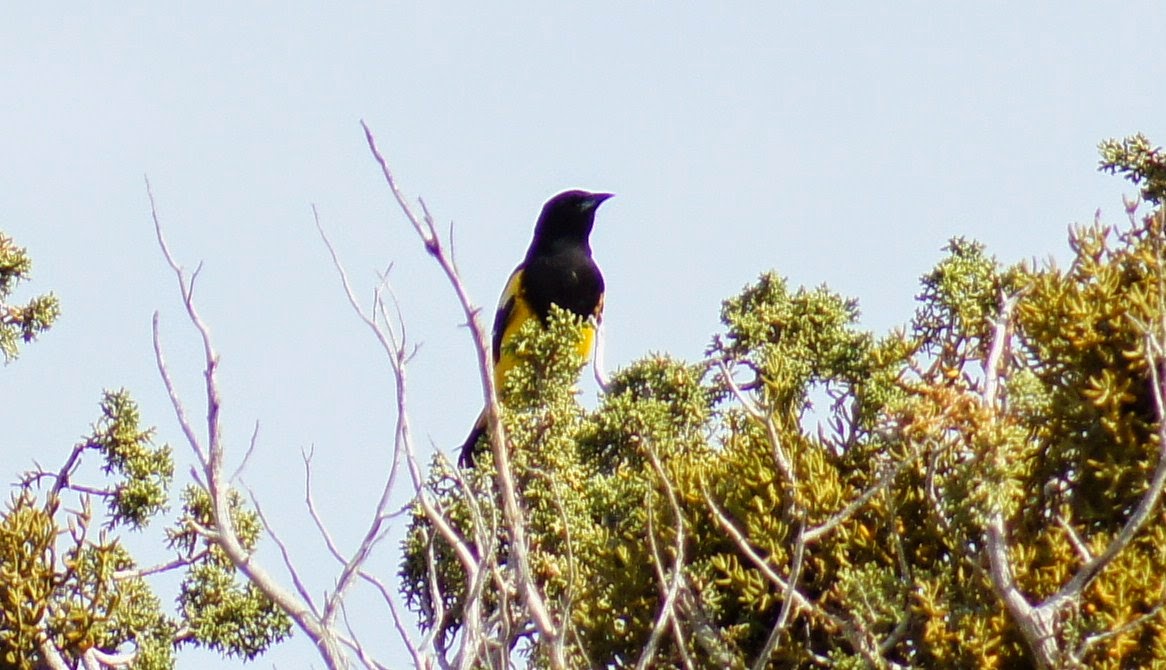
Orioles were very common.  I tallied 49 orioles of 3 different species:  29 Hooded, 17 Bullock's, and 3 Scott's.  This rather distant Hooded was my only proof that I actually saw one of them ;)


Two local raptors, Common Black-Hawk and Zone-tailed Hawk are always a big draw in this area.  While in a stand of riparian trees, I had a Black-Hawk fly over me.  In the surrounding hills and such, two Zone-tailed Hawks perched out in the open to give me a chance to snap a few pictures.


Cassin's Kingbirds are another bird I enjoy in this area.


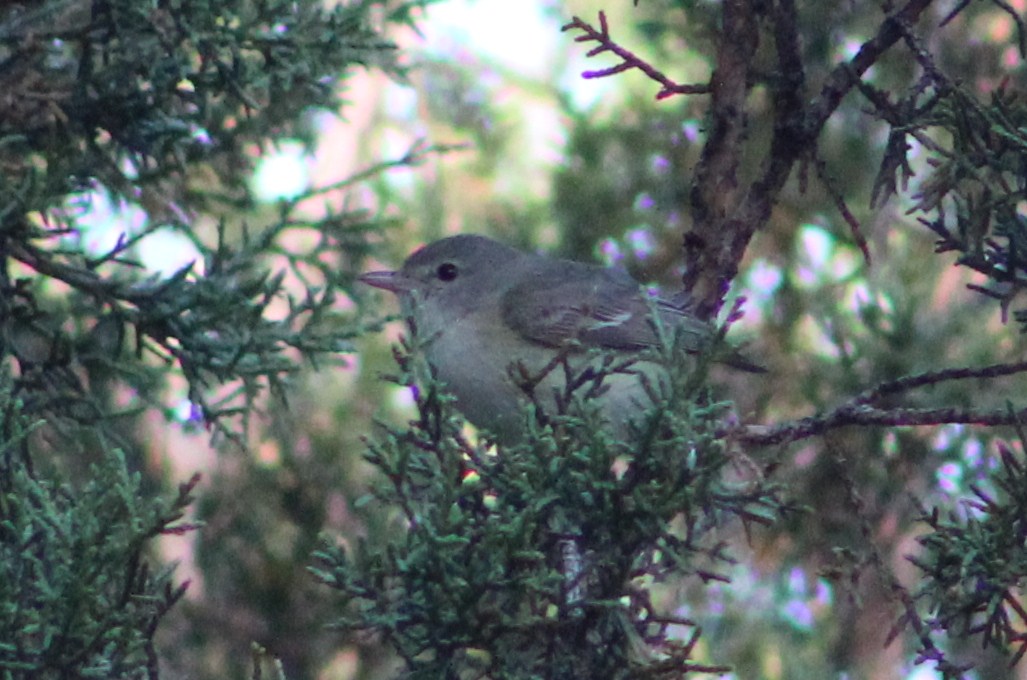
Bell's Vireos too...


Lucy's Warblers and Yellow Warblers were the day's most numerous birds.  Yellow won the fight with 69, but Lucy's was a close second in at 62.  Here are two of the 62 Lucy's.


Less numerous but still in good numbers was another "warbler", the Yellow-breasted Chat.  15 Yellow-breasted Chats are noisy with all the different vocalizations they give.  For a bird that usually skulks, I got my best ever shots of the species.


Black-throated Sparrows and Rufous-crowned Sparrows also highlighted the morning.  68 species total for my count, and a fun morning it was!


Friday, April 25, 2014

High On Humboldt

Today, I set out for a birding expedition to the general area of Seven Springs, with my plans originally being to have a hardcore day of birding.  This area is located 50 miles north of Phoenix, has excellent birding, but is highly underbirded.  I don't usually get up this way on a regular basis, but when I do, I usually cover a lot of the area, pretty hardcore.  A hardcore day of birding meant covering multiple locations, including the bushwhacking one mile route in the lush and thick Seven Springs Wash.  Truth be told, hardcore birding never really happened, and my route only drove over Seven Springs Wash, it never walked down into it.  I could have missed a rare eastern songbird vagrant, but I was fine with the could have today.  For me as a birder, things are more about having fun these days.  And having fun a lot of times means to relax and just enjoy the day.  Enjoying the morning is what I did, and my first stop ended up taking up most of my day.  For birding, I love it when the birding is great and the scenery is also great.  Today the two went hand-in-hand, and that place was at Mount Humboldt, which is accessed from Seven Springs Road before one gets to the Seven Springs Recreation Area itself.  The area of Mount Humboldt is a birder's paradise and a sight seer's paradise.  I like the nice combination, and I decided to spend most of my time on the four mile stretch leading up to Mount Humboldt.  The scenery here is breathtaking, and the birding compliments it well.  Avian life on Mount Humboldt isn't over abundant by species numbers, but those species that are present up there will make any visit worthwhile.  Just to name a few:  Scott's Oriole, Gray Vireo, and Black-chinned Sparrow.  I seem to keep on birding in places where these three species are found.  Maybe I just can't get enough of them?  I arrived to the base of the road and started to drive up to Mount Humboldt at about 7:15 A.M.


Mount Humboldt has interesting surrounding habitat that includes desert scrub, chaparral, and juniper.  From the access point to the base of the climbing mountain road, the elevation is about 3,500'.  Once one drives for four miles to the summit of Mount Humboldt, the elevation is then 5,204 feet.  It's not high like the forested transition zone elevations in Maricopa County's Mazatzal Mountains, but for this area, it is quite spectacular.  The views here are amazing, and they do include views of Mount Ord and Four Peaks as well as a towering overlook of Horseshoe Lake.  Today I drove straight to the top, and I've never really birded Mount Humboldt and Seven Springs much at all in April and May.  Here is a selection of photos that really show off the amazing scenery at the summit of the Mountain.

Four Peaks are the peaks on the right


There is Mount Ord!  You can see the tall towers from here!


The weather was perfect at the top of Mount Humboldt, and as we can all see, so was the scenery.  The birding was great too.  As I got to the top, an Ash-throated Flycatcher greeted as the first bird of the day.  He was sitting around the fences that shelter the towers at the summit.


The summit area has good chaparral habitat, perfect for Black-chinned Sparrow.  But the chaparral is really much more limited to the area of the summit and the last 1/2 mile of the road.  And there were a few pairs of Black-chinned Sparrows.  It was cool to see a pair up close.  The male has a much blacker chin than the female does.


There were some interesting migrants out-and-about, including several Green-tailed Towhees, a Townsend's Warbler, Black-throated Gray Warbler, and Wilson's Warbler.  The first two are shown below.


Things got really good when I was able to see this Rufous-crowned Sparrow up close.  This species is one that doesn't really come to mind much.  It's pretty secretive and is heard far more often than it is seen.  But this area is a good area to see this sparrow in.  And they are a neat sparrow, or towhee more properly.  They are in their own genus, but right up at the top of the sparrow family with the towhees.  This sighting also proves that with Black-chinned and Rufous-crowned Sparrows, and Green-tailed Towhee already, that Mount Humboldt is very sparrowy.  


I then started back down the road from the summit and stopped at many different places in search of more goodies.


And did I mention that the road up to Mount Humboldt is paved?  It's actually pretty nice.  But there are a lot of potholes in the road.  Some of the horrible historic potholes have been covered up, while others haven't.  I kinda like it, it makes the drive extra interesting and does keep the crazy speedsters out there somewhat at bay.


The main reason I came up to Humboldt was to try and attempt at getting killer looks and killer photographs at my favorite oriole, Mr. Scott's.  The Scott's Oriole is an incredible and beautiful bird, and I did see plenty of them during my time this morning.  I figured there would be plenty of them, since they do favor open and dry woodlands, such as those with junipers at places like Mount Humboldt.  As I drove down the mountain, it didn't take me long to hear a male Scott's Oriole start singing it's meadowlark-like song.  I found the bird and his mate, and I wasn't at a good angle to photograph him.  He then flew down the hill further, where I got somewhat decent but distant photographs.  But still, what a striking bird from a distance!


After this bird flew off, I drove down the road further to find another Scott's Oriole roadside.  I heard him singing right after I passed him, and when I put my truck in reverse, he headed up a slope.  After parking, I followed him around, and he had a female with him also.  As I was following the birds, I took two steps to far, only to have the oriole come back and perch in the open.  After retracing the two steps back, one wrong movement I made spooked the bird.  He was up and singing and was very close, hadn't I spooked him, I would have had great photographs.  I was VERY angry at myself.  Before this happened, though, and during the follow-around process, I did get a few decent shots in.  There will hopefully be another chance soon!


Ah, Scott's Oriole, what a class act of freaking awesomeness.  The juniper woodland is also home to another bird I've seen a lot lately, the Gray Vireo.  These noisy little gray songsters can be heard almost all day right now, as they have arrived for breeding season and have started to set up their territories.  They are a little hard to see at times as they forage through the junipers and occasionally briefly land on that bare perch.


Once finding the appropriate juniper, the gray pygmy will often show half of it's face in hide-and-seek fashion.


With patience, the Gray Vireo will often sit up and stare with curiosity while singing at the same time.  This is now the third location I have photographed this bird during this month of April, I'm sure the Gray Vireo population hates me by now.


Mount Humboldt has Crissal Thrashers too along with these three goodies a favorites of mine (Scott's Oriole, Gray Vireo, Black-chinned Sparrow).  It also has wintering Sage Thrashers in high numbers as well as Western and Mountain Bluebirds.  And of course there's plenty more other than what I mentioned.  Mount Humboldt is an awesome place to bird and have scenic gazes.  As I walked down the road further, I found that this Canyon Towhee had quite the meal going.  I think it was his way of asking if I wanted some, but there is no way I could ever eat that!


Mount Humboldt also has a few of the typical desert birds in it's limits in the desert scrub habitat.  This includes a lot of Cactus Wrens and this rad-looking Black-throated Sparrow.


I didn't shrike-out today either!


I made two stops at Mount Humboldt this morning, and in between that I made a visit to Seven Springs Recreation Area for about an hour, which I'll get to in a second.  But it's been awhile since I've been up on Humboldt, and it certainly won't be a long time gap ever again between visits.  I love this place.  The birding is fun, it's scenic and peaceful, and it's great exercise.  Thanks again Humboldt!


I did make a stop at the very nearby Seven Springs Recreation Area thinking I would maybe still have a hardcore day of birding.  Once I got there, I just wasn't up for the effort here or at the Seven Springs Wash.  I wanted to go back up to Humboldt.  Before I went back up, I did spend about an hour at Seven Springs, and it is always a neat area to visit!


A pair of both Common Black-Hawks and Zone-tailed Hawks were soaring overhead.  They never soar close enough together for both to get in the frame.  At least, that was the case today.


In the riparian area, I stumbled across these male and female Summer Tanagers.  The male was enjoying quite the snack.


An Indigo Bunting was singing along the creek, but after 15-20 minutes of following it around with no visuals, I gave up.  Plenty of noisy Brown-crested Flycatchers were around though!


At Seven Springs there a day use areas, picnic areas, and camping areas.  The Black Phoebe wants everyone to know they can't camp out in the day use area.  What a way to rub it in.  


The morning was a good one to be out birding.  Many great highlights, and awesome birding locations and birds.  Till next time.....