Showing posts with label Grace's Warbler. Show all posts

Friday, April 18, 2014

Mount Ord Does It Again!

Mount Ord does it again.  You probably sitting here and reading and thinking, why, why had Mount Ord done it again.  This title has made Mount Ord seem like it has won a championship, an M.V.P. award, or a repeat academy award, something like that.  You might think, "How can a small mountain in central Arizona have this title?"  Well, I'm a serious birder, and Mount Ord happens to be Maricopa County's premier high elevation ponderosa pine destiny for the serious Maricopa County birder, and that is what I am.  It is also a close escape from the summer hell that the Phoenicians find themselves trapped in.  But with Ord in close grasps of the dying summer Phoenicians, many see it as a remedy.  I see it as this, but Mount Ord has also had a plethora of amazing birds during the history of birding and exploration on this mountain.  Some of these birds have been incredible high elevation rarities that are very hard to find elsewhere in the county.  Many of my Maricopa County firsts have been supplied to me by Mount Ord.  And once again, after my Mount Ord trip today, I came back and could once again say, "Mount Ord has done it again".  I have many stories to tell from my outings at Mount Ord, and yet I am only one birder.  Read today's story about another great visit to this fine mountain.  When the Black-chinned Sparrow returns annually to Mount Ord for breeding season, it's plentiful habitat also has it singing, "Mount Ord has done it again!"


Today I was joined by my brother, Tyler DeBardeleben.  We left very early to arrive to Mount Ord at 6:30 A.M.  It was overcast outside and sun would breath through the cloud cover at times.  As we arrived on the mountain, we decided to hit up and bird the top first.  Misfortune hit us however as I realized I had a big problem with my steering system as we arrived at the top.  And the top was birdy, too.  Birds were everywhere and singing, including a few Olive Warblers who liked to be hidden for the most part.

I was hoping the problem wasn't as bad as it seemed as we got out of the truck and started birding.  The system acted up right as we got to the top.  It made it hard to enjoy the birding, so when we got back, we realized the problem was still alive.  I was contemplating leaving the mountain all together and heading back into town to Midas, but after a phone call to my Dad, I realized we could probably still take our time and have a good hiking and birding outing at the wonderful Mount Ord.   


At this point, we were down lower than the level of the summit, at the beginning reaches of Forest Road 1688.  Forest Road 1688 is my favorite part of Mount Ord, largely because of it's tall ponderosa pines throughout the stretch of two miles, but also because it comes into contact with the Upper Sonoran Life Zone that consists of chaparral and juniper habitat.  Unlike the rest of Mount Ord, Forest Road 1688 is entirely in Maricopa County.  Anywhere else on the mountain one is always close to Gila County, which holds most of the Mount Ord geographical makeup.  But Road 1688 is a treasure for birders in Maricopa County, as it has a lot of great pine and oak habitat for two miles and over.  This visit was a traditional Mount Ord visit, where I like to cover a lot of ground.  Such as visit includes a trek to the top and birding the Maricopa County stretch of the top, as well as the duration of Road 1688 and a shaded forested drainage that is accessed at the southern end of 1688.  Today it took is over 6 hours to complete the route.  On days that I really take my time and search thoroughly, it might take me longer.  


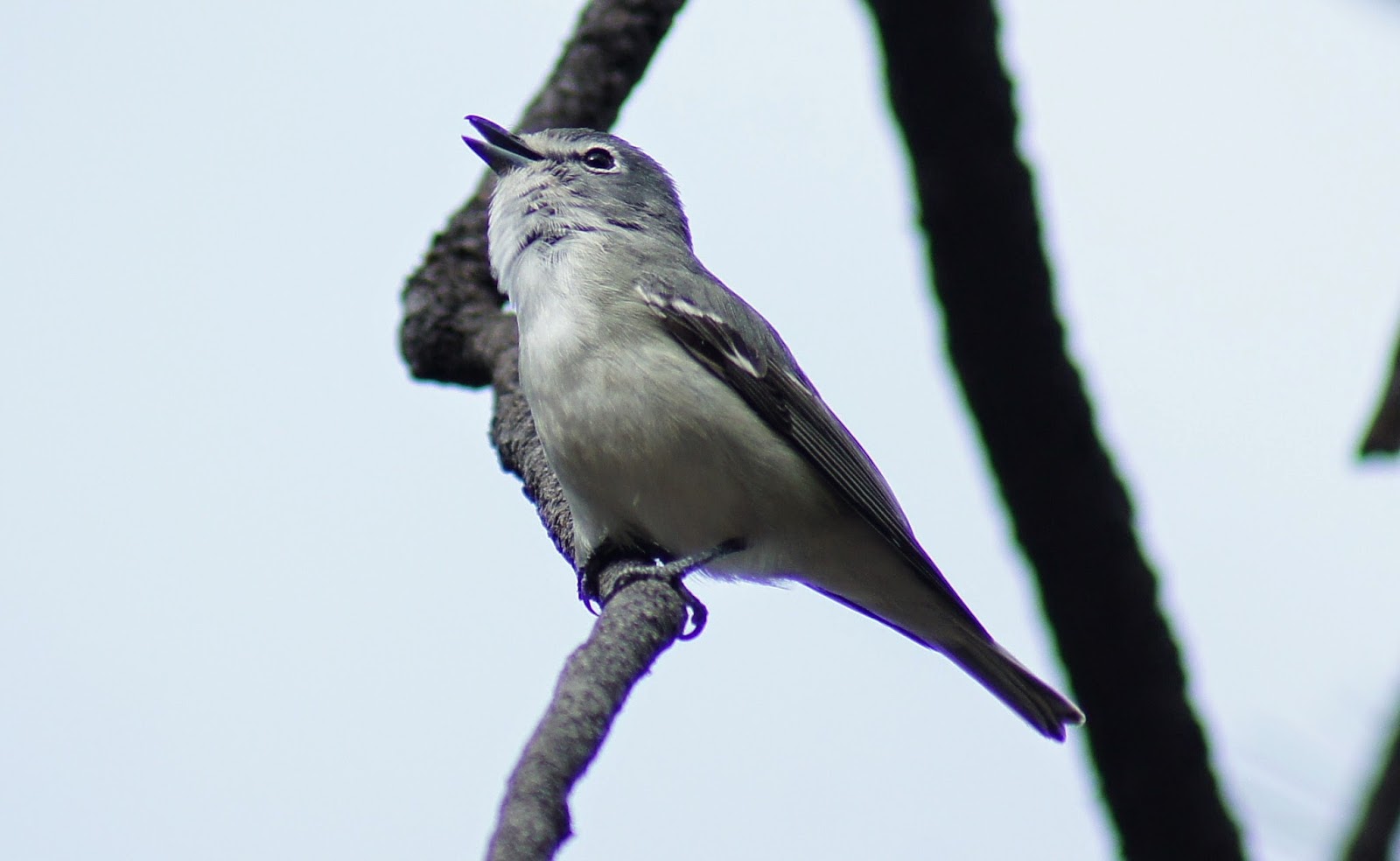
In similar ways to the summit area of Mount Ord, Road 1688 had active bird life from the start as Tyler and I headed north/south down the road in search of birds.  Tyler isn't a birder, for him it was a hike and an outing he claimed he needed to have before the day was said and done.  One of the first birds we encountered was a vocal Plumbeous Vireo.  He eventually came out in the open and gave us good views.  His cousin, the Gray Vireo, was also nearby, but stayed out of sight on steep slopes.  Like the Plumbeous, the Gray Vireo was also very vocal.


Black-throated Gray Warblers everywhere and numerous at Mount Ord.  However, they weren't cooperative for pictures like I was hoping they would be.  But their loud songs were never silent for a moment during the 6+ hour morning.


Along Road 1688, is a lot of brushy chaparral habitat near the pines.  This provides home to one of the most abundant birds of the mountain, the noisy Blue-gray Gnatcatcher.


April is the season when all of the breeding Mount Ord birds arrive, and many migrants are passing through.  In places along the road, the buzzy calls of Lazuli Buntings were heard.  It was nice to look up and see several of them in bare branches of trees.


I then looked below my eye level and saw this Virginia's Warbler flitting around.  The song of the Virginia's Warbler was one that was commonly heard throughout the morning at Mount Ord.  They arrive here in the month of April as well to breed in this area.


Along the hike, we encountered many Empid flycatchers that were Dusky/Hammond's types.  I heard each species vocalize several times.  I got a picture of this one, which I'm going to call a Dusky.  If I'm wrong...oh well :)


Another loud and common bird of Mount Ord is the Bewick's Wren.  This bird's high pitched song and strange call note is commonly heard during Bewick's Wren breeding season here.  This bird wants to compete with the Sinaloa Wren, and it perched up to try and be better.  


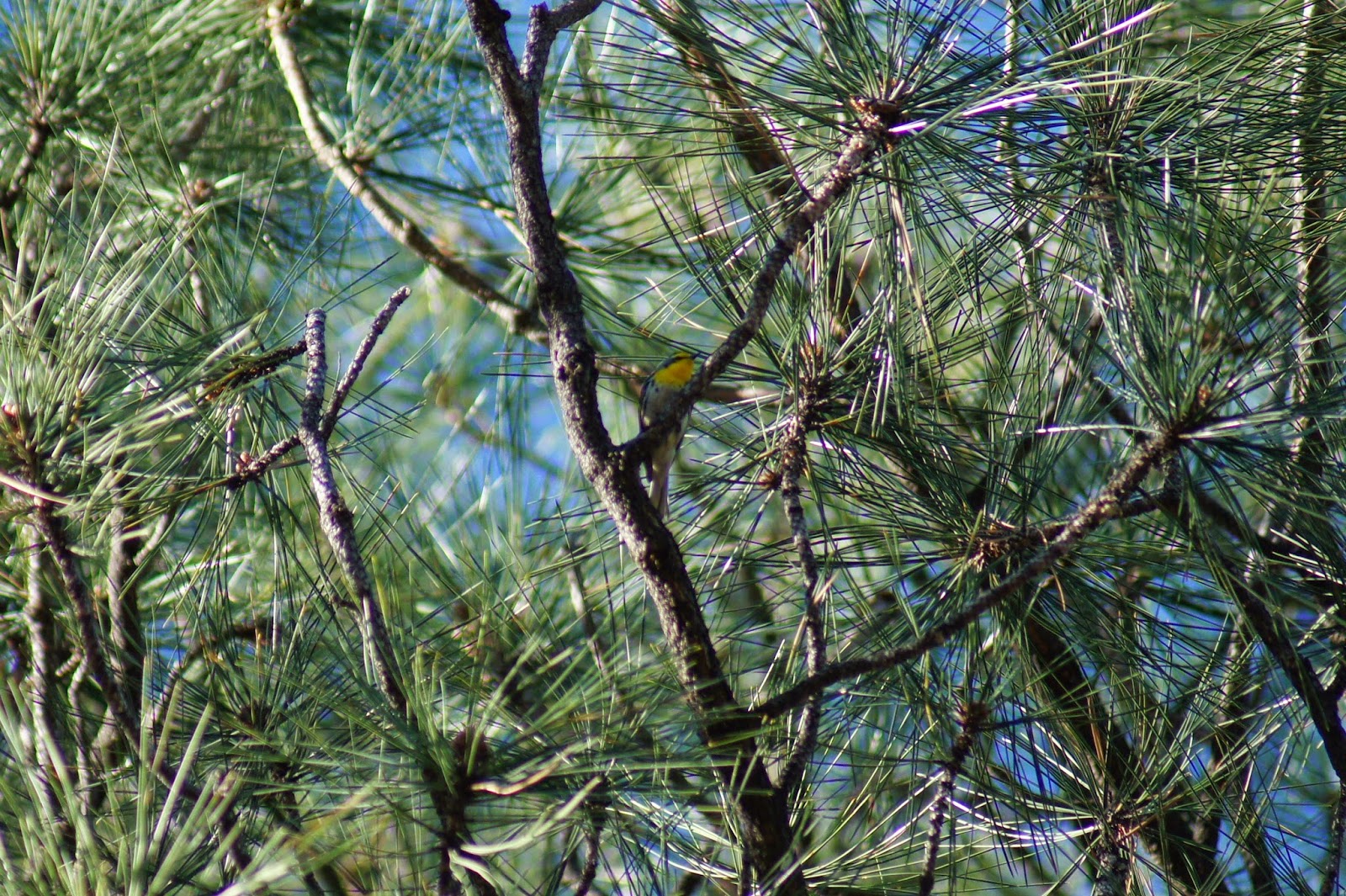
We then encountered a Grace's Warbler out in the open on a bare branch.  Like the Olive Warbler in the beginning, this bird also loves to hug the pine needles and stay up high in the pines for the most part.  It's song is a common audio up on the mountain.


As we saw the Grace's Warbler, we then left Road 1688 momentarily and headed down a nice forested drainage that is productive for birds for over a half mile.  Beyond the half mile, the drainage continues for a long ways, but is too rough for hiking on.  It takes one to know that, I wonder who walked down that drainage?  Probably a good chance it was the guy writing this...


After the walk down the drainage, Tyler and I were tired and started to head back up to Forest Road 1688.  As we were nearing the road, I caught a glimpse of a woodpecker.  It was a brownish and barred woodpecker overall, and one that I was hoping for.  But I only caught a glimpse of it...before it turned around to the other side of the tree.  The lighting was bad, and I didn't think I would be able to make out the woodpecker.  Ten minutes later, I was still searching, and the bird disappeared on me!  At least that's what I thought...


From the quick glimpse I got of this woodpecker, I had a good feeling of exactly what it was.  I didn't want to get my hopes up, especially with a poor look.  But after searching, I scanned the top of a pine and there the woodpecker was, sitting motionless.  I was speechless at the sight, it was what I was hoping for.  "Its a....i a....it's......it's..yes....it's a Will.....it's.....it's a Sap....is a......oh, my gosh.....Tyler, I have female Williamson's Sapsucker!!!!!".  


I was shocked at the sight of the female Williamson's Sapsucker!  This species has been a huge target of mine in Maricopa County over the last four years, and it was great to have one right in front of me at my favorite place.  And it also completes all four Sapsuckers in Maricopa County for my list.  It was number #360 on my Maricopa County list, so in other words, a new Maricoper!  Ironically, my 350th Maricoper was a Red-breasted Sapsucker, and ten birds later, was finally the Williamson's Sapsucker.  Any new ten on a list is fun, and now it's about the next set of 60's.  The female Willie ended up being pretty cooperative, and the bad lighting was a huge downside to getting good pictures.  This bird did face in my direction well once while standing on a horizontal branch.  She had a bright lemon yellow belly as well as a black breast.


The Sapsucker then climbed up to the top of a tall pine, and sat up high for a long time, where it sat mostly motionless.  We left the sighting at that after waiting awhile without the bird moving.  But what a neat way to get a county bird, which doesn't happen for me much anymore.


Tyler and I then had our own way of celebrating the Sapsucker and the hike!


There was still room for one more amazing sighting.  The final amazing sighting came from a nice Black-chinned Sparrow up close, who was active along the road!


It was another amazing outing at Mount Ord.  I recorded a total of 41 species, and the highlights are shown here.  Some of the highlights weren't able to be photographed, as any birding day.  But with a great hike, great birds, great company, and even a new Maricoper, I found myself thinking, "Mount Ord does it, again!"

Monday, April 14, 2014

Birding in the Bradshaw Mountains

The Bradshaw Mountains are just south and outside of Prescott, Arizona.  It is a great area to bird in, and there is an abundance of mixed conifer woodlands at high elevations situated at a close range to Phoenix.  This area is often my getaway, and I really enjoy it a lot.  To make matters better, it only takes me 1.5 hours to get to the Bradshaws from Phoenix, which isn't long at all.  These mountains are a great place to see a handful of birds that people usually head straight down to southeastern Arizona to see.  But some of these birds are reliably found in Central Arizona too, and the Bradshaw Mountains are a wonderful location to do such birding.

On April 11th, 2014, Dominic Sherony and I left Phoenix near 8 P.M. after I got off of a long twelve hour work shift.  We headed to a location in the mountains called the Kendall Camp Trail.  This location has been known to be a good one for Flammulated Owl, an hour that Dominic and I have both only heard in our life but have never seen.  The Kendall Camp Trail is a very reliable place for this species, and I saw a handful of reports on eBird of local Prescott birders finding the owls.  And about half of those sightings included visuals of the bird.  For a tiny owl like the Flam, you have to love those odds!  I figured this would be our best shot at this species.  When Dominic and I arrived at the trailhead at 10 P.M., we spent the next three hours searching for the Flams.  Well, we found two of them and one of them we followed around consistently.  It was very vocal all night, and we were right under the bird at least four times.  With owls, since I say we found one doesn't mean we saw one.  The owl sat up at the tall end of the ponderosa pines it perched in, and was easily audio for hearing.  Dominic and I searched and searched with our flashlights, and never got to have a visual of the small dark eyed owl, other than when I saw it fly up out of the pine.  That's really not to great of a sighting at all.  After the three hours, we finally got too tired after being really tired and called it a night.

After a four hour sleep, we went back to the Kendall Camp Trail and other areas in the Bradshaws for a pleasant morning of birding.  The Kendall Camp Trail has been known in recent years to be a reliable location for breeding Greater Pewees.  When we got there in the morning at 7 A.M. after a McDonald's breakfast, the Greater Pewee was the first bird we heard after getting out of the van.  Due to the fact the Greater Pewee loves to scale the highest perches and stick to those high perches, it was hard for us to truely get close to the bird.  But he was loud, and he sang the famous song, "Jose, Maria!".  Dominic and I have decided to name every Greater Pewee male Jose and every female Maria.


The Violet-green Swallow is a beautiful swallow that loves to nest in higher elevations.  In the Bradshaws, these striking birds are plentiful!


The Hairy Woodpecker was also seen in several locations that we birded in the Bradshaws.  This bird is often hard to photograph, as you can see right here.


In Arizona birding, April is a month of enjoyment as the breeders start to arrive.  For me, a lot of those favorites have to do with the higher elevation warblers that breed in our state.  There's nothing quite like hearing those loud and yet very peaceful songs coming from a handful of eye candies that come in small packages.  One of those warbler's is the Virginia's Warbler.  Although this is a poor shot, it does show the bird well.  And it's song was very evident throughout the Bradshaw forests and shrub.


The Black-throated Gray Warbler is a handsome black-and-white, and tends to like more open oak and pine woodlands with manzanita understory.  It's song is buzzy and loud, and you always know when the Black-throated Gray is around.  Dominic and I found this bird in poor lighting, but even with these poor shots, it still shows an awesome bird!


While some warblers forage lower in the forest, others hug the top of the pine trees, and they really don't give birders a lot of grace when it comes to warbler neck.  But every once-in-awhile, the Grace's Warbler will come a little lower for good views if one is patient enough.  Typical views of Grace's Warbler will often look a lot like this....


Patient views will often result in something a little better....


Of the high mountain warblers, one of my favorites is quite the showoff, isn't very shy, and has a lot of personality and isn't too picky about it's perches.  The Painted Redstart is this bird, and it is always super cooperative for birders, forages 100 feet over your head or 5 feet under your face, and it is plain beautiful.  I've seen plenty of Painted Redstarts during my birding time, but I must admit, I never get tired of watching them.  When I hear their high pitched calls and sweet song in the forest, I always stop and look.....


One of my favorite locations in these Bradshaw Mountains are the south and ending sections of Walker Road.  This is where Dominic and I ended our day, and it is always flowing with an abundance of forest birds.  And a lot of them are the awesome and sexy warblers.  Despite hearing several Olive Warblers, they were distant, another one of our favorites.  As we birded Walker Road, we were coming close to our ending point, and we exhausted.  Having four hours of sleep at night after a full day of work and little sleep the night before that, I was exhausted and so was Dominic.  The tiredness had us quite red-faced, but nowhere as close to being as Red-faced as the next small creature we were looking for......


In central and northern Arizona, the Red-faced Warbler arrives in the later part of April for the most part.  Dominic and I knew we were on the early side.  But last year, at a specific mile marker on Walker Road, I found a very early and vocal Red-faced Warbler where Walker Road passes a narrow bridge and turns into a dirt road after being a paved joyride through Lynx Lake Recreation Area and plenty of ponderosa forest.  After the pavement ends, the pine forest turns into a beautiful mixed pine, fir, aspen, and oak forest for the remainder of it's duration.  And were the dirt starts, that's where this vocal male was found, nearly a year ago from the 12th (April 14th, 2013...to be exact), when we were looking on the 12th.  Well, as we approached closer to the spot, I heard that cherry and familiar song.  And that Red-faced, who wants his mate extra early, was back again, at his spot!  Incredible!  At least...I'm assuming it's the same bird, most likely...since he's the only Red-faced we detected...probably.  Last year, it was the only Red-faced I detected on April 14th, too.


As you can see from the photos, Walker the Red-faced is a very active dude, and he has the brightest and redest face of all of the Red-faced Warbler population.  With the naked eye, it almost looked like a bright red ball bouncing around up in the trees until one looks up and says, "Wow, it's a tiny bird with a bright red face!".


Walker isn't going to stop singing until his mate shows up, it won't be too much longer.  Last year, when I returned to Walker Road a few weeks later, the place was alive with the song of the Red-faced all along the several miles of road after the pavement ended.  I think this place is one of the top places to view this bird in the state of Arizona.


The Bradshaws are one of my favorite mountain birding locations, and is one that is close to home and an awesome day trip or camping trip.  This trip was a nice one, and with me loving to list in Yavapai County now, the Flammulated Owl was a new addition.  Any trip with warbler sightings like the ones Dominic and I had on this trip will make the drive worth it alone.  Hopefully, I'll be back in the Bradshaws again soon before I know it!  Then, the warblers will really be in full force.  If your reading this and haven't birding in these mountains or in the Prescott area, give it a try instead of a trip to southeastern Arizona.  The birding is almost as awesome, and is much closer to Phoenix!  And here is one more Red-faced Warbler shot from April 12th.....