Over the last two years, I've become an overall Arizona birder rather than that dude who was only obsessed with birding in my home county of Maricopa. I'm still obsessed with my county, but I've gotten into exploring and birding throughout the entire state of Arizona. While this drive has led me to many neat places, there are still many locations and hotspots that I still need to explore. Each Arizona county holds a plethora of different birding locations, some that are birded daily and others that are barely talked of or known about. Until recently, my will to explore new counties has left me to explore at least several areas in all of Arizona's fifteen counties except for one of them. And this last county is one I have rarely thought about and is also one that I have known very little about. When I would see this county on maps or on the list of Arizona counties, I would usually think 'Who gives a Graham'. I really wouldn't think that, but I would usually skip over it, kinda like the one song everyone skips on the CD. Well, I'm talking about Graham County. And it's an awesome county. If the Arizona counties were lined up in CD track listing fashion, you can guarantee that I wouldn't skip over it now! And this past weekend, I stepped my foot into Graham County for the very first time...

Graham County is highlighted by the spectacular Pinaleno Mountains, which has a high point at 10,700' feet at Mount Graham. It's a massive and is the most extensive sky island region in southeastern Arizona, and one of the only mountain ranges that I haven't been to yet in southeastern Arizona. There are massive forests on Mount Graham that I had heard about, and it made me want to visit the location. Below the high country of Mount Graham are many other habitats, elevations, and varied bird life around the cities of Thatcher and Safford. When I went on my trip to Graham County, I wanted to cover all of the many habitats and see the variety of spectacular bird life.

My good friend Gordon Karre is the person who got me interested in Mount Graham. He told me about the mountain and it's variety of habitats and bird life. Just by hearing Gordon describing the Pinaleno Mountains (mountain range where Mount Graham is) made me want to take a trip up to the area and explore Graham County, and I didn't want to wait long (next year for example). I suggested to Gordon that we should take a birding and camping trip together to Graham County and explore the many habitats of the area which would mainly be an exploration of Mount Graham. At first, Gordon had plans during the weekend I was wanting to go to Graham County. But then, his plans got luckily cancelled and we made the adventure into Graham County, to explore the areas of Mount Graham and more. As in any birding trip, there were birds awaiting us. And there were crazy birds to be seen and missed on this trip, come along for the ride!
The weekend the trip took place was August 23rd and 24th. During this time, Kevin Love was officially traded to the Cleveland Cavaliers, forming what may be a deadly force with LeBron James for years to come. Back to the subject, I arrived at Gordon's house at 4 A.M. on Saturday and we headed southeast to Graham County. It was a fun drive. Once we crossed the county line into Graham County after 2.5 hours, the first bird of the trip and my first Graham County bird was a Common Raven. The list was officially underway to the last county I have needed to bird in. Gordon has birded in Graham County several times, and has a list of over 100 species for the county, which was our goal for the trip. While heading through several locations into Graham County as we headed east, we quickly picked up our trash birds such as Great-tailed Grackle, Eurasian Collared-Dove, Rock Pigeon, and more. A non-trash bird in the Barn Swallow was numerous and was literally everywhere on power lines and fields through the area. Once we got close to Thatcher, we made our very first and hardcore birding stop of the trip, which was at the Cluff Ranch Wildlife Area. I have read about Cluff Ranch many times, and it was cool to see it. Cluff Ranch is located at the northern base of the Pinaleno Mountains, and it's habitat makeup consists of riparian areas and agricultural fields. Several ponds are in the area, and one of those ponds is really more similar to that of a lake. The lake was surrounded my mesquite woodland, desert scrub, and a lush cottonwood and willow riparian woodland. Throughout Cluff Ranch, we recorded nearly 50 species to kick start our trip in the right direction. The luck began immediately as we turned onto the entrance road into Cluff Ranch. I got my first two Pyrrhuloxia's of the year for Arizona (which I thought I already had), and we also had this nice-looking Swainson's Hawk perched along the road. The Swainson's Hawk is a raptor we don't see too often, so any observation is always a treat.


As we were down low at Cluff Ranch, it was amazing to look over to the south and see the Pinalenos rising above the desert we were in. It was hard to believe that we were going to be up there later in the day!

While working a riparian area near the main information center on the Ranch, we got lucky and found a Northern Beardless-Tyrannulet while we were listening to a few Western Screech-Owls. After hearing the bird close by for several minutes, we eventually had a few close up views. The Tyrannulet is a tiny flycatcher, and is very easy to overlook. For a bird that is as small as it is, it certainly has a very loud voice! This was a life bird for Gordon, and was my first of the year and my 300th overall for Arizona for 2014. While we watched the bird forage and preen in a cottonwood, Gordon was able to get a few good pictures while I was standing at an angle where the Tyrannulet had a branch in it's face. It would be one of those pictures that would make a good identification challenge!

One of the funnest areas of Cluff Ranch was Pond # 3, which was almost like a small lake in a way. We added many different species to our list while walking around the pond. Some of these species included Yellow-breasted Chat, MacGillivray's and Wilson's Warblers, Green Heron, Black-crowned Night Heron, and more.
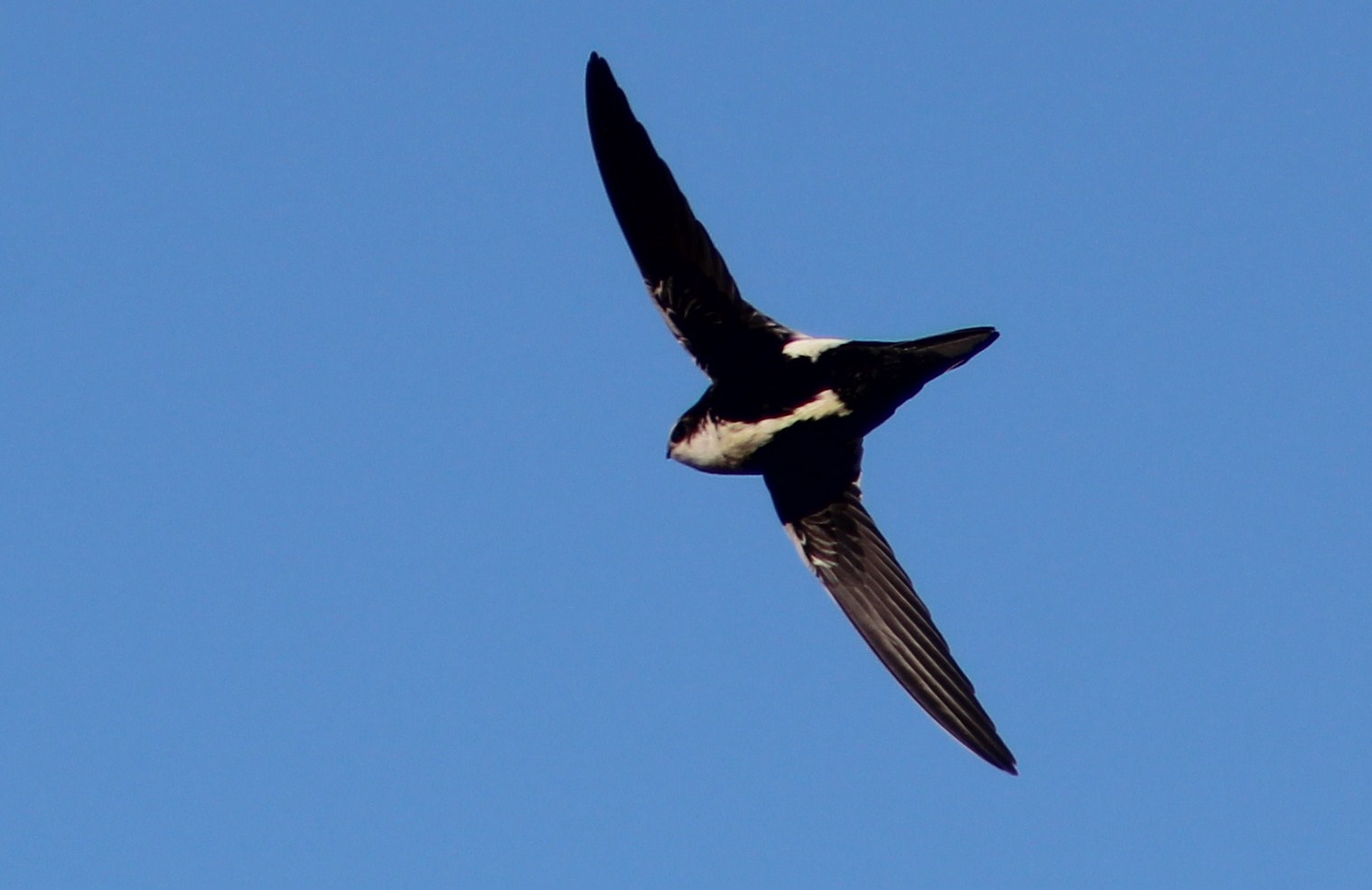
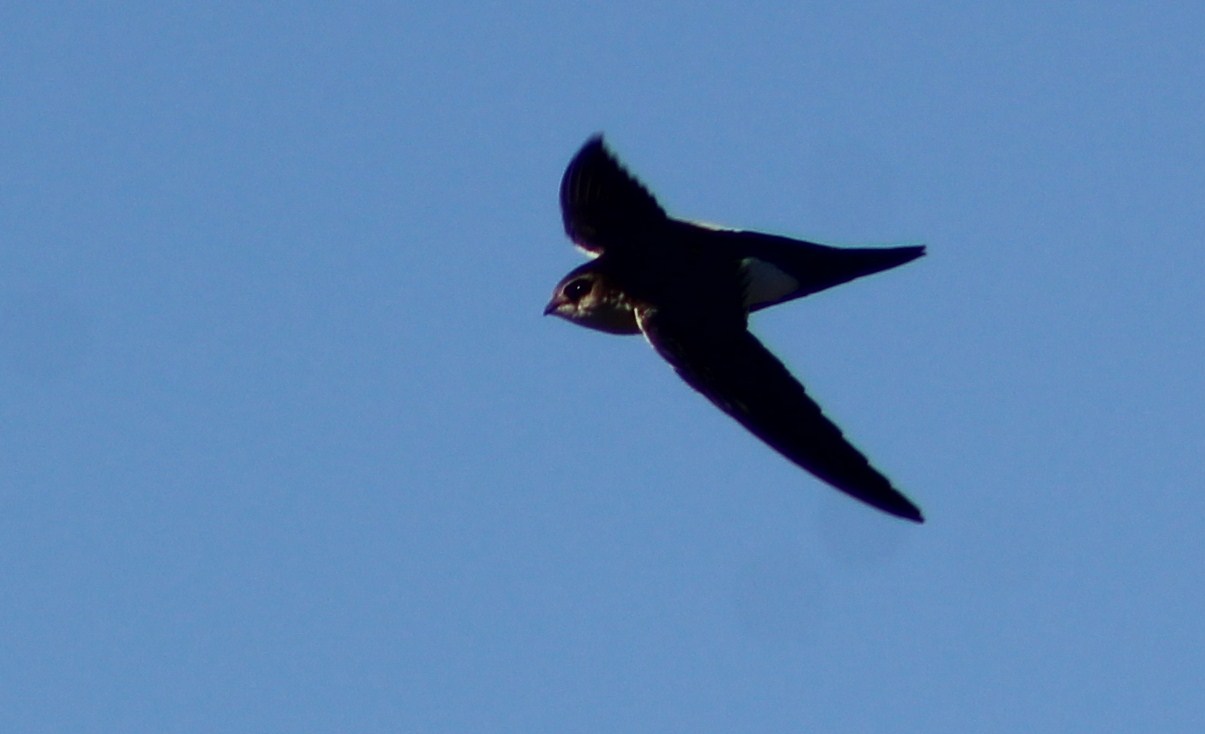
One of the better highlights from the pond and all of Cluff Ranch was a flock of White-throated Swifts flying over the pond and feeding. These impressive "torpedo" flyers are very hard to photograph. Gordon and I each managed several shots of this impressive bird.


Before heading up into the Pinalenos toward Mount Graham, we made a few more stops in the lower elevation. These stops consisted of the Raey Lane Sewage Ponds in Thatcher, and Roper Lake State Park and Dankworth Pond State Park just south of Safford. The sewage ponds were closed up after we had the impression we would be able to walk in. Despite that, we were able to drive along a border road and view some of the ponds. We were rewarded with an up close Greater Roadrunner, a flock of Wilson's Phalaropes, and a mix of swallows that included several Purple Martins. Once we got to Roper Lake, we were hoping to find a good waterbird. There didn't appear to be much at Roper Lake. It was getting hot out and was quite boring. That tern we were hoping for was a no show. You can see the American Coots from here though-yay!
Things got a little better when Gordon looked up and spied this female Belted Kingfisher hovering over the lake.
Dankworth Pond State Park was a lot better than it's northern cousin. We were greeted by a male Vermilion Flycatcher and a family group of Hooded Orioles as we arrived on spot. The Dankworth Pond is...small. But it had a lot more bird life and it struck me as a spot that would be a very fun place to bird throughout the year.
There were several birds on the water and several in the air while we watched over the pond. Some of them included Ruddy Ducks, Neotropic Cormorants, and American Coots.


Between our four stops of Cluff Ranch, the Raey Lane Ponds of Thatcher, and Roper Lake and Dankworth Pond State Parks, we were already up to 70 different species for our trip and my first exploration of Graham County. It was now time to drive up the Swift Trail, the road that travels through the Pinaleno Mountains and goes high in elevation towards the 10,700' Mount Graham. The Swift Trail is 35 miles in length, and traverses through a tremendous variety of different habitats and life zones. While the very summit of Mount Graham is closed to access to protect the endangered Mount Graham Red Squirrel, one can access elevations easily that are close to 10,000'. Before we got up high in elevation, we still enjoyed some of the lower elevations within the Swift Trail, which start off at 2,900'. While driving a 35 mile stretch up from 2,900' feet to nearly 10,000', one can be sure that this mountain range is wonderfully picturesque and breathtaking! Once on the Swift Trail, our first stop was at the 5,200' Noon Creek Picnic Area.

As you can see, this location is dominated by oak woodland. It was a neat stop, and we added several birds to our trip list that were Rufous-crowned Sparrow, Canyon Wren, Black-throated Gray Warbler, Bewick's Wren, and Bridled Titmouse. Birds weren't very cooperative as far as photos go, but this Rufous-crowned Sparrow did participate somewhat.

From Noon Creek, the birding escalated just like the elevation escalated as we drove up the windy Swift Trail. The first 22 miles of the Swift Trail is paved by the way, which goes over 9000' in elevation. A quick stop at a shady and scenic narrow canyon called Wet Canyon at 6100' feet was a very nice stop. Many folks were enjoying a picnic on the spot, while we enjoyed a Painted Redstart, male Hepatic Tanager, and a flock of Bushtits. Wet Canyon was one that was hard to photograph, but being there was simply incredible. Visiting Wet Canyon and after that was what resulted in breathtaking views everywhere up the Swift Trail for the remainder of the drive. Our next stop came shortly after near a place called Arcadia Campground. The Campground was crowded as we got there and was also being used for a picnic area. But that didn't stop the birds from being active. In a short distance that Gordon and I covered, we had a variety of different birds. Arcadia was spectacular in it's scenery as well, with a beautiful mix of different conifer and deciduous trees. By looking at eBird, we saw that several Spotted Owls were recently seen in the area. While we were doubtful we would find any, we looked for the best potential habitat a Spotted Owl would desire in the area. As we started birding, a Red-faced Warbler gave us a nice welcome.

This female Hermit Warbler was then quite cooperative too for some pictures.

There were many other forest birds around that included Hermit Thrush, Yellow-eyed Junco, Mountain Chickadee, Brown Creeper, Olive Warbler, Red-breasted Nuthatch, Townsend's Warbler, and Acorn Woodpecker. Near the campground, Gordon and I then found habitats we thought would be good for Spotted Owls. Such habitat usually consists of very shady places that contain mixed vegetation such as different conifers and deciduous trees. We weren't going to search very long, but it was at least worth trying. Spotted Owl searching is difficult and birders usually have a hard time spotting the bird. With Spotted Owls, it all depends on angle and where you might be standing. One may be able to spy one by standing in one exact spot and then wouldn't be able to see one my moving over a foot or two. Spotted Owls are still roosters, but usually act surprisingly tame when found. Once we found the thick habitat, our search for the Spotted Owls began.


We walked through the good habitat and were going very slow. It felt like we were scanning every branch of every tree. There were a few times that we even found white wash. White wash (owl poop) is often a giveaway for locating a Spotted Owl if it is around. Even with two people looking (add more people if you want), the owls are still very challenging to find.
As I mentioned earlier, one may be directly adjacent to a Spotted Owl, but is facing the wrong direction. Before thinking to turn around, the observer moves over a foot or two and then turns around. The angle isn't the same a few feet earlier. For a bird that sits still all day, they are harder to find than one thinks. I'm sure Spotted Owls get good laughs in daily throughout their range at the many birders who pass on by without seeing them.
Or, better yet, a birder may be facing his target directly. With the combination of thick trees, numerous branches, and a still moving bird that blends in well, it's still hard to find the Spotted Owl. Hmmmm.....what's that object just to the left of the upper-center of this picture? The observer, Gordon Karre, doesn't see it.
Tommy: "Wow Gordon, I'm sure these birds are definitely around here somewhere. I'm sure there right around the limb or a trunk".
Gordon: "No kidding Tommy. They are looking at us right now and laughing at us. It happens to every birder though".
Gordon and I came to a point that looked very awesome. We looked around on almost every branch of every tree. There were many tall oak trees that had wide horizontal branches, as well as some big pine trees. We stood there and scanned, and came up with nothing. As we got on a topic and started a conversation on it, we walked over a few feet from where we were standing. I happened to turn around and see a fat blob perched about fifteen feet above from where we were standing. We had only gone a few feet, and I spotted our Spotted Owl and exclaimed, "Gordon, LOOK! HERE IT IS!!".

See the fuzzy ruff on the bird, yeah, it's a hatch year Spotted Owl. And hadn't I turned around, Spotty would've eluded us and made us look like idiots. But only the Spotted Owl would've known that. We would've gone back to the car and said, "At least we put in a hardcore effort for it". Gordon and I walked back up the way we came, and the Spotted Owl was right above our heads. While we stood there for several minutes and searched the other big trees around us, this Spotted Owl was only feet away from us and was perched on a small fir tree! For this to happen, it's proof of how hard these birds can be to find. It makes me wonder how often it really does happen...probably a lot.

The Spotted Owl was very welcoming. It sat their with it's big black eyes wide open in curiosity about who and what we were. It didn't budge. Despite the fact this bird acts so tame, we took a few pictures and quickly backed off to avoid causing stress on the bird's behalf. After backing up to a respectful distance, we still had great views of this Spotted Owl. At times, it watched an active squirrel running around near the treetops.
This year has been a great year for me with seeing Spotted Owls. The Spotty is one of my favorite birds, and this is the 3rd area I've visually seen one in this year. Looking at eBird shows many historical sightings and observations of Spotted Owl throughout the Pinaleno Mountains. This range sounds like it may have one of the densest populations of this bird in Arizona. While Gordon and I watched this Spotted Owl, we were lucky to have the lighting change many times from several clouds in the sky.
We watched this amazing creature for about twenty minutes before moving on. Both of us were in amazement of how close we came to missing this bird. After walking further down the area, we couldn't locate any of the adult Spotted Owls. They were probably watching us too! There is no doubt in my head! Here's a few more pictures of us with the Owl.


From Arcadia, we headed up further into the Pinalenos up the Swift Trail. Arcadia is 6,700' in elevation, and we were going to wind up at 9,500' feet and camp out. The Mount Graham area is spectacular to see, and no amount of photographs can do the area any justice at all. With the many vegetation types, this place is regarded as very scenic. In the higher elevations, the place gets even better. The forests are dominated by spruce and fir and have some aspen and birch in the midst. There are many streams, some of which form gorgeous waterfalls. The high Riggs Lake is found near the last stretch of the Swift Trail. High alpine meadows are found also in several locations. There are many breathtaking views of the surrounding mountains and landscapes below the reaches of Mount Graham. One can see for miles. And the birding is good too. Gordon and I spent the afternoon and night camping at Soldier Pass Campground, and then spent four hours birding in the higher reaches to start off the second day. The two different days up here were great, highlighted by great scenery, birds, and company. While the place is excellent for birding, the forest birds and thick habitat here make photography very challenging. Gordon and I made a fire at camp, which took us 30 minutes to get it started. We felt dumb while watching the profane propane campers light their fires. After awhile, we had the best fire in the campground. Sleeping at night was impossible as a group next to us was rowdy and profane all night. Oh well! Before I get to more birds, here are a few scenes from this epic area.


The high elevations have a handful of different campgrounds and camping areas throughout it's duration. One could spend a week up here and still have more and more to explore. The potential is endless in the Mount Graham area. While birds were pretty difficult to photograph in this area, there were a few that were cooperative. One of them was this Wild Turkey that we found by the side of the road. The Turkey was foraging when we first found it, and it eventually crossed the road in front of us.
Yellow-eyed Juncos were the most abundant bird on the mountain. They are also fun to observe too, despite the fact that they are everywhere at every stop. During the trip, they were also rather skittish and were uncooperative for photographs. These two Yellow-eyed Juncos were more friendly than the others.
The Brown Creeper and Acorn Woodpecker were also common in the area, with the Acorn sticking below 8000'. Brown Creepers could be heard almost everywhere throughout the Trail from Arcadia Campground and up.
On the way up during the first day, we caught sight of this Zone-tailed Hawk. During a hike on the second day near Shannon Campground, we heard what may have been a Short-tailed Hawk calling. The call was reminiscent of a Short-tailed Hawk, but we were never able to get any sort of recording or visual.
There are many other forms of wildlife in the Pinaleno Mountains other than birds. There are many herps and mammals. The mammals that are most often seen are Coues White-tailed Deer and many of these cool-looking Abert's Squirrels.

When it was time to come back down from the higher elevations, Gordon and I took our time and we stopped at many places on the way down like we did on the way up. Our bird list was over 100 species, and I was very glad to explore places in my final county I needed to bird in for Arizona. One of the places we stopped at on the way down was Arcadia Campground for the second time. Right-off-the-bat, we found both Plumbeous and Hutton's Vireos, which were two new birds for our trip. We saw a handful of good birds, many of which we saw on the previous day. Also, we wanted to walk in the Spotted Owl area again just to see if that young bird would be there or maybe some of it's parents. We didn't find the younger owl again, but we did find one of the adults perched pretty high in an oak tree.
There was then a path by us that went up a slope that gave us some very nice views that were close to eye level of the Spotted Owl.
It was very exciting and very fun to find yet another Spotted Owl in the area. Before we left the area of Arcadia Campground and drove out of the awesome forest habitats, this Hermit Thrush was the last bird that I saw in those elevations. A cool way to end.

On the way down we stopped at a few desert areas to add birds to our trip list such as Canyon Towhee and Cactus Wren. As we were about to explore a park called Discovery Park, Gordon than was able to check the Birding Listserv. A report came in on the previous day about a guy who found an Anhinga at 3:30 P.M. at Dankworth Pond State Park! The Anhinga is basically unheard of in Arizona, and the other record of the bird came from 1893. Gordon and I were there just before noon, and we missed finding the second record of the species for Arizona (and it hasn't been seen in 121 years!) by several hours. AAAHHHHHH! We made a u-turn and headed back to Dankworth which was only a few miles away. Ever since the bird was found by a visiting Florida resident, it left and wasn't to be found again. Birders put in searches for it without success elsewhere, including Roper Lake. Gordon and I weren't getting our hopes up by any means. At least we weren't there inside of the hour that the Anhinga was discovered. Gosh though, we were RIGHT THERE!!!!! This young Black-crowned Night-Heron was hanging out in the Anhinga-less pond.

Gordon and I made one more stop at the Raey Road Sewage Ponds and added Bank Swallow, Spotted Sandpiper, and a flock of White-faced Ibis to our trip list. From there it was back to Phoenix. Concluding, the trip was a major success. We missed the Anhinga, but that is something we can't get upset about. These birds are unpredictable. Because we were looking to have a good trip list, we looked over Dankworth very well before we left. The trip was great, and the best bird was by far the Spotted Owls. This was once again my first time into Graham county and Gordon's third time. Our final list for the trip was 118 different species for a very varied list.
A huge accomplishment I made was just stepping foot into Graham County. I have now been birding in at least several different spots in every Arizona County. I have 100 species or more in 12 counties. The remaining counties I need to get 100 in and there current numbers are: La Paz County (98 species), Mohave County (71 species), and Greenlee County (36 species). La Paz is one trip away while Mohave and Greenlee Counties might have two trips required to get 100. We will see. Mount Graham was an awesome place, and is probably one of my favorite sights in all of Arizona, and it is probably my favorite Sky Island mountain range in southeastern Arizona. I hope to visit more. And closing, thank you Gordon so much for a great and awesome trip!!