The Mount Baldy Wilderness lies in northeastern Arizona's White Mountain range in Apache County. This wilderness area features several hiking trails, and two of them that lead to the summit of Baldy Peak. Baldy Peak is the highest point in the White Mountains and Apache County, topping out at 11,409 feet. This peak this also the second highest point in Arizona. The Ft. Apache Indian Tribe considers the summit of Baldy Peak to be sacred, and access to the immediate peak is forbidden unless written permission is obtained from the Apache Tribe. At 11,409 feet, the vegetation starts to decrease on Mount Baldy's upper ridge up to the peak. This gives the Peak a "bald-like" appearance, which is where Mount Baldy has gotten it's name from. Mount Baldy and is surrounding area has pure spruce-fir as well as mixed conifer and aspen forest, open meadows, and the Little Colorado River flowing through a large percentage of it's duration. In my opinion, it is Arizona's most beautiful location. The White Mountains are a unique location in Arizona, and Mount Baldy really sums up the location for it being the highest in elevation in the mountains. Some people consider the White Mountains to be part of the Rocky Mountains, because it has similar weather, elevations, animal species, and vegetation types. When I'm at the Mount Baldy Wilderness, I don't ever feel like I am in Arizona. I feel like I'm much further north than I really am. That is the great thing about this area, it's not all that far away. And of course, I really like to bird the Mount Baldy Wilderness Area.

Everyone loves the Mount Baldy Wilderness Area. There are two trails that go right below Mount Baldy's summit: the West Baldy Trail # 94 and the East Baldy Trail # 95. Both trails are over seven miles to their ends, and then they meet up with each other and form a fine loop through the wilderness area. The East and West Baldy Trails are both very beautiful and scenic, it's hard to pick a favorite. The West Baldy Trail #94 is usually the trail I stick to hiking and birding, as most of the other folks around do as well. Sheep's Crossing is located at the base of the West Baldy Trail and is an excellent fishing and birding location. While birders are drastically outnumbered, let's take a second and go through what you see in people most of the time at along the Mount Baldy Wilderness.
Due to the Little Colorado River being there, the beginning stretch of the western area is filled with people who love to go fishing. Fishermen and fisherwomen spend hours at a time fishing and attempting to bring the native Apache Trout to their dinnertime plates.
The Mount Baldy Wilderness is also a dog's paradise. Many hikers and outdoor folks bring their dogs along on the trail. For a dog, this place is nothing short of heaven. With all of it's different trees, scents, tall grass to play in, squirrels to chase, and things to mark, the Baldy Wilderness should be visited by every dog in Arizona.
And not to mention a cluster of people who go to Mount Baldy just for the sight-seeing, picture taking, and having a picnic for a couple of hours. The area is perfect for that. Seeing people taking family pictures is a daily occurrence. And most of those people are very happy to be here...
And then you have the serious hikers, people that love hiking and who cover great lengths of the trail. Mount Baldy is a famous area, and on most days, the parking lot is pretty full with hikers and fisherman alike. On weekends, you better get here early. The serious hikers are usually the ones who hike the 7.5 miles to the area just below the summit of Mount Baldy. This is where the East and West Baldy Trails collide, and if one goes up one, they might as well go down the other. Even if one goes four miles one way and comes back, that is a very decent hike too.

And every now-and-then, you might see a birder or two..or three. Birders are armed with binoculars, bird logos on clothing, camera gear, and all of the other things a hiker might have with them. They are in search of any bird that might be lurking in Mount Baldy's dense wilderness, from common to very elusive. And trust me, Mount Baldy has a fair share of plenty of common birds, and plenty of elusive birds. But the birders go all out with whatever they can find.

This is a birding blog, yes, but I did fit in with all of the Mount Baldy people types mentioned above during my trip. I hiked, took pictures with family, had fun with the family dog, enjoyed watching my sister and mom fish, and of course I spent a lot of my time birding Mount Baldy. I'd have to say Mount Baldy is my favorite place in Arizona, for a lot of reasons. Those reasons are listed above, and another thing, the birding is great and the Mount Baldy Wilderness gives me the perfect chance to exercise my favorite birding method or protocol, which is WILDERNESS BIRDING.

Wilderness Birding, sounds cool huh? It is very cool, and it's by far my favorite birding approach. Wilderness Birding involves hiking far into a remote area, and discovering species that aren't on the beaten path. It makes you feel like an explorer in an uncovered area, and you may have the chance to discover some very neat things others might find shocking. Don't get me wrong, I love the stop-and-go birding too, but this can't be beaten in my opinion. Hiking for miles into the wilderness and finding cool birds along different points along the hike is nothing short of awesome. During this trip, I went to the Mount Baldy Wilderness Area a lot, and I spent a lot of time in it's pristine habitat. My family feels the same way I do about Mount Baldy, and we were there a lot as a family. On one of the days, I took a huge trek into this area, and it was one of the best hikes I have ever completed in my life. There were shorter hikes that were also taken for some great wilderness birding results. Come along and enjoy Baldy for yourself, there are cool birds to be found everywhere here!

On this trip, birds were really a highlight on every portion of both of the East Baldy and West Baldy Trails. Most of the time, I didn't even have to hike much to see cool things, even though I did hike a lot. Lets look at Sheep's Crossing, for example. Sheep's Crossing is the beginning stretch to access the West Baldy Trail. It gives people easy access to the Little Colorado River. A bridge also crosses the river here too on Highway 273, the highway going through this area that continues south to Big Lake. Over the course of the trip, a family of Red Crossbills hung out together along this bridge. It was incredible! I would often walk out on the bridge and would have eye level views of this species that is usually a tree-topper. With a nice bridge that brings one eye level with a favored Crossbill tree and feeding area, one really has it made!
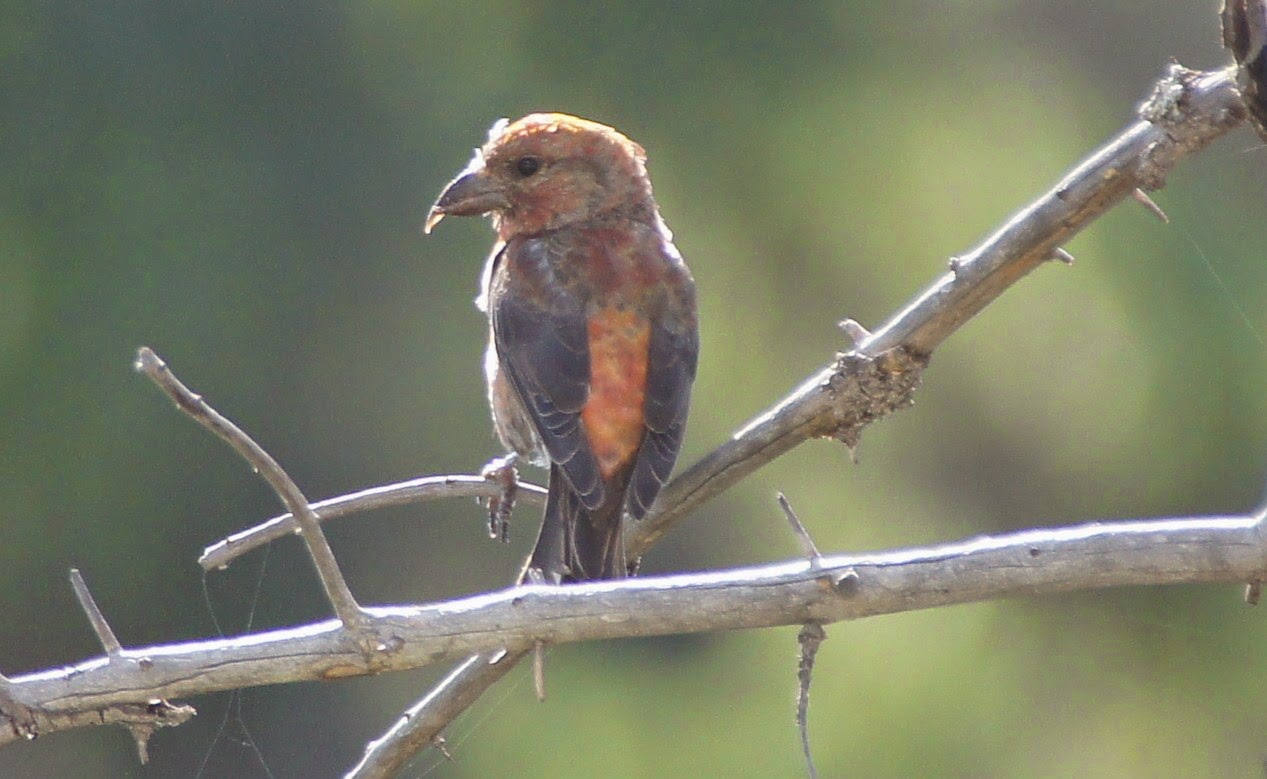
The Crossbills would even fly under the bridge too, for some reason that I wasn't able to figure out. There was probably a food source, which was tucked in underneath the base of the bridge, still above normal ground level. Although I wasn't able to photograph it, I had one sequence where the Red Crossbills perched on the bridge. This species obviously gets it's name from the overlapping tips of their mandibles. The overlapping tips help this species feed, which they do so by sticking their mandibles into conifer cones, and than forcing the scales of the cones apart while the tongue scoops the small seeds into their mouth. There are many different Red Crossbill subspecies, and many ornithologists consider these to all be separate species. If they were ever split, what an identification mystery it would be! Detective glasses on, everyone..


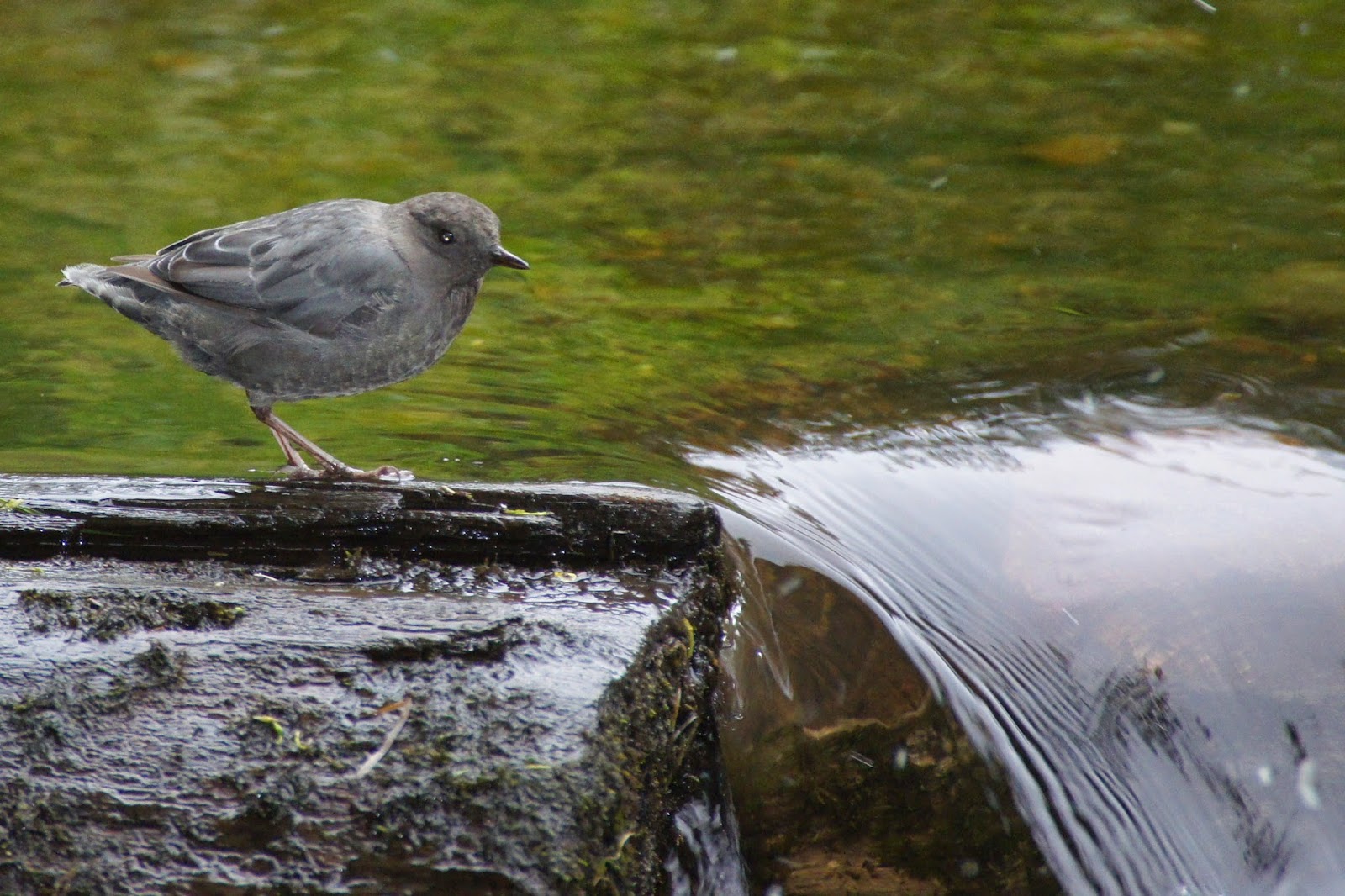
The beginning stretches of the Little Colorado River here at Sheep's Crossing has also been dynamite in recent years for North America's only aquatic songbird, the American Dipper. This bird is somewhere in my Top 10 favorite birds list. To have a songbird (who is quite the songbird at that!) who swims underwater and is only tied to healthy rivers, gosh, that is very cool! The Dipper feeds on aquatic insects, and it uses it's wings to forage underwater. It has even been seen walking on the bottom of rivers while foraging underwater.
To find an American Dipper, one has to walk along the river, looking up or down the river. The Dipper may be perched on a rock or log over the river, or it may be hiding underneath a big bush. Once it's seen, it is usually approachable.
And who wouldn't like watching the American Dipper? I had one lady ask me, "What kind of bird is that?". I explained it to her, and she was amazed by it. When my sister Tiffany fishes, the Dipper often joins her. While Tiffany fishes, the Dipper looks for bugs and other aquatic prey.
The American Dipper has quite the personality, and it bobs up-and-down as a wren would. I've seen numerous hikers and fisherman along the Mount Baldy area stop, laugh, and enjoy the Dipper. It is a very local species in Arizona, and as I mentioned in my earlier post, it is part of the "White Mountain Big Five". Arizona birders actively search for this bird whenever they come up here, making it one of the most sought after White Mountain species.
The Osprey also hung out near the beginning stretches of the area. This majestic fish eating raptor thrilled dozens of fishers and hikers while I was on my trip. While the Osprey seems to be more numerous in open reservoirs, they will sometimes reside along rivers too. And the Little Colorado River here was wide and open in some places, making it an ideal place for the Osprey, or "Fish Hawk".
I also didn't have to walk very far away to come upon a family of Green-tailed Towhees. A young Towhee was very curious most of the time that I observed this family during the course of my time up here.
At times I observed the mother Green-tailed Towhee working hard for her youngster. Although this next picture is blurry, it does show a bee she caught with Towhee Jr. being about ready to devour it's food source.
One one morning, I was hiking with my Dad and brother Tyler on the East Baldy #95 Trail. We hadn't hiked this trail in a long time, and we hiked about three miles of it. Just like the West Baldy #94 Trail, the East Trail is also very scenic and beautiful.

A Gray Jay caught my eye. I followed a small flock of three of these Jays around once I caught sight of the first one. The Gray Jay is another highly sought after bird by Arizona birders, and it too, is part of the "White Mountain Big Five". In the White Mountains, the Gray Jay is another local species. The White Mountains are at the southern end of the Gray Jay's range, and I encountered quite a few of them during the course of the trip. The Gray Jay is a very hardy wilderness species, but is yet very tame towards humans also. It can imitate the Northern Goshawk's vocals with perfection, which amazes me. Despite the fact they act tame, they also move around pretty quickly. Throughout the trip, I had a very hard time getting good photographs of this bird.

Sometimes when I was hiking with my family, we would see other wildlife that was cool. My Mom is into photographing butterflies, and the Baldy Wilderness area is filled with open meadows and wildflowers that butterflies and more certainly favor. I spent about an hour one day with her as she did this. I found this Hummingbird Moth to be super cool.
And of course the many butterflies were very cool too!
Yeah, yeah, yeah, the good old Mount Baldy Wilderness. You've gotta love it just by reading about it if you haven't been there yet. While this post so far has been from shorter hikes, I was then craving a huge wilderness birding expedition. The type of birding that I live for! And that is when July 31st, 2014 came around. My parents and I planned on hiking all of the Mount Baldy Wilderness. My heart raced just by thinking about it.
Rain is always an issue at this time of year. With active monsoons, you never know when that pour down shower is going to drench you. That was our main concern when it came to hiking through the entire Mount Baldy Wilderness area. It started off as a family hike on the 31st for the first few miles, and then my Mom, Dad, and I would proceed for the remainder of the huge hike once Tyler, Tiffany, Talia, and our dog Honey were going to turn around.

And how were we going to do this hike? Well it would have to be with Tiffany's help. We parked at the Sheep's Crossing base of the West Baldy # 94 Trail, and were planning to hike way up to the ending point of that trail, just below Baldy Peak at the elevation of more than 11,000 feet. Once reaching that point, we would access the East Baldy Trail # 94, which would take us back down through the east side of the Baldy Wilderness. Each trail is about 7.5 miles in length, so we had a 15 mile hike and some change ahead of us. Tiffany was planning to either pick us up at the East Baldy Trailhead at a certain time or she would just get my Mom's truck keys and drive it over to the Trail head and just leave it there for us. We had a tiring and long task ahead of us, but I was stoked. My wilderness birding brains were jumping out of my head. As Mom, Dad, and I came up on a meadow, I looked out and saw an adult Northern Goshawk in all of it's glory flying across the meadow and into a stand of firs. Although the look was distant, my parents got to see it too. Cool beans! My third Northern Goshawk of the trip. And before I knew it, we were getting deep up into the trail. With the skies looking decent, I knew my wish of conquering this area with my parents was going to come true. This proved to be the case when the Clark's Nutcracker sounded off his alarm.

As we were going at a good pace, my Mom turned around and said, "Tommy, if you see a good bird, don't hesitate about trying to see it and get pictures of it. Your good at catching up to us pretty quickly". Gee, thanks Mom! And that really helped when I heard a couple of Pine Grosbeaks calling about 4.5 miles up the trail and into our hike! Pine Grosbeaks......what!? After getting this Arizona rarity on the first day of my trip, I was even more stoked to find my own Pine Grosbeaks on my favorite trail. In the past, they have been found in this area, but still, very rarely. As I made my way in the directions of the sounds, I stumbled upon a female Pine Grosbeak in front of me at a very close distance. She was actively foraging for food, and she was on the ground and below my eye level. I had several chances to get good photographs of her, but I blew it. At least you can "tell" what it is, right?

The Pine Grosbeak flew lower into the forest, which was on a very steep slope I couldn't get down to. I heard more Pine Grosbeaks calling, but I didn't manage to get any better documentation photos. It was disappointing on the photo part, but inwardly I was stoked that I found these birds. As I watched the female, I could see her associating with another female-type Pine Grosbeak before they flew back lower into the forest and out of my sight. They stopped calling too. As I continued down the trail for just over a quarter-mile, I looked up and saw....
Two more Pine Grosbeaks! This was a male and female pair. With the first sighting of the Grosbeaks, I detected 2-3 birds, and with these two, it gave me a count of at least four, probably five. I was stoked. These Pine Grosbeaks were high above me near the dead tree top, and I climbed up a slope a little ways to try and get more eye level with the male.
These Pine Grosbeaks moved on right when I got to a very good vantage point. But after they left, I thought I would have more further up on the Baldy since I was having them at the 4.5 mile area. If they were this low, wouldn't they be more likely up further in elevation? I guess I would find out.
A Red-faced Warbler also made a nice appearance.
At this point, I had gotten pretty far behind my parents. I hiked extra fast to catch up to them. Of course, I was also still listening for more Pine Grosbeaks. We were now up and away from the river and open meadows during the first stretch of the West Baldy Trail, and into the thick timber and mixed spruce and fir forest.
As I was catching up to my parents (confirmed by echoing voices), I was thinking, "I bet Pine Grosbeaks are breeding up here". I hoped that I would find evidence, somehow. Regardless, I was thankful with the count I had of the birds. And looking around, I couldn't help but be amazed of God's incredible creation wherever I turned my head. Before I knew it, I caught up to my parents. They were sure enjoying every second of the hike, just like I was!
We were up high now. Before we knew it, we were near the summit area of Mount Baldy, and were almost to the point where we access the East Baldy Trail. I swear, I felt like we were in Colorado or Canada, certainly not in Arizona.

Once we crossed over to the East Baldy Trail while we were just under Baldy Peak at 11,400 feet, we stopped to eat lunch before starting our second half of the long trek. A few Gray Jays came by at this point. I thought I caught a glimpse of another Pine Grosbeak, but my look was brief. It certainly gave the right appeal though. While I expected Pine Grosbeaks to be up this high if they were going to be around rather than where I had them, it turned out to be the other way around completely. After finding the Pine Grosbeaks I did earlier, I didn't see or confirm anymore after that. However, I did think I also heard a call note from a Pine Grosbeak while we were eating. There was a breeze blowing through, which made it hard for me to be sure. With a possible sighting and possible heard only, could that add up to a bird? No, but nice try.


After eating lunch in the Baldy heights, we confirmed with Tiffany to have Mom's truck being dropped off at the East Baldy Trailhead. And now, we had over seven miles left of the East Baldy Trail to do down after hiking for over seven miles on the way up the West Baldy. I was stoked to see the duration of the East Baldy Trail and to hike through it. Before this day, I had only completed this trail once when I was a little kid. I couldn't remember it very well, but I did remember that the East Baldy Trail has a different look in scenery when compared to the West Baldy Trail. Both trails have incredible scenery, I don't know how to pick a favorite. Things started off very good as we switched over to the East Baldy Trail. My parents were shortly ahead of me when they said, "Hey Tommy, what are these? Are these chickens?" Right away, I knew what they were talking about and I made my way over to my parents as fast as I could. When I got there, they said, "There were just a few baby chicken-like birds right there, and their Mom is sitting right up on that log!". I looked on the log, and....

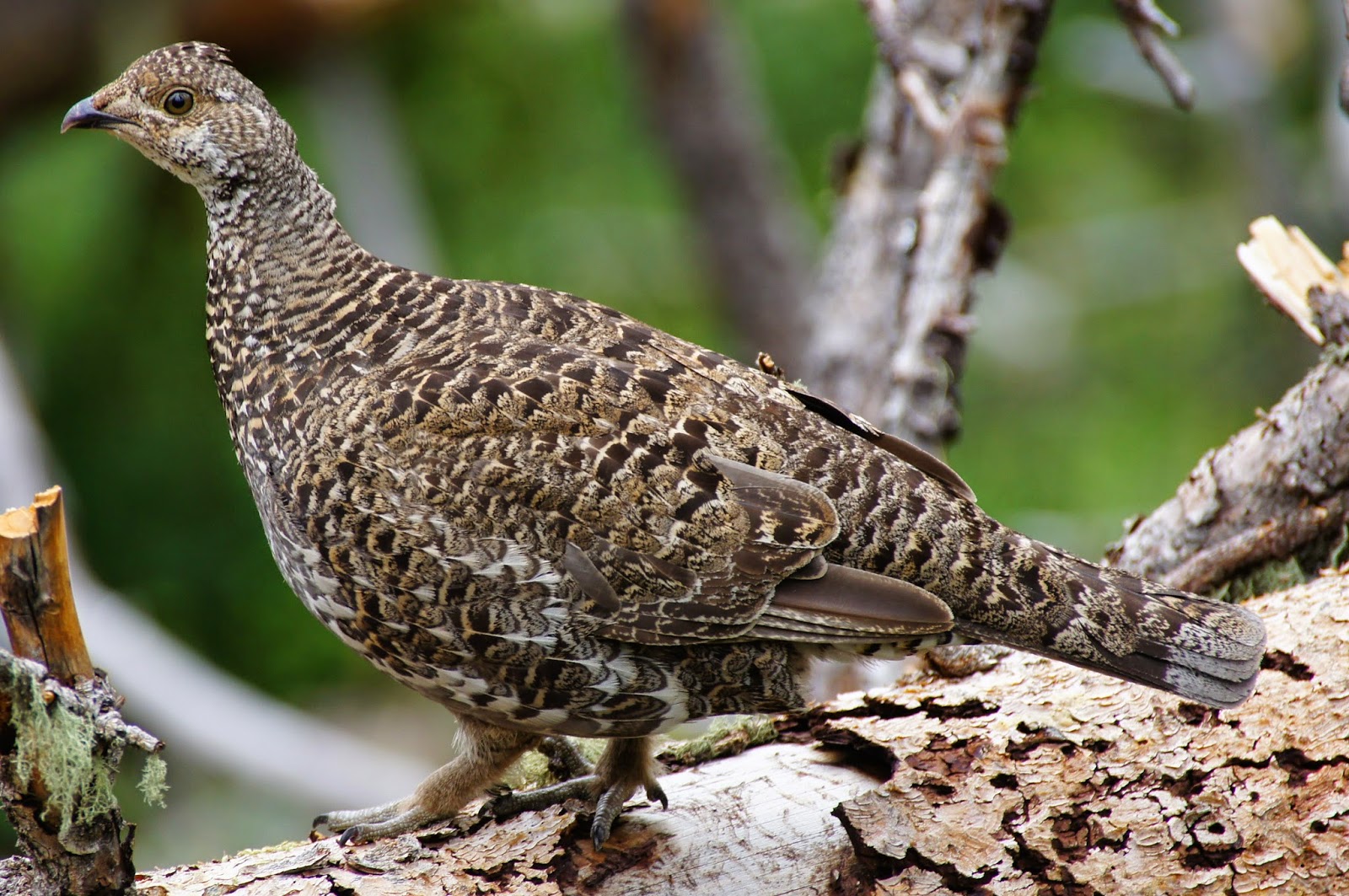
There it was! My first visual of a Dusky Grouse in over two years! I was very pumped up at the sight of this bird. The two young grouse walked low through the thick vegetation, while this adult female kept a close eye on them. She stayed on the log in plain view for us for several awesome minutes.
The Dusky Grouse is of course a member of the "White Mountain Big Five". It is another highly sought after bird by birders who are visiting the White Mountains. Although they are found in a few places elsewhere in Arizona, the White Mountain region is the best place to find them. Dusky Grouse are elusive and are hard to find. They have great camouflage and can hide very well. Once discovered, they usually act surprisingly tame. I have had some good luck with this species up here in the past, and I was happy to have more luck on this hike.


With the Dusky Grouse sighting, I had now completed my "White Mountain Big Five" search for the trip. I was stoked. Those five awesome and local birds, American Dipper, American Three-toed Woodpecker, Gray Jay, Dusky Grouse, and Pine Grosbeak, are what birders come up to the White Mountains for in hope of awesome sightings. I've been very fortunate. I thought to myself, "Boy, it would be hard to find all of them in one day, and the chances of that are probably very slim".
Up next, we came upon an awesome open area with bright blue wildflowers. It was one of the coolest sections of the trek. I'm sure my Mom got some very good pictures of it too!
Many highlights continued to come. Up next was a section of broken forest, and I was hearing a call note that I knew needed investigation. It turned out to be a White-crowned Sparrow, who had several juvenile birds around it. This was a new White Mountain bird for me. White-crowned Sparrows breed in two areas in all of Arizona, here near Baldy Peak and the Humphrey's Peak area near Flagstaff. They like very high elevations near the treeline. While Mount Baldy has very little tundra habitat, the San Francisco Mountains in Flagstaff has a decent amount.
The East Baldy Trail proved to have good birds along it too, just like the West Baldy Trail. I continued to encounter more birds, including this young Townsend's Solitaire, more Gray Jays, and two American Three-toed Woodpeckers.
And of course, here are some awesome scenes from the East Baldy Trail, as we made our way down!
A long time later but also at the same time before we knew it, we were coming close to the end of our long journey and loop hike. We even found a Prairie Falcon near a rocky area, a White Mountain first for me. It was a great time to be out hiking and enjoying the wilderness. I really enjoyed the day with my awesome parents. My Mom loves to celebrate things, and she made an awesome picture effort to celebrate the Mount Baldy Wilderness trek.

After starting at 7:30 A.M. that day on July 31st, we arrived back to the trailhead at almost 4 P.M. We could've been back to the trailhead much earlier, but with the many things to see and pictures to take and just enjoying the Mount Baldy Wilderness in general, we needed to take our time. The day resulted in over 15 miles of hiking, and we were tired. We also ate very well and slept very well that night. The following day, we returned to the Mount Baldy area again as a family to do a shorter hike. What a shocker. Thanks to my parents, Tom and Catherine DeBardeleben, for making this Expedition possible. Here are a few more pictures, courtesy of my Mom during our long hike:


This hike was the perfect "Wilderness Birding" Expedition that I could ask for. With over 15 miles of hiking and 40 species of birds logged down, it was an epic outing. 40 species is a good count for a location like this, but with species like Gray Jay, Clark's Nutcracker, Pine Grosbeak, Northern Goshawk, Dusky Grouse, American Three-toed Woodpecker, Prairie Falcon, White-crowned Sparrow, and more made for a great and exciting outing. I had one empty space still lurking inside of me and questioning my Pine Grosbeak sighting. I had the gut feeling they were breeding up here, and I wanted to study them further. With a few days left on our trip after this day, I didn't know what I was going to do as far as the Pine Grosbeaks were concerned. Our family day was the next day, and I had Greenlee County to explore (see previous post) on our last full day. I was bound to do another Pine Grosbeak search, somehow, and someway. Stay tuned to find out. This is now the fifth post I've made for this trip. We are now halfway through. There are five more posts coming. As for this post, conquering the Mount Baldy Wilderness Area was something I was very happy with. On top of that, I saw great birds, great scenery, and got to hang out with my parents. What a great combination. To close out the post, here is the conquering photo. I did it!