Showing posts with label Blue-headed Vireo. Show all posts

Friday, January 6, 2023

2 Days of Pima County Birding

 On January 5th and 6th, my first two days off of work for 2023, I decided to do some county birding and the county I chose was Pima.  In the past, I haven't really focused on county birding in any of the southeastern Arizona counties, and looking at what has been seen in Pima as of late, I knew I had a chance to get a lot of birds.  A nice selection of rarities are present in the county such as Black-throated Blue Warbler, Blue-headed Vireo, irruption species like Evening Grosbeak and Cassin's Finch, and the potential in a state first for me in Common Grackle.  There was also a selection of easier species I still needed for Pima County, and Great Blue Heron was one of them.  Going into the two days my list for Pima County started off at 262 species, and I was stoked to bird and go for some county birding.  Day 1's plan was to meet up with Ronnie Reed to chase birds around Tucson, and Day 2 was to bird with Caleb Strand and Scott Bradley.


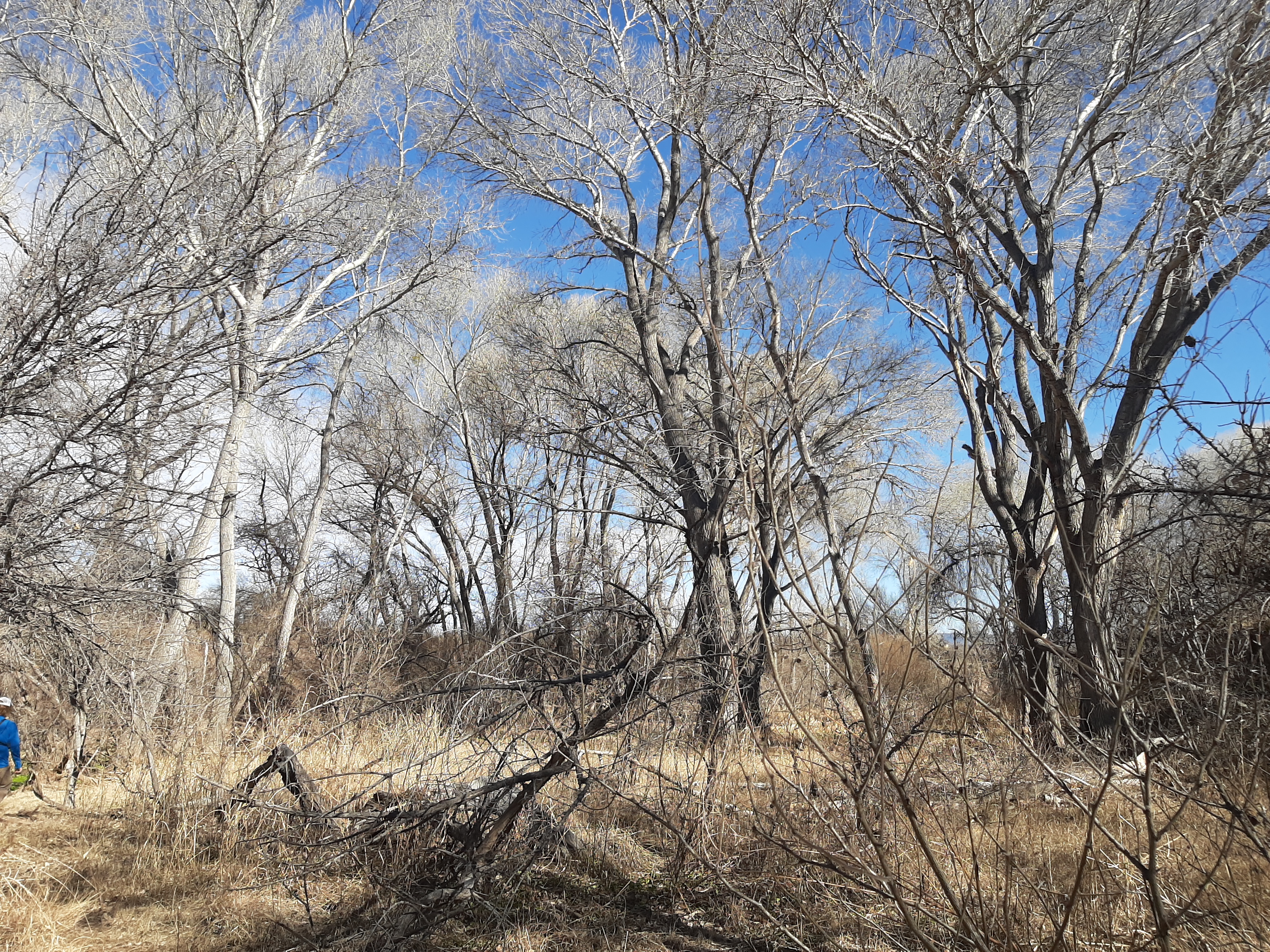
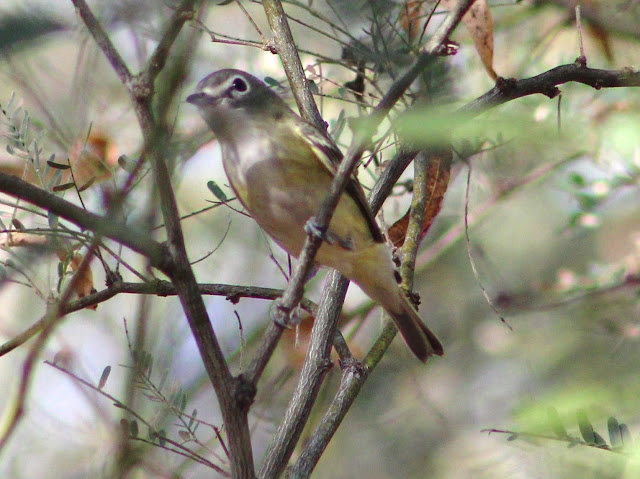
January 5th's first stop was along the Santa Cruz River at Crossroads at Silverbell District Park, which has good habitat variety that includes productive riparian stands along the river.  Ronnie and I started right around 7:30, and we were targeting a Blue-headed Vireo that was found by Caleb Strand a week ago and has been continuing for many birders.  The vireo was hard to find at first, but my Pima first Great Blue Heron made an appearance.  Can't believe it took 262 birds in this county before I got a Great Blue Heron!  Among 35 species total, a Indigo Bunting was a surprise and Red Crossbills flew overhead.  It took awhile, but a vireo scold got us on a vireo I thought was a Cassin's Vireo for awhile until reviewing photos after the time in the field revealed that it was the Blue-headed Vireo.  A 2.5 hour search that I thought was empty for the main target was thankfully productive.  In the field, Ronnie had more of a correct suspicion on the bird than I did.  After Silverbell, we made a quick stop at Arthur Park Regional Park where Double-crested Cormorant and Common Merganser were two more Pima lifers for me.


Great Blue Heron

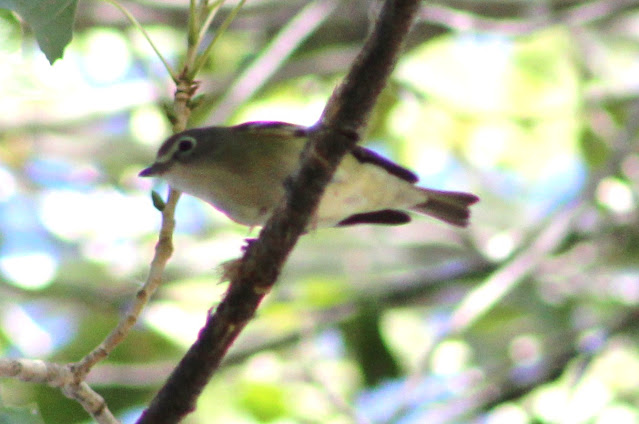
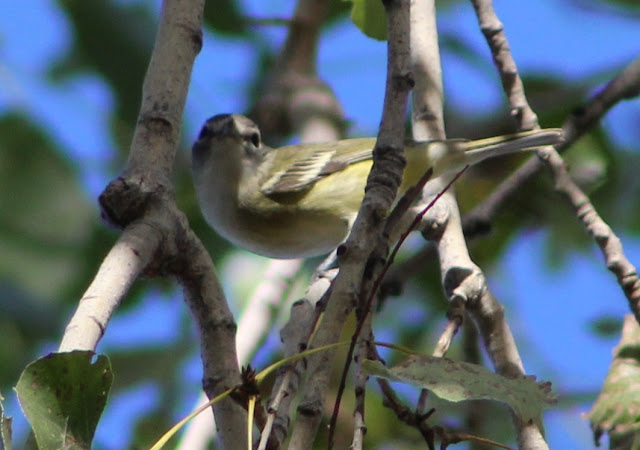
The Blue-headed Vireo


Indigo Bunting

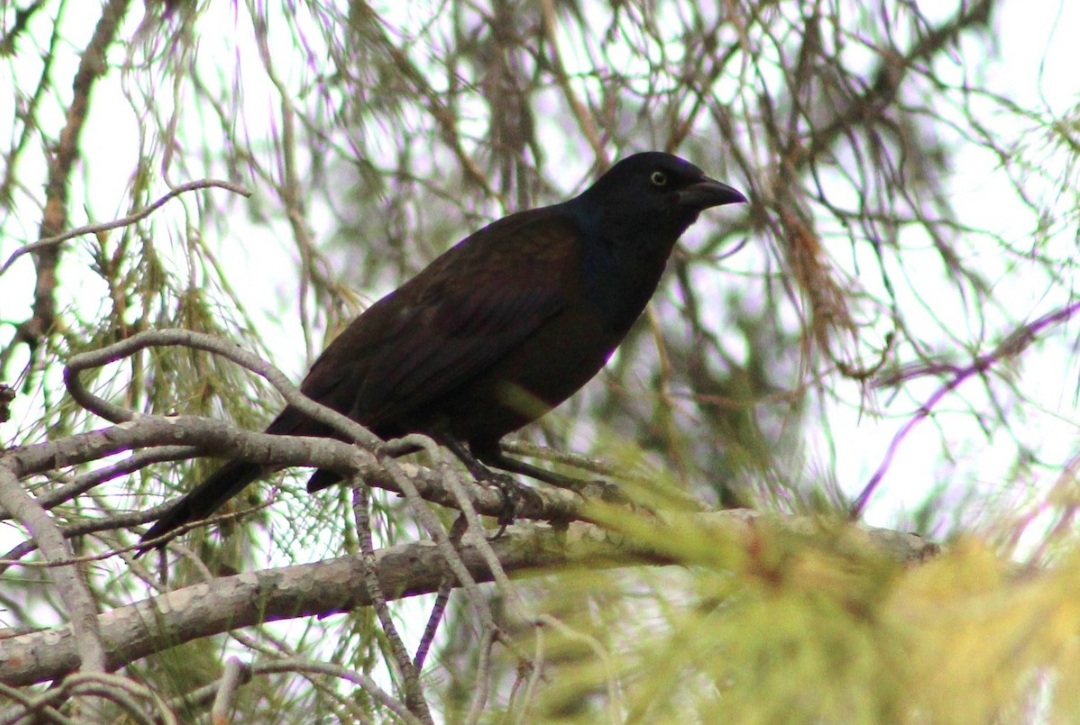
At 11:30 we arrived at Woodland Road in east Tucson to search for the biggest target of the day, which was Common Grackle.  A Common Grackle has been here among many birds, and Woodland Road has a lot of farming properties that feature good habitats to attract a variety of birds.  In the past, Bay-breasted Warbler, Arizona Woodpecker, and Yellow-eyed Junco have been some of the interesting birds that have shown up.  For me, the Common Grackle would be an Arizona first and for Ronnie it would be a lifer.  When we arrived we had some fortune when we saw an adult male Yellow-bellied Sapsucker flying around in the trees, a Pima bird for me and one that has been around for some time.  We visited with Mark Stevenson, Alexis Stark, and Jake Thompson for some time and we all searched for the bird.  Approaching two hours, after Mark had just left and Ronnie and I were heading out to chase a nearby Black-throated Blue Warbler, Alexis found the bird in an epic "buzzer-beating" way.  The Grackle sat up in a pine tree close to the road before going down into a grassy yard to feed among Great-tailed Grackles.  My cousin Alexis has an eagle eye!  The Common Grackle became my 487th bird for Arizona, and the trip was already made. 

Vermilion Flycatcher

The Common Grackle!  My 1st for AZ!


 After Woodland Road, we ventured to Ventana Canyon, where a male Black-throated Blue Warbler has been present all winter and has been coming into a mesquite tree to feed amidst thick vegetation.  It didn't take long for it to come in for us, and in over an hour it came in four times.  Jake and Alexis joined us here for some of the time too, as well as Harriet Marble.  It was cool to meet Harriet (who was also looking for the Blue-headed Vireo when we were), as she found Arizona's first American Woodcock and it was neat to hear her story about finding it.  Ronnie and I both had a chance to get great pictures of the Black-throated Blue, but we were a second late and the otherwise skittish and quick-moving bird wasn't hard to see but it was difficult to photograph well.

Black-throated Blue Warbler

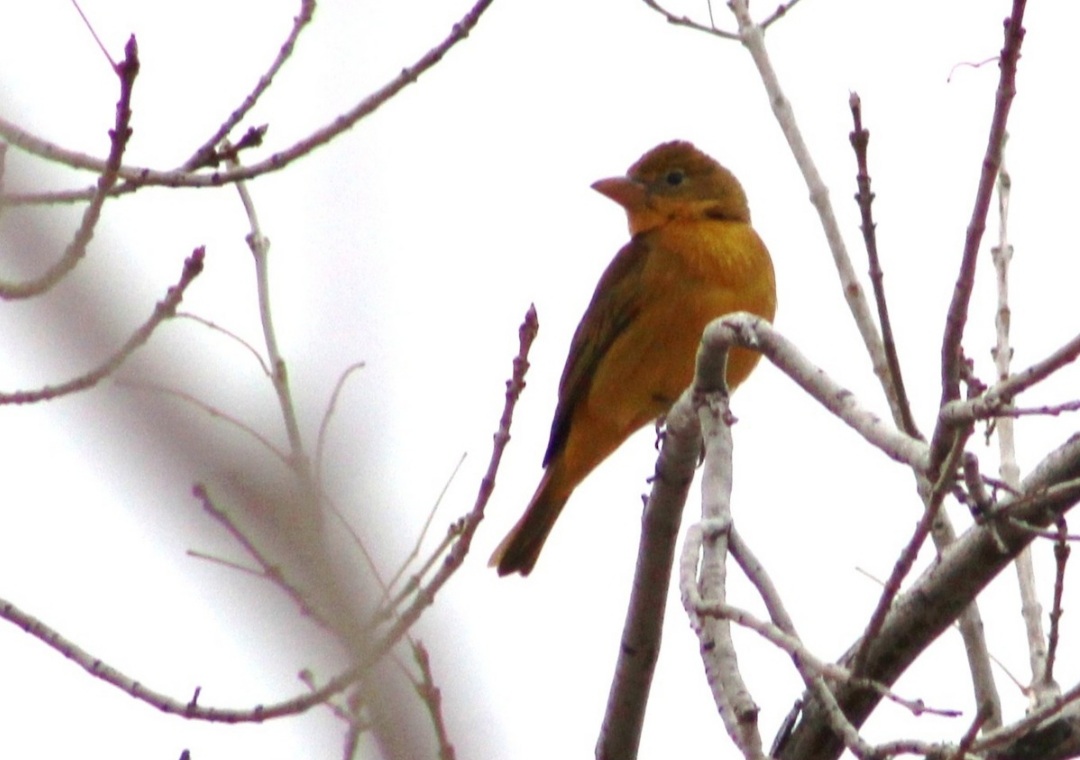
Toward the end of the day, we went to Lakeside Park and Reid Park to target more species.  Lakeside targets were a resident Snow Goose as well as an Osprey, where the raptor was elsewhere and the resident was reliable as usual.  At Reid Park our targets were Wood Duck and a Lewis's Woodpecker, each of which were at opposite ends of the park.  Aside from targets, Reid was full of birds and it was impressive to see irruptive species such as high numbers of American Robin and Cedar Waxwing.  A wintering Summer Tanager that's been present also showed for us.  The Lewis's was nowhere to be found for us, but we got to see two drake Wood Ducks that were in the ponds and they were a fun Pima lifer.  Another Pima lifer for me came from this park when two Peregrine Falcons made a pass overhead.  From there Ronnie went back to Phoenix and I hung out with Caleb and Scott in Tucson.  We had a plan to bird Pima on the 6th and planned to visit Redington Pass east of town as well as Las Cienegas Conservation Area.


Snow Goose 

Wood Duck


Neotropic Cormorant

American Robins

Summer Tanager

On January 6th, Caleb, Scott, and I headed east of Tucson and went into the mountains up to the chaparral and juniper habitat in the 4-5,000' range along Redington Road to Redington Pass.  This was to be a fun trek, and personally, I had 5 targets that would all be Pima lifers (and add these are fun birds anytime, anywhere):  Evening Grosbeak, Cassin's Finch, Woodhouse's Scrub Jay, Juniper Titmouse, and Sage Thrasher.  The road up to the pass was a bit rough but is doable for most vehicles.  For Caleb's Exterra, it was easy.  We made a few stops along the way as we went toward the 12 mile of the road, where most of the Evening Grosbeak action (as well as the others) has been.  American Robins and Townsend's Solitaires were very common everywhere, and it didn't take us long along our stops to get Juniper Titmouse, Woodhouse's Scrub-Jay, and Cassin's Finch.  As we were at mile 11.7/11.8, things got really fun when a flock of 30 Evening Grosbeaks flew to the road right adjacent to us, and then they were joined by 15 more.  This species is freaking awesome, and we watched them for some time.  I went off the road and got close to them and had the best looks and photos I've ever had of the species.  They ate berries off of the junipers in front of me, and both males and females gave me a show.  On the way down, we got the last target for Redington, a Sage Thrasher.  And Redington Pass area, what an awesome place with lots of cool scenery.

Juniper Titmouse

Townsend's Solitaire

Cassin's Finches


American Robin

Remarkable Evening Grosbeak flock


Sage Thrasher

Black-throated Sparrow


After coming down Redington Road, we stopped at Woodland Road to get Common Grackle for Caleb's Pima County list.

From Tucson we headed south to Las Cienegas Conservation Area, which has awesome grasslands and riparian habitat.  The area is in both Pima and Santa Cruz Counties, and we stuck to Pima for our birding in the northern section of the area.  Our first stop was at a productive area in the northern reach of Las Cienegas, and we had 30 species in 30 minutes as the clock reached past noon.  My Pima first Western Screech-Owl replied to Caleb's whistling as he attempted to bring birds in.  Up to 10 Soras were in a nearby marsh as well as a few Virginia Rails.  Lingering Gray Hawks were also present.  We then ventured to Empire Gulch, an area I've been to once previously in the past (I was looking for Malachite Darner here while looking for odes in summer of 2018).  A Winter Wren has been present here, and after a short wait it became another addition to my Pima list.  It's Song Sparrow-like double-note calls are always distinctive, and we had a few looks at the wren.  After riparian areas we decided to walk 2 miles through grassland habitat in hopes of getting Baird's Sparrow, longspurs, and more.  Nolan Walker joined us too.  Sadly it wasn't productive for much, but I was still happy to get my first Chihuahuan Meadowlarks for Pima County.  The only sparrows seen were singles each of Savannah and Vesper.  Raptors were present in high numbers though.  Caleb tallied 15 Red-tailed Hawks and 14 Northern Harriers.  When we got back to where we parked, we scanned for raptors for awhile and Cathy Beck also joined us for the scan as she and Nolan were going to search for Short-eared Owls later in the day.  While we scanned, Caleb spotted a White-tailed Kite, always a great bird and what was another addition to my Pima birding. 


Caleb and Scott at Las Cienegas 


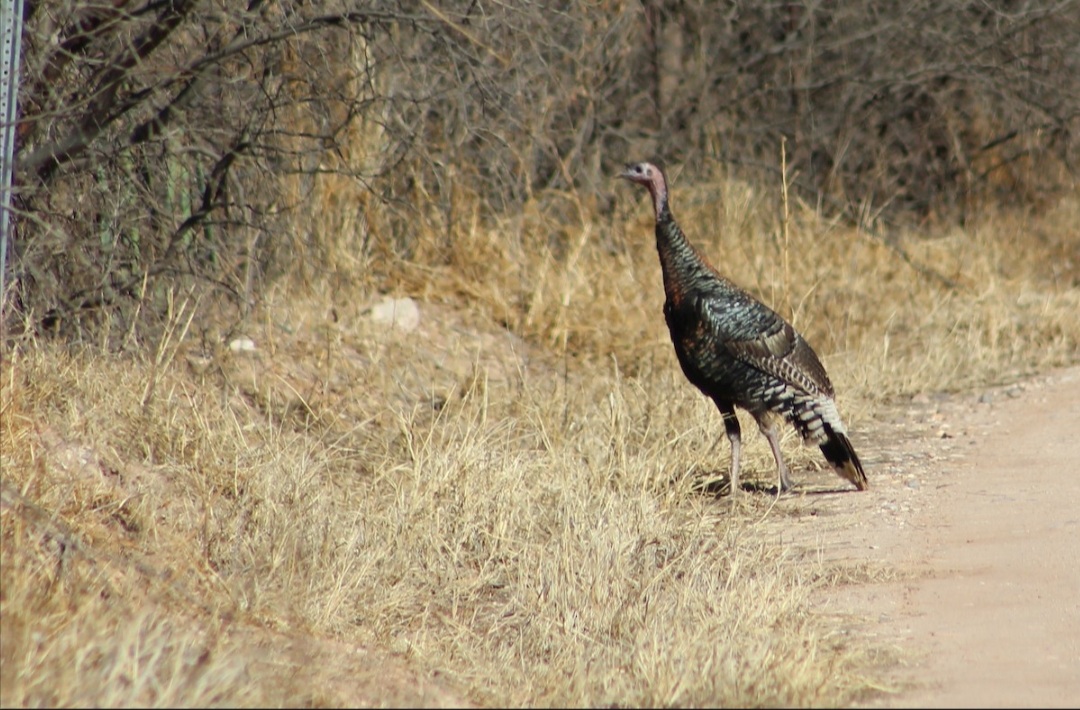
Wild Turkey Las Cienegas

Once back into Tucson, Caleb, Scott, and I stopped at Reid Park quickly as it was right on the way back.  It was another quick shot at the Lewis's Woodpecker.  Caleb was impressed at the high numbers of Yellow-rumped Warblers, American Robins, and Cedar Waxwings.  The woodpecker appeared to be a no-show again, but right as we were leaving I scanned the neighborhood to the north of Reid to see the Woodpecker there on a telephone pole!  It was a great way to end the two days.  Thanks to Caleb, Scott, and Ronnie for 2 great days of birding.

Lewis's Woodpecker

Vermilion Flycatcher is Pima County's logo bird


For some facts on the 2 days, January 5th and 6th:

-In total I got to see/hear 111 species in Pima County for the 2 days.

-I got a total of 20 Pima lifers, and I went from 262 species to 282 species.  The 20 birds in order of sightings went:  Great Blue Heron, Blue-headed Vireo, Double-crested Cormorant, Common Merganser, Yellow-bellied Sapsucker, Common Grackle, Black-throated Blue Warbler, Snow Goose, Peregrine Falcon, Wood Duck, Juniper Titmouse, Cassin's Finch, Woodhouse's Scrub-Jay, Evening Grosbeak, Sage Thrasher, Western Screech-Owl, Winter Wren, Chihuahuan Meadowlark, White-tailed Kite, Lewis's Woodpecker.

Monday, November 29, 2021

Maricopa County: A Blue-headed Vireo

 On November 19th, I decided to go birding at the Lower Verde River to explore a stretch of the river I don't know much about.  This location lies south of the Box Bar Recreation Area and Rio Verde Ranch, and there is a lot to explore here.  By following Box Bar Road south past the turnoff to the actual recreation site, it leads to a dead end and a parking area.  From here, several trails and a wash head east to the Verde River.  It isn't a developed recreation site like the Box Bar and Needle Rock Recreation Sites just to the north.  In similar ways to those spots, it has impressive stands of cottonwood and willow riparian.  Adrian Smith told me about the spot on October 23rd when I ran into him at Box Bar, and we went over to this "new" area he had explored some of a few times.  I was impressed from what I saw in the field in the short distance we explored and from the looks of things while viewing the area on Google Maps.  It was high on my birding "to do" list, and after a long birding trip to southeastern Arizona on November 18th (will be mentioned in a future blog post), I decided to do something somewhat close to home.

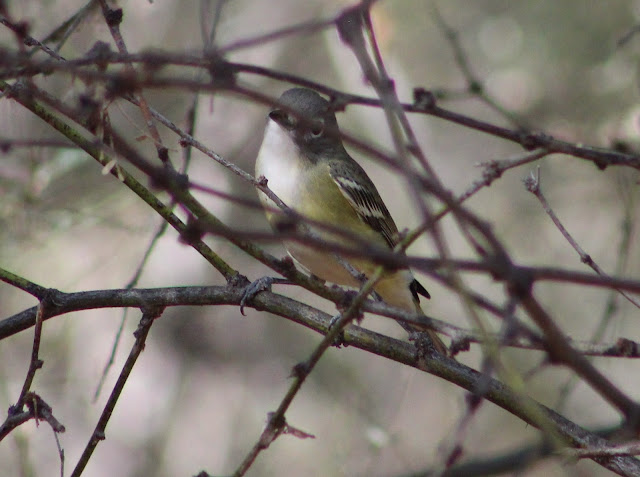
The time in the field was awesome at this new place and the habitat is great.  I slowly worked the riparian stands, which are about a mile in length once hiking to the river from the parking lot.  Birds were everywhere and numerous, and when I got to the southern part of my route, there was a thick cottonwood, willow, and tamarisk stand that was close to the river and then ended up going right up to the river.  When I got to it I heard a big mixed flock of birds, with the most abundant being Yellow-rumped Warblers.  However, as I started to scan the first warbler I found was a Chestnut-sided Warbler.  At about 9:30, a bright vireo caught my attention.  I snapped pictures and it didn't take me long to wonder if it was a Blue-headed Vireo candidate with how bright it was.  A dark head that contrasted with a white throat, contrasty white spectacles with the dark head, bright white underneath with lots of greenish yellow on the flanks and vent.  While pictures gave off a greenish-yellow, the bird was more in the yellowish category by the looks I had in the field. I took these pictures from 9:33-9:54 A.M., according to the time on my camera. 


After talking to Caleb, he felt the vireo looked very interesting and was leaning toward Blue-headed.  But I needed better shots for sure, as Blue-headed and bright Cassin's Vireos can be indistinguishable.  I kept trying and eventually got back on the vireo.  This time my looks were closer and better.  From 11:02 to 11:09 A.M., I shot these following photos of the bird.


At times when the bird was in better lighting and close to me, I looked at it with my binoculars aside from taking photos.  I've never seen a more constrasty vireo in my time of birding in Arizona.  It's dark head really constrasted sharply with it's back and white throat and undertail coverts, as well as it's flanks that were more lemon yellow as well as having a slight hint of a greenish tinge at times too.  Caleb and others felt that it was a Blue-headed Vireo after looking at a few of the second set of pictures I was able to attain.

Vagrant Blue-headed Vireos in the west as well as vagrant Cassin's Vireos in the east pose major identification challenges much of the time.  A bright Cassin's Vireo can look very similar to a Blue-headed Vireo, and some of them have to be UN-identified.  It usually boils down to looking at a bunch of features.  I read a great article online about Blue-headed VS Cassin's Vireos written by Andy Birch.  As I studied his article, among the features my bird does have are:  A very dark bluish/gray head area that contrasts greatly with white spectacles around the eye.  The head area also constrasts sharply with the throat area, and as well with a lot of white on it's underparts.  Yellow flanks and vent area is also good for BHVI, which my bird shows much of the time.  At times, it appears to show a greenish tinge to the flanks too.  Another aspect is lore contrast with the head color.  If the lore appears to contrast and look much darker than the rest of the head, it tends to be more of a Cassin's trait.  On this bird the head is so dark that it doesn't contrast with the lores.  Another good mark is the contrast of the dark head along with the greenish back, which this bird shows.

This record has been sent to the Arizona Bird Committee, who will make the decision on whether the record will be accepted or not.  Hopefully it will be, but a conservative approach has to be done with this species due to such similarity with bright Cassin's Vireos.  There haven't been many accepted records of Blue-headed Vireo in Arizona, I believe there have been 5 or 6.  There have been suggestive birds that haven't been accepted as well.  

On the other hand, many others have chased this bird after my discovery, which is awesome.  Not only are more eyes on the bird for more documentation that may show traits I haven't captured, but this new spot is now getting a lot of attention.  

Chris McCreedy, Ronnie Reed, Adam Stein, Jeff Ladderud, and Roy Jones were among those who photographed the bird further and had photos to show the features of the bird well.

Jake Thompson and Anne Leight got audio recordings that are posted on eBird, and I eventually got audio too when I went back on November 26th.  

When I went on the 26th I wasn't able to see the vireo even though I got recordings, but Chris, Cathy Beck, and Janine McCabe were able to get eyes on it and McCreedy got solid photographs.

McCreedy also talked with Andy Birch, who wrote the excellent blog about Blue-headed and Cassin's Vireo identification.  He sent Andy my pictures and his pictures of this Blue-headed Vireo, and Andy said he was ok with it being called a Blue-headed Vireo.

McCreedy also talked with Nathan Pieplow, who is an expert at bird sounds, about the recordings that were obtained.  Between Anne and Jake's recordings, Nathan got what was mostly a Blue-headed Vireo vibe.  In Jake's recording, some of the phrases of the song sounded a little like Cassin's Vireo in midst of what mostly sounded like the Blue-headed Vireo.  The recording wasn't great, and Nathan wasn't sure of what to make from some of the notes.  Luckily, when he listened to my recording he was able to conclude Blue-headed Vireo out of it, according to sound.  

This vireo has certainly been an interesting one to find and learn about.  In the past, I've encountered a few vireos at Hassayampa River Preserve that looked like Blue-headed Vireo candidates and I wasn't able to get close enough to them for any sort of good documentation.  Good thing I had the encounter I did with this one!