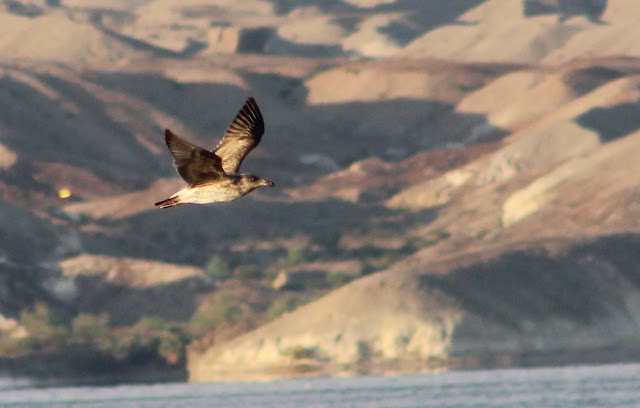
On September 10th, Keith Kamper was birding at the Lake Havasu area. When he got to the Windsor Beach site on the lake, he found an odd gull that turned out to be a mega rarity for Arizona, a Yellow-footed Gull. Contrary to the bird's name, the legs and feet of this bird change with maturity. Keith's bird was an immature, and it had pink legs and feet. A heavy bulbous bill on any gull in Arizona like Yellow-footed Gulls have indicate a rarity and also eliminate other rarities. Similar cousins are Western Gull and Lesser Black-backed Gull. A Western also has a big bill, but not as big as Yellow-footed. While Lesser Black-backed is similar plumage-wise, it's bill is much smaller. A whitish belly and pale rump observed pointed to Yellow-footed Gull, and the birding community made plans to make the trek to Lake Havasu to try and see Keith's outstanding discovery. Keith has had quite the lineup of great finds, and this one added more to the lineup. For Arizona, this was the 2nd record of Yellow-footed Gull, and the first was an adult near Page in April, 1999. For days, the Yellow-footed Gull was seen following Keith's discovery. Windsor Beach was it's usual haunt, and it would be present for hours at a time, it would be hit-or-miss, or birders would have to wait for hours at a time for it to fly in. It often sat on buoys. Most of the birders who made the chase got to see the bird. I wanted to see it too, but I wasn't able to chase it at first and I hoped it would stay put long enough for me to get a chance.
My pelagic birding trip was much more important to me, and I prioritized that. Luckily, the gull stayed put as many birders went and reports came in daily. On September 23rd, Ronnie Reed and I decided to chase the bird. It would Ronnie's second time of going Lake Havasu, as he saw the Yellow-footed Gull in the earlier days after it was first discovered. Ronnie really wanted to do some migrant birding for passerines, which I wanted to do too after what we would look for the Yellow-footed Gull. We hoped it would be present and wouldn't give a stakeout. After leaving Phoenix before 4 A.M., we arrived at Windsor Beach early. There were gulls on the beach, and out on Havasu. Luckily for us, it only took a few minutes. Ronnie looked out and spied the gull. We got to watch it for about an hour, and it gave us a variety of different views. It also acted like a typical gull in the parking lot. A fun bird to get for Arizona, thanks to Keith!
We then ran into Keith the rarity finder himself, Jeff Ritz, and Dara Vazquez at Windsor as we were about to go to Rotary Park in Lake Havasu City to search for migrants, and they joined us. Rotary Park was awesome, and it had a cast of migrants. We were always busy looking at something. Dara found a surprise in a Townsend's Solitaire, and Keith found another rarity in a Clay-colored Sparrow. Those were 2 of 5 Mohave County lifers I got at Rotary Park. Over the years, Rotary Park has hosted an incredible array of species.
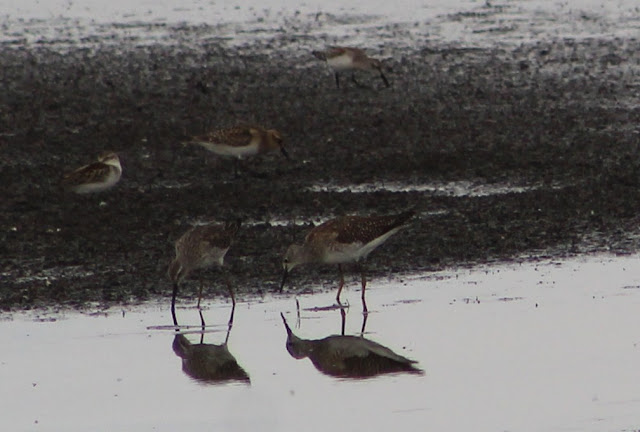
After leaving Lake Havasu City, we stopped at the Vicksburg Road Farms on the way back, one of my favorite locations in La Paz County. An assortment of shorebirds were present at a slop pond, including a few La Paz lifers in Stilt and Pectoral Sandpipers. Shorbs are always fun.
Another awesome birding day down in the books. It was great to get back into Mohave and La Paz Counties a little bit after focusing on them a lot earlier this year. Thanks Ronnie for the trip!
On June 2nd after leaving Michigan, I made another stop at Rock Lake State Natural Area in Wisconsin. That was the spot that Gretchen and I went birding at, the location where I tried to get good observations of Black-throated Blue Warblers without luck but also the location where I lifered on my first Yellow-bellied Flycatcher. I went back to try and see more of the warblers. The trip had become a warbler obsession. Who could blame me? They are freaking awesome. On this go around at Rock Lake, the weather was very overcast and there were small rain showers. I spent my last hour of birding time for the day at the location without getting a peep from any Black-throated Blues. The time was limited and I didn't see the overcast conditions improving, and I went back to Gretchen's cabin with some daylight left. I sat out on the dock of her cabin for about an hour, and enjoyed that Yellow River until bed time. For the day that was ahead of me, I'd have to leave the cabin early. I had what I considered to be a great adventure ahead.
My plan for June 3rd was a big big deal. It would involve the first of many Northerly Treks into one of my favorite states for birding and one of my favorite states in general, the great Minnesota. My buddy Josh Wallestad is from Minnesota, and he would join me for some of these expeditions in the days ahead. I would stay in the northern parts of Minnesota during these anticipated treks like I was doing for the whole trip, which is referred to as the boreal region. The word boreal refers to the cold, the north, and also a very cool owl, and a chickadee too. My main bird target of this day was the Cape May Warbler. If I could find a Cape May Warbler and hopefully get some photographs to go along with the memory, it would be a big big deal. After seeing Kirtland's Warblers for the first time and getting some photos, the only regularly occurring Wood Warbler/New World Warbler I would need for the ABA area would conclude with Cape May Warbler. While good fortune has been along with me with getting rare Mexican warblers in Arizona: Fan-tailed, Crescent-chested, and Rufous-capped Warblers, and Slate-throated Redstart, it helped boost my US warbler list to 54 species, and if I'd land a Cape May, I would have 55 out of a possible 56. The other one missing is the primarily-found-in-Texas Golden-crowned Warbler. Someday, that will hopefully be a chase that I'll attempt.
The day ahead of me was one that I planned out carefully. I looked at Cape May Warbler reports from last year on eBird, and I planned on birding in the area near the North Shore of Lake Superior. After waking up and leaving at 3 A.M., I headed northwest from Spooner, into Minnesota and through Duluth, and then north to Two Harbors. At Two Harbors, which is a good birding area, would be a road called County Road 2. The county that I entered into to bird this road is called Lake County, and it's an awesome county that birders love. Anyways, County Road 2 is a well-known road for getting most birds that are found in the boreal region forests. It goes for 53 miles until it reaches County Road 1, another well-known road with similar birds and habitats. I got to County Road 2 early, but not as early as I would've liked. The road branches off from Two Harbors and goes in a northwest direction, and as I drove up the road, I passed through an endless amount of forests that had beautiful spruce bogs in the midst. At first, I was going to drive up the road for it's 53 miles in search of my lifer Moose. These large and massive members of the deer family are found in northeastern Minnesota, and County Road 2 is talked about for a great bet to find Moose. As I read about the wildlife of the region, I also read that the area harbors good potential for seeing Gray Wolves. Although the potential is good, a sighting is still rare to have. Before the trip, Josh told me that Cape May Warblers really thrive during spruce budworm breakouts, and that they like two different types of tree: balsam fir and white spruce. I looked up the trees on Google and took screenshots, and noticed that the two trees looked pretty similar to one another. As I was going up County Road 2, I started to see stands of trees that held plenty of balsam fir and white spruce. I was trying to focus on my Moose search, but when I saw the Cape May Warbler habitat, I couldn't help but think, "I'll stop for a few minutes, listen, and move on while it's still early". And then I heard a Cape May Warbler singing when I rolled down the window. And just like that, my Moose search was over.
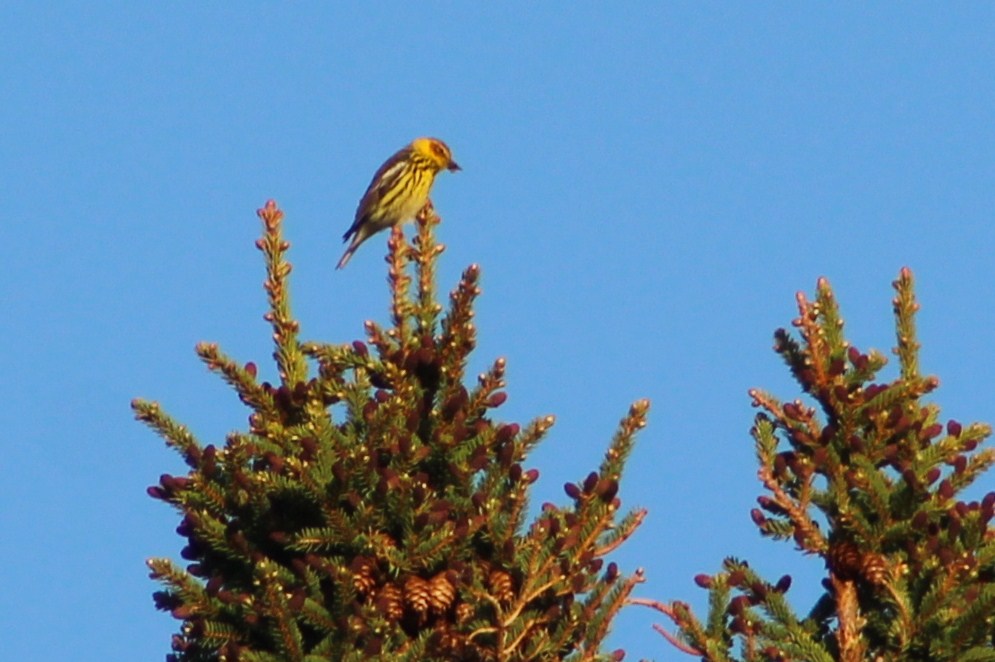
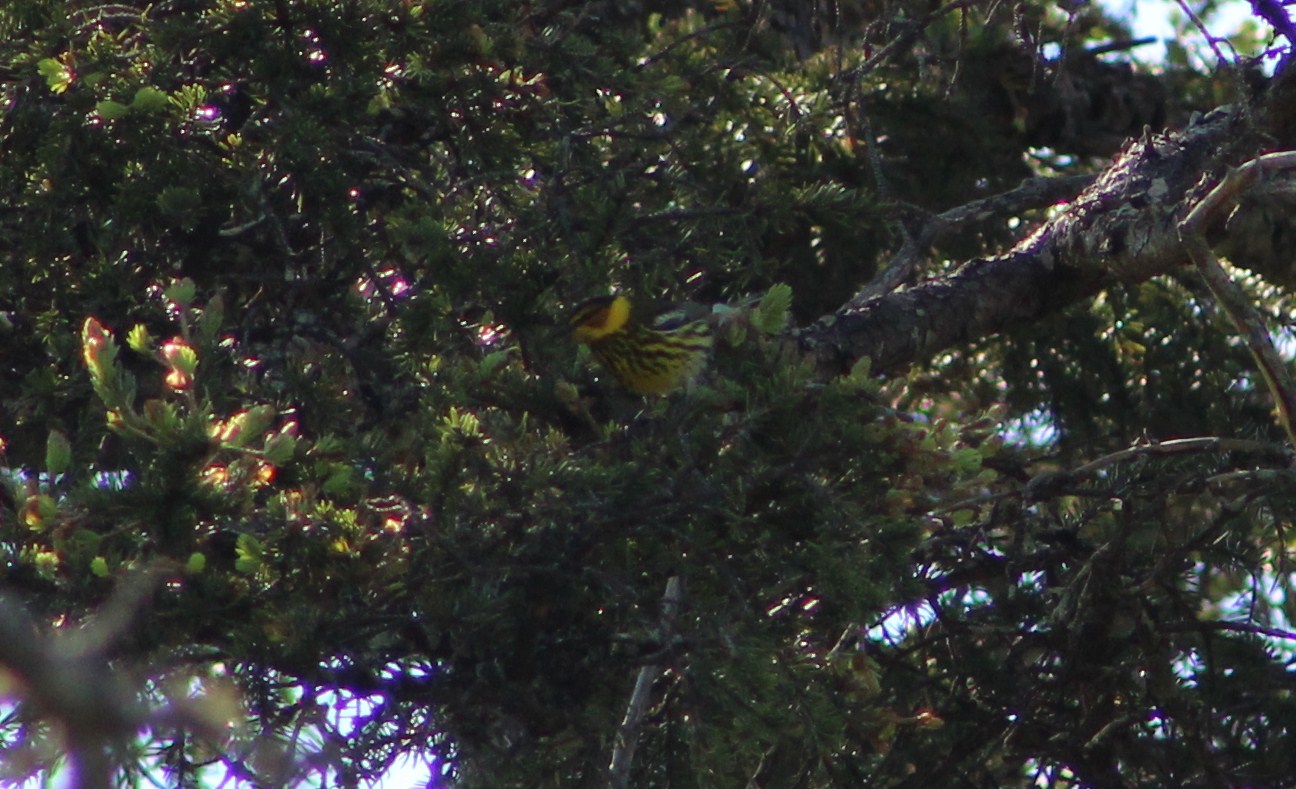
A series of high, thin, and quiet notes, "tsee tsee tsee tsee tsee" was the indicator of a Cape May Warbler nearby. Things got even better when I heard a second and possibly a third start singing too. I pulled off the road at a place called Little Langley Creek, which was a dense forest of spruce that had a creek flowing through a bog area. It was beautiful, and it was good to be in Cape May Warbler habitat. I anxiously had my eyes out for movement, as Cape May Warblers tend to stick up up very high in the coniferous trees that they inhabit most. When a song got closer, I pished and a bird flew out of the trees and across Road 2. It landed in a dark shadowy area that had yet to have the morning sunlight hit. As I looked through my binoculars I could see a yellowish warbler with dark streaks across it's breast. The bird didn't stay there long, but I knew it was a Cape May Warbler. I decided to focus back on the sunlit trees that were back across from Road 2, and after a few minutes and looking near the top of a tree, there it was in perfect lighting-my first Cape May Warbler. Although it wasn't very close, the striking look of a yellowish bird with a yellow rump and yellow sides to the neck, black streaks across it's breast, a dark greenish back, a bold white wing patch, and bright chestnut cheeks on a yellow face screamed it all out. Cape May Warbler baby!
After watching this bird for a minute, I walked up Road 2 as it went across Little Langley Creek. There was another nice stand of spruce trees, and I caught sight of another male Cape May Warbler, as well as a quick look at a female. The male posed rather far away like my first, but the views were awesome.
Just like that I had my 55th Wood Warbler for ABA, and Cape May Warbler was a fun warbler to do that on. Like Connecticut Warbler, the Cape May Warbler is poorly named. In Cape May, the warbler is only a migrant, but that is where the first specimen had been collected in roughly 1811, twenty years before the bird was named in 1831 by Alexander Wilson who was the first to describe and sketch the specimen (Wood Warblers World by Hal H. Harrison-this line and the next few lines). It was crazy because Alexander Wilson and Audubon himself actually never got to see a live Cape May Warbler. The latin name of this bird is Setophaga tigrina, where tigrina means, "striped like a tiger". There's more to mention about the life of Cape May Warblers, as we go along and up County Road 2 further on this post when I look for more of them, I'll say more about their lives.
A lot of other songbirds were present along Little Langley Creek, and before I knew it, I had been there for over thirty minutes. It was awesome when I heard a Tennessee Warbler start singing and was able to get a looks and some photographs. While I've seen non-breeding, female, and first-year birds as Arizona vagrants, it was really fun to enjoy adult males on breeding grounds.
Here is a video of the Tennessee Warbler singing.
Evening Grosbeaks were another. Their call notes from this region, as opposed to what I have heard in Arizona, sound much different. Like Red Crossbills, Evening Grosbeaks have their own types.
As I went north of County Road 2, I made a few short stops before going to White Pine Picnic Area, a place that has had a lot of good birds and a variety of birds. I parked at the picnic area, and walked in the north and south direction. The habitat was awesome and had a mix of spruce, pine, aspen, and other deciduous trees. Right off the bat I could hear several Northern Parulas singing. I focused a lot of my time on them in the hour that I spent at White Pine, and it was awesome. It was the first time I've seen this small and awesome-looking warbler on it's breeding grounds, where they seemed to like trees with mossy substances growing off of them. I got some awesome looks at a few Northern Parulas.
I had to photograph the Canada Warbler I heard too.
Among the 25 bird species present at White Pine, 11 of them were warblers.
What was funny about me wanting to get Cape May the second I heard them was that there ended up being probably close to a dozen of them in total throughout the combined locations that I stopped at along County Road 2. At a spot close to White Pine, I had much better looks at this male, who sang right along the road!
Heck yes. As Cape May Warbler breeds in boreal forests that contain a spruce-tree dominance, they also have a strong food preference during breeding season, which is an abundance of moth larva that is called the spruce budworm. Outbreaks of these budworms mean much a much higher and more numerous population of Cape May Warblers, as their numbers go up and down based on budworm availability. Cape May Warblers may be anywhere from uncommon to very common based on this food source. While it is important for Cape Mays, it is important to a lot of other warbler species too.
In that book, Wood Warblers World, author Hal H. Harrison described the difficulty of finding the nest of a Cape May Warbler, and that the nest is concealed in a spruce tree from anywhere from 35 to 60 feet up. And he described in his book how clever the female warbler is, and how she can ward off potential predators by distracting them away from the nest. When Hal was doing his research, he was trying to find the bird's nest, and Mrs. Cape May doesn't fly to the nest with someone nearby, but she goes to the tree below the level of the nest and makes her way to the nest by sneaking up from branch to branch close to the trunk. Hal also notes something else about Mrs. Cape May. She not only cares for her family, but she really cares for her family. While other warblers fly out of their nests in a horizontal fashion, Mrs. Cape May jumps toward the ground, swoops up right before hitting the ground, and flies out of sight. I find this freaking incredible about Cape May Warblers, and it makes me want to experience the behavior for myself.
Cape May Warblers are also notoriously aggressive toward other birds, and will chase off birds that get in the way of their food source on their nesting grounds. During migration and winter, the diet of these warblers becomes quite the assortment of food items that include more nectar and fruits than other warblers. The Cape May is not only aggressive during breeding season, but they will also chase off others over food source in migration and winter. Like it's latin name means "stripes of a tiger", I guess the name holds true to it's behavior, as it can be tiger-like when it comes to securing it's food.
The song of the Cape May Warbler is pretty muted and quiet, and it can make it challenging to locate the singer. As I had an eye on one of the male Cape Mays that I saw, I watched it go into a dense spruce, where it was hard to see. Fortunately I was pretty close to the bird, and I decided to get a recording of it singing.
As my exploration continued, I got out of the truck and walked along a fun habitat that consisted of a bog, as well as a stand of spruce trees along the road. I saw a bird chasing another bird. The chaser landed in view and I quickly raised my binoculars, already knowing what the result was going to be.
This Alder Flycatcher was nearby and was singing: Rhhe-biierr or Free Beer!
This Blackburnian Warbler out of several Blackburnians was awesome to see.
Here are a selection of scenes from County Road 2.
When I woke up and made plans, I had a plan in place that I would head back to Gretchen's cabin earlier in the afternoon and go to bed early. The original plan for June 4th was going to be going south of Spooner for a three hour drive to central Wisconsin near a town called Wisconsin Rapids to target prairie species such as Greater Prairie-Chicken, Henslow's Sparrow, Upland Sandpiper, and possibly Short-eared Owl. As the time reached noon, I started to head back toward Two Harbors after that exploration of County Road 2. I added a place called Tettegouche State Park to my route, which is right along the main Highway 61 that parrallels the western shoreline of Lake Superior. My goal was to search for Black-throated Blue Warblers on a trail at Tettegouche. When I got to the trail, the birds were active, but I didn't get a peep out of any Black-throated Blue Warblers. It was frustrating, and I wished I had stayed on County Road 2 longer and went for a longer hike in that epic area. But Tettegouche was pretty cool, and I hoped to cross paths with a Philadelphia Vireo there too, but I didn't have success.
Going back toward Two Harbors, I knew about a vagrant Eurasian Tree Sparrow that was found there. Josh mentioned it to me earlier in the trip and while I had other targets that were being more highly considered for the main goals of the trip, the Tree Sparrow was enticing too. The bird was found with House Sparrows in a parking lot area on a street in Two Harbors. I decided to go for the sparrow and give it a shot. This species is very closely related to the House Sparrow, and they have similar behaviors and habits. Eurasian Tree Sparrow was introduced into the United States in St. Louis, Missouri, from Germany in 1870. They didn't spread too far, and are primarily in east-central Missouri and southern Illinois. But vagrants do happen. It was weird to chase this bird, but it was also cool when I got it after waiting for about thirty minutes.
This Clay-colored Sparrow and Chimney Swifts were fun to see too.
Once I started to head back to the cabin, I realized I was a bit tired and decided I was going to put the central Wisconsin trip off until later in the trip. I decided I would go to the Rock Lake State Natural Area during the following morning of June 4th to try for Black-throated Blue Warblers, and from there I would then start a camping trip through many areas in northern Minnesota. I contacted Josh and we made plans that we would bird two very awesome state parks in Minnesota most of the day on June 5th. That will be the next post on Northerly Treks.
After a great evening and night at the cabin, I woke up and went back to Rock Lake State Natural Area pretty early, which was an hour northeast of the cabin near a small Wisconsin town called Cable. Unfortunately, the weather was very cloudy, but I heard Black-throated Blue Warblers singing their lazy, Blues-like songs. These guys have the bulk of their population in the south, where Blues music is from, but fortunately for northern birders in some of Minnesota, Wisconsin, and Michigan, the Black-throated Blue Warbler does extend itself to the northern part of it's range. I caught up with a few of these awesome birds as they sang, and while my shots aren't great, they did top what I previously.had. My first Black-throated Blue Warbler was in Pinal County, Arizona and had to be viewed from about 100 feet away as it was hanging out on private property and was on someone's line of Christmas lights. What a cool bird, and a good bird to close this post off with!