Hi everyone,
Sorry for the late report, but on Tuesday, April 9th, 2013, I spent the day birding in the Prescott Area. This area holds spectacular birding, and I spent my time birding at four different lakes right around Prescott that are all a very short distance away from each other. These four lakes: Lynx Lake, Willow Lake, Watson Lake, and Goldwater Lake, all made up for an incredible day of great birding opportunities combined together. It was my first "real" time of birding this area, and I was very impressed. Weather wise, the day was pretty cold, with overcast most of the day with light snow showers in the afternoon.
My first stop of the day was at Lynx Lake, where I spent over two hours. This lake is nestled in the Lynx Lake Recreation Area, which is mainly ponderosa pine and oak forest throughout the recreation area. The lake itself is a medium-sized reservoir, and it has a convenient 2.5 mile hiking trail with easy difficulty that circles the lake. There is also a nice riparian area close to the parking area which is also very attractive. I spent most of my time here along the trail that circles the lake. Waterfowl at this lake was minimal, with MALLARDS being the only duck. A raft of four EARED GREBES (with some in breeding plumage) was the one notable waterbird. DOUBLE-CRESTED CORMORANTS were very numerous. Raptors present at the lake were two OSPREYS and an adult BALD EAGLE. The Bald Eagle was extremely cooperative and practically tame. This bird sat on a perch right along the trail, and I was able to get right beside the bird without spooking it. It was the best look I've ever had of a Bald Eagle in the field! BLACK-CHINNED and ANNA'S HUMMINGBIRDS were both present, and a single BELTED KINGFISHER flew around to different parts of the lake during the time. Three woodpecker species were represented by ACORN and HAIRY WOODPECKERS, and a few NORTHERN FLICKERS. BRIDLED TITMICE and BUSHTITS were both very common around the lake. WHITE-BREASTED and PYGMY NUTHATCHES were both common also around the lake, and I heard a single RED-BREASTED NUTHATCH calling in the woods. A single TOWNSEND'S SOLITAIRE called on a brushy slope in the area. Warbler wise, at least five PAINTED REDSTARTS were in the area, especially in the riparian area around the lake. LUCY'S WARBLERS were also common around the north side of the lake, a few BLACK-THROATED GRAY WARBLERS were heard singing, YELLOW-RUMPED WARBLERS were common, and a few GRACE'S WARBLERS were singing along the road south of the lake near Hilltop Campground. A few Abert's Squirrels were also around, a squirrel I do like. I recorded 41 species around the lake in my time spent there. It costs 5 dollars to park and bird at Lynx Lake.
Bald Eagle
Osprey
Hairy Woodpecker
Bewick's Wren
Bridled Titmouse
Great Blue Heron
Abert's Squirrel
Lynx Lake
.JPG)
.JPG)
After Lynx Lake, I headed up to Willow Lake. This lake is an Important Bird Area, and the birding was beyond amazing. Willow Lake features a large body of open water, scenic rocks, and amazing riparian areas. In the time I spent here, I recorded 61 species in 2.5 hours. I'm sure if I spent more time and started here much earlier, I would've seen a lot more. By looking at eBird reports, there have been plenty of birds I missed when I birded here, including rarities such as Brown Pelican and Red-breasted Merganser. This lake held amazing numbers of waterfowl, including CANADA GOOSE, GADWALL, AMERICAN WIGEON, CINNAMON TEAL, NORTHERN SHOVELER, GREEN-WINGED TEAL, CANVASBACK, BUFFLEHEAD, and RUDDY DUCK. EARED GREBES were also present in fairly good numbers. Raptor wise, I had 2 OSPREYS, a BALD EAGLE, 2 COOPER'S HAWKS, SHARP-SHINNED HAWK, and a RED-TAILED HAWK. Gull wise, I saw five or so RING-BILLED GULLS and probably close to 15 FRANKLIN'S GULLS floating on the waters. 5 WHITE-THROATED SWIFTS flew over the rocky areas. Flycatchers included a HAMMOND'S FLYCATCHER who I located by hearing it's call, and a WESTERN KINGBIRD. A few WESTERN SCRUB-JAYS could be found in the area. Swallows flew over the lake in very high numbers, being represented by BARN, CLIFF, NORTHERN ROUGH-WINGED, and TREE SWALLOWS. BRIDLED TITMOUSE and a single JUNIPER TITMOUSE were found by hiking a few of the trails. A calling CRISSAL THRASHER was also present and nice to have around. A few groups of AMERICAN PIPITS also flew overhead. Out of the numerous YELLOW-RUMPED "AUDUBON'S WARBLERS, I found a nice MYRTLE WARBLER. WESTERN MEADOWLARKS were another nice highlight for me singing around the lake. A two dollar fee is charged to park at Willow Lake Park. A highly recommended birding location!
Distant Franklin's Gulls
Myrtle Warbler
Willow Lake
.JPG)
.JPG)
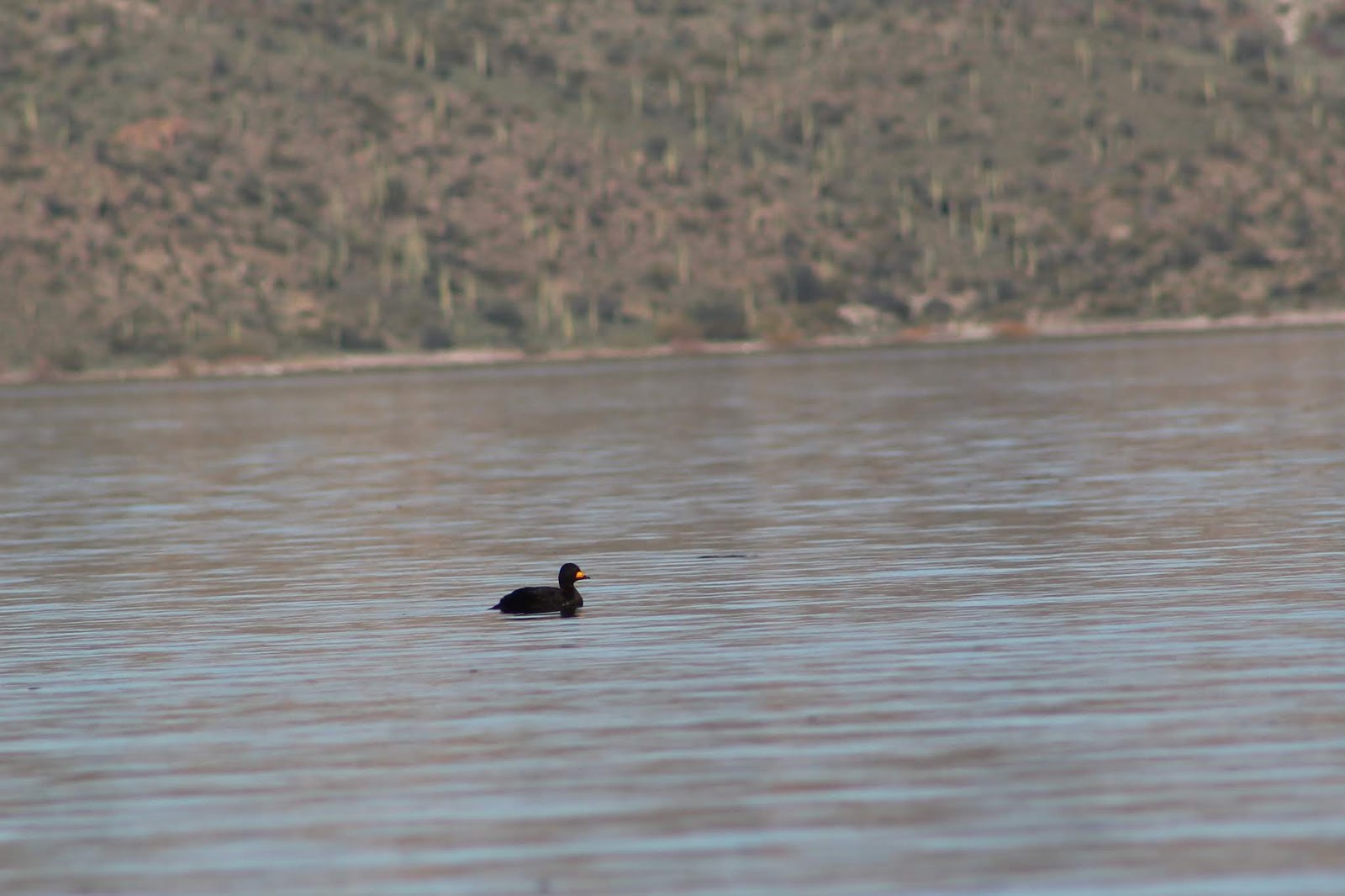
After Willow Lake, I headed over to the lake's next door neighbor, Watson Lake. This lake is also an Important Bird Area, and was almost as impressive to me as Willow Lake was. My time was cut short here however because snow showers started up. I didn't realize these showers were minimal until after I left. But in the time I spent here, it was awesome. Watson Lake features a nice riparian preserve at the south end of the lake, Watson Woods Riparian Preserve. This preserve is filled with cottonwood and willow groves, and has a few ponds. This Preserve has been good from what I've read for viewing Wood Ducks and Common Black-Hawks. Trails from the preserve lead right out to Watson Lake. Watson Lake Park is better however for seing more of the lake without walking too far. At Watson Lake, a White-winged Scoter has been present all winter, which I wasn't able to look for long before leaving. In the hour plus I spent in this area, highlights included BUFFLEHEAD, OSPREY, HAIRY WOODPECKER, MARSH WREN, BEWICK'S WREN, LUCY'S and YELLOW WARBLERS in common numbers, COMMON YELLOWTHROAT, LINCOLN'S SPARROW, and WESTERN MEADOWLARK. I also spied a gull soaring near an Osprey that was probably a California Gull. I wish I had more time to cover this area. Across the street from the parking area to the Watson Woods Riparian Preserve, were a few treatment ponds that held LESSER SCAUP, RING-NECKED DUCK, and NORTHERN SHOVELERS. Like Willow Lake Park, the Riparian Preserve at Watson Woods and Watson Lake Park are two dollars to park apiece.
Western Meadowlark
Osprey
Watson Lake
Watson Woods Riparian Preserve
.JPG)
.JPG)
From Watson, I headed west to the Senator Highway, to head to the small Goldwater Lake. Goldwater Lake is a small and very peaceful reservoir, and is surrounded by towering ponderosa pines. The forest in this area almost seems to be in a valley. My time at Goldwater Lake was interspersed with light snow showers. Goldwater Lake is always an awesome place to me, and was the very first location I ever birded at. This lake is to thank for my birding obsession. I was bored at the lake way back in the day on a family day trip, and I saw a bird book and decided to identify a few birds around the lake, which launched the interest. This time at Goldwater Lake, my favorite highlight came with three female HOODED MERGANSERS. I found one at first, and then there ended up being two others it joined at the opposite side of the lake. Also present on Goldwater Lake were four COMMON GOLDENEYES, a drake and three females. An OSPREY fished the lake during the whole duration. Migrant flycatchers were represented by singles of GRAY and HAMMOND'S FLYCATCHERS. I found 26 species at Goldwater Lake in almost 2 hours, most of which were common forest birds. Goldwater Lake is also a two dollar fee.
Hooded Mergansers
Common Goldeneyes
Western Bluebird
Goldwater Lake
In the day of Prescott birding I tallied 88 species in the four stops. I was very satisfied with my first "real" visit to bird this awesome area. Amazingly, this area only takes about 1.5 hours to reach from home, which is the same time it takes me to drive to other areas I often explore. I will be covering this area more hopefully, and I highly recommend it to anyone else who hasn't birded it.




.JPG)
.JPG)
.JPG)
.JPG)
.JPG)
.JPG)
.JPG)

.JPG)
.JPG)
.JPG)
.JPG)
.JPG)
.JPG)
.JPG)
.JPG)
.JPG)
.JPG)
.JPG)
.JPG)
.JPG)
.JPG)
.JPG)