Showing posts with label Canada Warbler. Show all posts

Saturday, September 19, 2020

What Can Happen In A Week Of Birding: Part 2

After the excitement with the Northern Jacana, I knew that it was a good way to kick off my "Friday" and prepare for my "weekend" of having Thursday and Friday off, which was September 10th and 11th, 2020.  I planned to go birding in the first half of the day and wanted to be home earlier in the afternoon.  On the 10th, I opted for Phon D. Sutton and Granite Reef Recreation Sites of the Lower Salt River.  On the 11th, I birded Seven Springs Wash and Camp Creek.  The mornings were fun but didn't have anything too noteworthy.  The Salt River locations were loaded with birds, especially Granite Reef.  At Granite Reef I had close to 70 species right about noon-time, which included Black-and-white Warbler, Dickcissel, Wood Duck, and this showy Painted Redstart.


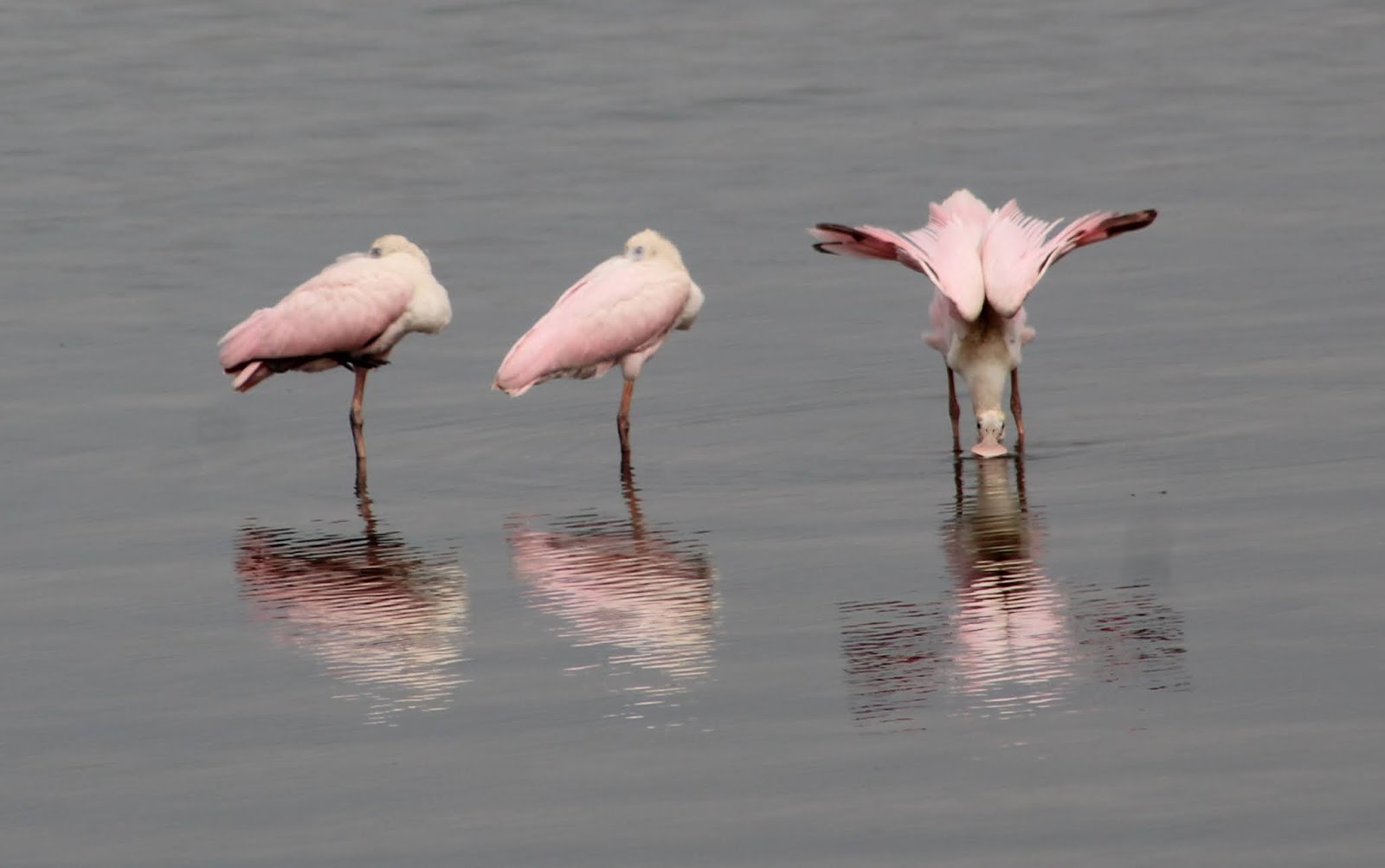
When I got back from the Seven Springs/Camp Creek area on September 11th, reports came into the birding community from Jennie McFarland and Richard Fray that Jennie had found three Roseate Spoonbills at the Glendale Recharge Ponds.  I knew I wouldn't mind seeing these awesome birds, and it's only a ten minute drive from my home in Peoria to the ponds.  When I got there I joined Caleb, Jeff, Levi, Louis, and Pierre.  We all enjoyed the Spoonbills, and we also looked for birds in other five ponds. 


Then, something really awesome happened for my Maricopa County birding, and everyone else's Maricopa County birding.  Caleb spied a Common Nighthawk flying over the basin, and it foraged and dove down at prey a few times.  In Maricopa County, Common Nighthawk isn't "Common" at all.  Back in the day, I had my first Common Nighthawk sighting near my Grandfather's house in mid-November of 2002.  We were walking through the neighborhood, and I flushed a bird that I described as having, "boomerang shape wings with white bars near the end of the wing".  I also noted the bird giving a loud call, and that call stuck with me.  When I got home, I listened to Common Nighthawk calls and it was the match.  As time went on, I realized that a Common Nighthawk in November is freaking rare.  I know I had a nighthawk, but could a Lesser Nighthawk pull something off that is loud like a Common on rare occasions?  In recent days, the record has had me wondering if I really saw that bird, even though I identified it right.  When Caleb spied this Common Nighthawk while we were Spoonbill watching, it became the first Common Nighthawk documented in Maricopa County by photograph.  We were all stoked at the sighting.  With Common Nighthawks in visual comparison to Lesser Nighthawks, they have the white bar further down on the wing and closer to the wrist than Lesser does, a tern-like flight, and darker primaries.  We watched the bird for about a minute before it went off.  What a huge highlight and bird it was for me, thank you Caleb!


The Common Nighthawk was one that turned out to be reliable.  As I write this now, it has been present and chasable at Glendale for a week now.  Birders have been finding it in the evening and early morning.  On September 12th, I was driving home from work and was planning to go grocery shopping and then spend the rest of the day at home.  When I was about to get to the store, Caleb texted me saying, "Chris Benesh has a Canada Warbler at Gilbert Water Ranch".  I forgot about everything else and took a 45 minute drive to Gilbert to for a bird chase.  In Arizona, Canada Warbler is a very rare bird.  Really freaking rare.  Once getting to Gilbert, I made my way to the spot that Benesh had indicated where the warbler was.  There were already plenty of birders there, including Chris and Holly Thomas.  Holly was the one who identified it first, and she and Chris had the local birding community in a search after their awesome find.  Despite many many pairs of eyes looking for the Canada Warbler, it wasn't to be re-found for the rest of the day.  Caleb got there and had two shorebirds flying around while calling.  He felt like they were Buff-breasted Sandpipers.  However, Chrissy Smith had an awesome detection when she was birding around and she found an Eastern Kingbird in Pond 5 of the ranch.  Many birders flocked over to see the Kingbird.  This was only the second time I've seen this species in Maricopa County (as well as in Arizona), and it was fun to see it and watch it forage alongside a Western Kingbird.


September 13th was a day that birders were hoping the Canada Warbler would be re-found.  It is one that is a very challenging statebird to land.  Troy Corman was saying that in his years of birding Arizona, he has never been able to get a Canada Warbler in Arizona.  Ronnie and Caleb were teaming up, and would be at Gilbert.  Scads of birders were there for the day, and the Eastern Kingbird was a big reason for the turnout.  Luckily, Caleb worked up some magic and relocated the Canada Warbler!  It was along the same path in between ponds 3 and 4 of Water Ranch.  I was already prepared to chase the bird after work, and 1 P.M. couldn't have come around sooner.  At about 1:45 when I was pulling up to the ranch, birder Alex Grant had relocated the Canada Warbler along the path between ponds 4 and 5.  I was hoping that this would be an easier spot to see the bird.  In the previous and limited viewing haunts of this Canada Warbler, the vegetation was dense and the bird would be seen with quick, fleeting glimpses.  Earlier in the morning, many were able to see it, but not many were able to photograph it.  I walked up to the new spot and there was a crowd of about 15 birders there.  Luckily, it had been seen about 5 minutes before I got there.  After about 5 more minutes of waiting, I heard the phrase I wanted to hear that goes, "here it is".  I got over to the spot where it was being pointed out and there it was, my first Arizona Canada Warbler, and my 396th bird for Maricopa County!


Canada Warbler is a bird I've dreamed about getting for Maricopa County for a long time, and of course for Arizona as a whole too.  It's one that doesn't usually stick for very long once discovered, and many birders at Gilbert Water Ranch on the 13th got to see this bird and it stuck around for several more days to come.  It ended up being obliging a few times while I was there watching it, and it would behave well in the following days for more birders to get awesome views.  When it was found earlier in the day, I thought it was going to be the elusive bird that it was as Holly and Chris found it. 


It was fun to run into many birders while viewing the Canada Warbler and searching for the Canada Warbler.  After the fun, I realized the fun was only getting started.  I was off of work for three days from September 14th through September 16th.  Caleb and I had conversations at Gilbert about birding, and once I finished up with viewing the Canada Warbler, we made plans to bird together the following day.  After landing an epic rarity, we were feeling lucky.  We decided to go to the southwest part of Maricopa County to see if we could turn up any good birds at Arlington Wildlife Area, several ponds, and at Paloma Ranch.  When September 14th came, I picked up Caleb early and we went down to Arlington Wildlife Area.  We had vagrants on our mind, and Field Sparrow was one of them as we knew it hasn't shown up in Maricopa County yet.  We didn't find anything like that, but scanning a field I found a Roseate Spoonbill.  Can you find it in this picture???


Yeah, yeah, the picture is horrible, but we didn't need to hike out to that bird.  Arlington Wildlife Area is a birdy place, and it has great potential for a lot of birds.  I particularly like a tamarisk treeline that is inviting to migrants.  Caleb and I made our way south to Gila Bend after Arlington.  As we were just a few miles north of Gila Bend, something caught Caleb's attention.  "It was a light-looking Kingbird perched with Western Kingbirds", he said, "can you turn around, it might've been a Scissor-tailed Flycatcher".  I turned around and drove to the spot.  Caleb quickly scanned and said, "Yes!  Scissor-tailed Flycatcher!".


We both started screaming our heads off.  I couldn't believe that I was looking at a Maricopa County Scissor-tailed, and it became back-to-back days of getting lifers in Maricopa.  Scissor-tailed was #397.  Caleb and I got out and got closer to the bird before it flew further off and into farm fields.  We had great looks at it perched and in flight.  On another good note, this bird has entertained many other birds and has been present as I write since Caleb spied the bird.  Scissor-tailed Flycatcher is a bird I've kept in mind a lot for Maricopa County, and is one that I've dipped twice on in the county in the Arlington area.  Thank goodness Caleb was there to look out the window.


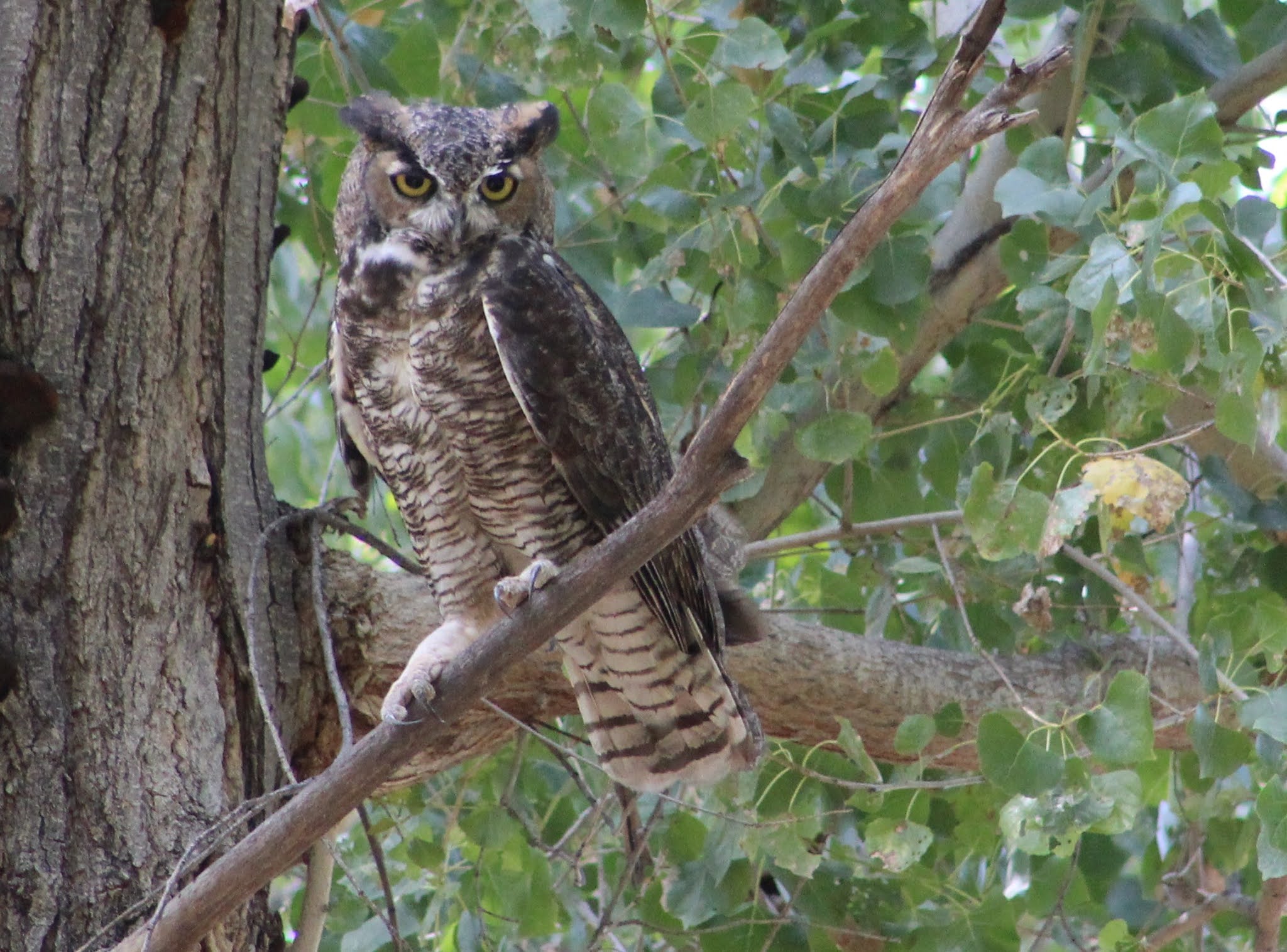
Caleb and I were stoked after the Scissor-tailed sighting.  A mesquite tree was along the road we were driving on.  Caleb said, "Tommy, I feel like I can go up to that mesquite tree and find a Philadelphia Vireo in it".  We were both pumped up.  After stopping at ponds and Paloma Ranch, the Scissor-tailed Flycatcher remained as our best highlight of the day.  To conclude our day, Caleb and I decided that we would bird together again on September 15th, which would be Caleb's 21st birthday.  Because of that, it was bound to be a great birding day, right?!.......  Look at this Barn Owl from Paloma Ranch, cool huh...

For his birthday on the 15th, Caleb opted to bird and hike south from the Kerkes Trailhead along the Hassayampa River.  This is a location that is in the town of Wickenburg, and is a few miles north of the famous Hassayampa River Preserve.  From the Kerkes Trailhead, the Hassayampa River has impressive stands of cottonwood and willow forest.  Caleb and I figured that it would hold something awesome and rare.  

At one of our first stops of the day, barely south from the trailhead, we stopped at a spot that had good bird activity and one that looked good for birds.   We started pishing and carefully watched for any birds to come in.  As we looked above us, we saw that a vireo flew in to a big cottonwood that we were standing in front of.  After a minute of more pishing, the vireo emerged and we immediately thought in the initial second that it was a Red-eyed Vireo.  And the bird was very bright...

Caleb got some better pictures than I did, and as the vireo foraged, he questioned why it wasn't the much more rare Yellow-green Vireo.  I looked at the picture above, and it according to the horrible picture I took, it almost resembled more of a Red-eyed Vireo face pattern.  But then I looked at the next picture, and the yellow sides on the bird were a bit striking for a Red-eyed Vireo. 

Looking at the bird closer live, it started to look more and more like a Yellow-green Vireo.  The bird came closer and gave Caleb and I some excellent views.  It was a Yellow-green Vireo, and became a life bird for both of us and an incredible find on Caleb's birthday.


You know what's incredible?!  The Hassayampa River corridor and some of the rarities it gets.  This was a welcome surprise and joined rarities like Green Kingfisher and Streak-backed Oriole.  It was only the second Yellow-green Vireo that's ever been found in Maricopa County, and the first was found by Gary Rosenberg at Paloma Ranch in the 1980's.  But here we were at the northwestern section of Maricopa County in September, documenting this remarkable bird.  Most records from Arizona out of the 14 previous records have come from southeastern Arizona in summer.  This bird is very similar Red-eyed Vireo in many ways, but it has a muted face pattern (one that's not sharply defined like a Red-eyed), a larger pale bill, and extensive yellow from it's underparts to it's ariculars.  Wow, this bird...


Once we reported it to the birding community, it got a good response, and Caleb got an outpour of birthday wishes.  For Caleb and I it was an epic lifebird.  For me personally, it was almost a nemesis.  It was a bird I had chased four times, and struck out each time.  Each of those times came with narrow misses:  one by a few minutes because I was photographing a Varied Bunting, one by a few seconds when I couldn't get on it while others in my birding party were a few feet luckier in their standing place than I was, one by 12 hours (it had been present all day the previous day, and it came right back the next day), and then another one by 15 minutes.  It was great to finally be on the lucky end!  Yellow-green Vireos can be quick wonders a lot of times when they do show up.  It was present when Caleb and I got back from a long hike further down into the Hassayampa River corridor.  Chrissy, Ryan, and Dara were able to get looks at it.  The following days resulted in empty searches by birders, although Erin and Derek Bowen probably saw the bird.

The Yellow-green Vireo's range consists of it breeding in tropical woodland and forest of Mexico and Central America.  Most United States records come from Texas, where it can be fairly reliable.  The bird winters in the Amazon.  Caleb's birthday was fun and had about 80 other species of birds, but none of them are really worth talking about after we found the Vireo!

 
 As I took Caleb home, we decided that we would bird again for a third straight day on September 16th.  After toggling back and fourth and back and fourth for a long time about where we should go, we decided to go to the Verde River to bird at the Box Bar and Needle Rock Recreation sites in northeast Maricopa County.  We felt like we were on a serious roll and wanted it to continue.  Box Bar and Needle Rock are two sites that are close to each other that have impressive riparian stands of willow and cottonwood.  We wanted to try our luck there.  Box Bar was our first stop, and would be our main stop of the day.  Birds were numerous to start things off.  I got to see my first Vaux's Swift of the year.  This Hermit Warbler was also cooperative.  
 

Caleb and I got to an impressive stretch along the Verde after awhile, and it was one were I found my first Red-eyed Vireo about five years ago.  We stood at this one spot that had a dense clump of awesome habitat.  A call note emerged from the surrounding habitat, and we looked up to see this.


The white undertail coverts, smoky gray upperparts, yellow underparts, eyering, and as it turned it's body to reveal a streaked "necklace" across it's breast it resulted in us finding our own Canada Warbler.  We were shocked again, and with this discovery, I couldn't help but burst out laughing after I got a better shot.


A few days prior to this, Caleb and I were both searching in high hopes of a Canada Warbler that we were chasing.  And then we find our own!  The Gilbert Water Ranch bird was one that had me freaking out and when I got to see it, I was relieved.  Funny enough, the Gilbert bird wasn't seen on the 16th, as the 15th was the last day it was seen.  Caleb and my Canada Warbler stuck around for a few days, and allowed several birders who missed the Gilbert bird, to get on this one!  Erin and Derek Bowen are big year birding Arizona, and they were in Texas while the Eastern Kingbird and Canada Warbler were at Gilbert.  Our Canada ended up being Erin's 400th Arizona year bird on September 18th.  After our first minute of watching the Canada, we lost it and came back to find it foraging around, where it gave us great views.  


I also enjoyed these two birds a lot, as always!


At Needle Rock, I spied this Northern Beardless-Tyrannulet in midst of a bird flock.  It was only my 3rd of this species for Maricopa County, and Caleb's second.


After the Ty, we headed back.  At about 3 P.M. that day on September 16th, I dropped Caleb off at his house.  It was almost exactly a week after I had arrived at Canoa Ranch at 3:15 P.M. on September 9th, a tad less than a week.  What exactly happened in that one week?

-Two lifers were obtained:  Northern Jacana and Yellow-green Vireo
-I got three Maricopa County lifers on three straight days:  Canada Warbler, Scissor-tailed Flycatcher, and Yellow-green Vireo (Caleb got those plus Eastern Kingbird, so he had four straight days)
-Common Nighthawk was practically in the Maricopa lifer department, it was incredible.
-Eastern Kingbird was a second time only in Maricopa County for me.
-Aside from these highlights, the birding was awesome too.  I don't wanna write too much.

Thanks Caleb for the fun days.  Speaking of Caleb, on September 17th, he had Maricopa County's first Chimney Swift fly through his yard, and he documented it well.  Today he had a Least Flycatcher at the famous Dateland vagrant trap in Yuma County.  

For me, Maricopa County life birds are a huge deal.  In three days, my list went from 395 to 398.  It was something I didn't see coming, and the action kept coming.  The Canada Warbler was good enough to last for awhile, and the Scissor-tailed Flycatcher and Yellow-green Vireo blew things up.  Getting our own Canada Warbler was freaking crazy.  As I'm getting close to hitting my dream of 400 birds for Maricopa County, I'm hoping it'll get here soon.  It may happen soon, but it may not happen for a long time.  Who knows, time will tell and birding hardcore will tell too.  Till next time...

Friday, July 3, 2020

Northerly Treks: No Cooking On Gunflint

Think of a vast wilderness area full of bogs, lakes, and rivers.  Imagine them all seeming clumped together, as water becomes the dominant force.  A road through such an area would be a pleasure for sight-seeing, but it would not only be impossible to build a road in a place like this, but it would also disturb what is meant to be a secluded environment.  As I looked over maps of this area, I was impressed and wanted to explore it.  It falls in the very northeastern edge of Minnesota, and the Canadian border is the nearest neighbor.  The overview I looked at is called the Boundary Waters Canoe Area Wilderness.  It is a huge attraction, and National Geographic called it one of the world's "50 Places of a Lifetime".  The more I found out about it and wanted to explore it, I found out that I'd need a canoe or kayak, and I'd also need to have a special permit.  In the waterways of this region, the way to get around comes at the hands of light water travel.  This area comes near the northern reaches of the popular Gunflint Trail in Minnesota's northeastern-most county, which is Cook County.  While this area is a huge attraction, the Gunflint Trail in itself, which is a 57 mile paved road that goes off of Minnesota Highway 61 adjacent to the town of Grand Marais, is worth the trip alone.  As I made my way north from the Spruce Grouse for another 4 hour drive to Cook County and it's Gunflint Trail, I knew I had another adventure in front of me as I would be extremely close to Canada.


It was still June 6th, and when I entered into Cook County I was stoked that I had reached Minnesota's northeastern-most county, and it is a county that is famed and well talked about among Minnesota birders.  Cook County hosts vast boreal forests, bogs, lakes, rivers, and the shoreline of Lake Superior.  When I entered Cook I started to do a few incidental eBird checklists.  However, I did have an issue arise, which was weather.  As I was scheduled to get on the Gunflint Trail and drive it's length from Highway 61 around 3 P.M., I realized that the remainder of the 6th was supposed to be sunny with some clouds rolling in overnight.  But on the morning and most of the day on June 7th, indications were that a steady rain would take place in most of the region of Cook County.  I was bummed out of the news, and I hoped that the rain wouldn't be as bad as forecasts were saying.  Regardless, I had about six hours of daylight to explore along Gunflint on the current day, and if it rained all day on the 7th, I would simply see it as a sight-seeing trek along the entire Gunflint Trail.  While I wanted to see as many birds as possible, I guess the rain didn't effect my main target of being in this area and seeing it.  And I also didn't see it as really effecting my chances of seeing the creature that I wanted to target most on Gunflint, which was the Moose.


When I turned on Gunflint to head northward, the entry signs said it all.  I was in freaking Moose Country.


As I headed north, I made a few stops here and there to enjoy scenery and to start building my Cook County list.  When I saw a sign indicating, "Moose Viewing Trail", I had to stop, get out, and start hiking to a platform that would overlook a small lake.  Apparently, Moose come down to the lake to eat and drink quite often.  A lady I ran into on my way said no Moose were currently present, and that I should try at dusk.  In the woods surrounding the trail made up of conifers and deciduous trees, the forest was made alive by Black-throated Green Warblers, Blackburnian Warblers, and Swainson's Thrushes.


After the Moose trail, I took some time to drive a good distance north on Gunflint before deciding to turn around and spend as much time birding as possible.  Gunflint Trail hosts the possibility for finding breeding Boreal Owls, Spruce Grouse, Black-backed and Three-toed Woodpeckers, and over 20 species of breeding warblers.  For my trip, I had written 26 species of warblers down that I could encounter on the trip in northern parts of the three states.  At this point of the trip, I had 24 of them, and the only two remaining warblers I had to find for the trip were Wilson's and Bay-breasted Warblers.  In Minnesota, Gunflint Trail is the best place to look for both species.  After going north on Gunflint, I worked my way south to bird a road called Forest Road 325.  It would go for a ways and would connect with other roads, including a road called Forest Road 315, which went along and accessed a birder-famous ridge called Lima Mountain.  I didn't have time to cover as much as I wanted to on the 6th, but I hoped the rain would be reduced on the following day.  For the limited time I had and with wanting to search for Moose in the evening, I stuck to FR 325.  A mix of coniferous and deciduous forest filled the area, as well as some bogs.  I didn't try to photograph too many birds, but several species were still cooperative.

White-throated Sparrow

Chestnut-sided Warbler

A striking Canada Warbler 

As I continued on from the Lima Mountain area, I started to search for Moose.  I was blown away by the beauty of this area, and when I was on Gunflint, I kept forgetting I was in Minnesota.  It was hard to say I was anywhere.  Few places that I have been to in my life have made me say this.


I didn't see any Moose on the evening of the 6th, despite covering as much of Gunflint as I could, and another visit to the Moose Viewing Trail at dusk.  Here is a video of the small lake, as well as a video of singing Swainson's Thrushes.


Although I didn't see any Moose, I was happy to encounter a few Snowshoe Hares and a Red Fox along Gunflint with a recent kill he made.


Once it got dark out, I settled down at a campground for the night before an early start the next morning.  Once morning and June 7th hit, my plan was to cruise for Moose again, with this time being at dawn.  The skies were cloudy, and as I decided to drive to the Gunflint Trail's ending mark of 57 miles, the rain started to come down within the first hour, and there weren't any signs of it stopping.  I still got out and birded in random locations, but I wasn't able to take pictures because the rain stayed consistent and I didn't want my camera to get harmed.  The drive up and down Gunflint was amazing, and I enjoyed the incredible scenery.  I still couldn't grasp where I was, and I kept reminding myself that I was in Minnesota!  As I drove up slowly to the end of Gunflint and searched for Moose, I was coming up empty.  Despite the rain, dozens and dozens of cars were coming up with their canoes.  I went to a trail head and saw that some of the hiking areas required permits too.  It made me wish I could stay along Gunflint for a week to really explore the area well.


When I reached the ending point of Gunflint, I drove back down slowly as the rain kept coming down and down and down.  I treated it as a scouting trip for the future when I hope to come back someday.  Things happened fast and quick and the highway took an awesome turn when the turn luckily had a young male Moose in the middle of Gunflint!  As soon as he saw me, he got a little nervous and went back into some thick habitat that was by the side of the road.  I didn't have room to pull over at that point in driving, but as I drove by slowly, I could see the Moose's upper body over shrubby roadside habitat it had gone into.  I couldn't believe it, and I managed to snap a few poor but diagnostic images.


The Moose was a big score for me on this trip.  I found a pull off up the road further and tried to see the Moose again, but it went into some dense forest and remained out of sight.  I then pulled off of the side of the road for some birding.  One spot had a river flowing nearby and thick stands of conifers.  A handful of different warblers were represented by Northern Waterthrush and Cape May Warbler.  I wished the rain wasn't as bad as it was, or otherwise I'd likely have more bird pictures to display.  Driving more of the Lima Mountain area was fun and was worth exploring.


When a came upon a stretch where I was able to get cell phone service from, I pulled up the weather and looked at the radar.  As it pinpointed my location, I realized that the rain was going to continue through 2 to 3 P.M.  As I was planning on birding Sax-Sim Bog on the 8th, I did want to leave Gunflint around 3 P.M.  I didn't like the weather conditions and it was appearing very likely that rain would eat up the rest of that day.  I scrolled down to Lake County and looked at the radar along County Road 1, which is near County Road 2 where I spent the morning earlier in the trip in a successful hunt for Cape May Warblers.  According to the radar, the rain would disappear when I would get there around 1 PM, and then it would put me an hour away from where I'd need to stay in Angora, Minnesota for that night.  It was tough to make a decision to leave Gunflint and Cook County, but I had to if I wanted to have more successful birding that day, and more birding time.   Someday, I hope to stay at the Gunflint Trail for 4 to 5 days to the point where I can explore the area with much more time.  Regardless, I'm proud to say I birded Cook County, Minnesota, where I detected an even 50 bird species in the shortened time that I was there.  I shot a video of the drive as I was leaving the rainy, but beautiful, Gunflint Trail.


From Gunflint to the area that I wanted to go to on County Road 1 in Lake County was about a two hour drive.  While most of the drive was rainy, the rain did clear up along County Road 1 right about the time when radar indicated it would.  I decided that I wanted to bird this road called Spruce Road, which is said to be productive for a variety of species and conifer dwelling ones I wanted to see more of such as Spruce Grouse, Black-backed Woodpecker, Cape May Warbler, and maybe even Bay-breasted Warbler.  When I arrived at Spruce Road, I parked and walked for about two miles one way.  It was awesome.


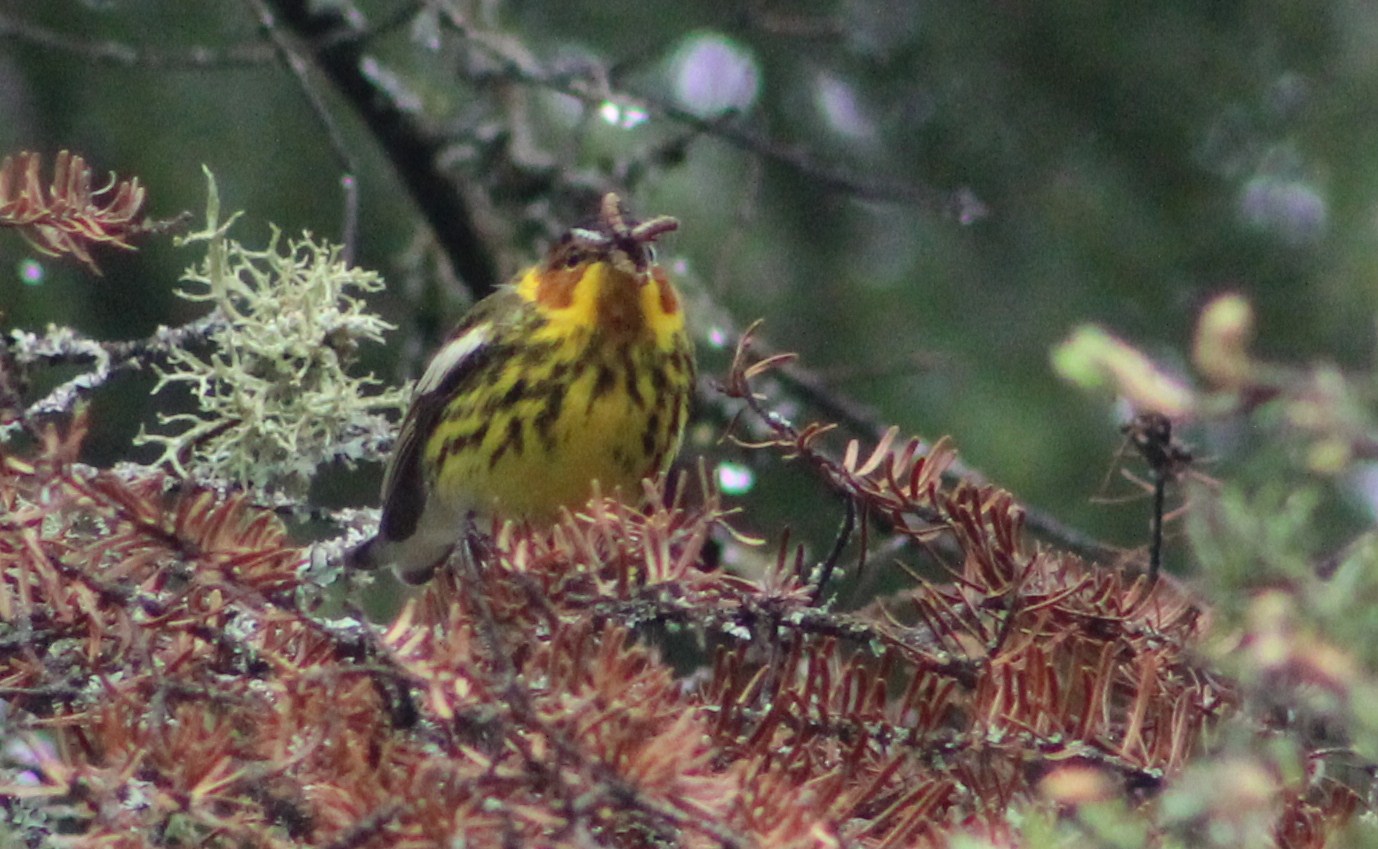
Bird wise, there were several Cape May Warblers.  One of them showed pretty well, but I was hoping for something a little closer.  And it looks like he was eating some of those freaking spruce budworms!


This Ovenbird was fun to observe for a few minutes, and it walked across branches and sang it's head off, proclaiming, "Teacher! Teacher! Teacher! Teacher!".


After Spruce Road, I was thinking about going elsewhere, such as a thirty minute drive to a few spots I covered earlier on the trip on County Road 2.  I noticed that I had plenty of awesome habitat near where I was at at County Road 1 and Spruce Road, and I decided to spend the remaining hours that I had left before heading to my hotel in Angora right along roads that were less than a mile away from Spruce Road.  I ended up liking the decision, and I was tired of driving.  As I went short distances down County Road 1, I found 3 roads to walk down and explore, as well as walking right along County Road 1 itself.


A male Blackburnian Warbler was awesome to see, as usual.


A big surprise came when this Black-backed Woodpecker came and landed on a conifer at a very close range to me.  I was shocked, and this is the best look I've ever had of this species, which I had only seen a few times previously!


I joined my family for a quick and planned ten minutes via Zoom chat online and by using my data.  The cell coverage was decent in the area.  When I heard a Cape May Warbler singing right at my limit of ten minutes on the data and battery-eating Zoom chat, I knew it time for me to go.  And that Cape May Warbler gave me everything!  I couldn't have asked for any better as the bird gave me an absolute show while it foraged low for a quick stint in midst of singing high up in conifers.


Here's a recording video I was able to get of the Cape May Warbler.


And here's a few more photographs of when he was higher up and a few more from the lower sequence.  What a beautiful warbler it is!


The area I spent birding was awesome, and I'm glad I did much more birding and much less driving.  I did want to be to my room in Angora by 7 P.M. and to bed by 8 PM, as I wanted to have a lot of energy for the next day when I would bird at the legendary Sax-Sim Bog the next day, which was only 30 minutes from Angora.  As I drove through Angora to get some food after checking in, I thought this gigantic Common Loon out on a town-park lake was awesome.


Up next on Northery Treks is as I mentioned, a visit to the legendary Sax-Sim Bog.