


And it didn't take me long before I saw those two loud songsters!


I decided to go for a hike from the truck and I hiked for almost a mile up the road towards the summit of Mount Ord.

Once at the summit at over 7100', the views are amazing of the surrounding area in all directions. Of Phoenix, of the Mogollon Rim, and of course, Roosevelt Lake to the southeast.

Up near the summit of Mount Ord, are a few Maricopa County local breeders that don't really breed in the county much elsewhere. The other high elevation areas may harbor these species in places, but high Mount Ord is probably the best place in Maricopa County to see these species breeding. One of those species is the Chipping Sparrow. The Chipping Sparrows buzzy and low-pitched song is often heard while walking up the road.

The Western Bluebird is another one of these local breeders in Maricopa County that happens to favor the higher reaches of Mount Ord in the breeding season. This bird is beautiful, and is always a pleasure to see up close. In the summer at Mount Ord, you can almost have a guaranteed Western Bluebird sighting. Both male and female are shown below, which is quite the drastic difference between the two!


And I may have discovered a new breeder for myself up near the summit of Mount Ord! As I was searching for Northern Pygmy-Owls and trying for them, I heard a few Pygmy Nuthatches calling in the woods. These tiny nuthatches are scarce in Maricopa County, but are usually annual. I've never had them in breeding season, only in the colder months, such as late fall, winter, and very early spring in the County. When I tried for the owl, they were somewhat responsive to the owl toot. Whenever I hear the Pygmy Nuthatches on Mount Ord, I always follow them to record how many of them there are. It's a species I like to keep tabs on, because they are scarce. But this time, I came across at least two of them together, and they were foraging on a bare tree with a lot of old woodpecker nesting holes in it. One of the Nuthatches was utilizing the hole, so perhaps this pair near the summit of Mount Ord is breeding. And one of the two posed nicely for pictures!

"This guy isn't an owl....let's leave!"

Besides these Ord-top breeders, at this time of year on Mount Ord, it is always extremely pleasant. Reason being, the breeders are arriving, and numerous migrants are passing through. It's always nice to hear the sweet songs of some of these returning birds, such as the Hepatic Tanager. The male Hepatic Tanager has to fight with his Western cousin for being the brightest bird on Ord, but he still comes very close! A horrible picture, but not a horrible bird..

The loud songs of the Plumbeous Vireo are in full effect pretty much everywhere now in places in the Mount Ord area that has a pine tree or two. But the Solitary Vireo complex all sound very much alike to each other. As I thought it would be a Plumbeous Vireo, it actually turned out to be a Cassin's Vireo. I like.

After being abundant and dull throughout all of the winter and into early spring, the Yellow-rumped Warblers look awesome as they come into their breeding plumage, and are in fact, still very abundant!

Rather unexpected on Ord near the summit were a few migrant Gray Flycatchers. At a first glance I thought this bird was going to be a Dusky Flycatcher, but it's longer bill and continuous Phoebe-tail-bobbing made me realize that it was a Gray Flycatcher. You've gotta love a bird with a distinctive behavior like this to make at least one empid an easy identification-I sure do!

As I finished up on the area of the top, the Spotted Towhees were still up and singing just as much as they were during the dawn of the day.


For the last 2.5 hours of my morning before I had to head back to Phoenix for dreaded work, I walked on my usual favorite route of Mount Ord, Road 1688. I love the views on this trail, even though one is still well below the summit towers of Mount Ord itself.


Near the start of Road 1688, birds were active from the start here as well. I got lucky and found this female Anna's Hummingbird tending her nest.

Something I really like about birding on Road 1688 is the fact that chaparral and juniper habitat of the Upper Sonoran Zone come into contact with the pine and oak Transition Zone.

With this mix, it gives the hike a good variety of fine avian bird life. This makes Road 1688 a good bet for Black-chinned Sparrows, and also, the popular Gray Vireo..

This Gray Vireo ended up having his girl with him, so there was a pair at this spot on Road 1688.


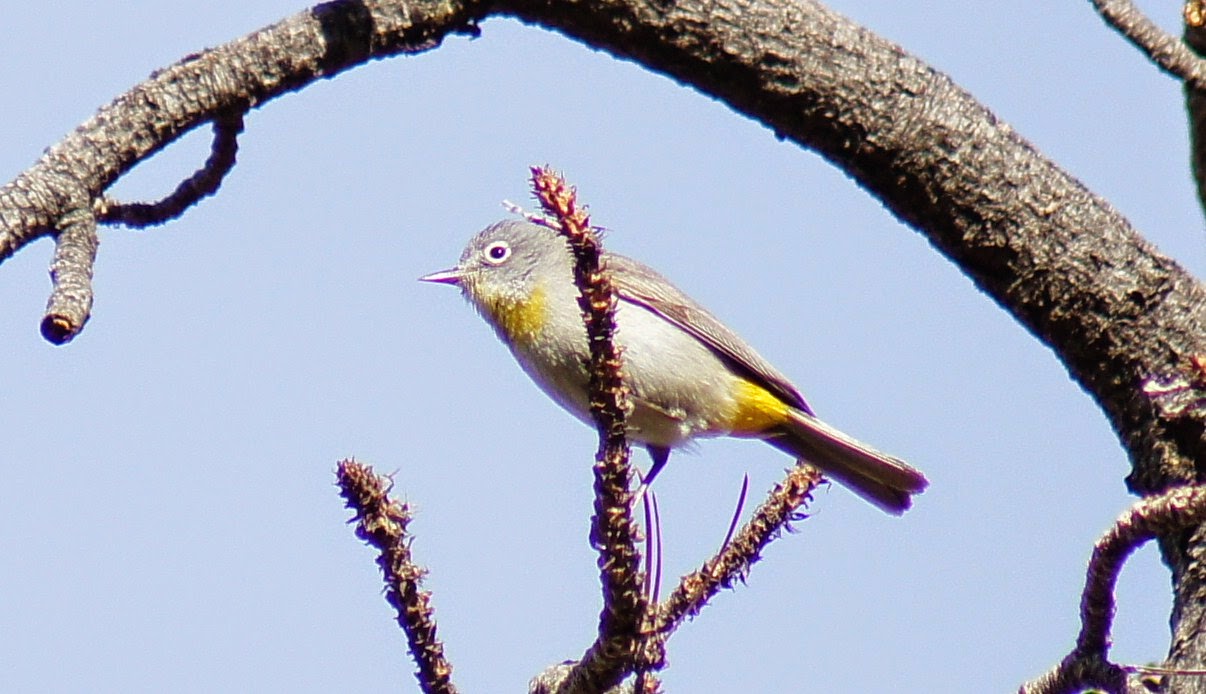
The brushy habitat that comes into contact with the pine forests is also good for Virginia's Warbler.

I've had my struggles lately with getting fair shots of male Black-throated Gray Warblers. This particular male Black-throated Gray Warbler helped me out quite a bit.

I then saw this Grace's Warbler up in it's usual place, which is high in a pine. With a strong phish, I was able to bring it down to almost eye level. Score!


Once again, and a little further down 1688, I ran into another pair of Gray Vireos. And this individual perched quite nicely for my camera.


Mount Ord is also a good place to observe the Ash-throated Flycatcher. This bird is very versatile in it's habitat selections and breeding areas within Maricopa County. They are found in the low deserts and venture all the way up into the pine forests, such as Mount Ord.

This bird is a Western Scrub-Jay. They are common and frequent the chaparral and juniper habitats. They are also pretty shy. Usually, this is how close I am able to get to one of them.

Road 1688 and the rest of Ord is always a worthwhile visit! Well, this is basically how I like to bird at Mount Ord on a regular visit. I recorded 44 species of birds for the morning. Till next time, see ya Ord!


.JPG)


