Showing posts with label Royal Tern. Show all posts

Tuesday, July 25, 2017

Birding: The True Royal Ternout

Hey everyone.  I've been very behind in this birding blog of mine lately.  It's been getting harder and harder for me to keep up on it.  Call it laziness, maybe even say it's because I'm really busy.  Maybe it's a little bit of both.  Maybe it's because I've decided to lean towards observing other wildlife rather than just birds all the time. I have really come to love odes over the last two months.  And maybe it's because I have limitations on going far away places right now.  And maybe it's because the Phoenix area typically has three good birds at this time of year which are Least Bittern, Ridgway's Rail, and Yellow-billed Cuckoo.  And maybe that occasional vagrant.  As I've been intrigued by all wildlife lately, all it took was a text message to remind me that birds are still by far in first place.  A rare bird in Maricopa County at that..one that I thought was only remotely possible someday.


Wow, Dale, wow.  Dale Clark is a friend of mine, good birder too.  I was at work when I received his text message, and I was stuck there for the rest of the day (which would include well after dark).  There was no doubt it was a Royal Tern.  Do you all know how rare that is?  Well, in Arizona's previous birding history, one known Royal Tern in 2006 circled Willcox Lake and I don't think it ever landed.  One lucky observer was there, and the rest wish they would have been there.  On July 23rd, Dale found this bird near his home in Chandler, Arizona, and I thought it would be another repeat of the 2006 scenario.  After all, Dale found the bird in the morning, it quickly flew away, and then, it didn't come back the rest of the day.  Dale, who loves others to be able to see such rarities, kept on checking throughout the day without any additional luck.  After a storm blew through the entire Phoenix area, I thought, "Yeah, that tern is for sure gone".  I played my XBox after a long day of work and decided to forget about it.  On a better side note at the time, the Phoenix Suns are the best team in the NBA on X Box and Kawai Leonard is the star of the Suns.  

On July 24th, I heard my text message alert go off at 6:38 A.M.  I knew it was most likely something that was birding related.  I rushed to my phone after getting out of bed.  Sure enough when I looked at my phone, it was Dale.  Dale said, "The Royal Tern is back at same spot!".  Within 10 minutes, I was out the door and had a 45 minute drive ahead of me to Chandler.  The location the bird was at were at a series of ponds right outside of the Sun Lakes Community, near the intersection of Riggs and Old Price Roads.  Rain clouds filled the sky, and at times, it was raining well.  Traffic had good mercy on me, and I was able to get to the spot quicker than I thought I would get to it.  This area of Riggs and Old Price Roads can be very good for birding.  It is Dale's patch, and he visits the ponds on a regular basis.  The area has hosted 170 different bird species, and Dale has an incredible number of 165.  There are a few ponds, fields, and some trees bordering the ponds.  But this time, Dale had a mega Arizona rarity on his hands and one that every birder in Arizona wants to see.  For me and the Maricopa County birder that I am, I was thinking more of how awesome it was that it was a Maricopa County record.  

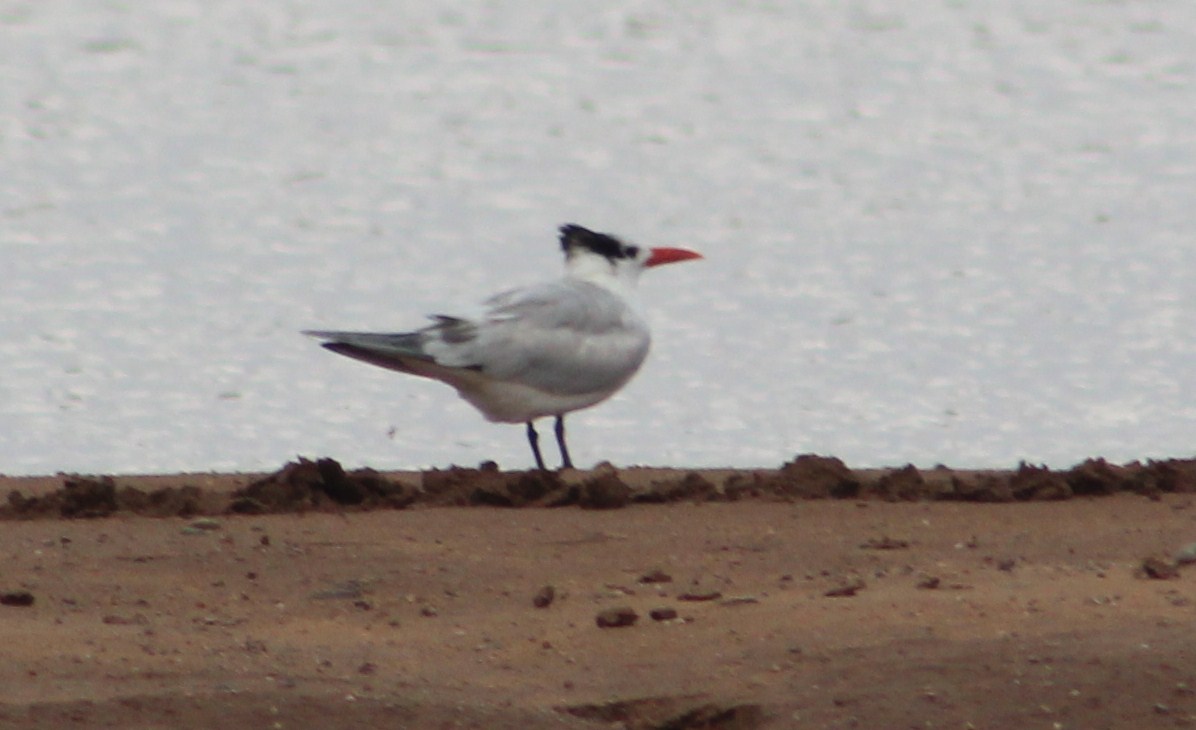
I arrived at the spot at 7:40 A.M. and found Dale.  On the west side of Old Price Road about 1/3rd of a mile north of Riggs Road, was the pond where Dale was seeing the Tern.  The bird flew off once while I was speeding up to the location, but then returned after a few minutes.  As I drove up Old Price I saw Dale, away from the pond.  He told me the bird was there at the pond, but he kept away for awhile to kindly assist others, such as me so I would be able to see it.  I looked to where Dale pointed and there was the Royal Tern, just sitting out in the open.   I drove up adjacent to the bird, who was about 100 feet away from the road.  Before returning back to where Dale was, I took some shots of Maricopa County's latest addition.


I went back and visited with Dale after getting my first good look and we eventually went back up adjacent to the Tern.  Good grief!  The rains picked up, and we started to get poured on.  I rarely say this, but I loved the rain in this time span because it was keeping the bird down.  Birds don't like to fly when the rain is pouring.  It wasn't long before birders started to pile up and chase this remarkable discovery by Dale Clark.


Prior to this outing, I have only seen Royal Tern in San Diego, California and a little north of San Diego, too.  It's a large tern that is slightly smaller than a Caspian Tern but larger than Elegant Tern.  The size of Royal Tern approaches Caspian Tern, but it is noticeably slimmer with much more slender wings and more of a slender bill.  The age of this Royal Tern is a 1st year bird.


A huge thanks goes out to Dale Clark for finding this bird, and not only for finding it, but for assisting me and many others in hopes that they would get it too.  The Royal Tern remained at the pond for most of the day on July 24th, allowing dozens of thankful birders to see it and appreciate it's vagrancy away from the coasts.  I spent an hour and 45 minutes watching this awesome discovery, and a neat bird I don't see often.  Most of the time, it sat at the farm pond west of Old Price, but a few times it flew a short distance into the Sun Lakes Community on private property.  Thankfully, it spent most of it's time at the pond where it could be viewed publicly!  I'll close this post with a series of more pictures that I took of the Royal Tern...


Royal Tern with Green Heron

Royal Tern with Great Blue Heron


Sunday, March 2, 2014

Birding Orange County, California

On this fourth day of our trip, March 2nd, 2014, Dominic and I were headed to Orange County, California to bird the Huntington Beach Area.  The plan was to bird Orange County for the first half of the day and then we were going to head to the San Jacinto Mountain Highlands to stay in a cool high elevation town called  Idyllwild overnight.  We were highly anticipating this fourth day, and were in pursuit of a very strange bird.

The Nutmeg Mannikin is established in Orange County, California all the way south to San Diego, and is a countable ABA bird.  This is similar to my Phoenix Rosy-faced Lovebirds.  Dominic and I chose to bird a park that is a good bet for the Mannikin, which is called Huntington Central Park.  We chose to bird that for a few hours early in the morning in search of the Mannikin, which would be a lifer for both of us.  When we arrived, we weren't having much luck with the Mannikin, but I did hear my first lifer of the day....a Nuttall's Woodpecker.  The Nuttall's Woodpecker is very similar to the Ladder-backed Woodpecker, but has several visual differences and is vocally different.  The two species have ranges that don't strongly overlap, and also have different habitat preferences.  In the Nuttall's Woodpecker, the bird has solid black on it's upper back, which is one of the best field marks.  As we walked over to where we heard the bird calling, we quickly found it!  It was my 19th lifer of the birding vacation.


Huntington Central Park is huge, and has had a lot of birds over the years, including some remarkable rarities.  One could easily spend a day birding this large park.  Another cool highlight we had was this singing "Sooty" Fox Sparrow.


The trees were dripping with common warblers.  One of them included this nice Townsend's Warbler.  Although the picture is blurry, it was a great memory of seeing this bird.


A rare Rusty Blackbird was also being seen at the park.  Dominic and I looked for it, but came up empty.  Two hours later, we were still walking through the park without any Nutmegs.  We decided to give the nearby Seal Beach a shot at a few recently reported Black Oystercatchers before coming back to the park to try once more for the Mannikin, which we thought would be very easy.  Regardless, the park was a very beautiful place and was fun to walk through.


We then headed shortly west to the Seal Beach area to look for three previously reported Black Oystercatchers.  Dominic and I checked numerous jetties without any luck of finding that striking and large black shorebird.  At least we tried, and it's hopefully a bird I can see on a future birding trip.  But we did have some incredible highlights during the time at Seal Beach, starting with several Surf Scoters in breeding plumage.  What a striking duck this is!


We then started to walk out and about at Seal Beach.  This was the first place I ever looked at birds briefly on the coast when I was with my church youth group in 2003.  The impressive deck goes out to a nice restaurant.  Back in 2003, I walked that entire deck.


On the beach we found a nice-sized flock of terns.  We were glad to pick out an Elegant Tern in midst of the flock, which was dominated by Royal Terns.  Over the next 15 minutes, Dominic and I had a great chance to study terns.


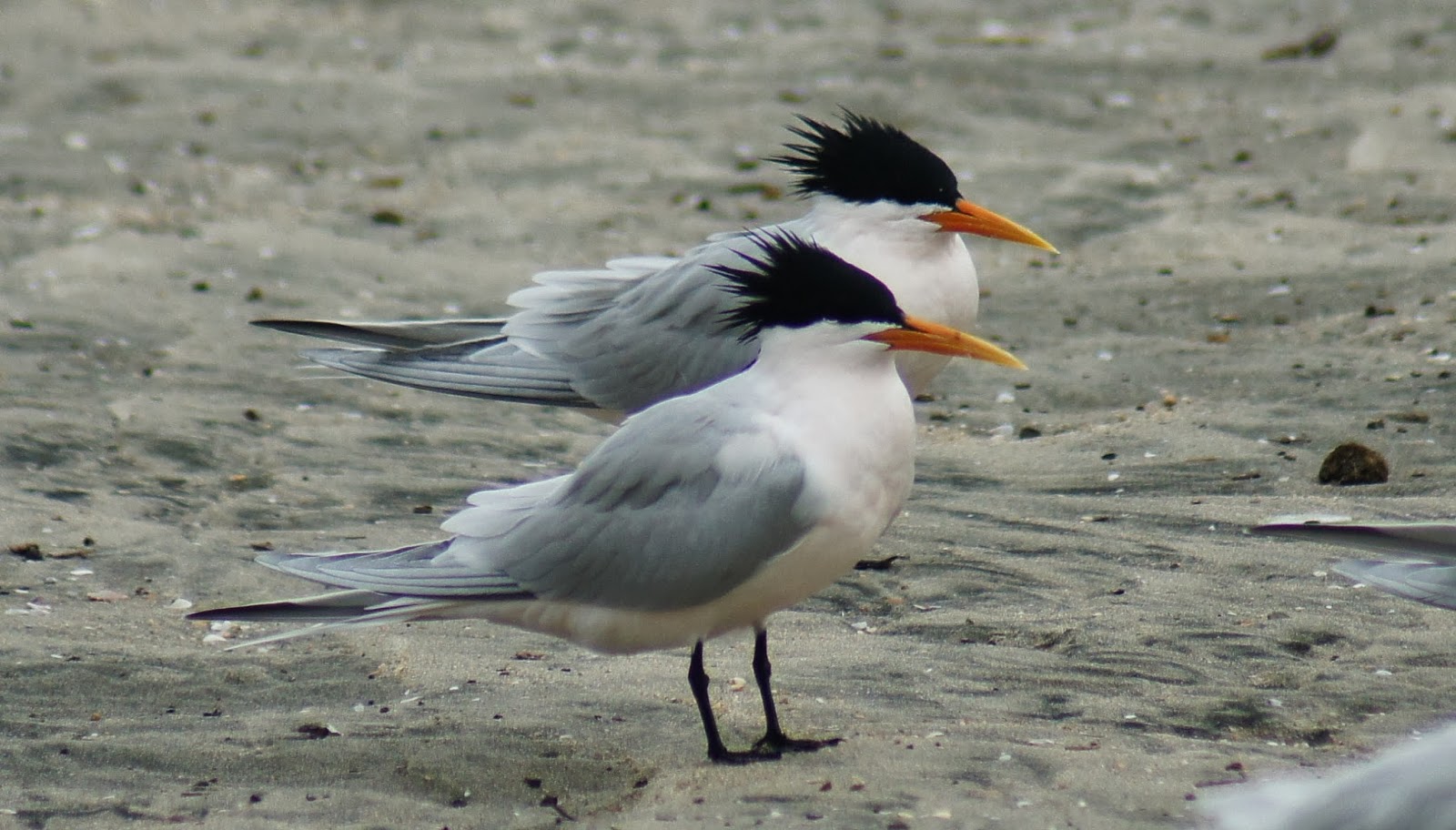
There are three large terns in this area.  Since the Elegant Tern was the one we got excited about, I'll start with that one.  In the tern flock, there ended up being 3 Elegant Terns.  As you can see, the Elegant Tern in breeding plumage has a long, droopy bill, and a very long crest.  Royal and Caspian Terns don't have nearly as long of a crest (Caspian hardly has a crest at all) as Elegant does.


While both Caspian and Royal Terns tend to have noticeable black on their under primaries in flight (Caspian way more than Royal, Royal mainly in non-breeding), the Elegant doesn't have much of it at all in flight.  Elegant also has a much more graceful flight, almost like that of a small tern.


And now, I'll display my pictures I took of the Royal Tern.  The Royal Tern has a much larger and thick bill than Elegant does, and it is noticeably bigger than Elegant, and slightly smaller than Caspian.  Both breeding and non-breeding plumaged Royal Terns were present in front of us.


Royal Terns have a very powerful and direct flight, which doesn't really have the graceful appeal to it like an Elegant Tern does.  Regardless, if these birds are distant and are flying over the ocean, they do take some time to learn about.  I found myself in question over a lot of the distant terns I have been seeing on the trip.


To me, Royal and Elegant Terns aren't as distinctive in flight and perched as the Caspian Tern is.  This experience really gave me my first chance to ever study these two species side-by-side and in comparison with each other.  Before this trip, I had only seen one rare-in-Arizona Elegant Tern, so this was a great chance for extended study of these two species.  Here are a few comparison shots of the Elegant and Royal Terns.


As Dominic and I were looking at the Royal and Elegant Terns, we didn't realize there were two of the largest terns standing there at first!  It took us awhile to notice, but we gave Prince Caspian a nice welcome.


As one can see, the Caspian Tern is much heavier and has large and very dark red bill.  In non-breeding plumage, the Caspian Tern retains most of it's dark cap, despite the fact it looks more washed out.  


In flight, the Caspian Tern has noticeable and extensive black on it's under primaries.  It also has more of a large gull-like appearance to it when it is in flight.  In other words, it's flight is very gull-like, and not very tern-like.


Terns aren't the easiest of birds to identify when they are in distant flight or are in non-breeding plumage on top of that.  Perched birds up close are much easier, and I feel like I learned a lot by studying this flock up close.  This experience was a great start.  As I look through my photos, I realized I have all three of these larger and somewhat large terns in one frame.  The Caspian Terns were there all along, even before we walked up.  Try to find all three in this shot!


Now, where are we?  Oh yeah, we are still at Seal Beach.  A sealless Seal Beach.  We then went up to the shore, and had a mixed up and incredible frantic flock of feeding shorebirds.  The flock contained Marbled Godwits, Sanderlings, Black Turnstones, and Willet.


Seeing this raft of Surf Scoters out at sea was very awesome too!


As rain was soon moving in, we left Seal Beach to try one more time for the Nutmegs at the Central Park.  After another hour, we came up empty on the Mannikins :(.  However, I'm almost positive I heard them at one side of the park.  As we walked over to that area, we were unable to find them.  The Nutmeg Mannikin was recently added to the ABA list in 2013, and is the 981st ABA bird.  We did see a few birds though also on the second time around Huntington Central Park.

Northern Pintail

 Red-shouldered Hawk

As we left Orange County, we drove for almost two hours until we reached the San Jacinto Mountains, to stay in a mountain town called Idyllwild.  This area is extremely beautiful, and the town has nearly 4,000 residents!  It is kinda like a sky island range in a way.  We arrived later in the afternoon, and it was raining, and most of the mountain was foggy.  Dominic and I were highly in pursuit of two birds in this range, the elusive Mountain Quail and the striking White-headed Woodpecker.  We visited a nature center, where both species have been seen.  White-headed Woodpecker often comes to feeders here.  Nothing really came to the feeders, but I did hear a White-headed Woodpecker calling.  The bird disappeared right when we were about to get to it's location.  I heard a couple more of them in the hour or so we looked in the rain without seeing one, so I knew our chances were higher in the morning in hopes of it being more clear outside.  Dominic and I were anxious about starting the search in the morning.  After a delicious mexican meal at Arriba's, we stayed in a neat cabin overnight in Idyllwild.  The San Jacintos were bound to have great birding in the morning!  As for tonight, we had to enjoy it in the rain.