After South Padre Island, we were still close to the eastern side of the Rio Grande Valley. And after South Padre Island, we still had one more adventure we wanted to attempt in the Rio Grande Valley...
The Rio Grande Valley is one birders can't get enough of, especially in the sections of three full days that we birded in and around it. It's a place that I would love to spend a week or more in and to simply take my time while slowly birding all of the Valley. There is much to see and much to discover at all times of the year. This last expedition was on the shorter side, and it took us into the grounds of the Lower Rio Grande Valley National Wildlife Refuge. True to the other locations in the Valley we had visited, this area hosts the usual bird suspects and a plethora of exploring that can be done. It is also known to be home to the endangered Ocelot, the small wildcat that is a ghost to most visitors in the region. In the short time that we had, we were after Ferruginous Pygmy-Owls.
Ferruginous Pygmy-Owl is arguably the most wanted and toughest owl to get in the United States. It has the smallest range of any owl in the family, and it has to talk in order for birders to land it. I've had my fair share of Ferruginous Pygmy-Owls in Arizona and so has Caleb. David had seen the owl in Arizona on a trip he took and Liam had them previously in Texas. For Josh, it would be a highly wanted lifer, and we made a point to make an attempt for it. During the trip, we were also closing in on 300 species for Texas, and we all wanted to have a Texas Ferruginous Pygmy on there too!
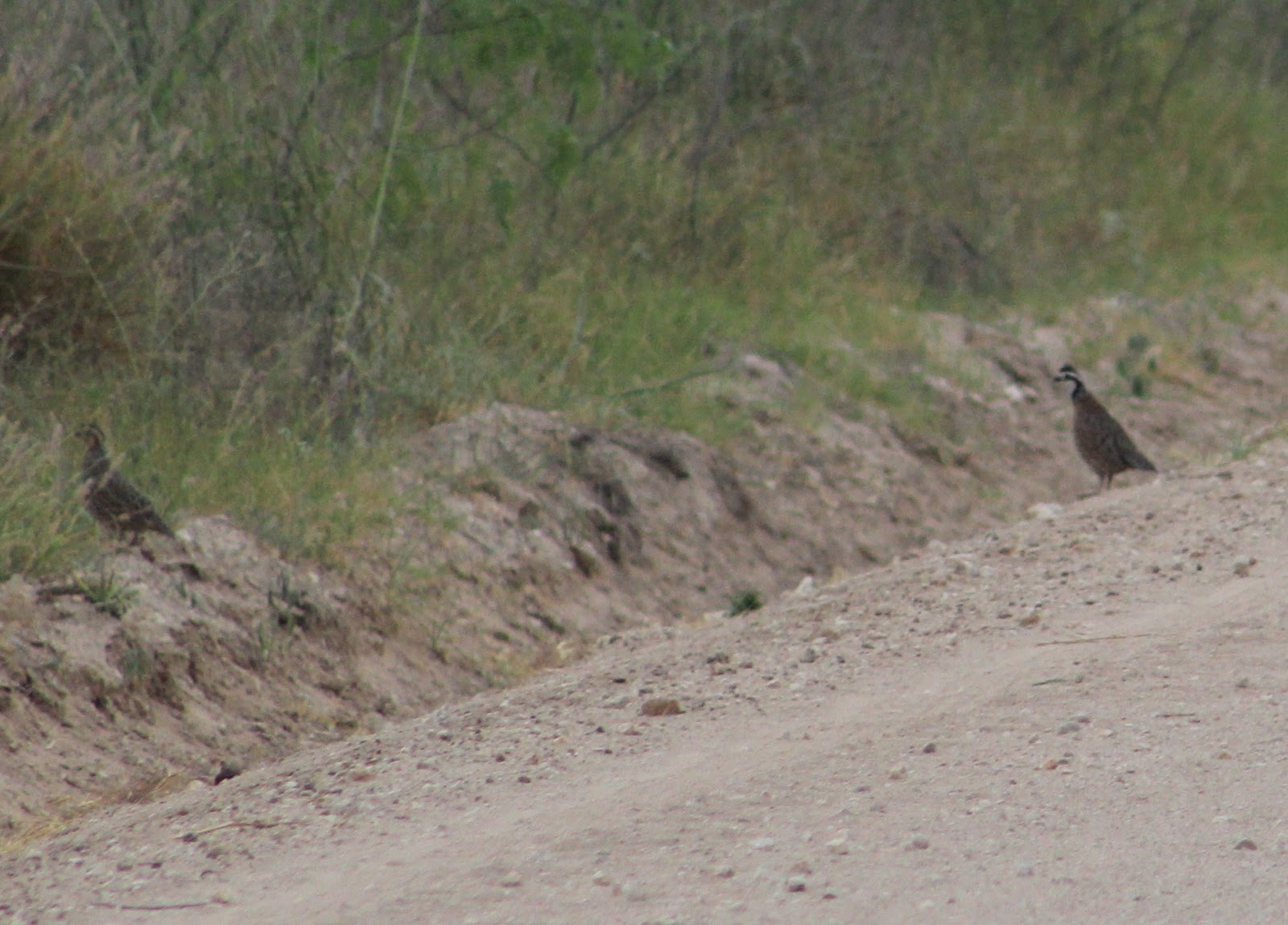
David, Josh, and I took one car to a location on the Refuge to look for owls and Caleb and Liam took another one. The day had become overcast and I thought that could boost our chances for the owl. At one point, Josh mis-read the directions for one spot that we were going to visit. We had to forget about the spot because we had already driven too far out of the way to go back, and it left us with one other spot that we were supposed to check. Liam and Caleb were searching a spot about forty minutes away from our spot. Josh had David go onto a dirt road, where we stopped at a spot that was said to be good for our target. We saw a few birds walking across the road, and I was thrilled that we chose this spot because these birds were my first ever real views of two Northern Bobwhite.
In eastern North America across farmlands, fields, brushy habitats, and grasslands, the call "Bob-Wheeiiit!" is a common sound. The second note of the call is much higher pitched and exclaimed than the first note, and it is clear that this is where this quail gets it's name from.
Northern Bobwhites are secretive birds, but their common numbers give birders good chances for observations. They travel together in flocks or "coveys" and try to find as much cover as possible. These coveys may have numbers that go from anywhere from three to fifteen birds, and they roost on the ground at night in groups that sometimes number thirty. The Bobwhite feeds mostly on seeds and leaves, as well as insects.
There are several subspecies of Northern Bobwhite in North America, including the endangered and southwestern race known as "Masked Bobwhite", which is being re-introduced into southeastern Arizona. For the common Bobwhites of the east, they are an important species to have habitat managed for and they are also a very popular game bird.
While pursuing the Bobwhites further, I lost track of them as they blended into their environment perfectly at a close range. I didn't realize how close I was until they flushed. At that time, I thought I heard a few "toot" calls that sounded like a Ferruginous Pygmy-Owl. They were immediately followed by a selection of notes from a Northern Mockingbird. The same thing happened again, and again. I was confused, and thought the owl-like notes had to have been coming from the Mockingbird. I looked down the road and it didn't seem to have caught David and Josh's attention.
As I continued to listen, I heard the owl-like notes again and this time a Mockingbird didn't immediately follow the notes. Just like that I knew we had a Ferruginous Pygmy-Owl and I keyed David and Josh into the calls. We walked up the road towards the calls, and luckily, it was an active owl who was delivering notes on a regular basis. On another lucky note, the calls were coming close to the road when the property of the Wildlife Refuge was a barbwire fenced-off on both sides and it would've been interesting to slide under the fence (and trespass). This owl was awesome, and didn't give us too much trouble.
The FEPO switched perches a few times, but for the most part it stayed put and was cooperative for us right along the road.
Those of you who know me well know that owls are my favorite family of birds. Ferruginous Pygmy-Owl is one that I'll want to see anytime, and this was only the fifth sighting that I've had of the species. I also love to see people get owls as life birds. As I said earlier, this was Josh's first ever FEPO!
The Cactus Ferruginous Pygmy-Owl, subspecies cactorum, is the subspecies that is found in Arizona. It is paler than the Texas subspecies of FEPO, which is called ridgwayi. The Texas subspecies of the owl is more rufous and brighter than the Arizona subspecies, and this Texas bird gave me some of the best views I've had.
Here is a picture of what the general Ferruginous Pygmy-Owl habitat looks like in the Rio Grande Valley.
Meanwhile, as Josh, David, and I were enjoying the heck out of an owl, Liam and Caleb were at a spot that was said to be much better for the bird than the one we were at. When we checked in on them to see how they were doing, they weren't having any luck. The overcast conditions that were common on our trip was something I wasn't fond of, but in this case, I think it may have contributed to the owl calling in the middle of the afternoon. Show us both sets of eyes, Mr. FEPO..
Pygmy-Owls are small owls that are fierce and will prey on birds that are larger than themselves. Due to their diurnal nature, they would also be prey for other owls and raptors. The Creator gave them false "eyes" on the back of their head to ensure their survival. When a predator sees a Pygmy-Owl, most of the time it will consider the chase a lost cause because it thinks the owl is already looking in their direction and will likely escape. Because of those false "eye spots", Pygmy-Owls remain as a heavy force in Mother Nature's balance.
The word "Ferruginous" means rusty in coloration, and it's where this small owl gets it's obvious name from. Because I'm obsessed with owls, here's a series of closing photographs to close out this FEPO observation.
With a productive smaller adventure going down as a success for our trio, it was a great to succeed on Ferruginous Pygmy-Owl like we did. This bird was brighter than the ones I have seen in Arizona, and I have to say I liked it better than the Arizona birds. We were about to head off and go further northeast along the Gulf Coast in Texas, and leave the Rio Grande Valley for the final time on the trip. Every location we visited and birded within this Valley was spectacular, and I know that I want to go back again in the years that are soon to come. I said bye to the Rio Grande Valley for the time being and when a Green Jay popped up as we were leaving, it was the perfect way to say, "till next time".
Walking underneath the canopies of dense riparian forests is an astonishing event when birding. The birder may hear and see as many birds as they possibly can, but with human limits and gravity, their only option is to be highly limited guests in the birds homes. Flight is a limitless gift that has been equipped to these creatures we have come to enjoy as much as we have, and it would be impossible to truly witness the mysterious life of birds. When we stop and think about it, the mystery and life of birds one of the best aspects to this crazy hobby of ours.
Some buildings we have created can put us in places at times that allow us to get better perspectives and ideas of what bird life is really like. These structures do have their limits and they can't stretch very far, but they are well placed and they enhance birding adventure while they speak catchy volumes of curiosity. Plus, these placements give us some of the best views we could possibly have.
While walking across elevated bridges or standing on a tower at one location where you can see for miles, it put me in a neat position where I was in midst and above the thick canopies of the subtropical Rio Grande Valley forest. The songs and calls of birds were either level with me, or I was above the action. My viewpoint was one that I don't witness very often, but it has left a reminding impact. I looked just below my level to see a Green Jay perched above the forest as high as it could. It was slightly above the treetops, and was sitting there quiet and motionless. If the other surroundings weren't as incredible as they were at the Santa Ana National Wildlife Refuge besides this viewpoint where one could "bird above the treetops", I could have stayed on this level for hours. Speaking of Santa Ana, it is that good and this post will fall in line with our adventure through it's many trails, thick woodlands, riverside surprises, bird abundance, cool birders to bird with, and the chances to have awesome sightings from a "bird's-eye view".
In Texas Times, we are now on the early morning of May 3rd, 2019. The four of us were eating breakfast before we would head over to the Santa Ana National Wildlife Refuge. Looking over the species we could see and the diverse habitat selections found across Santa Ana, it caught my attention more than any other stops did on the trip. We had a lady named Stephanie join us for breakfast, and she was from Massachusetts. She was probably in her mid-50's, and we had run into her the previous evening at Bentsen-Rio Grande Valley State Park while she was riding her bike around. Stephanie was a cool lady, and she thought it was really cool we were on the birding adventure that we were. Likewise, she was on her own neat adventure as she loved to travel throughout the United States and ride her bike around as many places as she could. She had a lot of exploring ahead of her for her day too. After breakfast and on our way to Santa Ana, we encountered our lifer Green Parakeets flying over the road. Green Parakeet is an established exotic in the Rio Grande Valley region, and it was good to tick it off for the trip. Red-crowned Parrot is another countable established exotic, but during our time in the area, we didn't encounter them. Exotics go in an ear and out the other for me, and what was on my mind the most was an all-out effort of birding Santa Ana, where we arrived at at 7:50 A.M.
After getting out and starting to hike along the beginning stretches and entrance of Santa Ana National Wildlife Refuge, I was in love with the place the first time I took a look at the map on a sign. You know, one of those maps that point out, "You are here", and you glance further and see that this is there and this is down there and these are over here..oh yeah. Santa Ana is filled with many trails that go along a variety of habitats, trails that circle ponds, lakes and wetlands, trails that take birders to the Rio Grande River, and trails that give birders all the birds. On top of that, an observation tower and canopy board walk in close proximity of each other raised the fun to it's maximum. The Refuge lies almost as far in extreme South Texas as one could possibly get, and it has a close proximity to a variety of different biological regions and habitats nearby.
Rather than birding around the entrance to start the day off, we immediately blitzed the trails. A Great Kiskadee was one of the first birds to start our morning off.
We made our way over to the Pintail Lakes trail, which had several small lakes. David caught sight of an Anhinga that slipped away before any of the rest of us had the chance to see it. The calls of Plain Chachalacas were everywhere to start off the day, and one could clearly hear the entire "Chachalaca". Dickcissels and buntings could be heard in the grassy fields around the lake. Altamira Orioles were heard in the tall riparian forests surrounding everything. A few Groove-billed Anis were present and were awesome to see on the trip, but they rarely showed themselves well. If it weren't for an Arizona vagrant that I saw several years ago who showed well for a birding crowd, I would have tried much harder for better photographs.
Pintail Lakes were an awesome quick start to our Santa Ana adventure, and we were only getting started.
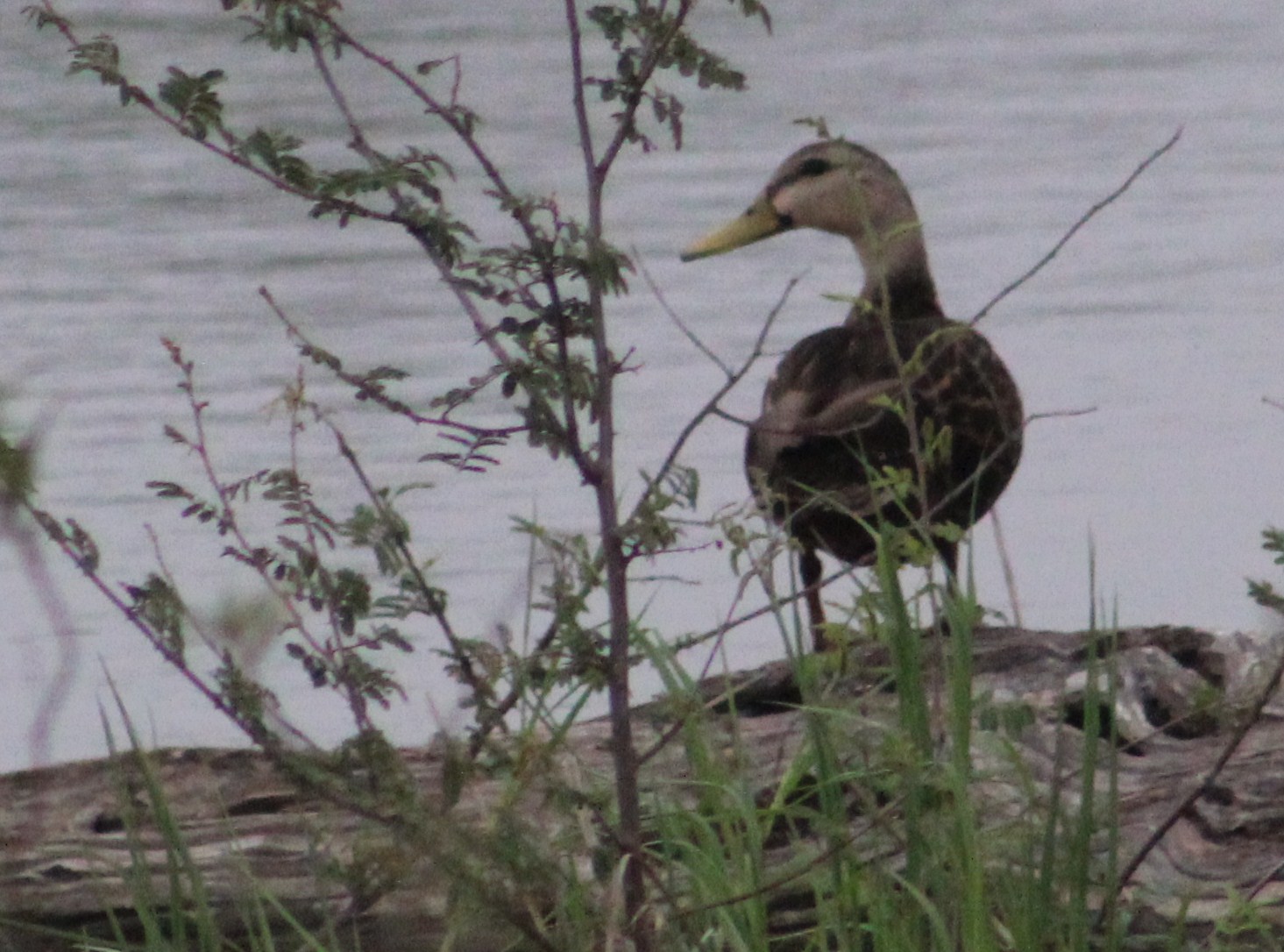
A small log floating just off of the shore of one of the Pintails was a lifer for Josh, Caleb, and I in a Mottled Duck.
The Mottled Duck is very closely related to the American Black Duck and Mexican Duck. They reside in southern marshes, ponds, and coastal prairies in the United States from south Texas, the Gulf Coast, and extending east to Florida. For a pure Mottled Duck like this one (they hybridize withe Mexican Duck frequently), good identification field marks to look for are a black spot on the gape of the lower mandible, a bright yellow bill, an unmarked buffy throat, and warm brown body coloration below the neck. In flight they show very narrow white bars on both sides of their speculum.
When a Least Grebe popped up in the same Pintail as the Mottled Duck, it was a lifer for Caleb, Josh, and David. I've seen a few of them in Arizona, and it was cool to see one for the first time in the Rio Grande.
An Eastern Kingbird hunted around the lake edges.
What was really cool was when a Great Kiskadee was close by to me and put on a show for as it hunted and fed near the water's edge. This Kiskadee displayed some of it's bright yellow center in midst of it's mostly black crown.
While on the Pintail Lakes trails, Josh and David split off from Caleb and I. They wanted to take a trail that went south and went right along the Rio Grande River. Caleb and I wanted to access the lookout tower and canopy walk features in the Refuge. Our first White Ibis of the trip flew by, and it was a lifer for Caleb and only my second sighting ever.
Caleb spied these Semipalmated and Stilt Sandpipers flying around one of the lakes.
Ryan and Leah came to Santa Ana not long after we did, and Caleb and I would meet them at the watch tower and canopy walk. I was in the mood to bird within the riparian galleries, and so was Caleb. Caleb really wanted to scan from the watch tower for raptors and other birds, and while I wanted to do that for awhile, I wanted to run through a good portion of the Refuge by myself. Seeing Spanish Moss hang down from many trees was incredible, and is often an attractant for Tropical Parula.
Once we got to the area of the high watchtower and canopy walk, we thought both of them were awesome. We started with the canopy walk, which was a similar to a bridge and a boardwalk combined. It was level to the forest canopies, and while I'm usually a little scared of heights, this was one I found to be nothing but freaking awesome.
Thinking back now, I would've liked to spend more time on the canopy walk. Once Caleb and I spent a few minutes on it, we climbed up a steep set of circular stairs that went up a lot higher than the canopy walk to the lookout tower, where we joined Ryan and Leah for what was primarily a raptor watch. The views were awesome and very elevated, where one could see for miles.
I hoped that at any second that we were up on the high tower, that a Hook-billed Kite would make a pass over the trees nearby and would join us. Right when we got to the top, Josh called me and said that he and David had a very possible Blue Mockingbird on the Mexico side of the Rio Grande River. It was certainly a bird that I wanted to see, but then, I liked where I was at within Santa Ana. I told Caleb about the Blue Mockingbird and asked if he wanted to search for it, and he simply said, "Na, I wanna stay up here". We told Josh to let us know if they found it again, as it did give Josh and David a very suggestive but inconclusive look, and then followed that up by disappearing. While keeping an eye out for raptors, (which we did see some of), it was a blast to enjoy the views.
A Chachalaca sat near the top of it all too...
As did Golden-fronted Woodpeckers...
And so did that striking Green Jay..the best of the tree toppers...
Some of the raptors we observed while I stayed on the tower were Osprey, Mississippi Kite, Cooper's Hawk, Gray Hawk, Broad-winged Hawk and Swainson's Hawk. The tower watch lasted about twenty minutes for me, and I wanted to solo-it and walk what would be about a three mile loop through the north and west side of the refuge, while planning to complete the Willow Lakes and Cattail Lakes Loop Trails. I started on my hike and enjoyed it for awhile. Birds were everywhere, and so were the great sights of Santa Ana.
A pair of Least Grebes highlighted my solo hike as I passed by Willow Lakes. Among the near fifty species I had started to observe on my hike were Black-bellied Whistling-Duck, Plain Chachalaca, White-tipped Dove, Grove-billed Ani, Yellow-billed Cuckoo, Gray Hawk, Broad-winged Hawk, Golden-fronted Woodpecker, Northern Beardless-Tyrannulet, Great Kiskadee, Couch's Kingbird, White-eyed Vireo, Green Jay, Bank Swallow, Black-crested Titmouse, Clay-colored Thrush, Long-billed Thrasher, Olive Sparrow, Orchard Oriole, Altamira Oriole, Rose-breasted Grosbeak, and Dickcissel.
After hiking for over a mile and well past the Willow Lakes trails and as I was getting into the section of the Cattail Lakes trails, I had a call incoming from Caleb. When I answered, he said, "Tommy! David and Josh just found and photographed a Gray-crowned Yellowthroat along the river. It's on the Mexico side but they are getting looks at it and it's singing. We should meet back here by the tower". Even though I was a mile away, I spent most of my time running back to the tower. I knew that Gray-crowned Yellowthroat was worth a workout in high humidity, and I was also thinking, "gosh, David and Josh are awesome". About 15-20 minutes later, I met Caleb, Leah, and Ryan and we started to hike for about another mile over to where Josh and David were stationed out along the Rio Grande. Before we would start, we enjoyed two snakes: the popular and coveted Texas Indigo Snake as well as the much more common Ribbon Snake. Ryan and Leah know a lot about herps.
Texas Indigo Snake
Western Ribbon Snake
Before we knew it, we got to the river and we started to walk down towards where Josh and David and the Gray-crowned Yellowthroat were stationed out at.
The Gray-crowned Yellowthroat, who is closely related to and at times hybridizes with Common Yellowthroat, is a casual visitor (very rare) to southern-most Texas. Back in the early 1900's, it had a nesting population in the lower Rio Grande Valley that was eventually eliminated due to habitat loss. Since that time it is a casual vagrant and can be challenging to spot as well as confirm due to hybridization with Common Yellowthroats as well as plumage variation with Commons. We walked up to the spot and found David and Josh, and it didn't take long for them to point out the song of the Gray-crowned Yellowthroat, which sounds more Painted Bunting-like than "Yellowthroat-like". Minutes later, they had their discovery in the scope.
David and Josh put their sighting out on the ABA Rare Bird Alert, as Gray-crowned Yellowthroat is one that many birders will seek. The six of us stood and watched in amazement, and we also hoped that it would cross over to our side of the river. You know it by now, right? The Gray-crowned Yellowthroat was in Mexico and we were in the United States.
The Gray-crowned Yellowthroat is larger, longer-tailed, and thicker-billed than Common Yellowthroat. It has a dark upper mandible and pale lower mandible, and unlike Common Yellowthroat, the black on it's face is only found in the loral region. Although hybridization occurs within the two species, this bird showed all of the classic field marks characteristic of pure Gray-crowned Yellowthroat.
After observing the bird for about ten minutes, Josh and Caleb went to the spot where Josh and David observed the likely Blue Mockingbird. David, Leah, Ryan, and I stood there and watched the Yellowthroat sing away, with good views through the scope. At one point it dropped down, and I heard them say "oh, it dropped down" as if that's all they saw it do. I was at an angle where I saw the bird drop down in full view, start flying towards us while low to the water, and it proceeded to fly across the halfway mark of the river and into dense cover of the side of the river we were on! "Guys, it just CROSSED the RIVER!!", I yelled out, "I'm serious, it just crossed to our side". They looked shocked, but seconds later the Yellowthroat repeated his usual song only it was right in front of us. We celebrated the fact that we were officially able to add the bird to our ABA lists. It was a big deal! The Gray-crowned Yellowthroat flew back to the Mexico side of the river after a few minutes, where we continued our observation of scope views and listening. Wow, what an incredible time in birding and what a fantastic find by David and Josh.
After the Gray-crowned Yellowthroat, there was still plenty more of good birding to be done at Santa Ana. An Altamira Oriole nest was a highlight to see.
Olive Sparrows were very common in the Refuge, and we had a running tally of 37 of them.
There were pushes of migrants in different places throughout the hiking trails. One that I really enjoyed was this striking Black-throated Green Warbler.
After we got done with the trail that took us to the Rio Grande River from the Pintail Loop Trails, Ryan and Leah would go elsewhere, including the Brownsville dump to see if the Tamaulipas Crow would make any appearances. We made sure to snap a few fun photos of our group before people would go to different places.
L-R: Ryan, Caleb, Josh, David, Leah, Me
The Maricopa County birders: Caleb, Ryan, Me
At this point, it turned out that Josh, David, Caleb and I were only getting started at Santa Ana. I mentioned to Caleb something about covering one of the bigger loops of the Refuge that would take us throughout most of the area. Without hesitation he said "yeah, we should do that". While the heat and humidity really set in for the day, we hiked for close to four miles without much water. It was probably a stupid decision, but we ended up with a really good bird list. Between the four of us, we had 105 different species of birds at Santa Ana. We ended up taking the main paved trail south from the Visitor Center, and took that around to end up at Cattail and Willow Lakes. It was exhausting, and it was good when it was over. But again, we had an epic bird list. Out of the 105 species, I had 98 for myself and my buddies each had over 100.
Total highlights (with some numbers) at Santa Ana among those 100-plus species present included Black-bellied Whistling-Duck, Blue-winged Teal, Mottled Duck, Plain Chachalaca (12), Least Grebe (4), Anhinga (David only), White-tipped Dove (6), White-winged Dove (425), Groove-billed Ani (5), Yellow-billed Cuckoo (7), Common Nighthawk, Chimney Swift, Buff-bellied Hummingbird, Stilt Sandpiper (7), Semipalmated Sandpiper, White Ibis, Mississippi Kite, Broad-winged Hawk, Gray Hawk, Harris's Hawk, Golden-fronted Woodpecker (26), Crested Caracara, Northern Beardless-Tyrannulet (11), Eastern Wood-Pewee (7), Great Kiskadee (14), Tropical (9) and Couch's Kingbirds (33), White-eyed Vireo (16), Blue-headed Vireo, Green Jay (18), Black-crested Titmouse (34), Carolina Wren (8), Clay-colored Thrush (10), Long-billed Thrasher (18), Northern Mockingbird (52), Olive Sparrow (37), Orchard Oriole, Altamira Oriole (8), Bronzed Cowbird (54), Gray-crowned Yellowthroat (RARITY), Chestnut-sided and Black-throated Green Warblers, Rose-breasted Grosbeak, Indigo Bunting (8), Painted Bunting, and Dickcissel (94).
One thing I wish I had more of was more photographs of the different birds. The skies continued to be overcast and photography was difficult. As we were close to leaving the Refuge, we ran into fellow Arizona birder Henry Detwiler. Henry is doing his own Big Year and was working his way around the states. He visited Florida before Texas and found the ABA's second ever record of Red-legged Thrush, which was an astounding discovery. After catching up with Henry, he told us about a Yellow-green Vireo that had been found at the Quinta Mazatlan World Birding Center where we had birded the previous day. We thought then and there that it would be good to chase the bird.
Exhausted and going on being dehydrated after hiking for eight miles, we finally made it back to the visitor center. The visitor center was a neat place, and they had some awesome bird feeding stations that could be watched by looking out the windows. What was shocking was this Northern Beardless-Tyrannulet who clung to the window and put on a show for people. For Josh, it was his first views of the small flycatcher.
Here's a video of the odd Tyrannulet behavior:
Santa Ana National Wildlife Refuge would turn out to be one of my very favorite birding stops of the entire trip. I love how diverse it was in birds and habitat selection. It's a place where one can spend an entire day, and one day might not be enough to cover the mass of it all. What I know now is that it's certainly a place I want to visit again in the future.