Showing posts with label Plumbeous Vireo. Show all posts

Thursday, December 5, 2019

In The Gila: Warbler Neck to Scoter Scans

Fall is one of my favorite times of year for birding in Arizona.  Songbird migrants that are common to rare can show up in any given habitat, and it's also a great time to scan water bodies for a variety of waterbirds.  The time frame of fall lasts from September through November in the birding world, and the best thing birders can do is get themselves out there to search different habitats.  For my Gila County birding trips, fall was greatly welcomed.

As I wrote in my last post for In The Gila, most of my summer was consumed by birding in high elevation forests and canyons in the Mogollon Rim and Sierra Ancha Mountains areas.  I went to San Carlos Lake with Caleb a few times.  As the early fall rolled in, I found a fun migrant in a Gray Catbird along the East Verde River (see last post), and Gila lifers that I got at San Carlos Lake that I wasn't able to photograph were Cave Swallow, Laughing Gull, and Lesser Yellowlegs.  All three of these San Carlos birds were seen with Caleb, and the Lesser Yellowlegs was my 315th bird for Gila County (It was a bit overdue).
I began my fall searching for warblers and other songbirds in late August.  Riparian habitats right in Payson were a starting point, and it was still hot enough to retreat to higher coniferous forests later in the day.  While one might look upwards for most warblers, I caught sight of a rare Northern Waterthrush as well as a cooperative MacGillivray's Warbler at American Gulch in Payson.  Both of these warblers stay low to the ground on most occasions.


An exploration of the San Carlos River with Caleb also produced another Northern Waterthrush.


Once September hit, I wasn't able to go birding until September 16th in Gila County.  That California trip took place and took four days which would equal my days off of work for two weeks.  When I did get back into things, I searched this awesome riparian area within Rye Creek, which is just north of Jake's Corner.  Rye Creek has thick cottonwood and willow habitat nestled in a valley.  Something that I really like about it is that most of the habitat is right along the creek and it doesn't take very long to cover the area.  The spot is lush and I can see it producing some great birds in the future.  I birded Rye Creek some during the summer, and my first fall visit gave me a variety of over fifty different bird species.  Migrants were abundant, and the rarest bird that I was able to find was a Black-and-White Warbler.


Plumbeous Vireo at Rye Creek

Tonto Creek via the towns of Tonto Basin and Punkin Center is a great place to bird.  On September 21st, I birded the creek via A Cross Road.  It was incredibly birdy, and I had 64 species in just over 4 hours.  I spent a lot of time looking up for warblers and it resulted in the classic sore "Warbler Neck".  A Cross Road at Tonto Creek is a spot I haven't started my day at very often, but this time proved to show how productive it can be.  Here is a link to my eBird checklist:

https://ebird.org/checklist/S59979986

Mary McSparen found the astounding Long-tailed Jaeger at Lake Pleasant also in late September.  It took up the first of my two days off to begin October, and I ended up with great looks at the Jaeger, which is still my latest life bird to date.  After being content with the Jaeger on October 2nd, that same day resulted in Keith Kamper and Doug Jenness finding four rare Roseate Spoonbills at San Carlos Lake.  Keith and Doug were scanning from the south side of San Carlos Lake, which is in Pinal County.  Even though they were in Pinal County, I knew it wouldn't take much for the Roseate Spoonbills to fly north into Gila County.  Doug and Keith also reported low water levels that would result in the lake being void of water throughout most of the eastern half of the lake.  This aspect makes the birding and bird-finding a bit easier.  On October 3rd, I left early and headed straight for San Carlos Lake.  I headed for the eastern side of where the water was on the lake, in the spot where Keith and Doug told me to look for the Roseate Spoonbills.  Once I started searching, it didn't take me long to find my target birds.  And luckily, they eventually took flight and flew into Gila County and became my 316th county bird!


During mid-October, I took camping trips to Gila County, where I would camp out at Three Bar Road on two Wednesday-Thursday "weekends" of mine.  The first trip took place on October 9th and 10th, and combined a variety of focused riparian birding with a lot of "warbler neck" involvement.  I didn't find any unusual warblers.  There were lots of times I scanned Roosevelt Lake on each trip.  The best bird I had was a Common Tern.  I also went northeast of Payson to bird some of the spots below the Mogollon Rim to try and get some dates for American Dipper and American Three-toed Woodpecker.  The high elevation targets were void, but a Cassin's Finch was kinda cool.


Something fun about birding is how quickly trips can turn around.  The next around the corner can hold an amazing bird.  That's why we always need to keep birding, and that's why we always need to bird our butts off.  On October 16th, I reminded myself of that when I riparian and warbler-necked Tonto Creek via Gisela and then later at Roosevelt Lake.  I didn't find anything notable outside of expected species, but I had a lot of fun.  Views of Roosevelt Lake from camp were epic.  And then there was the 17th coming up too...


On October 17th, I woke up and went to Tonto Creek via Bar X Crossing Road.  The endless stands of riparian habitat make it one of my favorite places to bird in Gila County, as well as for the practice of Warbler-Neck.  For some reason in my mind, I had a feeling that something awesome was going to happen in the Bar X riparian jungle.  When I started searching through the stands of cottonwoods and willows, it didn't take me long to find an American Redstart.


It was my second American Redstart for Gila County, and right up ahead from the bird came an interesting call note from a warbler that needed immediate attention.  I knew it was from the Black-throated variety, and as I caught sight of the warbler up in a group of tall willows and cottonwoods, a blurry glimpse gave me the impression of a Townsend's and Hermit Warbler hybrid.  The bird flew to the next tree and I worked to get on it again quickly for the next view.  My second look wasn't a glimpse and was a clear glance, and this followup look gave me ideas that it was an Arizona-statewide-rare Black-throated Green Warbler.  I snapped pictures away with the thought of it being that species as documentation was the highest need.  The warbler was fairly cooperative, and it allowed me to get a few pictures over the course of a few minutes.  My heart was pounding and the few minutes felt like an hour.  The call note the warbler gave reminded me of the call note I heard from a Black-throated Green Warbler a few years ago near Phoenix.  It's how we would locate the bird a lot of the time.  Knowing that the species hasn't been documented in Gila County before had me going, and as I reviewed my pictures, I screamed "Yes" out loud at the results.  It was a Black-throated Green Warbler, and it appears to be the first Gila County record.


The dull olive ariculars, greenish back, and yellow across vent are good field marks for this Arizona rarity.  After many times of birding Tonto Creek via Bar X, this was finally the time I found a really good warbler for the location with the understanding that the really good warblers certainly pass through.  That is a fun aspect of birding and one has to keep putting in efforts and time to find the things that are really wanted to be found.  


After enjoying the warbler, I still had a lot of habitat to cover.  The jungle of Bar X can be intimidating, and when I choose to bird it, I know that I have to be prepared to do a lot of bushwhacking.  Sometimes, one focused limb at a time...


It's good to look ahead sometimes too.  In this case, can you see the Great Horned Owl roosting near the ground? 


If I walked a few feet closer without catching sight of the bird near the ground, it would've flown up and surprised me that it was there all along.
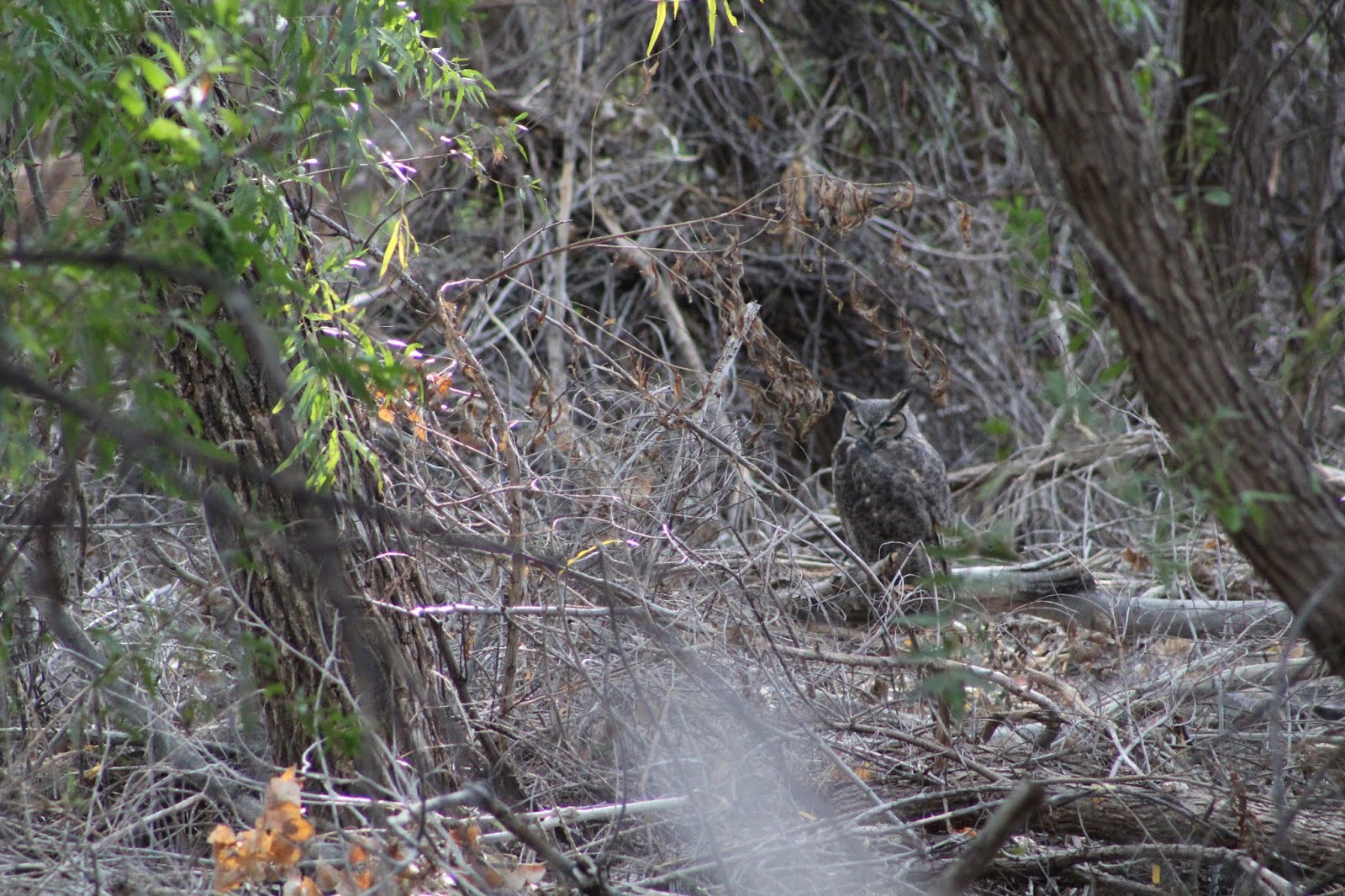

After this first Great Horned Owl, I stumbled across several others too.  An owl is an owl, which always equals out to being incredible!


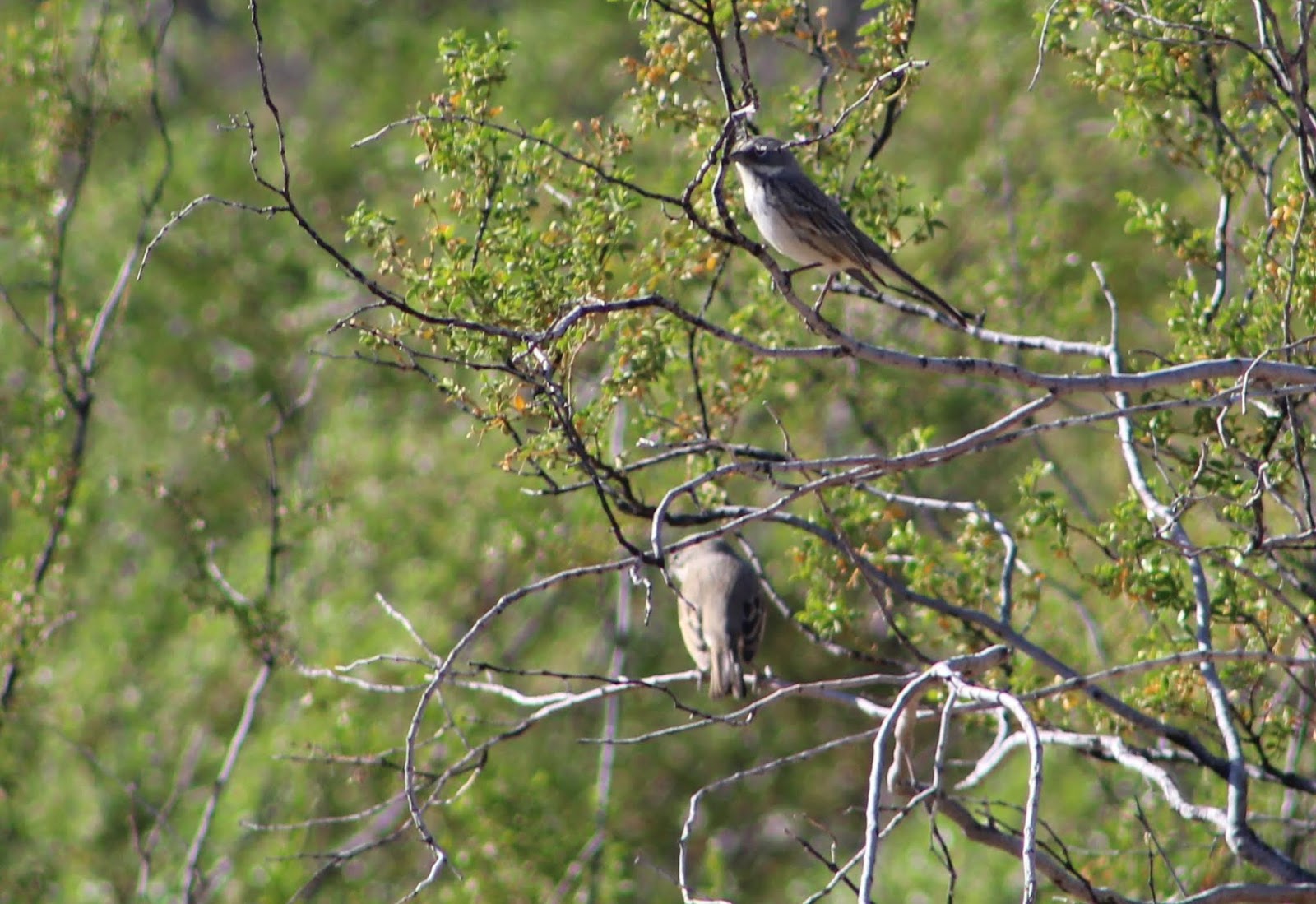
The 17th was full of riparian and scanning Roosevelt Lake, and that week would carry into the next week of October 23 and 24.  It was to be my third consecutive week of camping out in the Roosevelt Lake vicinity as my base for the birding trip.  I was still on a high from finding the Black-throated Green Warbler at Tonto Creek via Bar X, and I decided that it would be my first stop of the trip.  While tremendous luck was on my side six days prior to my last visit to the location, this visit gave me a 180 result.  The location was slow and lacked diversity in bird life.  It was a perfect example of how a location can have a bit of everything one day and then not have much the next day.  You gotta love migration.  After a few more stops, I hit started to bird Roosevelt Lake.  Because I was on a two day trip, I planned on birding the east and south half of Roosevelt Lake the 1st day, and the west and north half on the second day.  The Grapevine Group Site Recreation Area was second in line, and it's a spot where one walks out on a peninsula to get good overviews of the lake.  Things got exciting when I found a few Sagebrush Sparrows along the route out to the lookout.  This sparrow's status in Gila County is one that is quite the mystery, and these birds where my second personal record for Gila County, and I believe they are the third record for Gila County overall via eBird.  For my Roosevelt Lake patch, it was also fun to get these birds.  


Once I started scanning the lake, I picked out a Scoter floating and sleeping on the water with it's head down.  I was stoked to have a Scoter species, but it took awhile for it to lift it's head up.  From what I could see, it had a lot of white on it's face.  When it did lift it's head up, I was pumped to see that it was the rare Black Scoter!  It was an adult female plumaged bird, and it gave me solid scope views but was yet too distant to obtain photographs.  In Gila County, this was the first ever sighting that I could find of Black Scoter, and I was looking at it.  I scrambled around for the next few hours trying to find some sort of vantage point that I could walk out to to attempt photographs without luck before it got too dark outside.  Here are some notes that I wrote about my observation, and I hope to write a report to the Arizona Birds Record Committee soon about this statewide Arizona rarity.  It is a review species.

Notes:  Adult female plumaged bird. Spotted west of Grapevine Point and not far, but considerably east of Windy Hill Recreation Site. Bird was resting it's head a majority of the time, but luckily lifted it's head for about five minutes. When resting, what caught my eye was the bulky shape of the bird, the short tail sticking up (not nearly as long as a Ruddy Duck), dark cap and nape to the bird's head, and a considerable amount of white on the face and an obvious short neck to it's resting posture to easily stand out from the Western and Clark's Grebes that were nearby. When the bird lifted it's head, the bill shape immediately caught my eye while my eyes were adjusting to looking at the rest of the bird. The bill was thin compared to other Scoter species, overall concaved shaped, and pointed upwards at the tip. To nail the identification for female Black Scoter, the birds face below the eye and cheeks were a wide and striking white coloration, which contrasted neatly with the birds dark thin looking cap and nape as if viewed from the profile. Aside from the contrasting head pattern, the bird's overall coloration when sitting on the water was dark. Other Scoters wouldn't show this much un-interrupted white on the face. When the Black Scoter flapped it's wings briefly, they were dark without any white on them. This bird was bulkier and longer bodied than a non-breeding adult male Ruddy Duck, and had a longer neck than a Ruddy.

I planned my next day around trying to relocate the Black Scoter, and after some intense searching, I wasn't able to find it.  

During the following week, I initially had plans to bird on October 30th and 31st, again.  Sickness came over me and it kept me down on the 30th.  Even though I still felt a bit on the bad side on Halloween, I still went out to bird at Bar X and Roosevelt Lake.  Bar X was pretty slow for a second straight week.  I spent 2.5 hours there and the bird activity never really got going, kinda like most of Arizona's sports teams nowadays.  Roosevelt Lake was a different story.  In Arizona, late October and early November is prime time for waterfowl migration, and Roosevelt Lake was a perfect example as I started to cover the lake.  Because I had family plans for Halloween, I had to leave the lake by 4 P.M., and when I saw the numbers of waterfowl on the lake, I was stunned.  I regretted my start at Bar X rather than going straight to Roosevelt Lake, because rafts of waterfowl were everywhere.  There were scattered rafts of ducks everywhere, and one raft contained about 400 Gadwall, and about a hundred each of Canvasback and Redhead.  That was just one example.  Schoolhouse Point came up big when I picked out a Scoter among one of the duck rafts adjacent to the boat launch.  At one point, I thought I saw a glimpse of a white patch on the Scoter's secondaries.  As with the Black Scoter, this scoter had it's head down too.  Because I thought I saw a glimpse of a white patch on the bird, I started hoping that it would be the third and last Scoter I would need for Gila County-the White-winged Scoter.  After a patient watch through my scope, the Scoter finally lifted it's head and moved it's body more to show off white panels on it's secondaries.  It was a White-winged Scoter, and my sickness was numb during the two hours that I spent trying to document the Scoter.  I threw my fists up in the air and shouted, "yes!".  Here is the crappy but diagnostic documentation I was able to obtain of the White-winged Scoter, my 319th bird for Gila County.


Because it took me quite an few extra seconds to document the White-winged Scoter, I lost a lot of time I could've scanned elsewhere at Roosevelt Lake.  All I could think was that I wished I would've scanned the lake during my entire trip.  I had never seen it so full of waterbird variety, especially with high numbers of migrating waterfowl.  My last stops were planned out to be at the northern and western side of the lake at Vineyard Canyon Recreation Site and Bermuda Flat Recreation Site.  The planned second-to-last stop was at Vineyard Canyon, and I quickly had a bird of interest there too.  A flock of six white geese were distant and were across the lake from Vineyard Canyon.  From what I could see, there were five Snow Geese and a much smaller adult white goose, which I knew was either a pure Ross's Goose or a Ross's and Snow Goose hybrid.  The views were tremendously distant at first, and heat waves made it difficult to get a real feel on the smaller goose.  But luck would hit me for the second time of the day, and the geese swam much closer.  As they closed in, the smaller goose got more and more Ross's like and when it got within my scope's view, there wasn't any doubt it was a pure Ross's Goose with a steep forehead and small, stubby bill.  It was my 320th bird for Gila County, and an exciting one!  By looking at the picture below, the Ross's Goose is the only bird facing left.  Compare the size and structure with the adult Snow Goose facing right.


Halloween birding came through big time for me, it's not too often I get double Gila County life birds in one day.  Fall is an epic time of year for birding, and I was satisfied with what I was able to get in the Gila during the time this year in 2019!

Wednesday, July 17, 2019

In The Gila: High Country

The brutal heat of the summer is upon the state of Arizona anywhere relatively below 5,000' in elevation.  It's a given for those of us who live here, but the scouring temperatures that exceed 110 degrees are still dreaded like a feared event.  When it comes to birding in these lowlands, one may bird for the first hours of the morning before the heat becomes unbearable.  That's not a lot of birding time.  For me, I take this time of the year to retreat up into the higher elevations.  Even the higher elevations can have their share of uncomfortable times of the day.  I've been birding in elevations of over 6,000' in elevation on average, where there are coniferous and oak forests to provide plenty of cover from the impounding sun.  Finding shady areas by flowing creeks have become a common sight in the places I've been attending for my birding adventures.  Over the last month and change, I've decided to dedicate a lot of my birding times into the higher elevations of Gila County for the summer.  I'm happy with the amount of terrain I've been able to cover and new places that I've been able to see so far, and there is still a lot of terrain that I have on my agenda in the upcoming summer that I have yet to see.  A conifer forest at first light with a cool ambiance is the perfect way to start a birding day.


My progress so far has resulted in visits to the Sierra Ancha Wilderness and the Rim Country just below the Mogollon Rim to the north and east of Payson.  Both of these areas have vast amounts of exploring to do, and I am far from saying that I'm anywhere near content with my endeavors.  A bird man can wish for some crazy Mexican vagrant like an Eared Quetzal (which has occurred a few times in Gila County), a chance at finding my first Northern Goshawk for Gila County, seeing some cool mammals of the forest, birding along remote areas that have never been eBirded before, and detecting numbers of common high elevation birds that have always been "buddies" of mine.  There's always owls and Whip-poor-wills too.  As well as scenic slot canyons that harbor shade and chances of more surprises.


This summer goal of mine started on June 7th, 2019.  I went up Highway 260 and up and east from Payson.  Colcord Road is the first place I chose to bird at, at it sits just below the Mogollon Rim.  It is dominated by a surrounding habitat of pine and oak forest, and it has denser mixed coniferous forests in other sections.  Colcord Road has plenty of forest and atv roads that branch off of it, and those are the areas I usually like to explore and bird.  One road I like to climb transcends steeply up towards the Rim itself.  This road accesses stands of both live and burned trees, and it did produce American Three-toed Woodpeckers last year.  I was hoping that lighting would strike twice on the road for the scarce-in-Gila County woodpecker, but it wasn't to be said for a second straight time during the adventure.  Among a cast of birds were a few Greater Pewees singing their classic, "Jose-Maria" song.


June 7th
Colcord Road jeep roads
FR 188 to Valentine Tank
Valentine Ridge Campground
O.W. Bridge of Canyon Creek
Upper Canyon Creek and Fish Hatchery
Sinkhole Trail 179 via Two-Sixty Trailhead


The Greater Pewee is a songbird that I really enjoy observing, finding, and listening to.  They are more common in the sky island ranges of southeastern Arizona, but they do extend their range in much smaller numbers further north into central Arizona.


The Greater Pewee usually sings and forages high up in pine trees.  One would be considered lucky to get eye level views of this flycatcher.


ATV trail/road off of Colcord Road


Most of the area is dominated by pine and oak forests, but the drier sections that harbor juniper in the mix is favored by Black-throated Gray Warblers.


After Colcord Road, I went further east to rep out visits of Forest Road 188 to Valentine Tank, Valentine Ridge Campground, and the scenic Canyon Creek.  The latter included visits to both Upper and Lower sections of the creek.


Indigo Buntings, as well as Lazuli Buntings, have presented themselves to me at times during my adventures on these trips.  They all have been alongside healthy streams that have plenty of vegetation.  This Indigo Bunting was singing along Upper Canyon Creek.


Black Phoebe at Upper Camp Creek.


Osprey going over Upper Canyon Creek Fish Hatchery.


I love the Sinkhole Trail Number 179 via the Two-Sixty Trailhead.  In a short climb it enters a lush canyon full of mixed coniferous trees.  Red-faced Warblers and Western Tanagers thrive, as well as a handful of other forest species.  The timber in the canyon is thick and is a great escape from the sun.


Western Tanager is one of the commonest birds during my high elevation adventures.  As you can see, it's cool-looking.  The more of them I see, the better.


This Virginia's Warbler responded aggressively to my pishing while on the Sinkhole Trail.


This Plumbeous Vireo did too, only Douglas fir branches got in the way of a good focus.


June 14th:  Sierra Anchas

On June 14th and 15th, I took a two day camping trip up into the Sierra Anchas.  The Sierra Anchas are a scenic, mysterious, and beautiful mountain range that are highly under-birded.  It's lack of coverage and vast terrains ignite my thirst to bird the area and dig up what I can dig up.  On the 14th, I drove up Road 288 to Forest Road 410.  I took Forest Road 410 a short distance and parked, where I walked east for over four miles one way along the road.  I've driven this road before in it's entirety, but I wanted to see what birds I could come up with by walking along the entire stretch.  What's special about 410 is not much about the road itself, but about the canyon one walks through while driving or walking the road.  It also parallels the beautiful Reynolds Creek.  Pine, fir, oak, and sycamore make up the habitat along this stretch, and in my hike I encountered over 30 species of birds along FR 410.  30 species might not seem like a whole lot, but i these forested high elevations I've come to learn that 30 or more species is a solid list in the months of June and July.  


Reynolds Creek Area

This is my Sierra Ancha face.  I wish I was there right now.

Reynolds Creek along FR 410

A nearby devastating wildfire resulted in lots of smoke floating into the Anchas.  It gave the scenery an added haze.


At the end of FR 410, I like to take in the scenery.

A small "waterfall" canyon


Reynolds Creek

In the Sierra Anchas in areas with thick timber of mixed conifer trees and a variety of deciduous trees, the Red-faced Warbler is found in high numbers.  This is one of my favorite birds to watch in high elevations.  Young Red-faced Warblers were out and about, and some of them don't look so "Red-faced".  Some adult Red-faced Warblers put on some fun-to-watch "distraction displays" in front of my in attempts to deter my attention away from their nesting sites.  Some Red-faced Warbler families were further along than others in their breeding results.  More after these two pictures.


Along Forest Road 410 I encountered this Band-tailed Pigeon.  I loved the sighting, and I rarely get to see this species perched below eye level and up close.  Luckily, the pigeon liked it's perch just as much as I liked taking it's photograph.


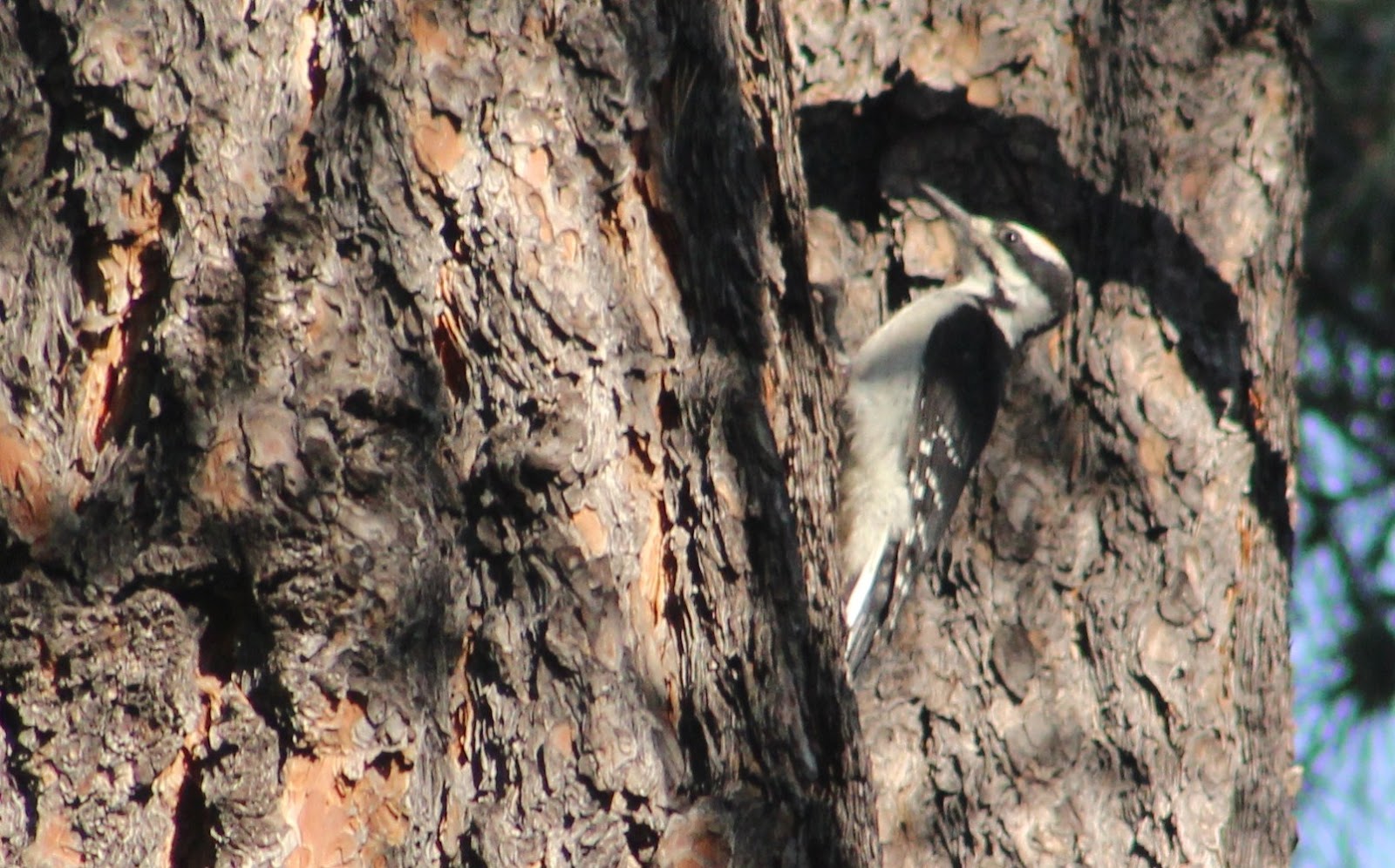
Hairy Woodpecker


Western Tanager cooperating well in the Sierra Anchas.  Switching sides, to the right to the left...


In the Anchas, I walked up a random slot canyon off of a main canyon in pursuit of awesome scenery and a search for a pair of Spotted Owls that I like to visit.  Looking through a window of bright green gave me the result that I wanted.


Spotted Owls don't mind human presence most of the time, but they still need to be respected.  I was able to get about 50 feet away from them to snap these photographs.  I'm thankful for what powerful zooms on cameras can do.  The male Spotty is on the left and the female is on the right.  Female Spotted Owls, as in all owls, and as you can see in this picture, are bigger than males.


Although they rested their piercing black eyes most of the time, they did open their eyes to me a few times in curiosity.  I never grow tired of these incredible owls.


Back to the Red-faced Warblers.  In the canyons and paths that I walked through in the Sierra Anchas, their families were prevalent.


Here is a young, recently fledged, Red-faced Warbler.  Not so Red-faced huh...


I missed parent feeding him by a second.
Here is another young Red-faced Warbler.  It's a little more red-faced than the former.


Distraction displays along the trails put on by parent warblers was thrilling to watch.


After the area of FR 410, I went further north on Highway 288 to bird along the main road itself.  To my surprise, the birding along this road was very productive even in the afternoon.  I hiked a trail from a place called the McFadden Trailhead.  I walked down a random drainage.  I birded Rose Creek Campground.  I drove up scenic Forest Road 487 to it's ending limits after paralleling the beautiful Workman Creek.  At this point I was near the highest point in the Sierra Anchas, which is Aztec Peak.  I didn't make it up to the peak, but it was fun birding around the highest elevation in the range.  The birding continued to be pleasant up until the end of the day, and I decided to camp out in these highest elevations of the Anchas.  A Greater Pewee above Workman Creek Falls stood out among the common forest birds.


Black-throated Gray Warbler along the McFadden Trailhead

Wild Turkey female who had young with her above the random drainage I hiked.  I didn't know they were bedded down and the sprung up just feet away.

Madrean Alligator Lizard


June 15th:  Sierra Anchas 

June 15th was the second full day of my camping trip to the Sierra Anchas.  I had hiked close to twenty miles of terrain the previous day and was exhausted, but I planned to get even more exhausted in a super fun way.  It was all about Parker Creek.  Walking along it, beside it, and up into the canyon that harbors it.

Parker Creek Canyon.  Highway 288 level..

Parker Creek has a lush deciduous forest along it via Highway 288.  I enjoyed that for the first hour of the day, as well as a small Forest Road, FR 142, that is just above Parker Creek.  142 goes out into chaparral and juniper habitat and ends in less than a half mile.  It is good for birds such as Black-chinned Sparrow, Scott's Oriole, Rufous-crowned Sparrow, and Gray Vireo.  After birding these smaller sections of Parker Creek, I decided to go on a very long hike on the Parker Creek Trail number 160.  This trail was awesome, and climbed up through chaparral, mixed conifer, oak, and spectacular scenery.  Burned areas were in places along the trail also.

Looking down on Highway 288 from the Parker Creek Trail

Birds were diverse on the trail.  Some of them included Cordilleran Flycatcher, Mexican Jay, Rufous-crowned Sparrow, Painted Redstart, Red-faced Warbler, Band-tailed Pigeon, Dusky-capped Flycatcher, Black-headed Grosbeak, and Western and Hepatic Tanagers.

Rufous-crowned Sparrow

Black-headed Grosbeak

Painted Redstart

The other "upper" side of Parker Creek Canyon

Band-tailed Pigeon


The result of forest fire.  It wasn't too bad walking through this stuff in stretches throughout the trail.  The trail was still easy to follow, surprisingly.  

The hoodoos of the Anchas 

A scary moment occurred for me when I was down in the drainage itself and walking along upper Parker Creek before the trail took back up and above the creek.  I turned a corner to see a huge Black Bear about 50 feet away and coming towards me.  I've encountered a share of Black Bears in the wild in my life, and this one was the first one that scared me.  However, this Black Bear didn't see me and before it had a chance to see me, I walked back on the trail for fifty feet.  I decided to give the bear the impression of, "oh wow, what on earth is coming down the trail, I better bail" as I clapped and shouted out loud that I was present.  I heard crashing branches to indicate a large mammal escaping.  When I went back, I slowly peeked my head around a large rock the bear was near and it was gone.  My regret was not being able to get a photograph of the impressive animal.  Perhaps what has as big of an impact in the small bird world as a huge bear does in the mammal world is the Northern Pygmy-Owl.  As I hiked along the ridges of the trail, I got lucky and encountered a family of these tiny but powerful owls.  I detected them by hearing the insect-like call of recently fledged birds, and one of the nearby adults was the one I was able to find visually.  These owls will kill birds that are much larger than themselves.


I'm sure Northern Pygmy-Owls have taken out plenty of Hepatic Tanagers in the history of time..


I've been looking for the superstar ode called the Apache Spiketail during my jaunts along creeks in Gila County's high elevation.  I haven't had any luck, but Red Rock Skimmers have been common and are kinda cool too.


After a four mile (eight miles round trip), one way hike up into the slopes of the Sierra Anchas via the Parker Creek Trail, I was exhausted as I anticipated.  I visited several stops along Workman Creek and closed the day in the Anchas out at Forest Road 489, a pleasant road through oak and mixed conifer that is lower in elevation that other forested spots in the Anchas.  It has some good potential to it, but is missing Cordilleran Flycatcher and Red-faced Warbler so far.  My camping trip concluded with about 35 miles hiked, and I was dead by the end of it.


Sierra Anchas: June 20th and 21st

It didn't take me to get back up into the Anchas again as I left from work on June 20th, camped out that night, and spent close to a full day on June 21st continuing my explorations.  On June 20th, I listened to the NBA draft before doing any birding.  I didn't have a lot of day left, and I set up camp at Rose Creek Campground, a place I have camped out at on a few other Sierra Ancha camping trips.  My goal for this trip was to take Forest Road 671 for a good hike on the morning of the 21st.  Once it got dark out on the night of the 20th, I owled and nightjared it up and detected Mexican Whip-poor-wills and Flammulated Owls.  On the 21st, I woke up and started to climb out Forest Road 671 for close to five miles one way.  It was a challenging hike, but was worth it.  The bird diversity was impressive for high elevations, and from the road's start just south of Rose Creek Campground on the west side of Highway 288 as it climbed up through mixed coniferous forest, chaparral, grassy slopes, and rocky areas I recorded about 45 species of birds.  The highlight was another detection of young Northern Pygmy-Owls.  Several Downy Woodpeckers were near the highest of elevations, where several stands of aspen came into the mix.  What I liked about this road was that it is probably the one road in the Anchas that goes up for a distance on the west side of 288, while the other roads go up on the east side of 288.  Could a vehicle handle this FR 671?  Probably not.  But people and animals can.  Plenty of deer were present.


And I encountered another Black Bear.  This one was pretty big, and I was glad to get a picture.


Grace's Warblers were one of many bird species who were present on FR 671.  I was focused on scouting the terrain and habitat that I didn't give photography much of an effort.  I hope to go back to 671 soon, I enjoyed it immensely.


A few more scenes from the Anchas.

Plumbeous Vireo


My campsite at Rose Creek Campground


After the Forest Road 671 hike, I was almost out of energy.  It seemed like I used up most of my energy for this trip up on the trip I took the previous week.  I spent the rest of the time birding the Reynold's Creek area again, and loosely scouting out terrain for my next visits.


July 4th: Whispering Pines and Washington Park


 On July 4th and 5th, I took another two day camping trip into the high elevations of Gila County.  This time I went up towards the Mogollon Rim directly north and east of Payson.  On the first day of my trip, I went north of Payson to explore the highlands in and around two very small communities called Whispering Pines and Washington Park.  This area was one I barely entered into last year, and after driving for about a mile or two of it, I never got out to bird before turning around.  The whole area was a location lifer for me, and I loved it.  Whispering Pines and Washington Parks creek is the East Verde River, and it flows throw the area and creates a beautiful recreation area.  Crowds of people were present for the Fourth of July.  I drove up towards Washington Park first, where there is a namesake trailhead.  I loved the trailhead and it's habitat of a thick mixed coniferous forest paralleling the creek.  Even though I got a late start to my day and didn't start hiking from the Washington Park Trailhead till about 11 AM, the area was still very birdy.  Here's an eBird checklist I did from the hike, as well as some pictures of the birds I encountered:


Red-faced Warbler

Western Tanager


Warbling Vireo

young Painted Redstart 


After the Washington Park area, I went south for a few miles and spent the rest of the day hiking and birding the pine and oak forests in and around Whispering Pines.  I loved all of it, and the area has a ton of exploring that needs to be done.  Common Nighthawks were a fun way to close out the day on the Fourth of July.


July 5th:  See Canyon, Christopher Creek


For July 5th, I headed east of Payson and went to Christopher Creek as my main goal, where I covered See Canyon Trail, See Springs, Christopher Creek Campground, the south end of See Canyon, Sharp Creek, and a few other spots south of Payson throughout the day.  I didn't sleep well at my Whispering Pines camp spot, and once I did sleep I slept an hour longer than I meant too.  It gave me a 5 AM start rather than a 4 AM.  I did get to see loads of Elk while driving out of Whispering Pines.  Hiking the See Canyon Trail was nothing short of awesome.  Several bird species were present in very high numbers, such as Western Tanager and Cordilleran Flycatcher.  A was glad to find a singing MacGillivray's Warbler just below the Mogollon Rim towards the end of the trail, still in Gila County.  The song of a Greater Pewee was more than welcome too, of course.  Here is a selection of photos from the See Canyon Trail, as well as a link to my eBird checklist:


Red-faced Warbler

Mountain Chickadee


Audubon's Yellow-rumped Warbler

Western Tanager


Red-faced Warbler action


Christopher Creek via See Canyon Trail


early morning sun in See Canyon


south See Canyon via Highway 260 (above and below)


South of Payson:  I went south of Payson to Bear Flat Recreation Area.  Not the best area for birding with limited access.  The canyon it is nestled in is awesome though.  A Common Black-Hawk was a bird highlight.


July 12th:  Camp Geronimo area and Whispering Pines

July 12th was another fun one, and I went back up into the Whispering Pines area, stopping at several recreation sites along the way at East Verde River just south of Whispering Pines before proceeding north.  Elk were abundant everywhere along the road (Houston Mesa Road) from Payson to Whispering Pines.  Once at Whispering Pines, I went west on Forest Road 64 for about 4 miles to the turnoff for Camp Geronimo.  Geronimo is a popular Boy Scout Camp below the Mogollon Rim, and a Arizona Trail trailhead is found just before camp.  I parked at the trailhead, Geronimo Trailhead, and went for another long hike up towards the Mogollon Rim in mixed conifer and oak forest.  A beautiful and flowing creek, Webber Creek, ran alongside much of the hike, which was the Geronimo Trail 240 and East Webber Trail 289.  Both of these trails produced bird great bird variety of 37 species apiece.  The scenery was beautiful and is another place that is worth my birding time.  Here are eBird checklists from the earlier hours of the day between the two trails, as well as a selection of photographs.  I closed the day out by visiting another location within Whispering Pines called Dude Creek.  True to the name, it was a creek, and I matched well with it being a dude and all.  Dude Creek was awesome, and looking it over on maps, there seems to be a bit of exploring and interesting terrain to look at as well.  


Elk are abundant in the Whispering Pines, Washington Park, and Camp Geronimo area


Mexican Jay, Geronimo Trail

Band-tailed Pigeon, Geronimo Trail

Pine vistas, Geronimo Trail


Geronimo Trail, going towards the Rim

Cordilleran Flycatcher

Geronimo Trail

Ash-throated Flycatchers


Mexican Jay


Elk at Dude Creek

East Verde River

East Verde River (above and below)


Webber Creek, Geronimo Trailhead


Geronimo Trail (Above and below)


Webber Creek, Geronimo Trail


swimming hole on East Webber Trail

upper section of East Webber Trail

More Gila birding to be coming.  Gosh it's awesome.  Before I forgot, Caleb Strand found Gila County's first Cave Swallow at San Carlos Lake.   Luckily, I was birding with him and got to see it too.  I didn't get a photo.