According to GreerArizona.com, there are a lot of different activities to do. These activities include camping, hiking, fishing, hunting, horseback riding, winter-time skiing, culture activities, cabin renting, eating, and wildlife viewing. Duh, I already knew that, I didn't need to surf the web. As you all know, my category falls in with the latter listed. Birding! Before I get to that, I'll say Greer has some amazing restaurants that have won my heart. If you happen to be in Greer, stop, and have a meal at the Molly Butler Lodge. It is fantastic Back to birding, well Greer has A LOT to offer. One can walk through town and work up a high bird list that will include several awesome forest species. Greer has open meadows and grasslands, the Little Colorado River, the riparian habitat surrounding the river, three lakes, endless mixed-conifer forest, and hiking trails. Some of those trails are accessed from Greer and rise to higher elevations. Greer is a birder's paradise, and the birders don't leave Greer unhappy. There are also plenty of hummingbird feeders around at some of Greer's best restaurants, including the fantastic Molly Butler Lodge that I mentioned above. This remarkable area is to thank for me being involved with birding. It kicked off my interest in birding to a very strong passion to begin with, even though my first official list and determined field effort came from Prescott back in 2000. A few months after Prescott, a five day trip here to Greer left me obsessed with it's many birds and my birding interest was very strong from then on.

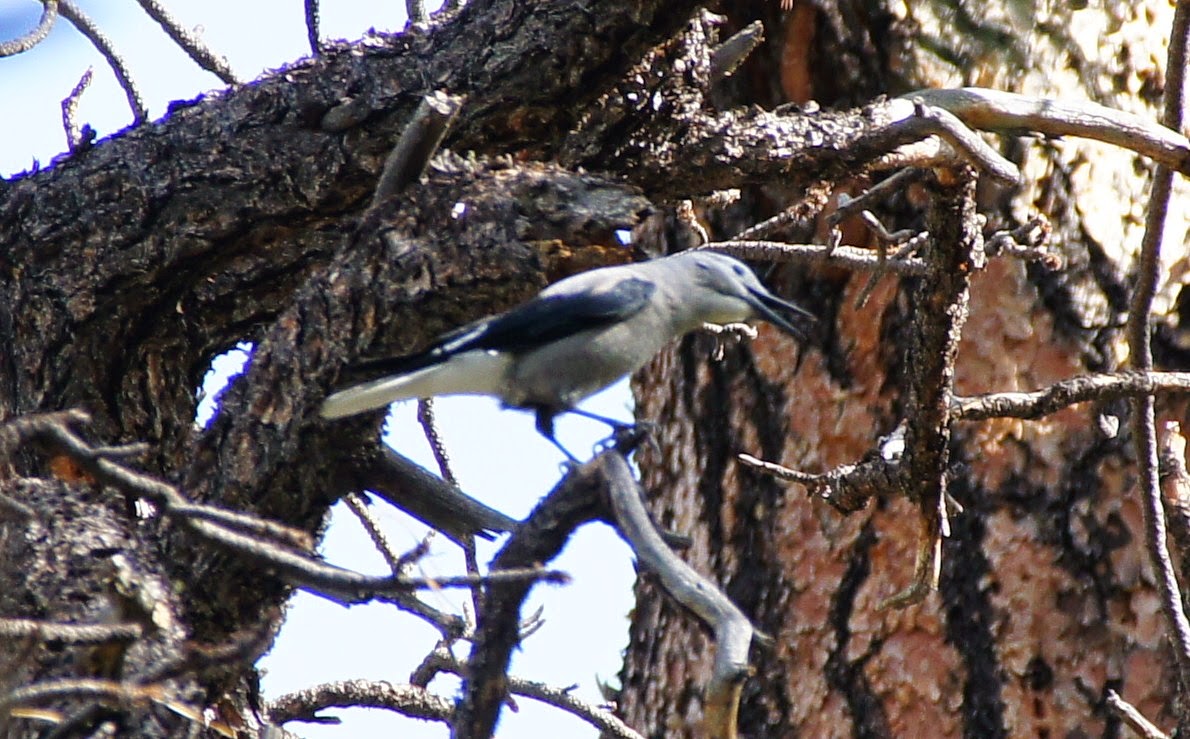
If you live in the town of Greer, there are neat birds in the forests nearby at all times. And this even applies to walking through the town of Greer down the main Highway 373. Getting a good morning from a Clark's Nutcracker is a fairly common sight. These corvids aren't very skittish, but unless they are curiously coming into campgrounds and places for food, they usually stay up very high in the trees. Most of my experiences with Clark's Nutcrackers on average are more distant views. But in Greer, you may have the chance of seeing one up very close!


This particular Clark's Nutcracker was joined by several other Nutcrackers in someone's yard. They stayed in the yard for several minutes, and then continued to forage around elsewhere. Before a Clark's Nutcracker is seen, they are usually heard giving their loud calls from the top of a conifer. It's an awesome sound, and if you hear it in downtown Greer, follow it. You may get an awesome and up close look or two.


While birding in Greer, you can work up a very nice species list with a high number without working very hard. Hiking is always an option, but Greer is great for stop-and-go birding. Parking the car and walking for a few minutes at a variety of different places and stops will result in a good bird list, and may produce excellent sightings of birds such as Clark's Nutcrackers. When I bird Greer like this, one of the stops that I make are at the hummingbird feeders at the Rendezvous Diner and Molly Butler Lodge. In late July and early August during my vacations up here, the feeders are swarmed by hummingbirds, most of which are Broad-tailed Hummingbirds as well as the aggressive Rufous Hummingbird. Dozens of hummingbirds compete for a spot at the feeder, and it's almost as bad as World War Two if bird terms were compared.

The Calliope Hummingbird drops by too, but isn't numerous as the other two species are. I make stops annually here when on vacation to get my Calliope Hummingbird fix. The Calliope Hummingbird is the smallest breeding bird in North America.


The hummingbird feeders at the Rendezvous Diner and Molly Butler Lodge are awesome. Things got even more awesome when my favorite hummingbird, a male Magnificent Hummingbird, decided to make an unexpected visit to the feeders on the main deck of Molly Butler Lodge. The Magnificent Hummingbird came in briefly several times during the two nights that I ate at Molly Butler's, and it was a new White Mountain bird for me. In the White Mountains, the Magnificent Hummingbird is considered annual but rare. I wasn't able to get a picture of the stunning hummingbird, but it was awesome seeing it. I even got to show it to my family and I describe the bird as "looking almost twice the size of all of the other hummingbirds around". Once they caught sight of the Magnificent Hummingbird, they found it to be very amazing too. Let's now trace our route north a few miles from the restaurants to the three Greer Lakes. The Greer Lakes are very popular for fisherman, and they have good birding opportunities too. One may park at either one of the three lakes and have easy walking access through nearby ponderosa pine forests and open grassland.


All three of the Greer Reservoirs have good birding to be found around all of their perimeters. At River Reservoir, a female Osprey has set up shop right by the parking lot. Over the years, I have watched many nesting Ospreys around the Greer Reservoirs. I've never seen one this close to where people consistently walk and park every day.

The Osprey started to get upset the second I got out of my vehicle, and I heard these sound alarms whenever I was around the nest or at River Reservoir the entire trip. Hopefully next year, the Osprey will avoid a hassle and build it's nest further away from where people are on a regular basis. On the other hand, these Ospreys were enjoyable for many people who were walking and driving by. Most of the time, the mother's offspring were sitting up and were very visible.


The adult bird was wasn't happy until I left, but it was enjoyable to view these birds for a few minutes before moving on. During one of my earlier Greer trips back-in-the-day in 2000, I took an intense hike around River Reservoir and found three different Osprey nests that had been built around the lake.


Even when I left the nest and had to walk by again, I was on the opposite side of the road closest to the nest, and for sure a respectable distance away. I thought the adult Osprey would by happy with that, but I was completely wrong.

In the surrounding pine forests at the Greer Lakes or anywhere else in general in Greer, you may find a Pygmy Nuthatch in almost every single ponderosa pine tree there is in Greer. These little guys are so common, but are also contagiously fun to watch at the same time. I found myself looking at this species everyday while I was on my trip.


The Pygmy Nuthatch is also quite the acrobat, and can feed at all different sides and angles. He's got momentum, baby!


As I walked around the grasslands surrounding the lakes, I heard the songs of Eastern Meadowlarks and Vesper Sparrows. Two very peaceful songs that come from the two of these species provide an excellent chorus of songs throughout these small grasslands within the Greer Lakes. If one comes out here to bird in the early morning, the songs are better than ever. One is also more likely to see the singing source earlier in the morning also as compared to later in the day, as with most birds.


As I continued walking through the grasslands, there were plenty of Broad-tailed and Rufous Hummingbirds feeding on flowers. This male Rufous Hummingbird was quite cooperative, and he made sure to chase any other competitors off as fast as he could.


Arriving back in the ponderosa pine woodland, I also stumbled upon plenty of Western Bluebirds. While the adults were quite difficult to get close to, this young juvenile Western Bluebird was pretty cooperative.


This time of year is a great time to study birds in juvenile plumages. At Bunch Reservoir, this young Red-naped Sapsucker was also another example. Over the last few years by the parking lot at Bunch Reservoir, I've been able to find Red-naped Sapsuckers on a regular basis in some of the riparian plants, and it is the location of this juvenile bird.


Along the edges of the three Greer reservoirs, there were families of Canada Geese and many loud cawing American Crows.


Greer also has several longer dirt roads that have excellent birding opportunities wherever the vehicle may stop. Two excellent examples are Apache County Road 1126 and 1121. Road 1126 is one that I usually cover when in Greer, and on this trip, I made sure to cover it and give it a visit. I usually drive to the end of this road, park, and explore for a short distance in four directions. There is a pond to walk down to that has had interesting birds such as Sora, the road can be walked, and there is also an area that can be hiked up into. I usually choose that latter, and this spot combines the habitats of both live and burned forest. It is often a good bet for Olive-sided Flycatchers and it is where I photographed a family of them last year. I didn't have Olive-sided's this time around, but I did have good looks and photo chances of the Western Wood-Pewee.
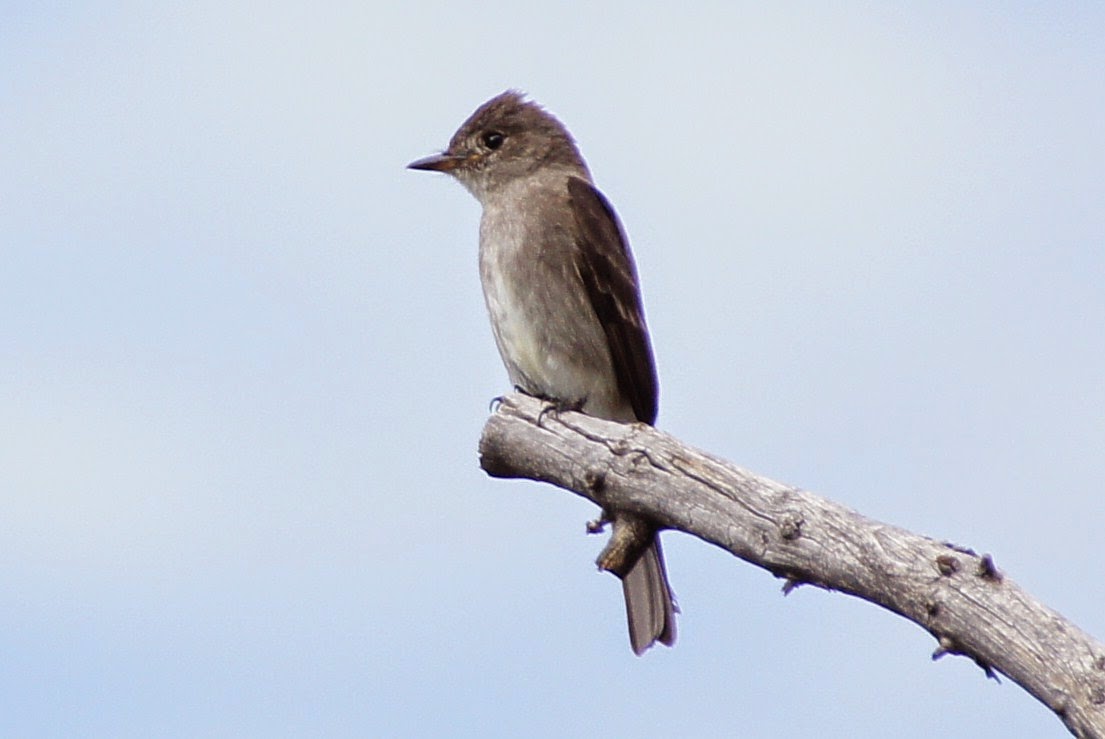

The buzzy song of this small flycatcher is often heard all day in the summers anywhere in Greer or in the White Mountains where there is ponderosa pine forest.

Walking further into the area, I found this pair of Hairy Woodpeckers, one of the commonest woodpeckers to be found here.

And the Green-tailed Towhee luck continued for me on this trip. They all seemed to be quite photogenic.


Yellow-rumped Warblers were also prevalent along this road, and would often feed on the ground.


In recent years, Greer has even been the host to a pair of nesting Bald Eagles. On one of the days I was birding, I saw the pair soaring together, a majestic sight. The birds nest in the vicinity of the Greer Lakes.

While these highlights have been pictures gathered up from my entire trip, a birder may have all of these sightings and more in birding Greer in only two hours or less. The birding is really that awesome in Greer. Besides the locations I have mentioned on this post, there are many more spots to bird at while in Greer. One is the Butler Canyon Nature Trail, which is obviously the main draw to birders who are visiting Greer. On my blog, the Butler Canyon Nature Trail deserved a post of it's own so check that out in the previous archives. Greer also has Benny and Rosey Creeks, the riparian stretch to bird along the Little Colorado River at the first crossing when coming towards Greer (excellent for breeding Gray Catbird), the West and East Forks of the Little Colorado Rivers, Osborne Road, and more. And there are also several trails and trail systems accessed from Greer that hold excellent birding opportunities. A few of these trails are the West Fork Trail #95 that leads to the Baldy Wilderness and the East Fork Trail #94 which is accessed near the end of Greer. Greer has a lot of birds with plenty of great areas for birders of all physical capabilities to enjoy birding and to see a variety of bird species with ease. Make Greer one of your next birding stops!