The Salton Sea is a place I've been to several times, and each time has been in late fall or winter. It is California's largest lake, and is truly an inland sea. As far as inland seas go, it is one of the largest in the world. California called this huge lake an oasis over a hundred years ago, but now it is considered to be the state's biggest natural disaster. For starters, the Salton Sea is a very shallow and toxic lake due to high saline levels. Water sources of three different rivers, drainages, agriculture, and creeks have filled up the Sea over the years and it has increased toxic saline levels. The Alamo River especially carries harmful pesticides, DDT and other harmful chemicals, and fertilizer nitrates into the giant lake, and this build up has occurred for years and years. What it has amounted to has equaled out to have much higher salinity levels than that of the Pacific Ocean. It's not safe to boat or swim at the Salton Sea. Because the Salton Sea is a saline lake, it will dry up in time and it continues to dry up. The toxic waters of the Sea that have been dominated by years and years of pesticides and more in it's waters are dangerous for those who have respiratory problems, and it's also harmful to birds. Speaking of birds, the Salton Sea has hosted more than 400 species. It has one of the highest densities of birds out there, and the numbers of species and the species that have shown up so far are truly remarkable. I've gone there to see incredible numbers of waterfowl, gulls, terns, and shorebirds. Rarities I've successfully chased have included Garganey and Bean Goose. While the Salton Sea is decreasing, it remains to be an incredible location for avian diversity. The Sea is located in southern California in Imperial and Riverside Counties. I'll flat out say that the surroundings of the lake are extremely ugly. If it weren't for an abundance of neat birds, I would never find myself wanting to go to the Salton Sea. It's right down there with Yuma County. As I've gone to the Salton Sea in the cooler months, I've never gone during the summer. The summer hosts hellish temperatures, but the birds are spectacular. It's the one reliable spot to see Yellow-footed Gull in the ABA area, and on top of that, there are many other birds. I needed to see a Yellow-footed Gull again after my one-and-only sighting had been of a bird about a mile away in 2010.
On July 9th, 2020, I joined my buddies Ronnie Reed and Caleb Strand, and we left Phoenix at 2 A.M. to go explore the Salton Sea. Ronnie and Caleb have both been to the Salton Sea much more than I have, Ronnie for fishing and Caleb for birding. As Ronnie had been there before, this would be his first time for birding and he was pumped. Caleb was hoping to find a stint. My main goal was to see and photograph a Yellow-footed Gull up much closer than a mile away. The best thing about the Sea was that we would be seeing an incredible variety of waterbirds. Shorebirds, waterfowl, gulls, terns, and more thrive at the Sea. And for birders, it is a place where they can pull out something incredibly rare at any time of the year.
We got to the north end of the Salton Sea early, and walked for over two miles to a location where we could bird a massive stretch of shoreline. It was hot, nasty, and there were millions of obnoxious flies everywhere. On the flipside, the abundance of birds made up for the abundance of flies.
Gulls became Seagulls and Terns were Turbo-gulls (Ronnie's previous name for terns before he was a birder). We had a good time! It wasn't long before Caleb and Ronnie spotted two Yellow-footed Gulls along the shore. While they looked at an assortment of birds out on the waters, I went to make sure I obtained a few pictures and closer looks at my main target.
And then there was an assortment of other birds that were briefly forgotten by me due to my tunnel vision. That Yellow-footed Seagull. Terns were fun as we had Gull-billed, Forster's, Black, and Caspian, as were all of the waterbirds really. Our first stop yielded nearly 80 species and was close to four hours. The heat and flies would make things challenging as the day went on further.
Black Tern
Brown Pelicans and Black Skimmers
Caspian, Forster's, and Black Terns on the sandbars
Caspian Tern
Snowy Plover
Caleb and Ronnie looking for a Bell' Vireo
One of our other stops was further south along the Sea as we drove along a road called Lack Road. This was one that I really wanted to go to, because it is known to be very good for seeing Yellow-footed Gull up close. It wasn't long on our drive along Lack before we found a nice adult Yellow-footed Gull right along the road.
In comparison to my first Yellow-footed Gull a mile away through a scope back in 2010 at the Salton Sea, the birds on July 9th with Ronnie and Caleb were practically lifers. We had 8 of them in total at the first stop at the north side of the Sea (some were fairly close, others more distant), and this one was the 9th and it gave us what we were hoping for.
It made it's way over to us to join us for the snacks that we were having. Perhaps our snacks were considered healthy compared to the crappy snacks it was getting out at the Sea. Literally.
Yellow-footed Gulls are native to Mexico, and they can be seen at the Salton Sea in good numbers after they breed. They are a large gull, and are very similar to Western Gull. The Yellow-footed Gull does have a considerably larger bill, and of course, yellow legs rather than pink legs. It is a well-named bird! It eats fish, crustaceans, eggs of other birds, carrion, and more. Because of it's snack leaching behavior, we found out it also likes Flaming Hot Cheeto Fries and Cheez-its. It was great to see the target bird at such a close, epic range!
When snack time was up, a Black Skimmer joined a flock of peeps along the shore.
And a Gull-billed Tern flew by too.
Ronnie and I got a much closer view of the Black Skimmer!
On the way out of the Salton Sea, we had excellent looks at this Gull-billed Tern at someone's farm pond.
We had 85 species in total at the Salton Sea, not bad for a scorching day in July. Thanks Ronnie and Caleb for a good time. Thanks to the Yellow-footed Seagull too!
Ever since I got back from Minnesota's epic birding, I haven't been out to suffer in Phoenix's heat very much at all for birding. There was one recent jaunt I went on to see a Yellow-billed Cuckoo, but that was the only birding that took place since June 15th when I was looking at a Pileated Woodpecker in Minnesota. I've been taking it easy and have been passing up long road trips in order to save money for that final owl for T.O.B.Y. I've been catching up on some other aspects in my life during this time and I can't complain. And then all-of-a-sudden, the birding rampage can hit when your least expecting it. On this recent Friday, July 15th, I had some evening plans and planned on being at my house until those plans would take place. But when Duane Morse reported two Black Skimmers just west of Buckeye at the Lower River Road Ponds at 11 A.M., I was out the door in less-than-a-minute and was speeding to get to the Lower River Road Ponds.
I couldn't believe what I read, but all I knew was that I wanted to see a Black Skimmer in Maricopa County! Black Skimmers are epic birds, and I have seen them in San Diego, California. I called my good buddy Caleb Strand who lives in Buckeye and I asked him if he wanted to come with me. Caleb quickly said yes and forty minutes later, the two of us joined forces and headed west to the ponds. It was great to be birding with Caleb, and we were both hoping that this duo of Black Skimmers would be present for us when we got there. As we got into Palo Verde and turned onto Lower River Road, we could see two vehicles parked alongside the pond with people looking. That was a good sign! As we pulled up to the ponds, Caleb and I saw the birds flying around within seconds. The chase was successful. Melanie Herring and Barb Meding were the two ladies there with the two vehicles, and the four of us enjoyed the rare sight of not only one, but two Arizona Black Skimmers!
As we started to enjoy the two birds, the Black Skimmers were very active and would circle around the pond. Several flights resulted in the birds flying right by where we were standing!
As you all can see by the photographs, that the Black Skimmer is a bizarre bird. This tern-like seabird is rarely found inland away from coastal beaches and bays. The Salton Sea in California is one such exception. Black Skimmer is one of three Skimmer species that are found in the world, and it is the only one that is found in North America. With it's black-and-white coloration and odd bill which has a much shorter upper mandible than lower mandible, it is a unique bird in North America.
The diet of the Black Skimmer consists of small fish that are usually about five inches long. When hunting for such small fish, the Black Skimmer shows off it's unusual feeding style that adds even more to how bizarre it is already. This bird flies low over the water with it's bill open. When it's trying to catch it's prey, the lower mandible barely touches the surface of the water. Once a small fish makes contact with the Skimmer's lower mandible, the upper mandible instantly closes in on the small fish. Because of this hunting tactic, the Black Skimmer can hunt at night or very low light on a regular basis!
Black Skimmer is very rare in Arizona, with just over ten records. Several of those records have come from Maricopa County at places such as the nearby Gillespie Dam (in proximity to Lower River Road Ponds) and at a large pond in Chandler. Most Skimmers that show up in Arizona are juvenile birds as expected, but these two Skimmers were an exception due to the fact that they were an adult pair!
There wasn't a major storm along any of the coasts during this time frame, so who knows why this adult pair of Black Skimmers decided to come to the Lower River Road Ponds in Maricopa County, Arizona. They were both very tired and exhausted as they were panting. The two birds rarely closed their bills, and they would often sit on the pond banks as much as they would fly around the ponds.
Thanks to Duane Morse for finding these incredible birds. Duane also found the Maricopa County first White-eared Hummingbird that spend close to two weeks in his Phoenix yard. Caleb and I enjoyed these birds for about 40 minutes before I dropped Caleb back off at home. After I dropped Caleb off, I decided to sunburn myself up and watch the Black Skimmers for about two more hours. Many birders stopped by to also enjoy the rare occasion. I enjoyed many binocular views of the birds, but I also snapped away. Here's a selection of photographs that I obtained during my two stops at Lower River Road Ponds.
The Lower River Road ponds have produced some incredible rarities over the years. Luckily, I got to be a part of this one. As the ponds produced my 378th Maricoper in the Skimmers, they also produced my 375th Maricoper in the Mountain Plover.
Through the end of the day, birders kept coming and coming to see the Black Skimmers after I left. These types of birds can be unpredictable how long they may or may not stay. On this Friday the 15th, everyone who chased the Skimmers got to see them, including my buddy Kurt Radamaker. Kurt zipped down the the ponds after he got off of work and got there later in the day. After enjoying the Skimmers, Kurt decided to check a few other ponds in the area, including a few ponds that were on a farm along the Old US Highway 80 just south of Lower River Road. As this farm was on private property, Kurt had to scan from the road. And then Kurt found another miraculous bird on these ponds, a breeding plumaged HUDSONIAN GODWIT! The Black Skimmers were good enough for my entertainment, but when Kurt called me to tell me he had found a Hudsonian Godwit, I thought I was going to explode. The Godwit is even rarer than the Black Skimmer in Arizona. However, this was later on the 15th and there was no way I could make it back out to the Palo Verde area before dark. Kurt went and got a few lucky birders who were looking at the Skimmers and took them a short distance to see this remarkable Godwit. This certainly wasn't the first time that Kurt has found miraculous birds like this either! I could only hope that it would stick around through the following morning...
When I found out from Kurt about his Godwit, I was barely walking into a movie, The Legend of Tarzan, with my Mom. The movie was great and when it got out, I made plans with Caleb and the two of us would join forces again to search for the HudWit on the following morning when I would pick up Caleb at his house at 5 A.M. My Mom is awesome and we had a great time at the movie, and we also proceeded to talk about life for 6.5 hours at my Mom's house. Before I knew it, I said, "Mom, I gotta go get Caleb now to search for that bird". I didn't get a minute of sleep, and this would be the first time I went over 24 hours without a minute of sleep in several years. But it was worth it. As I picked up Caleb, I was pumped and not tired. We arrived at the lookout area where we would look south into the farm from the Old US 80 and scan a few ponds about 500 feet away through the numerous Black-necked Stilts and other shorebirds.
Not the most ideal of places to be birding scenery wise, eh? But on the other hand, who cares about what a place looks like if there's a mega rarity involved. Caleb and I set up our scopes and were about 75 feet from each other to scan the ponds from different vantage points. My first scan didn't produce anything on it's first pan, but Caleb's did. He yelled out my name and had the Hudsonian Godwit in his scope! I ran up to see it, and there it was!
The Hudsonian Godwit was a life bird for me! It's one I've always wanted to see and one that I did have a chance to chase once in Arizona in Willcox but I opted not to. As I looked through Caleb's scope before getting my own scope on the bird, the HudWit became my 526th life bird and my 379th Maricopa County bird. This bird was a breeding plumaged bird, and gosh was it beautiful.
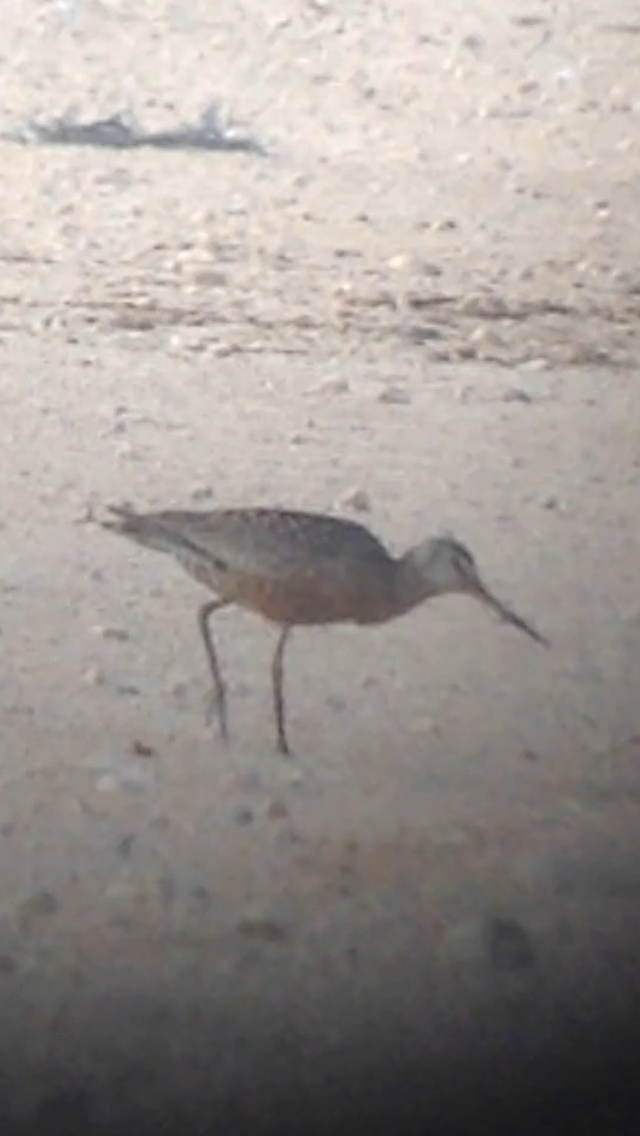
Because we weren't allowed to go on the private property that the Godwit was calling home, we had to photograph by digiscoping from about 500 feet away. The scope views themselves were decent for views of the Godwit.
Out of the four Godwits that have been recorded in North America, the Hudsonian Godwit is the smallest. The Hudwit has dark wings that have a contrasting white wingstripe on them, a black underwing, and a distinctive white and black tail. In flight, these characteristics are striking. As you can see, breeding plumaged birds have a dark rufous belly, a gray neck, a long two-toned black and orange bill, and a distinct supercillum among other Godwits. A few times I got to see the bird fly for a few feet, and it's flight pattern really was striking and stood out, even from 500 feet away!
Hudsonian Godwits breed in bogs within shallow water and around ponds in spruce woods in scattered northern locations. They chiefly migrate south and north through central North America, but there are number of annual migrants in smaller numbers outside of that range. In Arizona, this bird is about the 8th potential record, and only the second for Maricopa County. Because of it's Arizona status, there's no doubt it would bring in crowds of anxious birders!
It may be a very very long time before another HudWit is found in Maricopa County again. It may be a long time before one is found in Arizona again. It's one of those rarities in the state that one should chase if they have the opportunity.
Here's a short video I took of the HudWit:
And here's a few more poor digiscoped pictures of the bird. Just as long as you can tell what it is, right!?
Seeing two extremely rare birds for an Arizona scale both as new birds for me for Maricopa County and Arizona was epic. And to see them both in less than 24 hours was great and the fact they were discovered on the same day was great too. The Black Skimmers weren't seen on July 16th after entertaining many on the 15th. Fortunately, Kurt found the Godwit to prevent disappointment for those driving a long way. This 18 hour time span of seeing these two bird species apart from one another will go down as one of my best accomplishments for Maricopa County. My list is getting higher and higher, and birds are growing thinner and thinner. To have a day like this is great. Thank you Duane and Kurt. What a fun ride both birds were. And thanks to my buddy Caleb Strand for being awesome company on both days while observing both birds. And for fun, how far away was the HudWit from the Skimmers? Only 1.4 miles. The map shows it!