Showing posts with label Eastern Kingbird. Show all posts

Saturday, September 19, 2020

What Can Happen In A Week Of Birding: Part 2

After the excitement with the Northern Jacana, I knew that it was a good way to kick off my "Friday" and prepare for my "weekend" of having Thursday and Friday off, which was September 10th and 11th, 2020.  I planned to go birding in the first half of the day and wanted to be home earlier in the afternoon.  On the 10th, I opted for Phon D. Sutton and Granite Reef Recreation Sites of the Lower Salt River.  On the 11th, I birded Seven Springs Wash and Camp Creek.  The mornings were fun but didn't have anything too noteworthy.  The Salt River locations were loaded with birds, especially Granite Reef.  At Granite Reef I had close to 70 species right about noon-time, which included Black-and-white Warbler, Dickcissel, Wood Duck, and this showy Painted Redstart.


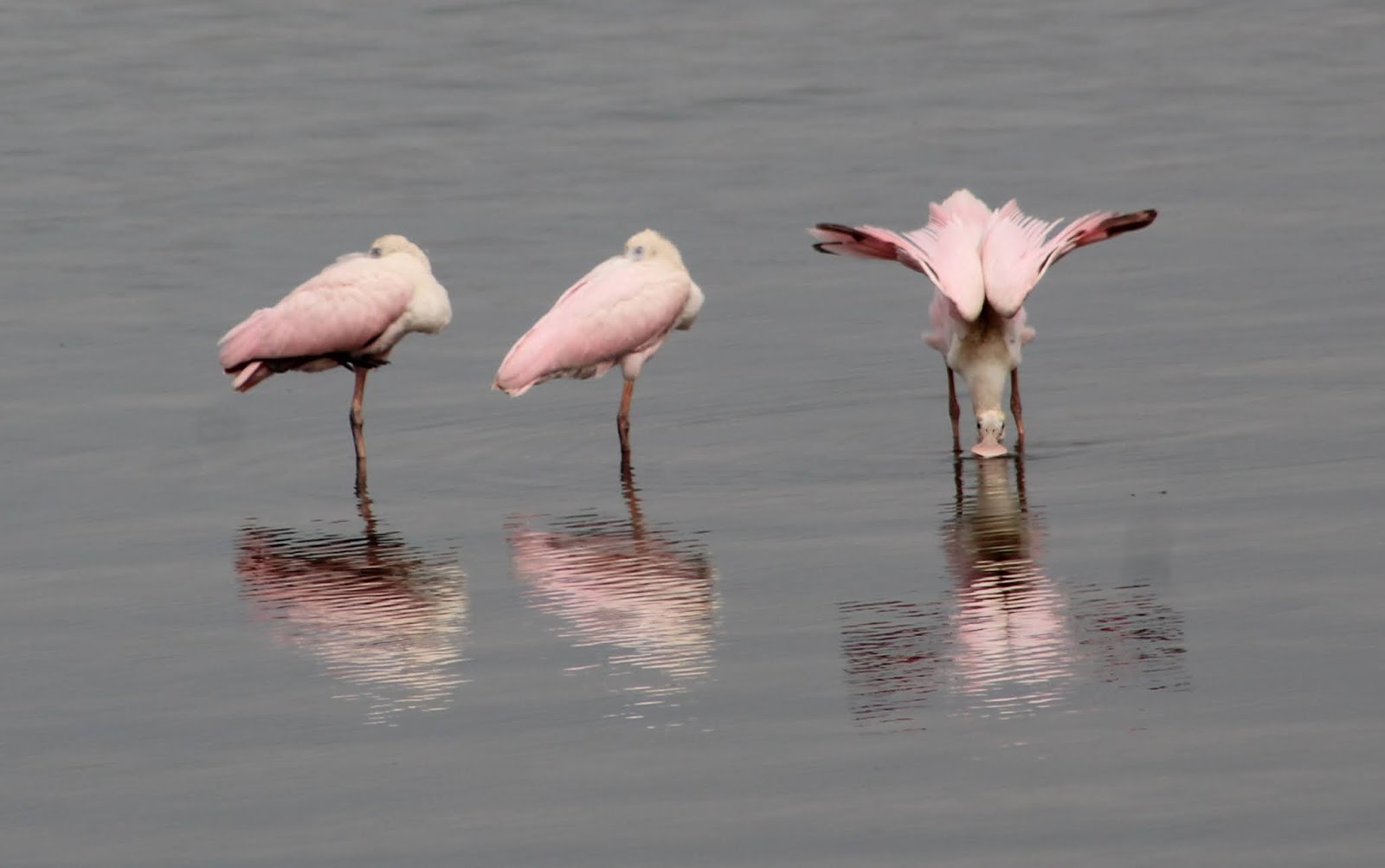
When I got back from the Seven Springs/Camp Creek area on September 11th, reports came into the birding community from Jennie McFarland and Richard Fray that Jennie had found three Roseate Spoonbills at the Glendale Recharge Ponds.  I knew I wouldn't mind seeing these awesome birds, and it's only a ten minute drive from my home in Peoria to the ponds.  When I got there I joined Caleb, Jeff, Levi, Louis, and Pierre.  We all enjoyed the Spoonbills, and we also looked for birds in other five ponds. 


Then, something really awesome happened for my Maricopa County birding, and everyone else's Maricopa County birding.  Caleb spied a Common Nighthawk flying over the basin, and it foraged and dove down at prey a few times.  In Maricopa County, Common Nighthawk isn't "Common" at all.  Back in the day, I had my first Common Nighthawk sighting near my Grandfather's house in mid-November of 2002.  We were walking through the neighborhood, and I flushed a bird that I described as having, "boomerang shape wings with white bars near the end of the wing".  I also noted the bird giving a loud call, and that call stuck with me.  When I got home, I listened to Common Nighthawk calls and it was the match.  As time went on, I realized that a Common Nighthawk in November is freaking rare.  I know I had a nighthawk, but could a Lesser Nighthawk pull something off that is loud like a Common on rare occasions?  In recent days, the record has had me wondering if I really saw that bird, even though I identified it right.  When Caleb spied this Common Nighthawk while we were Spoonbill watching, it became the first Common Nighthawk documented in Maricopa County by photograph.  We were all stoked at the sighting.  With Common Nighthawks in visual comparison to Lesser Nighthawks, they have the white bar further down on the wing and closer to the wrist than Lesser does, a tern-like flight, and darker primaries.  We watched the bird for about a minute before it went off.  What a huge highlight and bird it was for me, thank you Caleb!


The Common Nighthawk was one that turned out to be reliable.  As I write this now, it has been present and chasable at Glendale for a week now.  Birders have been finding it in the evening and early morning.  On September 12th, I was driving home from work and was planning to go grocery shopping and then spend the rest of the day at home.  When I was about to get to the store, Caleb texted me saying, "Chris Benesh has a Canada Warbler at Gilbert Water Ranch".  I forgot about everything else and took a 45 minute drive to Gilbert to for a bird chase.  In Arizona, Canada Warbler is a very rare bird.  Really freaking rare.  Once getting to Gilbert, I made my way to the spot that Benesh had indicated where the warbler was.  There were already plenty of birders there, including Chris and Holly Thomas.  Holly was the one who identified it first, and she and Chris had the local birding community in a search after their awesome find.  Despite many many pairs of eyes looking for the Canada Warbler, it wasn't to be re-found for the rest of the day.  Caleb got there and had two shorebirds flying around while calling.  He felt like they were Buff-breasted Sandpipers.  However, Chrissy Smith had an awesome detection when she was birding around and she found an Eastern Kingbird in Pond 5 of the ranch.  Many birders flocked over to see the Kingbird.  This was only the second time I've seen this species in Maricopa County (as well as in Arizona), and it was fun to see it and watch it forage alongside a Western Kingbird.


September 13th was a day that birders were hoping the Canada Warbler would be re-found.  It is one that is a very challenging statebird to land.  Troy Corman was saying that in his years of birding Arizona, he has never been able to get a Canada Warbler in Arizona.  Ronnie and Caleb were teaming up, and would be at Gilbert.  Scads of birders were there for the day, and the Eastern Kingbird was a big reason for the turnout.  Luckily, Caleb worked up some magic and relocated the Canada Warbler!  It was along the same path in between ponds 3 and 4 of Water Ranch.  I was already prepared to chase the bird after work, and 1 P.M. couldn't have come around sooner.  At about 1:45 when I was pulling up to the ranch, birder Alex Grant had relocated the Canada Warbler along the path between ponds 4 and 5.  I was hoping that this would be an easier spot to see the bird.  In the previous and limited viewing haunts of this Canada Warbler, the vegetation was dense and the bird would be seen with quick, fleeting glimpses.  Earlier in the morning, many were able to see it, but not many were able to photograph it.  I walked up to the new spot and there was a crowd of about 15 birders there.  Luckily, it had been seen about 5 minutes before I got there.  After about 5 more minutes of waiting, I heard the phrase I wanted to hear that goes, "here it is".  I got over to the spot where it was being pointed out and there it was, my first Arizona Canada Warbler, and my 396th bird for Maricopa County!


Canada Warbler is a bird I've dreamed about getting for Maricopa County for a long time, and of course for Arizona as a whole too.  It's one that doesn't usually stick for very long once discovered, and many birders at Gilbert Water Ranch on the 13th got to see this bird and it stuck around for several more days to come.  It ended up being obliging a few times while I was there watching it, and it would behave well in the following days for more birders to get awesome views.  When it was found earlier in the day, I thought it was going to be the elusive bird that it was as Holly and Chris found it. 


It was fun to run into many birders while viewing the Canada Warbler and searching for the Canada Warbler.  After the fun, I realized the fun was only getting started.  I was off of work for three days from September 14th through September 16th.  Caleb and I had conversations at Gilbert about birding, and once I finished up with viewing the Canada Warbler, we made plans to bird together the following day.  After landing an epic rarity, we were feeling lucky.  We decided to go to the southwest part of Maricopa County to see if we could turn up any good birds at Arlington Wildlife Area, several ponds, and at Paloma Ranch.  When September 14th came, I picked up Caleb early and we went down to Arlington Wildlife Area.  We had vagrants on our mind, and Field Sparrow was one of them as we knew it hasn't shown up in Maricopa County yet.  We didn't find anything like that, but scanning a field I found a Roseate Spoonbill.  Can you find it in this picture???


Yeah, yeah, the picture is horrible, but we didn't need to hike out to that bird.  Arlington Wildlife Area is a birdy place, and it has great potential for a lot of birds.  I particularly like a tamarisk treeline that is inviting to migrants.  Caleb and I made our way south to Gila Bend after Arlington.  As we were just a few miles north of Gila Bend, something caught Caleb's attention.  "It was a light-looking Kingbird perched with Western Kingbirds", he said, "can you turn around, it might've been a Scissor-tailed Flycatcher".  I turned around and drove to the spot.  Caleb quickly scanned and said, "Yes!  Scissor-tailed Flycatcher!".


We both started screaming our heads off.  I couldn't believe that I was looking at a Maricopa County Scissor-tailed, and it became back-to-back days of getting lifers in Maricopa.  Scissor-tailed was #397.  Caleb and I got out and got closer to the bird before it flew further off and into farm fields.  We had great looks at it perched and in flight.  On another good note, this bird has entertained many other birds and has been present as I write since Caleb spied the bird.  Scissor-tailed Flycatcher is a bird I've kept in mind a lot for Maricopa County, and is one that I've dipped twice on in the county in the Arlington area.  Thank goodness Caleb was there to look out the window.


Caleb and I were stoked after the Scissor-tailed sighting.  A mesquite tree was along the road we were driving on.  Caleb said, "Tommy, I feel like I can go up to that mesquite tree and find a Philadelphia Vireo in it".  We were both pumped up.  After stopping at ponds and Paloma Ranch, the Scissor-tailed Flycatcher remained as our best highlight of the day.  To conclude our day, Caleb and I decided that we would bird together again on September 15th, which would be Caleb's 21st birthday.  Because of that, it was bound to be a great birding day, right?!.......  Look at this Barn Owl from Paloma Ranch, cool huh...

For his birthday on the 15th, Caleb opted to bird and hike south from the Kerkes Trailhead along the Hassayampa River.  This is a location that is in the town of Wickenburg, and is a few miles north of the famous Hassayampa River Preserve.  From the Kerkes Trailhead, the Hassayampa River has impressive stands of cottonwood and willow forest.  Caleb and I figured that it would hold something awesome and rare.  

At one of our first stops of the day, barely south from the trailhead, we stopped at a spot that had good bird activity and one that looked good for birds.   We started pishing and carefully watched for any birds to come in.  As we looked above us, we saw that a vireo flew in to a big cottonwood that we were standing in front of.  After a minute of more pishing, the vireo emerged and we immediately thought in the initial second that it was a Red-eyed Vireo.  And the bird was very bright...

Caleb got some better pictures than I did, and as the vireo foraged, he questioned why it wasn't the much more rare Yellow-green Vireo.  I looked at the picture above, and it according to the horrible picture I took, it almost resembled more of a Red-eyed Vireo face pattern.  But then I looked at the next picture, and the yellow sides on the bird were a bit striking for a Red-eyed Vireo. 

Looking at the bird closer live, it started to look more and more like a Yellow-green Vireo.  The bird came closer and gave Caleb and I some excellent views.  It was a Yellow-green Vireo, and became a life bird for both of us and an incredible find on Caleb's birthday.


You know what's incredible?!  The Hassayampa River corridor and some of the rarities it gets.  This was a welcome surprise and joined rarities like Green Kingfisher and Streak-backed Oriole.  It was only the second Yellow-green Vireo that's ever been found in Maricopa County, and the first was found by Gary Rosenberg at Paloma Ranch in the 1980's.  But here we were at the northwestern section of Maricopa County in September, documenting this remarkable bird.  Most records from Arizona out of the 14 previous records have come from southeastern Arizona in summer.  This bird is very similar Red-eyed Vireo in many ways, but it has a muted face pattern (one that's not sharply defined like a Red-eyed), a larger pale bill, and extensive yellow from it's underparts to it's ariculars.  Wow, this bird...


Once we reported it to the birding community, it got a good response, and Caleb got an outpour of birthday wishes.  For Caleb and I it was an epic lifebird.  For me personally, it was almost a nemesis.  It was a bird I had chased four times, and struck out each time.  Each of those times came with narrow misses:  one by a few minutes because I was photographing a Varied Bunting, one by a few seconds when I couldn't get on it while others in my birding party were a few feet luckier in their standing place than I was, one by 12 hours (it had been present all day the previous day, and it came right back the next day), and then another one by 15 minutes.  It was great to finally be on the lucky end!  Yellow-green Vireos can be quick wonders a lot of times when they do show up.  It was present when Caleb and I got back from a long hike further down into the Hassayampa River corridor.  Chrissy, Ryan, and Dara were able to get looks at it.  The following days resulted in empty searches by birders, although Erin and Derek Bowen probably saw the bird.

The Yellow-green Vireo's range consists of it breeding in tropical woodland and forest of Mexico and Central America.  Most United States records come from Texas, where it can be fairly reliable.  The bird winters in the Amazon.  Caleb's birthday was fun and had about 80 other species of birds, but none of them are really worth talking about after we found the Vireo!

 
 As I took Caleb home, we decided that we would bird again for a third straight day on September 16th.  After toggling back and fourth and back and fourth for a long time about where we should go, we decided to go to the Verde River to bird at the Box Bar and Needle Rock Recreation sites in northeast Maricopa County.  We felt like we were on a serious roll and wanted it to continue.  Box Bar and Needle Rock are two sites that are close to each other that have impressive riparian stands of willow and cottonwood.  We wanted to try our luck there.  Box Bar was our first stop, and would be our main stop of the day.  Birds were numerous to start things off.  I got to see my first Vaux's Swift of the year.  This Hermit Warbler was also cooperative.  
 

Caleb and I got to an impressive stretch along the Verde after awhile, and it was one were I found my first Red-eyed Vireo about five years ago.  We stood at this one spot that had a dense clump of awesome habitat.  A call note emerged from the surrounding habitat, and we looked up to see this.


The white undertail coverts, smoky gray upperparts, yellow underparts, eyering, and as it turned it's body to reveal a streaked "necklace" across it's breast it resulted in us finding our own Canada Warbler.  We were shocked again, and with this discovery, I couldn't help but burst out laughing after I got a better shot.


A few days prior to this, Caleb and I were both searching in high hopes of a Canada Warbler that we were chasing.  And then we find our own!  The Gilbert Water Ranch bird was one that had me freaking out and when I got to see it, I was relieved.  Funny enough, the Gilbert bird wasn't seen on the 16th, as the 15th was the last day it was seen.  Caleb and my Canada Warbler stuck around for a few days, and allowed several birders who missed the Gilbert bird, to get on this one!  Erin and Derek Bowen are big year birding Arizona, and they were in Texas while the Eastern Kingbird and Canada Warbler were at Gilbert.  Our Canada ended up being Erin's 400th Arizona year bird on September 18th.  After our first minute of watching the Canada, we lost it and came back to find it foraging around, where it gave us great views.  


I also enjoyed these two birds a lot, as always!


At Needle Rock, I spied this Northern Beardless-Tyrannulet in midst of a bird flock.  It was only my 3rd of this species for Maricopa County, and Caleb's second.


After the Ty, we headed back.  At about 3 P.M. that day on September 16th, I dropped Caleb off at his house.  It was almost exactly a week after I had arrived at Canoa Ranch at 3:15 P.M. on September 9th, a tad less than a week.  What exactly happened in that one week?

-Two lifers were obtained:  Northern Jacana and Yellow-green Vireo
-I got three Maricopa County lifers on three straight days:  Canada Warbler, Scissor-tailed Flycatcher, and Yellow-green Vireo (Caleb got those plus Eastern Kingbird, so he had four straight days)
-Common Nighthawk was practically in the Maricopa lifer department, it was incredible.
-Eastern Kingbird was a second time only in Maricopa County for me.
-Aside from these highlights, the birding was awesome too.  I don't wanna write too much.

Thanks Caleb for the fun days.  Speaking of Caleb, on September 17th, he had Maricopa County's first Chimney Swift fly through his yard, and he documented it well.  Today he had a Least Flycatcher at the famous Dateland vagrant trap in Yuma County.  

For me, Maricopa County life birds are a huge deal.  In three days, my list went from 395 to 398.  It was something I didn't see coming, and the action kept coming.  The Canada Warbler was good enough to last for awhile, and the Scissor-tailed Flycatcher and Yellow-green Vireo blew things up.  Getting our own Canada Warbler was freaking crazy.  As I'm getting close to hitting my dream of 400 birds for Maricopa County, I'm hoping it'll get here soon.  It may happen soon, but it may not happen for a long time.  Who knows, time will tell and birding hardcore will tell too.  Till next time...

Tuesday, July 7, 2020

Northerly Treks: The Prairie To The South

I didn't do much after Sax-Sim Bog on June 8th except for getting dinner and going back to Gretchen's cabin for the remainder of the evening.  After enjoying time on the dock over the Yellow River, I went to bed early, because I was going to get up and hit the road early by 2 A.M. on June 9th.

My destination on June 9th was the Buena Vista Grasslands and Marsh in central Wisconsin in Portage County.  A town close to this area is Wisconsin Rapids.  From Gretchen's in Spooner, the drive to the prairie habitat was a little over three hours away.  I left a little after 2 A.M., and wished that I would've left at 1 A.M.  Giving the fact I would have to make a few stops along the way, and underestimating how quickly it does get light out in the north, I realized I should've left even earlier.  The drive to Wisconsin Rapids wasn't smooth either.  While deer on the roads weren't an issue for me on the entire trip up until this drive, this drive was different.  I had three deer run in front of my rental truck as I was driving highways.  Although I didn't hit any of them, they sure had my heart rate going fast.  One scared me, one really scared me, and one terrified me.  The latter two were lucky I didn't come a tenth-of-a-second earlier.  As I had been very careful of road wildlife all trip, I was phobic of hitting animals on this drive after those three deer.  I was glad when I got to the grassland and prairie just before 6 A.M., but I do wish I would've gotten there an hour earlier.

My main target of this trek was the Greater Prairie-Chicken, and another big target was Henslow's Sparrow.  A few others that were of big interest were Short-eared Owl and Upland Sandpiper.  When I got to Buena Vista, I started looking for Prairie-Chickens immediately.  I cruised up and down dirt roads that go within the area.  There were signs up that stated it was a Prairie-Chicken management area.  I drove up to a kiosk at the entrance to the wildlife area.  They had Greater Prairie-Chicken information everywhere.  Long description of a fun bird cut short, the Greater Prairie Chicken was once very common in this area from Wisconsin and the north-central United States and much further south in the central United States.  It's habitat has been destroyed to create a rapid decline in the species.  Wisconsin is a great example of once having high and much more widespread numbers of Greater Prairie-Chicken, but has also had habitat destroyed for human needs.  In the Buena Vista area, 15,000 acres of great habitat for Prairie-Chickens has been created, and it is a great place to observe this species in winter and especially in April, when birds begin "lekking" and looking for mates.  The males perform unforgettable courtship displays or "dances", and someday I'd love to visit an active lek.  All of the signs throughout the area and at the kiosk made me want to see one even more.


Other than an interesting chicken-like bird that ran across the road quickly and didn't give me any further views, I will say now that I didn't get to see a Greater Prairie-Chicken.  It opens the door to see it somewhere else, and for another adventure in the future.  I also laughed a little that I didn't find one, because if I found one, it would give me a perfect 9-for-9 on life birds that I could get on the trip.  When it comes down to birding, there's rarely ever that "perfect" trip.  As I thought I'd miss Spruce Grouse more likely out of the two, it turned out to be a flip.  Looking over eBird data in Buena Vista Grasslands and Marsh area, which is highly managed for Greater Prairie-Chickens, it showed sightings planted down on eBird literally everywhere throughout the entire area.  One would think that getting one would be a piece of cake, but it wasn't.  Maybe it was because I should've been there at 4:30 A.M. rather than close to 6 A.M.  When I arrived, there was a lot of light on the prairie already!


Despite missing the Chicken, I did get great looks at a species I've wanted to see much closer and for an extended amount of time in the Henslow's Sparrow.  Along a road called 130th Street, a route that goes through great prairie habitat, were plenty of Henslow's Sparrows.  Some of them popped up at close range for me and sang their simple song, which to some translates as "Hick-UP!  Hick-UP!  Hick-UP!".  This sparrow has a very large bill, a buff mustache bordered by black lines on both sides, a neat greenish coloration on it's neck and nape, a reddish back and wings with black streaking and white edging, and streaking on it's breast and sides.  Males will often sing relentlessly when arriving on nesting grounds and will even sing at night sometimes.  On average, these sparrows are usually secretive, and getting a few of them in view was a big accomplishment for me and was considered a major target of my trip.


Here is a recording I took of the Henslow's Sparrow's song.


Driving through the area gave me more good birds.  Sandhill Cranes were common.


A surprise came when I found two Whooping Cranes in midst of a large Sandhill Crane flock.  Whooping
Cranes are found in numbers in other places of central Wisconsin, primarily in the area of the Necedah National Wildlife Refuge, which isn't too far from Buena Vista.  Even though they are usually pretty close by to Buena Vista, I was still shocked to come across them.  It was awesome to see, and the Whooping Cranes who breed and summer in Wisconsin are part of the reintroduced Whooping Crane population.


Driving through the area also gave me four different Upland Sandpipers.  I love seeing this odd-but-awesome "shorebird".  Two of them were in flight, and two of them were in farm fields that had shorter grass.


Grasshopper Sparrows were common.


And Savannah Sparrows were abundant.


This Yellow Warbler at a structure was interesting, maybe it had a nest in there.


Eastern Kingbird is a common sight on prairies.


Bobolink and Dickcissel were also both quite common.


I didn't see any Short-eared Owls, and if I would've gotten to Buena Vista around 4:30, maybe I would've had a chance.  Short-eared Owls have been detected there, and in fact, one was seen a few days ago as I write today on July 7th at about 4:30 A.M.


I looked for Greater Prairie-Chicken from before 6 A.M. till about 11:30 A.M.  As I said before, I didn't have luck.  But I love to bird in the prairie and marsh-prairie habitat where the "fantastic four" of Greater Prairie-Chicken, Henslow's Sparrow, Upland Sandpiper, and Short-eared Owl, are found.  Before I started to head home, I got the expected-but-still sad news that the Amaranthe shows I was gonna go to were being cancelled.  It also means I'm going to put the Atlantic coast off this year, as that trip to go to concerts was also going to be one for birding.  The day became a bummer as the southern storm was quickly coming north from the south where it originated.  It made me extremely thankful that I added four full days onto this trip and that I got to enjoy this trip as much as I did.  As the storm was coming with some very heavy rain and wind in the forecast, I knew that this trek was likely my last good one of the trip.  I also got more news from birding back home in Arizona, that an Eared Quetzal had been found in the Chiricahuas.  It was found on the 8th, but confirmed and made official on the 9th.  As I drove through central Wisconsin, I still preferred the epic north over Arizona.  With the Quetzal, it is a freaking great bird, and a rare one at that.  If it stuck around, which I was doubtful of, I would have the full day of June 12th after I would get back to Arizona early on June 11th that I could potentially chase it, if I had the energy.  As for Northerly Treks, we still have one more post to conclude the great impact it had on me and my birding, and that post will be up next.