Showing posts with label Bell's Vireo. Show all posts

Sunday, June 5, 2016

My North American Migration Count-May 14th, 2016

Yeah, this is a late post.  In fact, there are many more late posts on the way.  I've been very busy so I haven't had the appropriate time for blogging.  On May 14th, 2016, I opted to explore the Bushnell Tanks arm of Sycamore Creek for the North American Migration Count (NAMC).  Bushnell Tanks is a great location, and it is one that is under-birded in general and is also one that I don't take the time to visit as often as I should.  Because of that reason, I decided to bird it hard and carefully count each and every bird in about a five hour duration.

Because I found a way to carefully count birds on this count in a quick manner, I think I can count birds with accurate numbers a lot more now.  And it's actually quite fun.  Here's my list from the count, I'm sure you can find my main highlight pretty quickly:

Beeline Highway--Bushnell Tanks, Maricopa, Arizona, US
May 14, 2016 5:55 AM - 10:35 AM
Protocol: Traveling
2.5 mile(s)
Comments: It's been a long time since I've birded this epic location, so I thought, "Hey, why not do this spot for the NAMC".
68 species (+1 other taxa)

Gambel's Quail 18
Turkey Vulture 5
Cooper's Hawk 1
Common Black Hawk (Common) 2
Broad-winged Hawk 1 Rare but annual in Arizona, especially in spring migration. What caught my eye today was a small buteo flying high with a Cooper's Hawk. I saw how small the bird was and that it had strong black primary tips with black trailing edges on the lower border of the wing. This bird appeared to show both adult and 1st year features from my pictures and the missing primary may indicate molt. The uniform brown coloration and black primary tips and trailing edges on the wings eliminate Gray Hawk. The noticeable white tail band eliminates the larger and longer-winged Swainson's Hawk and the much rarer in central Arizona Short-tailed Hawk (which has never been recorded in Maricopa County). The nearby Cooper's Hawk gave a good size comparison between the two birds. These are horrible photographs, but they do support Broad-winged Hawk. Also note the bird's flat flight dehidral when soaring with the Cooper's Hawk.
Zone-tailed Hawk 3 All from different spots along the old road through the area.
Red-tailed Hawk 1
White-winged Dove 11
Mourning Dove 8
Greater Roadrunner 3
Black-chinned Hummingbird 5
Anna's Hummingbird 1
Costa's Hummingbird 1
hummingbird sp. 5
Gila Woodpecker 25
Ladder-backed Woodpecker 3
American Kestrel 2
Western Wood-Pewee 2
Gray Flycatcher 1
Say's Phoebe 1
Ash-throated Flycatcher 9
Brown-crested Flycatcher 26 Well distributed throughout duration hiked.
Cassin's Kingbird 13 Well distributed throughout duration hiked.
Western Kingbird 3
Bell's Vireo 29
Gray Vireo 5
Western Scrub-Jay (Woodhouse's) 4
Common Raven 5
Northern Rough-winged Swallow 2
Violet-green Swallow 12
Bridled Titmouse 4
Juniper Titmouse 2
Verdin 9
Canyon Wren 2
Bewick's Wren 23
Cactus Wren 10
Blue-gray Gnatcatcher 2
Curve-billed Thrasher (palmeri Group) 1
Crissal Thrasher 1
Northern Mockingbird 5
Phainopepla 23
Orange-crowned Warbler 2
Lucy's Warbler 62 Well distributed throughout duration hiked.
MacGillivray's Warbler 1
Yellow Warbler (Northern) 69
Yellow-rumped Warbler (Audubon's) 6
Wilson's Warbler 3
Yellow-breasted Chat 15
Chipping Sparrow 4
Black-throated Sparrow 11
Lark Sparrow 3
White-crowned Sparrow (oriantha) 2
Canyon Towhee 4
Abert's Towhee 5
Rufous-crowned Sparrow 3
Green-tailed Towhee 2
Summer Tanager 8
Western Tanager 17
Northern Cardinal 17
Black-headed Grosbeak 3
Blue Grosbeak 9
Lazuli Bunting 12
Indigo Bunting 1
Brown-headed Cowbird 9
Hooded Oriole (nelsoni Group) 29 Well distributed throughout duration hiked.
Bullock's Oriole 17
Scott's Oriole 3
House Finch 54
Lesser Goldfinch 43


Yeah, on this count I found a Broad-winged Hawk!  It was only the second time I've ever seen this species.  This bird is turning into a rare but regular migrant in Arizona, particularly in spring.  This bird was a distant soaring sight, but when I saw it through my binoculars I knew it was something good.  Any small buteo in Maricopa County is a good thing to find.  As the Broad-winged Hawk soared with a Cooper's Hawk, I snapped as many pictures as I could before it left my sight.


The black trailing edge to the Hawk's wings, tail pattern, and uniform brown coloration point to Broad-winged Hawk.  It was the first time I've photographed this species, hopefully I'll have a closer chance in Minnesota in the coming week.

Another neat highlight was a total of 5 Gray Vireos.  Whenever I have birded at Bushnell Tanks in spring and summer, a Gray Vireo highlight was usually involved.


Orioles were very common.  I tallied 49 orioles of 3 different species:  29 Hooded, 17 Bullock's, and 3 Scott's.  This rather distant Hooded was my only proof that I actually saw one of them ;)


Two local raptors, Common Black-Hawk and Zone-tailed Hawk are always a big draw in this area.  While in a stand of riparian trees, I had a Black-Hawk fly over me.  In the surrounding hills and such, two Zone-tailed Hawks perched out in the open to give me a chance to snap a few pictures.


Cassin's Kingbirds are another bird I enjoy in this area.


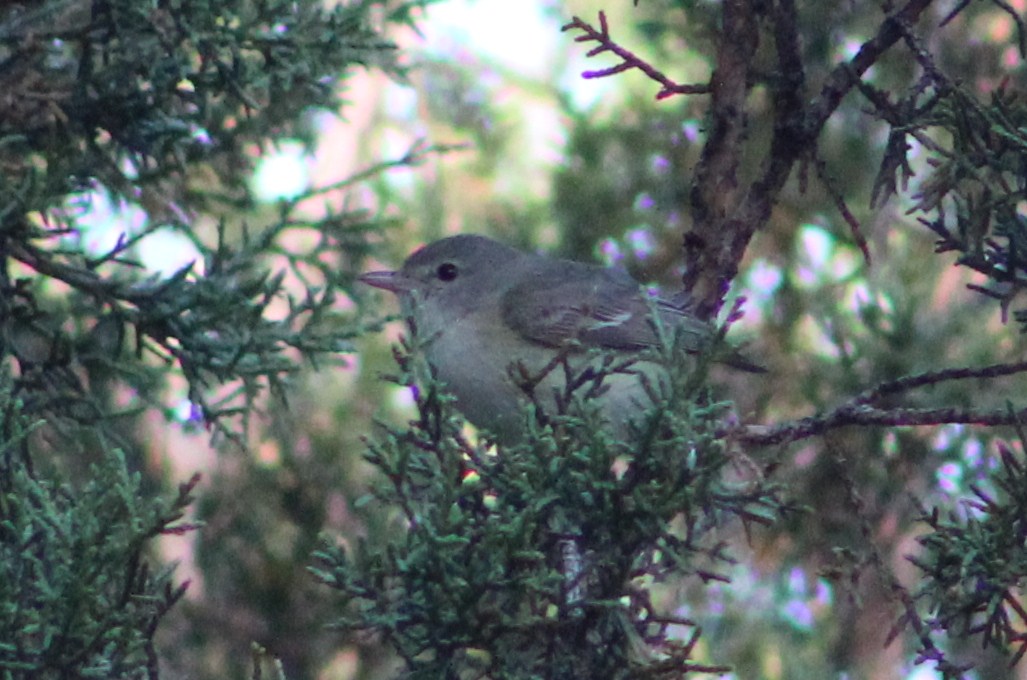
Bell's Vireos too...


Lucy's Warblers and Yellow Warblers were the day's most numerous birds.  Yellow won the fight with 69, but Lucy's was a close second in at 62.  Here are two of the 62 Lucy's.


Less numerous but still in good numbers was another "warbler", the Yellow-breasted Chat.  15 Yellow-breasted Chats are noisy with all the different vocalizations they give.  For a bird that usually skulks, I got my best ever shots of the species.


Black-throated Sparrows and Rufous-crowned Sparrows also highlighted the morning.  68 species total for my count, and a fun morning it was!


Thursday, April 24, 2014

Chatting Up A Storm at Hassayampa

The Hassayampa River Preserve is one of Maricopa County's best riparian corridors.  I love to visit this place, and there are always good things to be seen here.  This includes breeding Gray and Red-shouldered Hawks and Tropical Kingbirds, and a handful of other birds.


Despite the fact Hassayampa is home to a lot of birds, most of those birds are very hard to photograph.  The habitat here is thick and dense, and the birds have plenty of cover.  Today, I arrived and noticed from the start that the Yellow-breasted Chats are back in full force.  The Yellow-breasted Chat is "classified" as a warbler, but it acts like a thrasher or a catbird, and sounds like everything in the book.  It's an odd bird, but is very cool.  Chats are very chatty, and they are also very elusive.  They don't come out in the open much, and are often difficult to view yet alone get photographs.  Luckily today, I had a few Yellow-breasted Chats who were very cooperative for my camera.  This was by far my highlight of the day today.


The Yellow-breasted Chat is clearly the largest, and strangest "Wood Warbler".  What's weird about it?  It sings at night, it's large, it's bill is tanager thick, and it's tail is way too long.  It has the voice of a thrasher, and it's just freaking weird.  It's over 7 inches in length and it's wingspan is nearly a foot.  That is one weird bird, and one weird warbler.  It's also very cool at the same time!


There were a few other photo highlights during the day.  Although a poor few photos, I got to see my first Lawrence's Goldfinch of the year.


Yellow Warblers were very numerous, perhaps the most numerous bird at Hassayampa.  They sing away in the top of the cottonwoods.  They are hard to photograph!


The Bell's Vireo is another common bird that stays hidden.  They are hard to photograph also, why did I find myself photographing so many true hardcores today?  This bird was even banded too, probably right at the Preserve grounds.


The female Vermilion Flycatcher is a lot more easy to photograph, and was one of four Vermilions I saw during my trip.


I then made the average Common Yellowthroat look like a Yellowthroat robot.  I had my flash on and setting on automatic, a recipe and proof of a disastrous photograph.


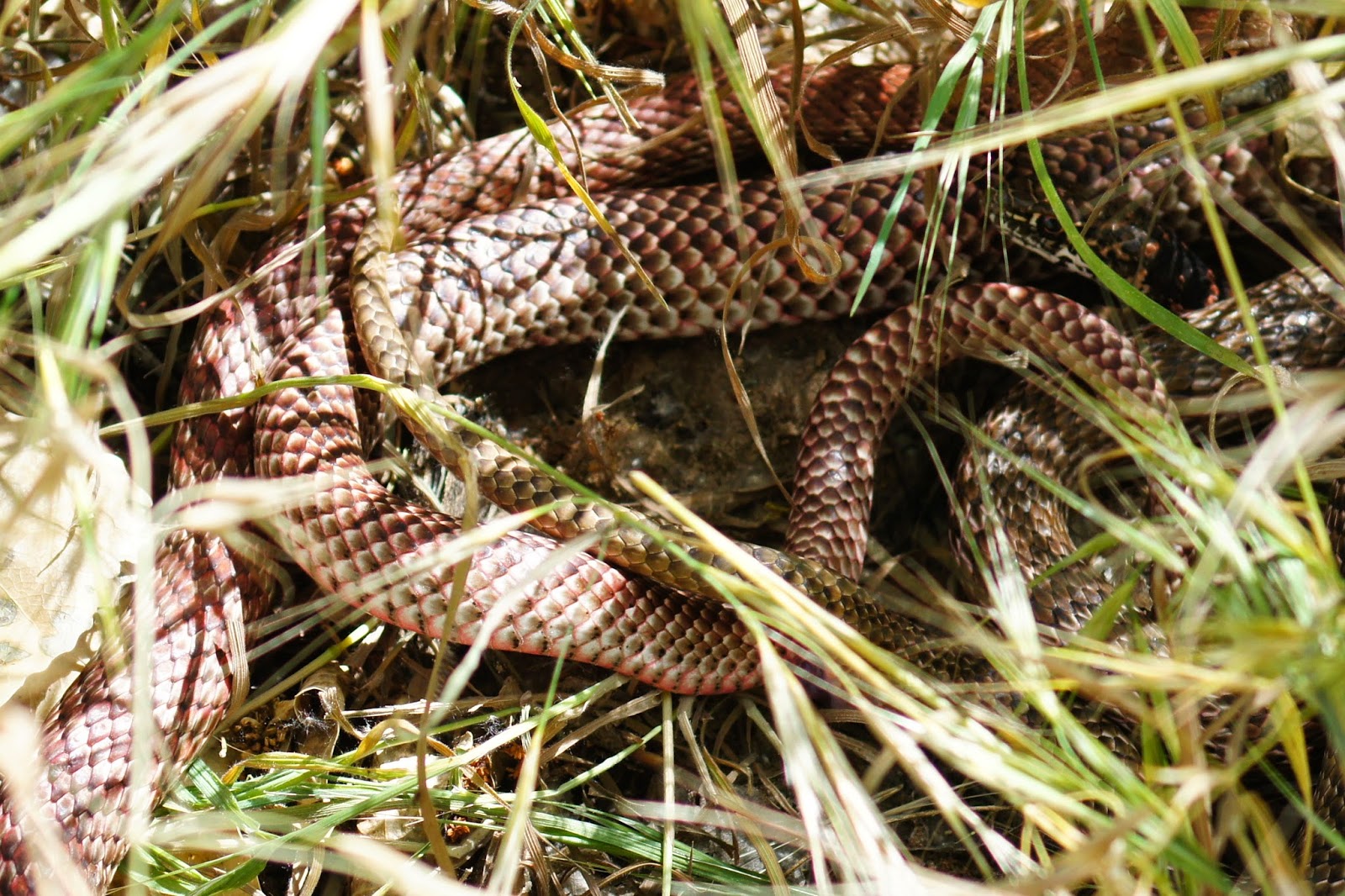
I then stumbled upon these red-phased Coachwhips on top of each other.  I think they were making snake love.  Now, this snake is usually shy, but not these ones.  It's usually a struggle to get a good look at one of these suckers.  


At Hassayampa, other highlights that weren't photographed were Gray and Red-shouldered Hawks, a female Broad-billed Hummingbird, Brown-crested Flycatcher, Canyon Wren, Cedar Waxwings, MacGillivray's and Townsend's Warblers, and Hooded Oriole.  Plenty of Summer Tanagers also.  Hassayampa is a neat place that is always fun to bird, 44 species in all.

Wednesday, March 27, 2013

Birding Hassayampa, Sun City, and Glendale


Hi everyone,

I explored several areas around the Hassaympa River Preserve today, followed by Lakeside Pavilion in Sun City Grand and the Glendale Recharge Ponds.

My first stop was a location north of Wickenburg along Jack Burden Road that has good mesquite habitat and some nice willow and cottonwood stands.  A GRAY HAWK greeted me as I started birding, and the surrounding mesquite was filled with the songs of returning LUCY'S WARBLERS and BELL'S VIREOS, as well as VERMILION FLYCATCHERS, several ASH-THROATED FLYCATCHERS, and a calling COOPER'S HAWK.

Gray Hawk

Lucy's Warbler

Bell's Vireo


I then spent almost five hours searching for birds at the Hassayampa River Preserve.  The recent Downy Woodpecker was my main target for exploring this area today, but I wasn't able to find the small bird.  Finding this bird is like looking for a needle-in-a-haystack, and I wasn't expecting to find it.  I did follow every LADDER-BACKED WOODPECKER I heard however, as they and the Downy Woodpecker sound very similar.  I did have very good highlights though with watching the LAWRENCE'S GOLDFINCHES along the Mesquite Meander Trail.  They have breed in this location before and look to be repeating the process again this year.  I also had a four vireo day here which included good numbers of BELL'S, two PLUMBEOUS, and singles of CASSIN'S and HUTTON'S VIREOS.  An INCA DOVE was somewhat of a surprise here along Palm Lake, which I don't recall ever seeing an Inca Dove within the Preserve.  A single HAMMOND'S FLYCATCHER was also present, and HERMIT THRUSHES were numerous near the Picnic Area.  A WILSON'S WARBLER was the warbler highlight.  The GRAY HAWKS could be heard calling from Lyke's Lookout as usual.

Lawrence's Goldfinch


Hermit Thrush

Lesser Goldfinch


From Hassayampa I went to Lakeside Pavilion at Sun City Grand.  I easily found Dominic's continuing GOLDEN-CROWNED SPARROW, who gave me a good show.  A bully MOURNING DOVE pushed the Golden-crowned and a WHITE-CROWNED SPARROW away as it obviously would win the size fight in order to claim whatever the three birds were feeding on.  Dominic also recently found a Greater Scaup here, but the bird wasn't here today and he hasn't seen it ever since he first saw it.  This can be a good location to see waterfowl.

Golden-crowned Sparrow


I lastly stopped at Glendale Recharge Ponds to see what was there.  As I was driving up, I saw a WESTERN KINGBIRD perched on a wire.  There are still a lot of ducks here, highlighted by several BUFFLEHEAD.  Shorebirds included AMERICAN AVOCET, BLACK-NECKED STILT, many LEAST SANDPIPERS, and LONG-BILLED DOWITCHERS.  A PEREGRINE FALCON who flew over the ponds in hot pursuit scared up plenty of birds.  The OSPREY sat on it's usual telephone pole.  Basins 2 and 5 have water in them right now.  Another good day of birding!

American Avocet