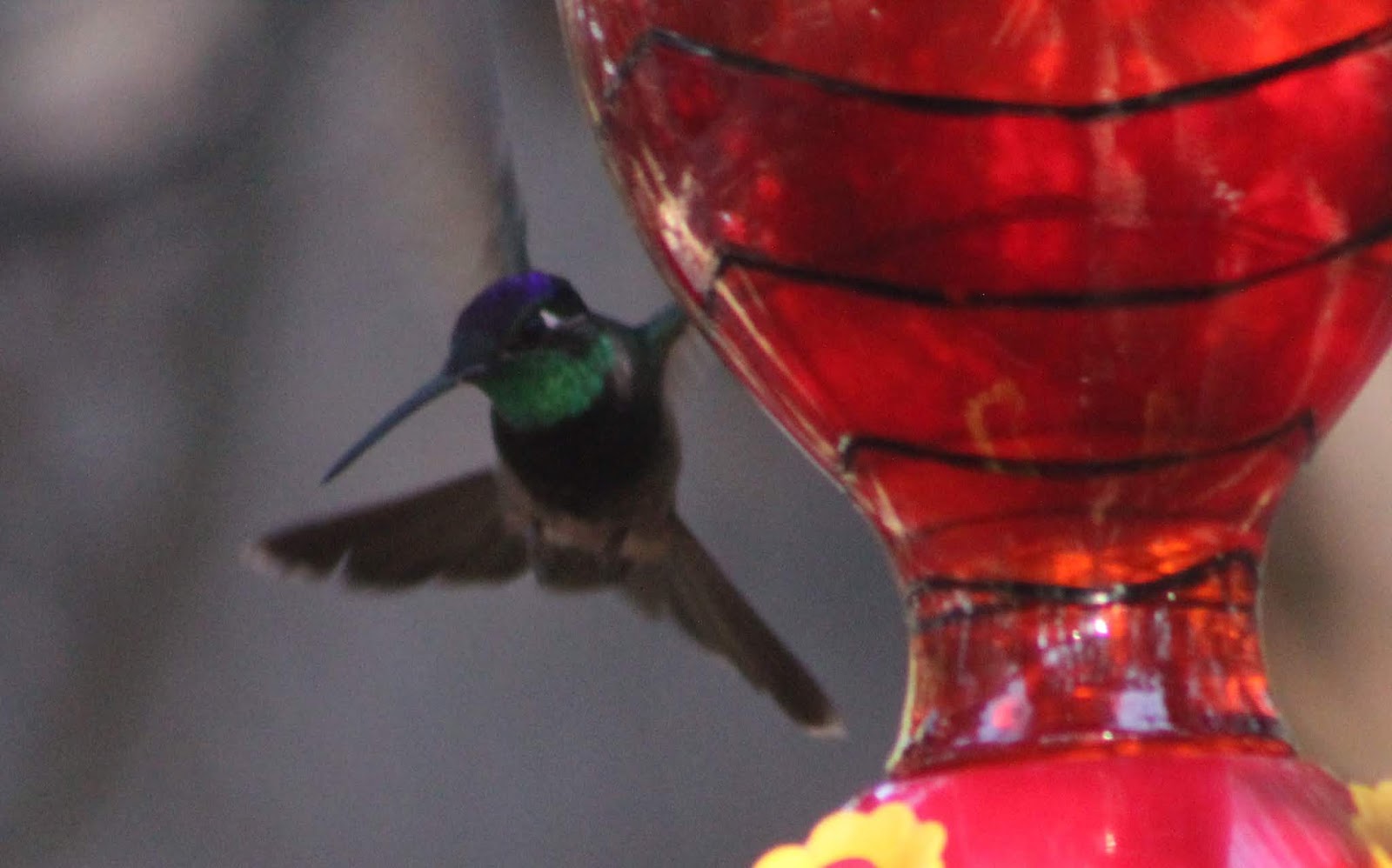
Showing posts with label Magnificent Hummingbird. Show all posts

Thursday, August 15, 2019

In The Gila: You Can't Win If You Don't Play

When Arizona birders hear the other-worldly calls from the Buff-collared Nightjar right after dusk, it usually comes from canyons in the southeastern part of the state.  Aside from Arizona birders, birders from many corners travel to witness this bird as the United States' range of the Nightjar is more knowingly restricted to these few Arizona canyons.  Over the years, this bird has shown that it has a high ceiling of showing up elsewhere and further north in Arizona into ranges outside of the typical canyons near the Santa Rita Mountains and California Gulch areas.  Last year, a Buff-collared Nightjar was sound recorded and eBirded in northern Pinal County, close to it's junction with Gila County and at the base of the foothills to the Pinal Mountains on the south side of Globe.  Just as nightjars are cryptic creatures of the night who would require a maze to locate if they didn't vocalize, it seemed as if a remarkable eBird record was just as fleeting on every level.  I never heard one person talk about this record.  Not one.  To me, a species of interest like this, a regional specialty, would qualify for a louder broadcast.  I never knew about it.  Thankfully Caleb Strand is a good buddy of mine, and he brought the record to my attention.  I was blown away, and Caleb made a good point that the species has to be somewhere in Gila County during certain years.  Looking at the eBird range map of Buff-collared Nightjar also showed records of birds in Aravaipa Canyon from Pinal County.  These records showed a handful of observers, but the knowledge of the observations were ones that still eluded me until a Caleb-inspired-research.  Between the bird near the southern base of the Pinal Mountains (which was less than a mile away from Gila County) and Aravaipa Canyon, Caleb and I looked over maps at habitat that looked considerable for additional records of the bird in Gila County.  The Boy and I made it a goal that we would find a good area or two and try to pull up a remarkable record of our own for Buff-collared Nightjar. An equal thrill of finding one would be it being a first Gila County record, a county that is well under the usual radar for the bird.  We were well aware that there was a much better chance of striking out rather than succeeding when looking for a species like this, but it was a worthy goal to us.  Caleb and I had the mindset of, "You can't win if you don't play".  The thought process stays true to the hobby of birding.  For great discoveries to happen, one has to put the work in for it.  I found myself planning a trip with Caleb over the days of July 18th and 19th, where we would be trying for not only a remote Buff-collared Nightjar, but for other birds that are scarce in Gila County that one wouldn't get if they didn't put the times in for.  You can't win if you don't play!

Buff-collared Nightjars are obviously named if you see one in the field or take the more likely route of looking in a field guide or simply going to Google.  These birds are at the very northern limit of their range in Arizona, and seeking them out in new places in places where they haven't been discovered yet is always of high interest.  Even though the nighjars are found in a variety of habitats further south throughout their main Mexico distribution, they are tied into a much more limited habitat choice in southern Arizona.  Most records come from dry canyon bottoms above 3000' and up to 4500' in midst of steep surrounding slopes within deserts or along drainage areas that feature some riparian habitats that have mesquite, hackberry, and oak trees nearby.  Caleb set his eyes on a place that is called Ranch Creek.  The creek is east of Globe and is on the western edge of the San Carlos Indian Reservation.  Looking at maps, Caleb realized that the habitat and elevations were similar to the habitats where Buff-collared Nightjars are typically found in southeastern Arizona.  While I had some places in mind south of Globe along State Highway 77, this place that Caleb had located seemed like a better option.

July 18th was an odd day.  Caleb and I planned to trek over to Ranch Creek after I would get off of work in the afternoon.  It was a Thursday, and for some odd reason I thought I had to work early in the morning that day.  I went into work only to find out that I was off for the day and that I mis-read my schedule, and by the time I told Caleb I actually had the day off, he made plans for the first half of the day.  That point in time was one of my dumbest, but in the early afternoon, we made our way towards Globe and Ranch Creek.  After purchasing recreational permits for the Indian Reservation, we made our way south down a rough road that eventually paralleled Ranch Creek for most of it's entirety.  Ranch Creek Road got rougher and rougher as we continued south.  Caleb's Suburu has a lot of muscle to it and can endure a lot of rough terrain.  Whenever we would cross a dry Ranch Creek, I was concerned for the vehicle.  It got to a point where Caleb parked the car and we would decide to walk south for up to three miles to explore the creek.  In the beginning stretches of the creek and it's riparian habitat of sycamore, cottonwood, and willow, we were greeted by a Zone-tailed Hawk.

Zone-tailed Hawk

Seeing Ranch Creek in person was better than it was on Google Maps, and Caleb was absolutely right that the habitat looked great for the potential in Buff-collared Nightjar.  We thought it also looked great for Varied Bunting, a species that we would have have had a much better chance at finding in the early morning hours or in the middle of a good monsoon season.  Northern Beardless-Tyrannulet was another bird that we thought would be present as we came up upon stands of healthy mesquite bosque with surrounding hackberry and desert vegetation along the sycamore and cottonwood riparian habitat in the creek.  It didn't take long before we heard the distinctive call of the tiny flycatcher, and it was a Gila County lifer for Caleb.  Ranch Creek was a fun place to bird during the remaining hours of daylight, and we had a variety of birds that included Cooper's Hawk, Vermilion Flycatcher, Cassin's Kingbird, Brown-crested Flycatcher, Bushtit, Woodhouse's Scrub-Jay, Bridled and Juniper Titmice, Crissal Thrasher, Canyon and Rock Wrens, Canyon Towhee, Hooded Oriole, Lucy's Warbler, Yellow Warbler, Summer Tanager, Blue Grosbeak, Rufous-crowned Sparrow and most of the common Sonoran desert birds.  Caleb also flushed up a surprise in his first Barn Owl for Gila County.

Cooper's Hawk

Zone-tailed Hawk

Ranch Creek Scenes


After a good hike, we returned to the vehicle at dusk.  Caleb planned it out perfectly (so did the rough road too, I guess) that we would go through what looked to be the best habitat for any potential Buff-collared Nightjars on our return drive north and out of Ranch Creek.  Common Poorwills didn't hesitate to sound off immediately as it got dark.  From the start, Caleb played the calls of Buff-collared Nightjar out loud by placing a speaker on his vehicle.  The sound carried for distance aplenty, and we hoped it would be answered.  We made stop after stop, and we weren't able to locate any Buff-collared Nightjars in close to two hours of nocturnal birding.  Neither of us had hopes that went too high for the species, but at the same time, it was extremely awesome to try.  It was also great to explore a new area that has probably rarely ever been birded.  You can't win if you don't play, right?  On the other hand, we did detect 12 Western Screech-Owls, 2 Great Horned Owls, an Elf Owl, and 4 Common Poorwills.  The first former of those night birds had several individuals that wanted to chill with us and perhaps they had always wanted to see a Buff-collared Nightjar in Gila County too.

Western Screech-Owl


Kangaroo Rat

Elf Owls were present at our camp out along Highway 77, south of Globe and north of the small town of Winkelman.  July 19th was the day, and we planned to venture south along the Gila River north of Winkelman before looking for Gila County rarities in Mississippi Kite, Black Vulture, and Varied Bunting and we would then visit the high elevations of the Pinal Mountains in the second half of the day.   Before the temperatures in this lowland habitat would hit triple digits, we birded along the recreation sites and riparian habitat at the Gila River.  Gray Hawks were a cool highlight, as was a heard-only Willow Flycatcher and Yellow-billed Cuckoo.  We didn't detect any Varied Buntings, which I've only found once along this stretch in 2017.

Gray Hawk

Summer Tanager 

In Gila County, Black Vulture and Mississippi Kite are two "you can't win if you don't play"-kind've-birds.  There are several records of Black Vulture in Gila County, most of which are from the town limits of Winkelman or just barely north of Winkelman while birders have been traveling on Highway 77.  I had tried for the bird a handful of times, and it managed to elude me.  Mississippi Kite is one that used to be reliable in Gila County in the town of Winkelman, especially on the public golf course in town.  From what I've heard, birders in the past used to be able to see the kites pretty easily, and often at times without having to get out of their vehicles.  Since then, they have declined in the area, but have been recorded breeding just to the south along the San Pedro River adjacent to the town of Dudleyville.  Looking at eBird, the last Gila County sighting of the kite was from Ed Dunn in June of 2015.  I still think the Kites visit the area, but are a species one has to make regular visits for in order to obtain a sighting.  Our stakes were definitely higher to see a Black Vulture out of the two, and as we got to Winkelman mid-morning, Winkelman Flats Park was our first visit.  Immediately after turning onto the entrance road to the park, I saw that three vultures were perched up on a large tree.  The left was a Turkey Vulture, and the other two were shaped differently, had gray heads that had bare skin that extended further down to the neck, and longer legs.  I freaked out and knew that we had landed our Gila first Black Vultures!

Black Vultures (Gila County #312)

Most of the Turkey Vultures in the area had started to lift up and start their morning soaring, but the Black Vultures weren't in any rush to start their soaring.  As Caleb and I observed them, they did fly away from us a few times to land on nearby perches.  It's been awhile since I've been pumped up to see a Black Vulture, but a Gila County Black Vulture is a Gila County Black Vulture...


This Tropical Kingbird was also nearby.
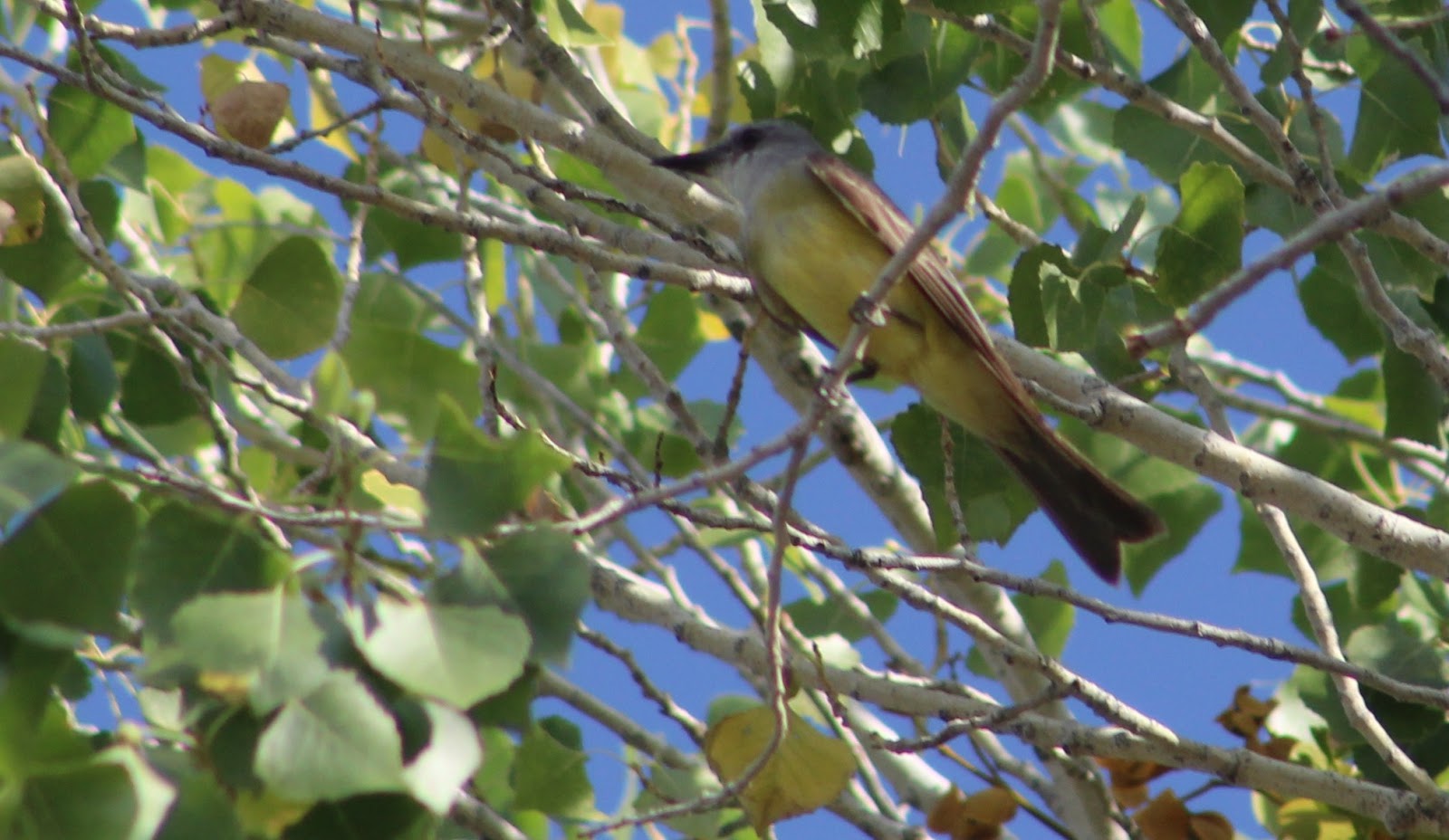

Our next birding stop was in high and cool elevations of the Pinal Mountains.  We started off in the Pioneer Pass half of the range, and we were impressed with the area.  It was my first time visiting Pioneer Pass, and we had close to 40 different bird species in the places that we stopped at, and that included a handful of Yellow-eyed Juncos.  We tried for a Sulphur-bellied Flycatcher that was found by Paul Wolterbeek while he was birding along Trail 200 a few weeks prior to our visit.  The Flycatcher eluded us, but what we were really searching for in the Pinals was Short-tailed Hawk.  Short-tailed Hawks are for sure "you can't win if you don't play-kind've-birds too, and Caleb and I climbed up Trail 196 in Pioneer Pass to get to an elevated viewpoint to scan the ridges for any raptors.  This small buteo was one that had eluded Caleb prior to our July 19th visit to Gila County.  We didn't find one at Pioneer Pass in our long shot attempt, but after Pioneer Pass we went over to the area of Pinal Peak, west of Pioneer Pass where the Short-tailed Hawk was more likely.

Juv. Yellow-eyed Juncos


Caleb and I were convinced we were searching for an active Shorty, especially since Dave Pearson and his birding group had seen an individual earlier in the season prior to our visit.  Even though the hawk was one I chased and got to see in the Pinals last year after Jeff, Dara, and Laurie had discovered two remarkable individuals, I was extremely pumped for Caleb to have the chance at seeing one.  I was rooting for Caleb, because it was a life bird to be for him.  When we got close to Pinal Peak, Caleb got excited as he saw a raptor that had a great initial impression.  But all it was was a Swainson's Hawk taunting Caleb.

Swainson's Hawk

The odds seemed to be against us after the Swainson's Hawk gave us a fool, and it's a raptor that usually sticks to lower elevations in mid-July.  Caleb laughed it off, and said that it was a perfect way to start our Short-tailed Hawk search in this upper part of the Pinals.  In the past, Caleb had looked many times in southeastern Arizona mountains and scanned ridges for Short-tailed Hawks without any success.

After we started scanning Pinal Peak for about ten minutes, Caleb spied two smaller raptors in the distance and further west of the towers of Pinal Peak.  They were harassing a Red-tailed Hawk.  Looking at their proportions, Caleb was convinced that they were a pair of Short-tailed Hawks.  We rushed over to get closer to spot where the hawks were at, and luckily, Caleb was able to get on them again and confirm that they were Short-tailed Hawks.  In all of the times that Caleb has scanned for this bird, it was freaking awesome to see him come away with not one, but the Pinal Mountain pair.  The behavior of the Short-tailed Hawks resulted in the birds coming after other raptors when they would fly over a specific part of the mountain.  It suggested nesting behavior, and there is probably a nest somewhere within that area where we observed them.  After a patient wait, one of the Short-tailed Hawks flew over at a fairly close range.

Short-tailed Hawk!

Caleb "The Boy" Strand right after getting his lifer STHA

The Pinals came through big time, and it's pretty rare to see Caleb get a life bird in Arizona these days.  Before leaving the Pinals, we made a last stop at a line of hummingbird feeders that are managed by a friendly couple who reside in a cabin near Pinal Peak.  We got to see Rivoli's and Calliope Hummingbirds during our quick visit among numbers of Rufous and Broad-tailed Hummingbirds.

Rivoli's Hummingbird


Searching for uncommon and rare birds as target birds is a fun way to bird, and it pays off when success is a conclusion.  In the future of my Gila County birding, I hope to make continued reps to search for the possibility of Buff-collared Nightjars.  There's also rare grassland birds one can expect in the winter, and those Mississippi Kites.  And I still need a Northern Goshawk for Gila...

Saturday, June 30, 2018

18 Years and a Parula

I've been birding for 18 years now, and it seems crazy that it's been that long.  My first real "birding" took place on June 18th, 2000, at Goldwater Lake in Prescott, Arizona when I wrote down field notes of observations.  Before that it started to pick up in Greer, Arizona.  In those 18 years I've seen some awesome things, and over the past month, I've certainly seen some more awesome things, such as a new life bird.  Before that life bird, there were some other great highlights.  And then there was that life bird.  Following the life bird, I'll look back on some birding memories from past to present.  This might be a fun post to write, maybe it'll be fun for you all to read too ;)

My Phoenix Suns won the rights to draft the Number 1 overall pick, and it looks like they made a good choice with Deandre Ayton.  After the Spotted Owl excitement that Caleb and I had in the Sierra Anchas, it seemed like some of my friends wanted to draft the Spotted Owls as their number one pick.  I returned to the spot again with Walker and Dara, and the Spotted Owl pair gave us a show.  Seeing Spotted Owls in the wild is always a spellbinding event.


Seeing a Raccoon peeking out of it's sycamore tree home was a highlight too in those Sierra Ancha Mountains.


The following week I returned to the Anchas again with my friend Jeff hoping to find the Spotted Owls.  We started off by covering multiple habitats in Gila County, such as Roosevelt Lake and upwards in elevation to the coniferous forests of the Sierra Anchas.  This Black-throated Gray Warbler and Red-faced Warbler, along with many other birds, were seen in quantity.  


Jeff and I had great fun exploring the Anchas.  We even drove over part of a fallen tree in the middle of a rugged road, talk about fun!  But we got skunked on the Spotted Owls.  And the perfect animal crossed our paths to prove it...


The Sierra Anchas are a mountain range that has extremely limited coverage.  Birders need to do more reps there.  Here is the canyon that harbors Workman Creek.  Jeff thought it was really cool too!


Caleb and I went on a trip to Madera Canyon.  Once at Madera, we hiked up the Carrie Nation Trail.  What a neat trail it was to hike, and there were many great SEAZ birds to go along with it.  Elegant Trogon anyone?!


Our first Sulphur-bellied Flycatchers of the year were stand out too.


Earlier in June, I went with Gordon Karre, Janet Witzeman, and Laurie Nessel to the Chiricahua Mountains.  It was a great time spent with friends while looking for the Slate-throated Redstart without luck.  Here, our quartet was in the South Fork of Cave Creek Canyon, one of the most scenic places one may see in Arizona.


We did spend about 6 hours looking for that Slate-throated Redstart, which would've been a milestone bird for Janet.  Even though we didn't see it, we still had a blast.  That time also included fixing a flat tire.  It wasn't an easy fix, we had to dig a hole into the ground to create space to fit the spare tire on.  Recent discussion among birders suggest birders look for the Redstart from the road.  We stuck to that, but we did go 30 feet off of the road to enjoy the shade of a huge pine tree.  There was pure soil on the ground on the path where we walked to the pine tree, and there was pure soil all around the pine tree.  There was no vegetation immediately around that would support any Redstarts.  We were good, and we weren't disturbing any habitat.  One birder, Doofis Magoo I'll call him, was an exact rule player.  He tried to explain ethics to us and gave us his two cents about us breaking ethics by sitting at even an arms reach off the road.  After I gave him my two cents back in less than 15 words, he left almost immediately.  I can remember Janet saying, "that guy was in the wrong place at the wrong time".  I can't stand birders who are like that guy, and the four of us didn't go any further past the infamous pine tree.  Some other birders may have gone further, but I don't really care.  It's their call, their business.  A door knob wasn't able to get to us, after all, it was just a door knob.  We were treated to a handful of southeastern Arizona birds between Pinery and Cave Creek Canyons, such as the Elegant Trogon.


A stop in Dave Jasper's yard in Portal gave us views of a female Lucifer Hummingbird.  It's a hummer I don't get the chance to see often, and it was a lifer for Laurie!


A recent trip up to Mount Lemmon was the first time I've thoroughly birded the Catalinas from the low to high elevations.  The place is amazing.  Here are some bird highlights from the time I spent there.

Yellow-eyed Junco

Buff-breasted Flycatcher on nest near Rose Canyon Lake in Catalina Mountains

same Buff-breasted Flycatcher

Red-faced Warbler

Guess which nest this belongs to?

Answer:  Yellow-eyed Junco

Rivoli's Hummingbird

June 20th was the day, and the main highlight trip of this post.  Caleb, Dara, and I were after a Tropical Parula.  The Tropical Parula is a Mexican warbler that reaches southern Texas and very rarely strays into southern Arizona.  This Tropical Parula, who I am talking about as being a potential buddy of mine, is about the 6th record for Arizona of his species, if I remember right.  He'd be a buddy to Dara, Caleb, and me if we could land him.  As we made our way through a long trek into Ramsey Canyon of the Huachuca Mountains of southeastern Arizona, we started our search.  It wasn't long before we were greeted by two Tufted Flycatchers.  Three years ago these small flycatchers were a huge deal, and now, they are reliable in two locations and seem to be increasing.


Before our hike, the three of us enjoyed a dawn bird chorus in Carr Canyon.  A Mexican Whip-poor-will was among the many and it sounded off a few times before going down.  What Caleb, Dara, and I did that day was hike down from the Comfort Springs Trail via Carr Canyon for 2.3 miles into Ramsey Canyon.  We had to do this due to Ramsey Canyon being closed on Wednesdays.  The hike is a scenic one.  Miller Canyon has always been my favorite canyon in the Huachucas, Carr Canyon has always been Dara's, and Ramsey Canyon has always been Caleb's.  We took turns saying why each other's was better than the other's, but Caleb boldly stated that Ramsey would be the favorite of all three by the day's end.  Once we got down into Ramsey I was blown away.  Birds were everywhere as we made our way down canyon towards the Parula's haunts.  In the bug world, we were distracted by the epic Apache Spiketail, which is the Liam Neeson of odes.


We crossed a creek, enjoyed more Spiketails, and before we knew it, we were at the stakeout spot for the Tropical Parula.  From here, all it was a waiting game.  In the midst, Dara showed off her food supplying skills.  Because of that, we all enjoyed a Snickers bar.  And then, The Boy heard it.  A good song was now playing in the trees.  And down steep slopes and a ravine we went.  It wasn't much longer before that Tropical Parula we were listening too became our buddy.


Tropical Parulas breed in oak and pine woodlands throughout their range.  This bird felt right at home in the whereabouts of his haunt.  We had Ramsey Canyon and the Tropical Parula to ourselves that day, and man it felt good.  This bird is very closely related to the familiar Northern Parula.  The main difference is the lack of eye arcs and the fact the Tropical Parula has a black "masked" look to it.  There's some other differences of course, such as the solid mango chest on the Tropical male.  Here are a selection of photographs I was able to obtain of this worthwhile bird.


After the initial detection of the bird, the Parula continued to sing away for close to an hour while we were in the area.  The adventure with Caleb and Dara was a great one, and the Tropical Parula was a lifer for all three of us!  I was thrilled to share the adventure with my friends and two birders that I respect.


Ramsey Canyon held one more awesome bird for us just past where the Tropical Parula was.  A singing tanager turned into the rare Flame-colored Tanager.  For Caleb and I it was only our third sighting of the species, and for Dara, it meant reeling in another great bird and lifer!  Caleb mentioned how incredible it was to have Tufted Flycatcher, Tropical Parula, Flame-colored Tanager and a handful of other things like Elegant Trogon, all on one checklist!  The Boy makes the best of points...


By the end of the day, we managed to combine our three favorite Huachuca Canyons:  Miller, Carr, and Ramsey, all into the itinerary.  And Caleb was right, Dara and I changed our minds.  Ramsey Canyon is all of our favorites now.  The Boy was right again, what can we do....


18 Years of Birding 

My first field notebook still seems like a classic to me in my own mind.  I cut pictures out of a magazine and pasted them on the front of a spiral notebook I bought at Walmart.


The inside flap had the same thing.  Real creative Tommy.


Over 100 pages of field notes filled my first book from 2000-2002.


Here's what I looked like when I first started birding.  I was just about to go into the 8th grade.  Just a little nerdy...


My first birding buddy wasn't technically a "birder" when I first started birding.  He was into wildlife watching lots of times, but when he found out that I became a birder, he decided to become a birder too.  This was one of my all time best friends who was my grandfather, Harold Crosser.  I got to share my first three years of birding with him, mainly through stories, before he passed away.  The second he would see me, we would have a conversation about it.  As shown in the picture below, there were always a lot of people around us and we'd always have our own conversation in the midst.  The bond we had was one I'll always remember.

My first real birding trip came from Greer in August of 2000 for 5 days.  After I decided to bird, I birded here and there, but when that Greer trip came around, I was stoked.  I had just turned 14, and those 5 days in Greer and throughout the White Mountains gave me about 60 species of birds.  And that's when I became obsessed with birding and haven't looked back.  I didn't have a good field guide at that time, and I had to check one out at the library.  My Dad saw the library book in my stash of things I was going to bring on the trip.  He told me I couldn't bring it because it was a library book.  I decided to put the book in a hidden place in my backpack and I managed to hide it from my Dad the entire trip.  If it weren't for Roger Tory Peterson's Western Birds, I wouldn't have been able to know much about what I was looking at.


2000 to 2008 were years that I birded a few times of year around Phoenix and always on vacation.  From 2009 through present, birding has taken over, and I'm always out birding.  Since field notebooks in my early days, technology has given us eBird and a handy eBird field app that we can use from our smartphones and enter our sightings in, from the field.  Birding has certainly changed and come a LONG way as the world has changed since that millennium year.  


After some thought, here are my Top 10 favorite birds through 18 years:

10.  Painted Redstart:  Never get sick of seeing it, even though they are very common

9.  Osprey:  The first bird I watched

8.  Elegant Trogon:  Doesn't seem right to be seen in Arizona

7.  American Dipper:  North America's one and only aquatic songbird, epic

6.  Spotted Owl:  Mysterious and wild but yet welcoming

5.  Laysan Albatross:  Can fly for thousands of miles at once over open ocean, can't believe I've seen one

4.  Northern Hawk Owl:  Fierce and it doesn't care

3.  Boreal Owl:  Completed one of my biggest goals, is freaking cool looking, and loves the spruce-fir

2.  Great Gray Owl:  Intimidating and majestic

1.  Northern Goshawk:  Became my favorite bird at a first glance, and it's a powerful and fearless predator who lives in those forests I love to bird in most


My Top 10 Favorite Arizona Birding Locations:

9.  Duncan Birding Trail:  There's something epic about this place

8.  Gilbert Water Ranch:  A classic that I used to go to 2-3 times weekly in 2009 when I really got serious about birding.  It was the location where I learned the most at.

7.  Morgan City Wash:  This spot is appropriately described as "an oasis in the desert".  And it really is.  When I go to Morgan City Wash, I almost expect the unexpected..

6.  Roosevelt Lake:  Roosevelt Lake is huge, and it's intimidating to bird.  One needs an entire day to bird it well.  That is why I like Roosevelt Lake.

5.  Miller Canyon:  The first place I really got to enjoy the birds in Southeastern Arizona, and it's left an impact!

4.  Glendale Recharge Ponds:  It's my patch and only 15-20 mins from home, and it's a location where one can see a ton of birds on any given day.  It's also one of the best shorebirding spots in all of Arizona.

3.  Slate Creek Divide and Mt. Ord:  My favorite Maricopa County locations.  Slate Creek is epic because of it's remoteness and replications of southeastern Arizona canyons that feature pine, oak, Doug fir, and sycamore.  Mount Ord has always been my quick escape for birding and more and gets me into pine forests faster than any other spot.  

2.  Greer:  Greer is where I grew up outside of home due to annual family vacations that were taken for long periods of time.  It was the perfect place to be taught about nature, and it was also the place that led me to this epic thing called birding.

1.  Mt. Baldy:  Mount Baldy features my favorite habitat in Arizona in good quantity, which is spruce-fir forest.  Birding in spruce-fir forest is life.


Spots Outside of Arizona I've enjoyed the most:

Washburn County, Wisconsin:  My Dad's family is from this northwest part of Wisconsin.  Great for seeing eastern warblers!

Sax-Sim Bog, Minnesota:  Great Gray Owl.  Boreal Owl.  Gray Wolf.  Enough said..

Mount Rainier National Park, Washington:  One of the most scenic places I've been to.  Boreal Owls with Walker and Khanh.

The Pacific Ocean outside of San Diego:  My first pelagic trip I took was out of San Diego with Gordon.  Two Albatross species and a handful of other sea birds.

Kandiyohi County, Minnesota:  Home of the Josh Wallestad family.  Great eastern birding too, I got many lifers here.

San Jacinto Mountains, California:  A mountain range close to Arizona where Dominic and I saw White-headed Woodpeckers and more.


To close, my top birding experience was my first look at Boreal Owls.  Seeing my first looks at Boreal Owls meant me completing an Owl Big Year.  To complete that goal, I traveled to six different states to see and photograph the 19 species of owls that breed in the United States and Canada.  It was the funnest thing I've done in my life.  And the epic Boreal Owl was the closer...