Showing posts with label Bullock's Oriole. Show all posts

Monday, May 13, 2019

Texas Times: The Plan and The Go

There are many places in the world that I haven't had the chance to visit, and most of those places I want to explore.  Some locations are a daydream and would require a lucky line of numbers to secure a visit anytime soon, and some are right up my alley.  While vacation time at work limits me to an understandable three weeks of vacation time annually, I have to plan that main yearly escapade thoughtfully.  Different states to visit are a dominating factor right now and probably will be in the next decade of my life coming forward.  It's exciting to see new places, and to fill in personal slots on the map.  And of course you all know me, it's all about birding.  When I started birding in the year 2000 at about 14 years of age, I held the "birding globe" in my hands and would spin it around.  Yeah...Africa, Australia, India, South America, and Antarctica have been out of the question over these last 19 years as I have looked things over, but different corners of the United States have always had my attention as places to visit.  Over the last few years I have birded more outside of Arizona, but the more I do it, the more states I've realized I indeed want to visit someday.  When I've spun the birding globe throughout the United States, one of the states it has landed on the most has been Texas.  Birders flock to Texas to see it's avifauna, as it's one of the most diverse states for birds in North America.  While I've gotten used to birders from the all over the world flocking to southeastern Arizona to see range restricted birds in my home state, Texas has their own showdown with such in the Rio Grande Valley.  Birds are rich in the Rio Grande Valley, and for the longest time of looking into my field guides and seeing their specialties, I've wanted to have the chance to bird the locations of the Valley myself.  Recently, I've gotten the chance to go and also, I held on tight to that chance and did go to Texas to see that Rio Grande Valley and many other locations and regions the state has to offer for birding.  After the long wait of wanting to see Texas, it was finally time to put an end to wanting to go.

Last year, I spent my vacation exploring Greenlee County, Arizona's most under-birded county, for close to a week.  It was a fun vacation, but was much shorter than vacations I usually take.  This year, I made my vacation plans faster than previous years.  While talking to Caleb Strand one night, he was telling me that he and our mutual buddies Joshua Smith, Jared Conaway, and David Tonnesson, were planning to go on a huge Texas road trip in starting in late April through the first week of May.  Last year, Caleb, Josh, and David did a huge road trip to Colorado, Oklahoma, Nebraska, and a tiny portion of northern Texas.  They really cleaned house on that trip and had impressive sightings and numbers.  As Caleb told me about Texas, he explained that it was not only the Rio Grande Valley that they would do, but they would also cover the western part of Texas as well as eastern Texas and the Gulf Coast.  It was to be a huge trip, and Caleb's description of their plans sounded extreme.  I think I jumped out of my seat several times as he talked about Texas.  The thirst to go to Texas hit me harder in the feels than it had ever hit me before.  Time halted in those few minutes and was equivalent to a few hours or days.  I wanted to go to Texas too.  Without much hesitation, I couldn't help but blurt to Caleb, "Hey, do you have room for one more?  I want to go".  Caleb said without hesitation, "Yes, let me confirm with the guys".  I invited myself on the trip, and I'm glad I did!  A few days later, I was officially part of the Texas squad and was on board with things as the boys wanted me along for the ride.  AND I was pumped up at the opportunity.

What is it about Texas birding that has ignited my interest over the years and captured my attention over other vacation possibilities?  West Texas is a good starting point.  There is much to explore, and a powerful draw for birders is a long hike into a mountain range to see a certain warbler who is mainly seen in that mountain range as a limited United States breeder.  Every serious birder in North America will come to a wanting of attempting the "death march" for the Colima Warbler.  Most famously, there's the Rio Grande Valley.  Everyone talks about the Rio Grande Valley.  As I said earlier, birding the Rio Grande Valley is similar for birders who want to explore southeastern Arizona.  There are a handful of species who are only found in that area of the ABA, similar to southeastern Arizona.  The Rio Grande harbors eye-catching specialties like the stunning Great Kiskadee, Altamira and Audubon's Orioles, Ringed and Green Kingfishers, Buff-bellied Hummingbird, Morrelet's Seedeater, Plain Chacalaca, Common Pauraque, Tropical Parula, Red-billed Pigeon, and the uniquely stunning Green Jay.  Some birders might get extremely lucky along the Rio Grande and be in the right place at the right time to cross paths with Hook-billed Kite or Wild Muscovy Ducks.  Special raptors found in or near the Valley are White-tailed Hawk, Ferruginous Pygmy-Owl, and the endangered Aplomado Falcon.  East and north of the Valley opens up more and more for the birding variety.  High Island and South Padre Islands are two primary sources to witness migration fallout in birds.  Such events are rumored to be unforgettable for birders as thousands of warblers and other songbirds see their first glimpse of land and are desperate to land and feed after migrating for long hauls.  Dropping down into the Gulf Coast to bird the shores and waters of the Atlantic Ocean heeds an incredible variety of waterbirds.  What's also great about Texas is it's variety of western and eastern birds.  At some places in Texas there are varieties of both.  Central Texas harbors iconic specialties like Black-capped Vireo and Golden-cheeked Warbler, and east Texas's decidous and long-leafed pine forests and surrounding fields and marshes bring fourth birds like Swainson's Warbler, Swallow-tailed Kite, Anhinga, Red-cockaded Woodpecker, Bachman's Sparrow, and Brown-headed Nuthatch.  It would take a lot more of a write up to explain the birds of Texas with justice, but Caleb's common words of, "Tommy, we can possibly see up to 400 species in Texas on this one road trip", said it all.  Also, the Scissor-tailed Flycatcher is a mysterious-looking species I've wanted to see for years.  They are said to be abundant throughout Texas, and I was looking forward to that too.

It was back in January that Caleb brought the trip idea up to me, and we had our plans set right after February.  The dates of our trip would last from April 27th through May 8th.  Caleb's Subaro Forester would be our source of transportation for the trip.  While that vehicle model is great for traveling, it would be hard to cram five people into the vehicle.  From the start, I wondered what that would be like.  I knew from the beginning that I was at least 11 years older than everyone else on the trip.  Joshua Smith is 21.  Caleb Strand is 19.  David Tonnessen is 18.  Jared Conaway is 16.  I thought it was kinda cool, and Caleb and I thought at first that it would be wise to consider renting a small trailer for carrying supplies, or else it would be very hard to fit everything, yet everyone, in our transportation source.  Unfortunately, things ended up falling through for Jared to come on the trip, and it brought our people count down to 4.  With nearly three months ahead of us before we would leave for our trip, it seemed a long ways off.  Josh, who is a great planner, planned out the itinerary for our trip.  He would factor in driving times and distances, what birds we could get at each stop, and where we would bird at and camp out at each night.  The itinerary was awesome as I looked over it, and Josh also made a bird list of the species that were more likely on our adventure.  For me, I knew that there was a great chance I could get 50 or more lifers on the trip.  By reading over the trip plans I realized how much driving would be involved.  We are talking hours and hours of driving at times.  As the time passed our group would talk over group text messaging, and a few times we'd talk about the trip over a conference phone call.  I knew I was going to be going on a trip with three skilled birders.  You guys all know Caleb from reading by blog by now.  Josh birded with me often when he lived in Arizona for a few years.  He's busy with college a lot, but he studies birds and nature constantly and isn't just a skilled birder, but an incredible naturalist too.  Josh lives in Colorado now, as does David.  I had never met David in person before the trip, but I always knew that he's a skilled birder.  David lives in Colorado too, and at his young age he's already found two first Colorado state records of Red-breasted Sapsucker and Tropical Kingbird.  With two Colorado birders joining forces with two Arizona birders over a twelve day span to bird and navigate what would be New Mexico for a day, Texas for ten days, and Louisiana for a day, I knew the time was going to be an epic one to remember for the rest of my life.

Before the trip, I meant to do a lot of book studying in my field guides, as well as audio studies of different birds I was unfamiliar with.  I put studying off a lot, and before I knew it, the big trip was already in front of me.  As a result I decided it would be fun to learn in the Texas field as I went, as spontaneous learning is usually how I learn best when birding.  April 27th came around very fast.  I had prepared everything I was going to take with me on the previous day, and I woke up and drove to Caleb's house to get the trip started.  We packed up both of our supplies and realized it would take up a lot of space, and Caleb said that David and Josh would have less than we would.  After getting groceries at the store, Caleb and I picked up Josh and David from the Phoenix area, and the trip was underway.  And the supplies would indeed cram up a lot of space and make it hard to move around in the vehicle..
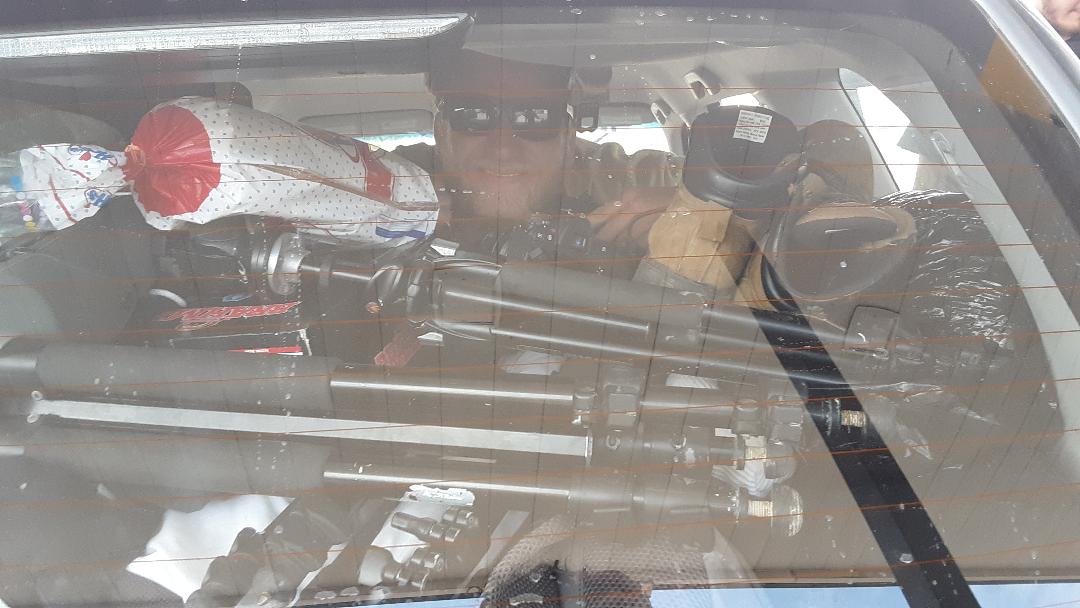


We made our way toward our first stop of the trip, Willcox Lake and Golf Course in southeastern Arizona.  From the start our team already had a lot of energy and excitement for everything that was ahead.  It was great to see Josh again, as well as meet David in person.  Willcox wasn't too exciting other than a break to stop and bird along the way for awhile.  A singing Bendire's Thrasher was a highlight.


From Willcox we would head into New Mexico for the remainder of the day for several birding stops.  After eating burgers at Whataburger, we camped out along a road near Las Cruces, New Mexico for the night and when Sunday, April 28th arrived, we birded New Mexico for a few hours in the morning at a productive place called Mesilla Valley Bosque State Park.  We added a lot of birds to our New Mexico state lists during the stops in New Mexico on the afternoon of the 27th and morning of the 28th.  Caleb spied a Semipalmated Sandpiper at a wastewater treatment plant as one of the best birds.

Some New Mexico birds

Swainson's Hawk

Sharp-shinned Hawk

Bullock's Oriole

Cliff Swallow


Something that was awesome from the start of the trip was that Josh would keep track of almost everything we observed through eBird.  It gave us many ticks throughout the trip for the many counties we would pass through.  Josh was constantly busy keeping track of everything that was being seen, and it was impressive.  It got even more impressive as we got closer and closer to Texas after we birded New Mexico for awhile and made sure that each of us passed 100 species for the state.  After birding Mesilla Valley, we made our way to towards El Paso, Texas.  We couldn't wait to officially get into the giant state where we would bird in most, and as we approached that state line and crossed into it, this is how it went..


It was 10:22 A.M. when we got into El Paso, Texas.  Josh cranked up eBird and started to make one incidental checklist after the other.  Once we got into Texas, that's really when it seemed like the trip began for me.  Our first birds in Texas were none other than Eurasian Collared-Dove, Rock Pigeon, Mourning Dove, and Northern Mockingbird.

The first spot in Texas that we got out and eBirded was a place called Ascarate Park, which featured a lake.  What drew our attention was that it had a lingering Snow Goose within the parks limits.  During our time spent of 1.5 hours, we didn't find the goose but did find a Canada Goose.  Caleb and Josh studied domestic ducks for quite a while, and David and I wanted to move on to the next spot as quickly as possible.  A few migrants were observed, such as a push of Wilson's Warblers and a Dusky Flycatcher.  Waterbirds on the lake included Blue-winged Teal, Mexican Duck, Northern Shoveler, Ruddy Duck, and Pied-billed Grebe.  There was also this domestic Muscovy Duck sitting alongside one of the shores.  I took this picture in case a chance of compare and contrast with a Wild Muscovy would come up.  We followed Ascarate Park with an awesome meal at a Mexican restaurant, which Texas has a lot of.


From El Paso, we took the Interstate 10 in the southeast direction for about an hour to our next stop, which was a lake in Hudspeth County called McNary Reservoir.  Birds started to fill our lists up such as Swainson's Hawks and several species of desert birds that included Gambel's Quail as we got close to the lake.  As we are used to seeing Gambel's Quail in Arizona in abundant numbers, the eastern range of their limit comes into this area in Texas.  Before the reservoir, a canal caught our attention that had reeds lining the water.  We got out to check, and looking up at the swallows above us gave me my first lifer of the trip, which was the Cave Swallow.  I predicted that this species or Scissor-tailed Flycatcher would be my first addition on my trip, and I was right.  There ended up being a few Cave Swallows in the flock, and some of them gave us very close views.


Cave Swallows look very similar to Cliff Swallows, but they have a cinnamon-colored forehead, a cinnamon colored throat that wraps around the neck, and relatively the same color of a rump.  They also give different calls than that of a Cliff Swallow.  As Cave Swallows have a history of wide vagrancy, they are most reliably found in parts of Texas and northern Mexico, which is their usual range.  Welcome to my life list, Cave Swallow!


McNary Reservoir had a share of waterbirds, such as Clark's Grebe, Blue-winged and Cinnamon Teals, Northern Shoveler, Ruddy Duck, Pied-billed and Eared Grebes, Common Gallinule, Ring-billed Gull, Double-crested and Neotropic Cormorants, Great and Snowy Egrets, and White-faced Ibis.


Our next stop would be another lake called Balmorhea Lake.  From McNary it took us about two hours to get to Balmorhea.  Along the way we drove through a few more Texas counties, and Josh had his eBird continuously going with incidentals.  It was easy to see that Balmorhea Lake had a lot of potential as we pulled up to it.


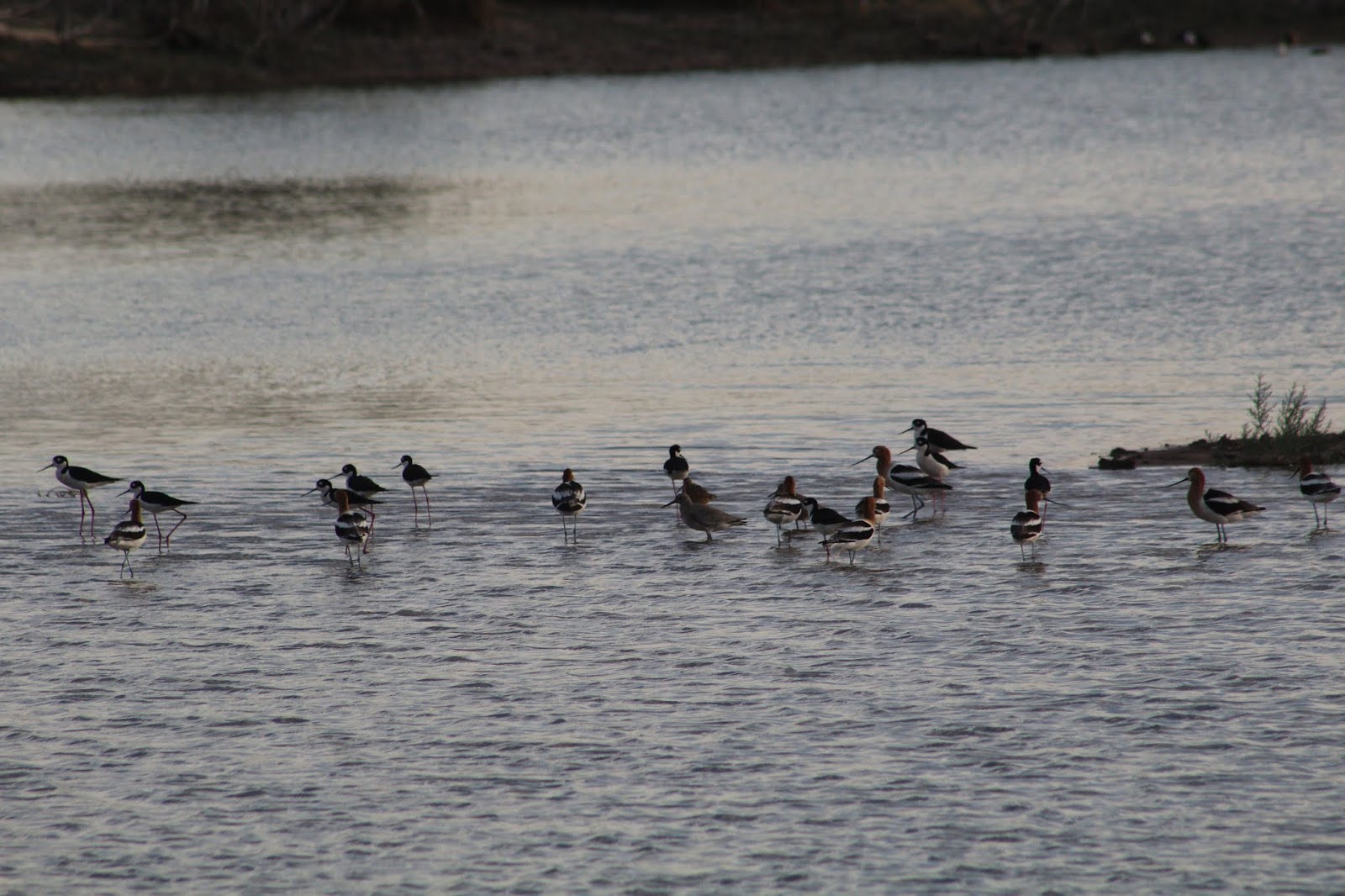
Scanning the big lake, we turned up numbers of waterfowl that included Bufflehead, Green-winged Teal, and American Wigeon.  Both Clark's and Western Grebes were on the lake.  Franklin's, Ring-billed, and a Herring Gull sat out on the lake as well as a flock of 26 Forster's Terns.  Caleb spied a Snowy Plover along the shore, and Scaled Quail could be seen and heard.  A friendly lady who lived along the lake was a birder and she told us about a pond that served as an inflow part of the lake.  The spot was good for shorebirds, and we added Black-necked Stilts, American Avocets, Least Sandpiper, Long-billed Dowitcher, Wilson's Phalarope, Spotted Sandpiper, and Willet to our young Texas lists.  A handful of songbirds were also present, as were a few Virginia Rails calling from reeds.

Scaled Quail

Snowy Plover


The birdy spot gave us about 60 species, but the one that grabbed me the most came out of the blue.  Two long-tailed flycatchers with split scissor-tails flew over and Caleb immediately called out, "Scissor-tailed Flycatcher!".  The pair landed close by to us and gave good views.  For me, it was finally the time to enjoy this bird for the first time in my 19 years of birding..


This bird is named for the obvious, as it often opens and closes it's tail like a pair of scissors.  These birds are unmistakable and distinctive among all others in North America, and they are most often seen over grasslands and other open areas while commonly perching on wires and fence lines.  They are commonly seen while driving, and they hunt from low perches to pursue insects on the ground.  The flights performed by the Scissor-tailed Flycather are often very acrobatic.  While the others in my party continued to bird on past the Scissor-tailed Flycatchers, I went aside to observe them for the time that they sat there.


Here's a video of the Scissor-tailed Flycatcher


Here's our crew:  David, Caleb, Josh, Me


After our birding at Balmorhea Lake concluded, we would continue to head further southeast into Texas's Davis Mountains.  Our first half day of Texas resulted in over 80 species, two of which were lifers for me.  Stay tuned for many more posts to come from this trip and this new blog series of mine:  Texas Times.

Sunday, May 22, 2016

The King of Thick Highlights at Hassayampa

The Hassayampa River Preserve near Wickenburg is always an awesome place to go birding at.  I usually see something very cool whenever I am visiting the location.


The endless cottonwood and willow riparian galleries are not only a rare habitat in Maricopa County but they are filled with amazing bird life.  One such example is a local Gray Hawk population that numbers in double digits.  Gray Hawks are rare in Maricopa County outside of the Hassayampa River.  A bird that isn't rare in the County is the Yellow-breasted Chat.  Their calls and songs fill the preserve.


Hassayampa has recently became "the spot" to see Broad-billed Hummingbirds in Maricopa County.  There are at least four of these hummingbirds at the Preserve that I can think of.  Once considered casual in Maricopa County, Broad-billed Hummingbirds are growing very fast in numbers in some areas.  Here is a male Broad-billed that was frequenting feeders within the Preserve.  What a cool looking bird!


The double call notes of the Summer Tanager is a very common sound along the river.  Sometimes it's all one hears.  The caller will sometimes come into view, followed by his lighter yellow counterpart.


Hooded Orioles also bring in excitement, and are usually seen right near the Preserve's entrance and visitor area.  A male was sitting up high here, but was obviously noticeable.


Bullock's Orioles too.....


A cool draw to me at this time of year at Hassayampa are the Kingbirds.  Along the Mesquite Meander Trail, a pair of Tropical Kingbirds have begun building a nest.  Like the Gray Hawk, the Hassayampa area has it's own population of Tropical Kingbirds. This is the usual location to see this flycatcher in Maricopa County, although they have been found elsewhere on occasion as a breeder or rare winter visitor.


One of my best encounters here during these visits I made was not from a bird, but was from my first ever Desert Tortoise.  These turtles are epic!  As I was hiking up a trail and was taking a quick break, I looked up the trail to see the turtle walking down the trail and in my direction.  I decided to sit there, and the turtle proceeded to walk right past me.  At times we were less than a foot away from each other, and I was the one who didn't budge!


Here's a video of the Turtle as I viewed him to show how great this experience was.


I mentioned days here didn't I?  Yup.  After I got home last Friday I thought I didn't miss any major highlights.  Turns out I did.  The next day, Melanie Herring found a Thick-billed Kingbird along the Mesquite Meander trail and in the same area as the Tropical Kingbirds.  Sometimes both species were in the same tree!  I was kicking myself and I probably walked right by the Thick-billed.  The Thick-billed Kingbird would be a new Maricopa County bird for me, and it's just an awesome bird in general.  I wanted to see it badly!  In the past, Thick-billed Kingbirds bred at Hassayampa and were mainly along Mesquite Meander within the known preserve limits from 2003 to 2008.  They stopped the year I really got into birding.  After Melanie found the bird, I saw that many others got to see due to it being the North American Migration Count on May 14th.  I was elsewhere in the field, but I did get off of work the following afternoon at 2 P.M.  With Hassayampa having it's last day of closing at 5 P.M. for the season, I would have about two hours of Kingbird searching.  I felt good about my chances on Sunday the 15th, since others had seen it earlier in the day.

Well, my two hour search didn't produce that highly wanted Kingbird.  I may have seen it after turning a corner to see a Kingbird flying away.  Thinking it was one of the two Tropical's that were present, I only looked to see the two Tropicals sitting together in the same tree this mystery Kingbird flew out of.  To be honest, I was very bummed out about missing this one.  With the Hassayampa Preserve going back to it's summer hours after this day, it would force me to wait and try for the Kingbird on Saturday.  Perhaps I was just there at the wrong time of day.  For the bird sticking around, however, and with the area it was hanging out in, however, history for Thick-billed Kingbird here was on my side!  The bummer was lifted in a lot of ways on my way out a minute before closing time at 4:59 P.M..  I looked up in a mulberry tree to see my first male Rose-breasted Grosbeak.  This is a striking bird, and I've only seen two females in my past.  Wow!


When Saturday, May 21st came around, I was ready to look for the Thick-billed Kingbird for the second time.  This time I felt hope was really on my side as Sean Fitzgerald and Tyler Loomis found the bird the day before on Friday.  With this species formerly breeding here in the past, I've always hoped they would return.  I was ready to see it in Maricopa County, and I wanted it badly.

My good friend Gordon Karre and I made plans to bird the Hassayampa together on this Saturday for the four hours that the Preserve was open.  Gordon and I were joined by Joshua Smith and his dad Garth, Dale Clark, Babs Buck, Lois Lorenz, and Julie Clark.  The eight of us headed over to the Mesquite Meander Trail quickly in pursuit of the Thick-billed Kingbird.  I was very anxious about wanting to see it.  Once on the trail, it took us less than ten minutes to get to the spot where the Kingbird was being seen at most often.  Looking up at the familiar trees, I could already see the Tropical Kingbird pair as soon as we arrived at the location.  And then the Thick-billed Kingbird started calling, and it started calling loudly!  It was very close to us.  At times, the loud voice of the Thick-billed Kingbird made it sound closer than it really was at times.  With many pairs of eyes scanning, Joshua Smith got his eyes on the Thick-billed Kingbird first.  I was very glad to look up and see it sitting on an exposed branch on a bare top of a tree.  The Kingbird vocalized often before being chased off by the two Tropical Kingbirds.  I forgot to check my camera settings before firing off shots of the Thick-billed Kingbird and I didn't get anything.  It was very frustrating, until the Kingbird came back twenty minutes later...

Joshua Smith has a good eye, and he spied the Thick-billed Kingbird flying into another set of cottonwoods further down the trail.  As we rushed over to the spot, the Kingbird started calling again.  Gordon managed to spy the bird through a "window" in a tree and this time, I had my camera settings right!


See how massive the Thick-billed Kingbird's bill is?  It's a well named bird.  In the United States (ABA area), southeastern Arizona is the main location to see this highly local species.  It is a sought after prize for many out-of-state visitors.  The fact Maricopa County has had them breeding at the Hassayampa River Preserve is a big thrill and that this one has appeared for many to see so far.


As the Kingbird switched positions, it then sat in a more open perch, where eight birders gathered around to enjoy it for a long time as it sat there contently.  The bird often preened itself and would call at times too.  Hearing the bird call was awesome, and the vocalizations it gave were very loud.  It almost sounded like the Thick-billed Kingbird was using a microphone.


The eight birders left the Kingbird sitting there.  After it flew off for a long time earlier, it then became that cooperative.  Gordon mentioned that without it's vocalizations at times, the bird would be very hard to locate, and he was right!


We had at least 5 Tropical Kingbirds on the day, but there was a good chance there were seven individuals.  A third pair couldn't be confirmed for sure, but that number was highly likely.


There were many swallows and some White-throated Swifts flying over the Palm Lake Trail when our group made it up there after Mesquite Meander.  In midst of them was an uncommon to rare migrant, a female Purple Martin!  She really stood out like a sore thumb with her much larger size.  The White-throated Swift was the one I was able to get a photograph of.  None of these birds are easy to photograph..


As we continued down the path along Palm Lake, a couple pointed out a Kingbird to us and said, "Here's the Tropical Kingbird up here".  I looked and saw that it was the Thick-billed Kingbird!  It was the Thick-billed Kingbird or another Thick-billed Kingbird, we can't be certain.  If it was the same bird, it was quite a distance away from where we were originally seeing it at.  In the near future, it's definitely worth checking the area for two birds.  This time, we all got a much closer look at it.


Gordon and I eventually covered the rest of Hassayampa on our own and saw many more birds in the four hours that we had to bird there.  Certainly some eventful three outings for me at the Preserve.  Thanks to everyone I birded with and to those who reported the good birds present during this time.

The Thick-billed Kingbird was the second addition to my Maricopa County list this year to bring that list to 377 species.  Speaking of 376, I haven't blogged about that one yet.  I will get to that in a near future blog post in an adventure that took me to a remote side of Maricopa County that I have never been to before.  I'm also behind in many blog posts, stay tuned for several others coming along also.  Last, TOBY will resume next weekend as I pursue my 18th North American Owl of the year.  With Flammulated Owl coming as my 17th species as of a month ago, I've had almost a month of my normal Maricopa County birding.  Stay tuned.