Showing posts with label Mountain Chickadee. Show all posts

Thursday, January 4, 2018

January 4th: A Day of Exploring

My alarm didn't go off quite the way I wanted it to this morning, so I slept through it.  Another thing that could have happened was that I've been so tired lately that maybe I slept through the alarm and had the natural amount of sleep my body needed.  Who knows.

My desired location to explore today was the northern portion of Gila County, east of Payson, just below the Mogollon Rim and west of Forest Lakes.  Since I got up late, I didn't think at first I would go through with that plan.  After sitting around for an hour thinking of what to do, I stuck with my plan.  Lately I haven't been exploring places that others have explored all that much.  I really like that idea of finding my own things, unless someone reports something new for Maricopa County that I don't have, OR if there is a reliable Gila County lifer somewhere OR if some lifer shows up in Arizona that can't be missed.  Pine Grosbeaks that Jason Wilder recently found at Snowbowl in Coconino County north of Flagstaff really had my attention.  Coconino is probably the next county I'll try and get 200 species in.  I had second thoughts though, and decided that I would try and find my own notable bird in the mountains of northern Gila County just below the cliffs and slopes of the Mogollon Rim.  I didn't have anything notable by the end of the day, but you can't succeed if you don't try.  I was hoping for a Nutcracker, or with a lot of luck, a rare finch of some sort.  Even a Gila County American Three-toed Woodpecker would have been awesome.  Or a Gila County Northern Goshawk.  I didn't get anything to scream about, but I did get good exploring and scouting in for when I return to explore the area further.  Spots I explored were Sinkhole Trail 179 from the 260 Trailhead, Christopher Creek via See Canyon, and the Tonto Creek Fish Hatchery.  Bird highlights did include Williamson's Sapsucker, Red Crossbill, Pacific Wren, Golden-crowned Kinglet, and a Greater Roadrunner in midst of pine and Gambel's oak forest.  It was the strangest habitat I've seen roadrunner in, and most of the forest was ponderosa pine.  Scrubby habitat of some sort wasn't close by.  Anyways, a beautiful area to explore and bird.

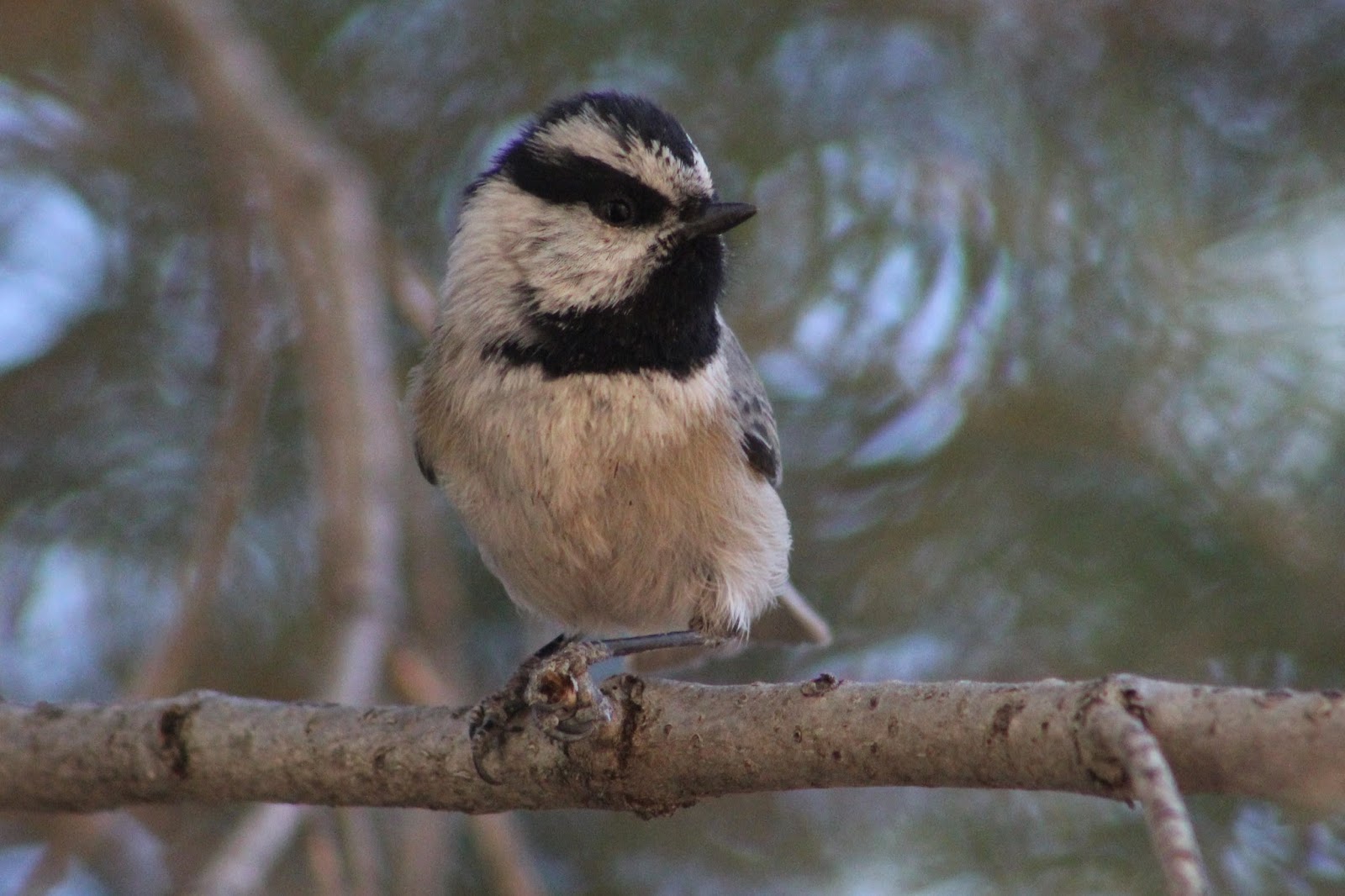
Photo wise, this Mountain Chickadee was cooperative and was awesome!


This Golden-crowned Kinglet was much higher than the Chickadee, but it is always a fun bird to see.


I checked up on Green Valley Park in Payson just in case a Cackling Goose would be back in play with the many Canada Goose there.  No Cackling.  But this Snow Goose was there, sleeping, and then, woken up from it's sleep.  I don't think I've ever seen a bird look this tired..


Sunday, August 10, 2014

Hannagan Meadow and Luna Lake: Terrifying and Peaceful

On Tommy D's Birding Expeditions, most Expeditions are problem free without any issues.  Every now and then, something freaky may happen in the field.  You never know what may happen.

Remember how I have been saying that the White Mountains is a big area?  Well, it's so big that it has three different counties in midst of it.  I decided to head to the east side of the White Mountains on one of the days I was on vacation.  On this east side, there are many more awesome birding locations.  I haven't explored most of them, and the ones I have explored, I haven't explored very much.  By heading south of Alpine on Highway 191, one quickly accesses Greenlee County.  This county is one of Arizona's smallest counties, and it is Arizona's most underbirded county.  I've never birded it, and I decided that I would take a morning of the trip to at least step my foot into the door and walk into Greenlee County for awhile.  The area that I wanted to explore the most in Greenlee County was Hannagan Meadow and the Blue River area.  I've never been to the Blue River, but the Hannagan Meadow area looks just like any of the other classic and beautiful White Mountain locales that are close to Greer.  While hiking in the Mount Baldy Wilderness Area one day with my family, I ran into Prescott birder David Moll.  David had hiked a trail in Hannagan Meadow that I was wanting to hike, the 4.5 mile Aker Lake Trail.  He informed me of a family of Spotted Owls that he found along the trail.  My mind raced at the thought of the Spotted Owl family, I really wanted to see them and start my Greenlee County birding expedition in a perfect fashion.  While David couldn't remember exactly how far they were from the trail head, he at least gave me a good habitat description so I could take my time and carefully scan certain spots along the trail.

Once I got to the trail, my Greenlee County list started to begin.  It was overcast skies to start off the hike, and it was drizzling with rain for awhile.  I planned to hike for at least the first two miles of the Aker Lake Trail so I could get out of the area at a decent time to explore other roads and areas in Greenlee County.  The vegetation on the trail was very thick and wet.  Before I knew it, I was soaked.  You've gotta hate tall grass that intertwines with the trail, especially early in the morning.  Birds called up in the trees.  There were plenty of Greenlee Mountain Chickadees.


There were plenty of other forest birds around too, most of which stayed out of sight and high in conifers.  I wanted to get the Spotted Owl search on.  David described the location as a section of broken forest.  I would search those sections that looked like that sort of habitat in hopes of finding the owls.  Starting off didn't feel so right though.  There was a feeling of eeriness in the air and in the thick woods, and it was quite freaky.  You know that feeling, that there is something else out there that can take you down if it wanted to?  That feeling that you might be being watched, or that something bad may unfold?


When I started to become very cautious, I heard something in the woods running in my direction.  It was getting closer, and closer, and closer.  It then started to make a yipping sound.  Seconds later, a Coyote came out of the woods, and ran right by me, about twenty feet away.  It didn't even notice that I was there, but it kept going, and it acted as if it was terrified.  The Coyote ran further into the woods, stopped, and started barking very loudly.  He kept going and going, and something was making him act very freaky.  Right then, another Coyote ran up.  I was now between two Coyotes.  The second one didn't see me, but he was barking too, almost as if he wanted the first Coyote to come back.  Both of them were acting weird.  They both started to bark and yip louder, and it was freaking me out.  To make sure they weren't involving me, I revealed myself to the second Coyote, and it took off the second it caught sight of me.  A breeze then came through.  I started to hear a longer, deeper, stronger, and more drawn out howl over the breeze.  Once the breeze stopped, I could hear the howling well, and it was also close by.  And these howls weren't coming from the Coyotes, they were coming from a pack of Wolves.  I'll admit, I was terrified, and so were the Coyotes, who must have gotten tangled up with the Wolves.  My mind was playing tricks on me, and I was certain for that time that I was in danger.  I wasn't very prepared if the Wolves decided to head into my direction.  I didn't even have a knife or broken bottle caps to tape and tie onto my hands, like Liam Neeson did to fight the Alpha Wolf in the movie, The Grey.  In the movie, Neeson was relentlessly followed by a rogue wolf pack in the winter hell of Alaska.  We still don't know if he survived or not, but we know he put up a good fight, it is Liam Neeson, right?  

Courtesy of The Grey

I was scared that I would have a wolf face-off on one of Tommy's Birding Expeditions.  Instead of using Neeson's techniques above, all I could do was grab a branch to defend myself.  The Wolves kept howling, and the nearby Coyote kept yipping.  I stood there, helplessly, and hoped for the best.  My heart was racing.  I looked over my right shoulder, and saw, nothing.  I looked over my left shoulder, and saw, nothing.  I thought, have I tried looking behind me yet?  I turned around, and......saw nothing.  The wolves were nearby, but they weren't all that close.  Only one the worst case scenario would this actually take place with a wolf attacking me.  Attacks on people are extremely rare, and plus, Arizona's Wolves are a subspecies known as the Mexican Gray Wolf.  They are considered to be a lot smaller than the Gray Wolves further north in North America.  Wolves are big creatures and are fierce carnivores, but are rarely aggressive towards humans.  Films like The Grey and such give us a general fear of Wolves, which is really a false fear that is very unnecessary.  But who wouldn't be scared of one though in a face to face encounter?

Courtesy of The Grey

The Wolf is actually my favorite animal.  It's the one animal I would choose to see over a certain or favored bird species in the wild.  There are birds that I would rather see than any other mammals out there, with the exception of a wolf.  While it was freaky hearing them howl, I was freaking stoked at the same time.  I actually wanted to see them, and truth be told, I loved the adrenaline rush.  Had I encountered them, they most likely would've ran as fast as possible in the opposite direction.  With wolves, that is how it is 99.99999999999999999999999999999999999999999999999999999999999999999999999999999999999999999999999999999999999999 percent of the time.  The Wolves then stopped howling after a half-minute.  Could I count them as a lifer, since I count some birds as heard only lifers?  Hmmm....probably not.  There isn't a mammal quite like the wolf.  Hearing one is indescribable.  I had both an incredible feeling of awe and fear at the same time.  If I saw one, I would be terrified, but yet amazing at the same time.  The wolf is a very powerful animal, but is more fearful of us than we can ever be of it.  I've never understood why people have persecuted and have had such hatred towards them.  As the howling was stopping, I did see some forest chickens flying around that the Coyote had kicked up.  As I was busy being scared, I assumed they were Grouse.  But when I went up to one of them, I saw that it was a young Wild Turkey.  He was petrified in fear inside too, and he already looks petrified enough on the outside, even at such a young age.


There was a whole family of Wild Turkey around, and I saw the mother shortly after photographing this young bird.  The wild dogs were now silent, and the sun then came out of the cloud cover.  The birds were active in the forest, but they weren't cooperative for pictures.  I searched hard for the Spotted Owls and covered two miles of the trail.  The Spotted Owls eluded me, but I did find a spot where I'm pretty sure was the place David probably had them.  There was a lot of fallen timber in midst of a standing, thick, and shady forest.  I walked around and looked.  Although the Spotted Owls were probably looking down on me, I couldn't look up to see them.  That is the way it usually goes.

I continued on my Greenlee County adventure after the Aker Lake Trail.  I "survived".  I pulled over at the side of the road and saw a neat sign about the Mexican Gray Wolves.  This subspecies is very endangered and reintroduction efforts have gone underway and have expanded in the White Mountains.  There are probably between 75 and 100 wolves in the region today, if I remember right.  Gosh, it would be cool to see one.  Nevertheless, it was amazing hearing them and knowing that they are indeed around!


One of the areas I wanted to explore on the Greenlee County section of the White Mountains was the Blue River.  I turned onto the road, Forest Road 567, and started to make my way towards the River.  The Blue River is famous for it's fishing, and because it is underbirded, I thought, "Could I possibly find cool things to make it a known location to go birding often".  Probably not, but I could speculate.  As I drove down road 567, I added a snacking Red-tailed Hawk and Clark's Nutcracker to my small Greenlee list.


As I drove further into the wilderness on Forest Road 567, I saw that the Blue River was further than I thought it was going to be.  The scenery changed drastically, and so did the road.  I had come four miles, and the last 9 miles to the river was a drop down steep and narrow road.  I had told my parents I would spend the second half of the day with them and I had to be back early in the afternoon.  It was already late in the morning, so the Blue River had to be put on hold.  On my next trip, I hope to explore this area more, cause it looks awesome.  Who knows what possibly awaited me in these awesome valleys below?  Maybe next time.


I decided to finish out my Greenlee County exploration by driving a few miles of other dirt roads.  After spending a lot of time on the Aker Lake Trail and then trying to get a lot of birding in a short time resulted in a low bird list of under 40 species.  At least I got my foot in another county, which felt great!  Greenlee County, you will see me more in the future.


On my way home after crossing back into Apache County, I ran through Alpine and decided to stop at the nearby Luna Lake, which has awesome birding.  I only had a few minutes to scan the lake, but I noticed that there were a lot of Eared Grebes nearby.  As I looked closer, I could see many young grebes, some of which were riding on their parents' backs.  This is always a neat thing to see, and I saw this earlier on the trip with my friends.  I then looked in front of me to see a family of Eared Grebes (a male and female, and grebelet), close by!  The Eared Grebelet was on it's mother's back, and both parents were taking turns feeding the small bird.  Since this post certainly has a lack of photos compared to the other posts I've written on the White Mountains, this series of Eared Grebe family pictures can make up for that.


With his mate and young grebelet, Mr. Eared certainly had a lot to be proud of.


I consider my trip to be a success, even though I didn't find the Spotted Owls or have a bird list to really talk about.  But I did explore a new area, and I know what to better expect next time around.  The Eared Grebes were something else, and were awesome to watch and photograph.  And I guess one of my next goals is to see a Mexican Gray Wolf.  Stay tuned for more posts from my White Mountain trip, because there are a lot more coming.  We aren't even halfway there yet!  

-Wolf howl (awoooooooooooo!)

Tuesday, November 12, 2013

The Bravest But Dumbest of Birds in Maricopa County

The name of this post might sound strange.  It is definitely very strange, but it's also true.  Birds may be brave, but yet so dumb at the same time.  Some of these birds are practically asking to be killed, others are just satisfied for a seed, even if it is way far and away from home.  Recently, Magill Weber and I went birding, and it seemed if our day was highlighted by brave and dumb avains.  On a quest into Maricopa County's higher elevation to see if we could win the Nutcracker lottery (without luck!), we were entertained by "dummies".

Let's start with this Horned Lark.  We went to Scottsdale's Rousseau Sod Farms in search of Longspurs, but we found this Horned Lark instead.  He decided to run up to my truck and then run along with it as we drove.  On one of the pictures below, the forward motion is obvious.  It was awesome to see it this close, but hey this lark drank too much larkquor.


Just down the street from the Horned Lark was this moron of an Osprey.  I wouldn't call this bravery, but stupidity.  We drove up on this Osprey, and he was eating his spectacular catch on the grass.  Who would want their meal to be covered in grass?  I know I wouldn't, and the Osprey couldn't fly to a nearby powerpole that abound nearby to eat his fish just scaly instead of the scaly-grassy combination.  But once again, it was awesome to see it this close, despite the fact the bird has issues.


On a stop at the Salt River, we knew about a few Mountain Chickadees that have been hanging out in the area.  The Salt River isn't in the Rockies by any means, but is in a desert dominated region.  The chickadee flew over nearby Transition Zones in order to have the mesquite seeds and beans, whatever they are.  Just northeast of the Salt River is the Mazatzal Mountains, which are full of good wintering Chickadee habitat.  But this guy ignored them.  Once again, it was cool to see them here, but the word "Dummie" still came out of our mouths.


When we drove up to a Least Sandpiper, it boldly stood it's ground.  After all, it was on it's favored cement drain.


We then stumbled upon this American Pipit on the same cement canal drain.  It ran down into the drain at first, but after awhile, it came back up and stood it's ground, while the Least Sandpiper still stood nearby.


The Clark's Nutcrackers didn't show up at Mount Ord like Magill and I had hoped for.  Instead, we found a handfull of crazy birds, represented in these photos.  It was a great day of birding, and some days are fun when you just have a lot to laugh at.  The following day, I went out to Lake Pleasant, and I found another brave and dumb bird.  A pair of Rock Wrens that seem to find their home right in the Scorpion Bay parking area.  Here they hopped on the sidewalk, ran under and on vehicles, sat on lightposts, and acted more hard core dumb than even a rock.  As long as these birds are cooperative for photographs, I don't mind the Bravest but yet Dumbest Birds in Maricopa County!

Sunday, October 13, 2013

Beeline Birding

Hi everyone,

Yesterday on October 12th, 2013, I headed up into the northeastern part of Maricopa County to explore the areas of Mount Ord and Sunflower.  The latter contained visits to both the Bushnell Tanks and the Old Beeline Highway.  All of these hotspots are accessed off of Highway 87.  It was a pleasant day of birding.

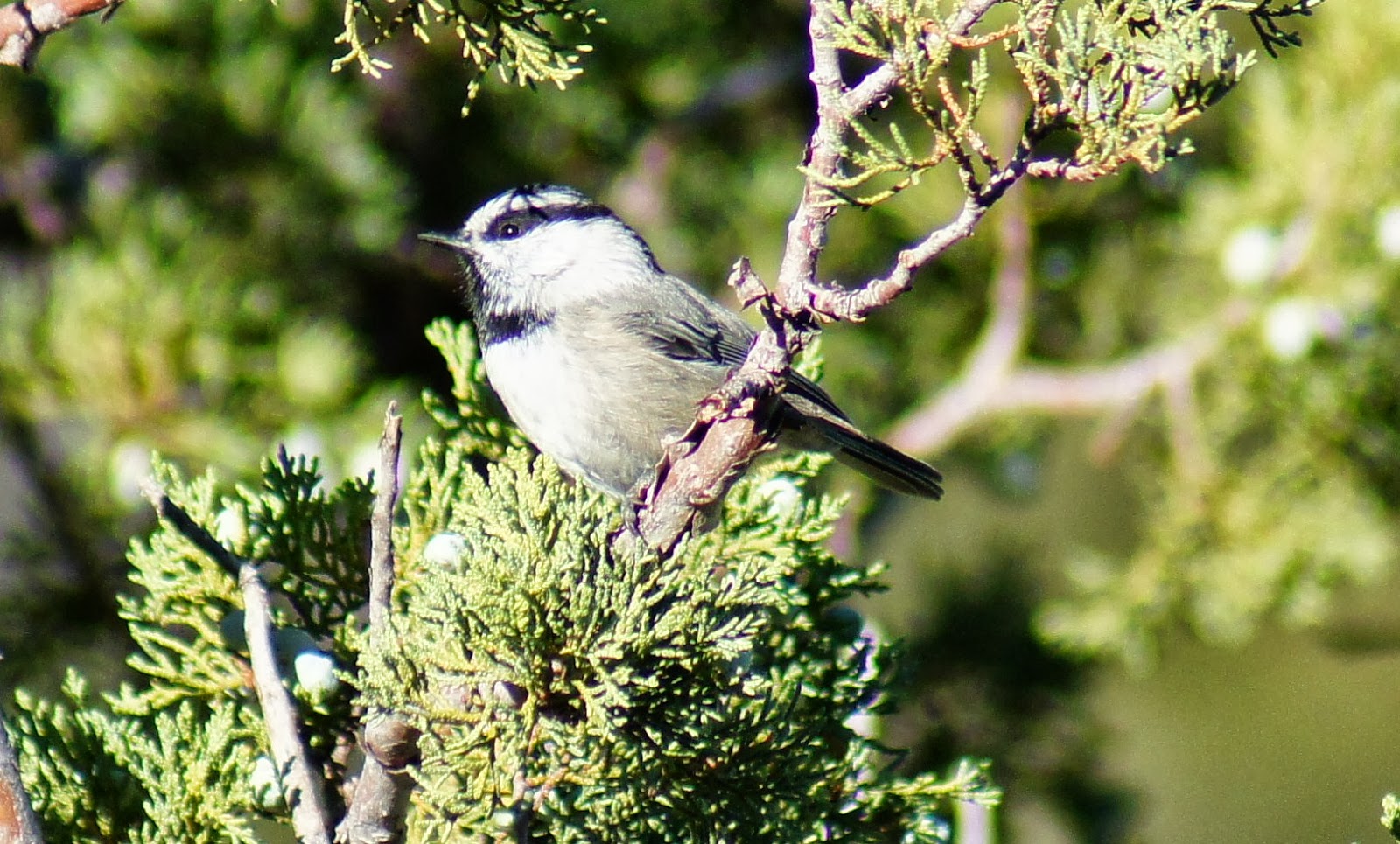
My first stop was at Mount Ord, where I had several good highlights.  This is Maricopa County's easiest "high country" to access, and it is a location favorite of mine.  I spent three hours on Mount Ord, with the entire time being on Forest Road 1688, which is three miles up the road to Mount Ord after turning off from the Beeline Highway (S.R. 87).  My main highlight was detecting at least 10 MOUNTAIN CHICKADEES throughout the two mile hike one way on Forest Road 1688.  These chickadees were mainly in pairs, although I did find three together and one loner.  Other than that, they were in pairs and were well scattered throughout 1688, from the beginning stretches near the water tank and near the end of the two miles.  This was only my second time ever of finding a Mountain Chickadee in Maricopa County, with the last time being a small flock of four near the summit in November of 2011.  Forest Road 1688 is about a thousand feet lower in elevation than the summit of Mount Ord (7,100'), and I found it interesting that chickadee numbers were high like this in the lower forested reaches.  This species is rare in Maricopa County for the most part, this is obviously an irruptive year for the species, who will show up in the lowlands at times too.  It'll be interesting to see when the winter months come, what the chickadee numbers will result in in this region.


Perhaps the bird of the day, was one that tragically got away.  When I was near the end of Road 1688, I heard what I'm sure was probably 99% a Downy Woodpecker.  The bird gave both of it's usual calls a few times and then stopped.  I wasn't able to track it down, whatever was making the calls, but it sounded perfect for a Downy Woodpecker.  Ladder-backed Woodpecker sounds very similar to Downy Woodpecker based on the call notes I heard.  While Ladder-backed Woodpecker is very unusual for this elevation, I did once have one in a forested drainage above 1688 around this time frame of the year in a previous year.  They do show up out of habitat on occasion, which is why I can't call this bird for sure.  If hiking in this area, do keep this possibility in mind.  Downy Woodpeckers are very rare in this area, but have increased in recent years in this area and the county.  There have been 3 or 4 sightings in the last 5 years.

Other than the Mountain Chickadees and very possible Downy, there were some other good highlights on Forest Road 1688.  Another one was a lingering female HEPATIC TANAGER.  This is the latest date I've had this species at Mount Ord (or elsewhere in Maricopa County) in many visits.  I also found 2 PYGMY NUTHATCHES together along this stretch, another species that is uncommon in the County and can be hard to find.  This year, however, has been very good on Mount Ord for the Pygmy Nuthatch.  WHITE-BREASTED NUTHATCHES were very common throughout, and I surprisingly didn't have any Red-breasted Nuthatches.  2 OLIVE WARBLERS were present, and I also found at least 5 BROWN CREEPERS.  I also had several empid highlights which contained a DUSKY FLYCATCHER, 2 HAMMOND'S FLYCATCHERS, and even a GRAY FLYCATCHER that was notably dipping it's tail continuously like a Phoebe would.  Woodpeckers I did find were several HAIRY and ACORN WOODPECKERS, NORTHERN FLICKERS, and a nice male RED-NAPED SAPSUCKER.  A SHARP-SHINNED HAWK was also seen flying overhead.  Other highlights among 28 species that I recorded on Forest Road 1688 of Mount Ord included WESTERN SCRUB-JAYS, BEWICK'S WREN, JUNIPER TITMOUSE, large numbers of WESTERN BLUEBIRDS, and CANYON WREN.  I wanted to go to the summit area of Mount Ord to search for more chickadees and other goodies, but the birding areas nearby along Sycamore Creek were calling my name.

Hepatic Tanager

Hammond's Flycatcher


Pygmy Nuthatch

Ruby-crowned Kinglet

Orange-crowned Warbler

Olive Warbler

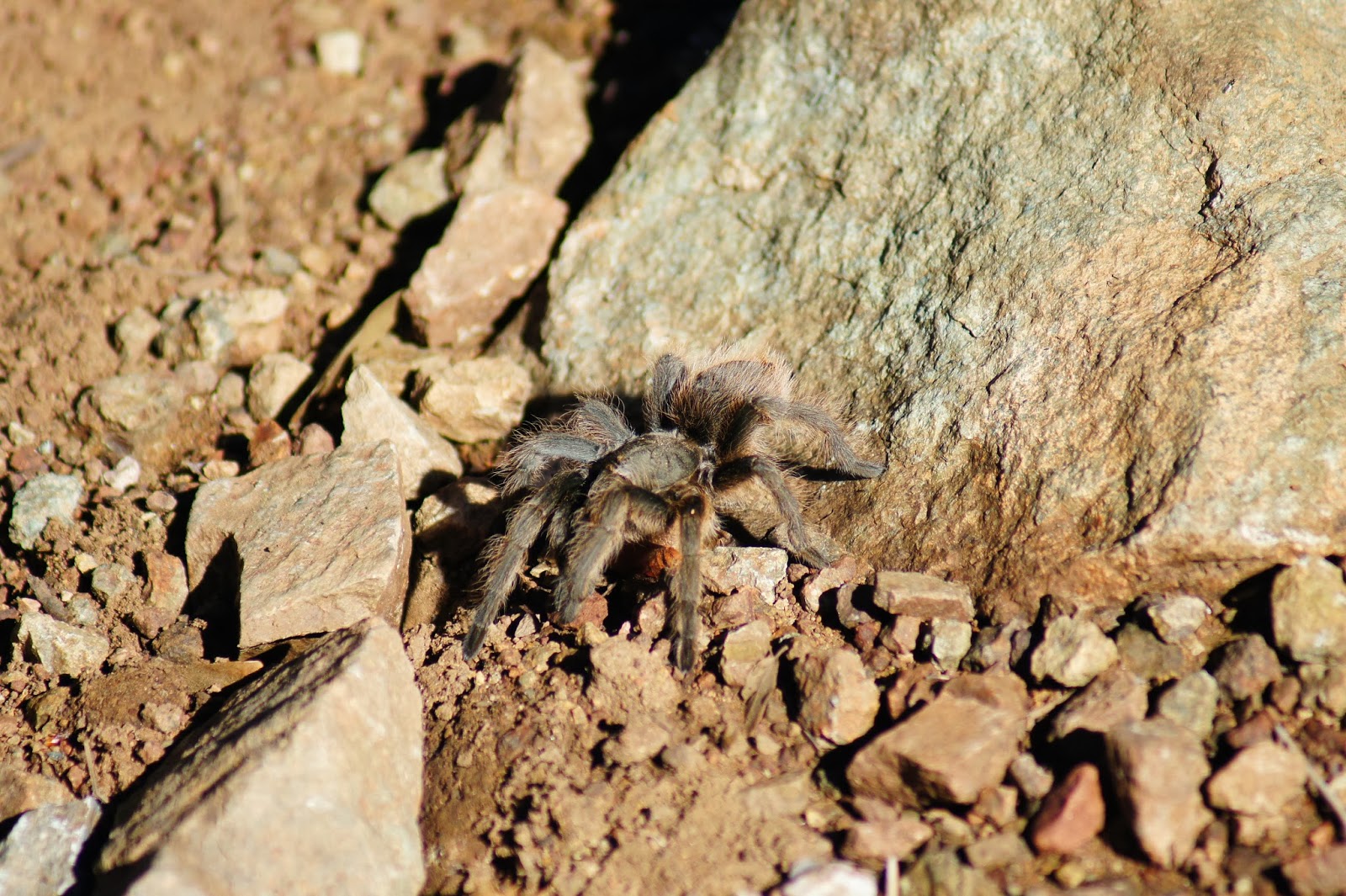
Tarantula


The birding along Sycamore Creek adjacent to Sunflower turned out to be just a notch better than dead, and I was kicking my own butt for not staying at Mount Ord longer.  Lesson learned, bird at the lower elevations first (I already knew that, but for some stupid reason, didn't do it).

At Bushnell Tanks, a few highlights included a nice flock of BUSHTITS, a JUNIPER TITMOUSE, a flock of BRIDLED TITMOUSE, HUTTON'S VIREO, and BLACK-THROATED GRAY WARBLER.

male Bushtit

Juniper Titmouse

White-crowned Sparrow (juvenile)

Sycamore Creek


Walking on the Old Beeline Highway, the main highlight was seeing a TOWNSEND'S SOLITAIRE and hearing at 5-6 of them, both in song and in their unique high pitched callnotes.  I also heard a late SUMMER TANAGER calling along the creek.

Townsend's Solitaire

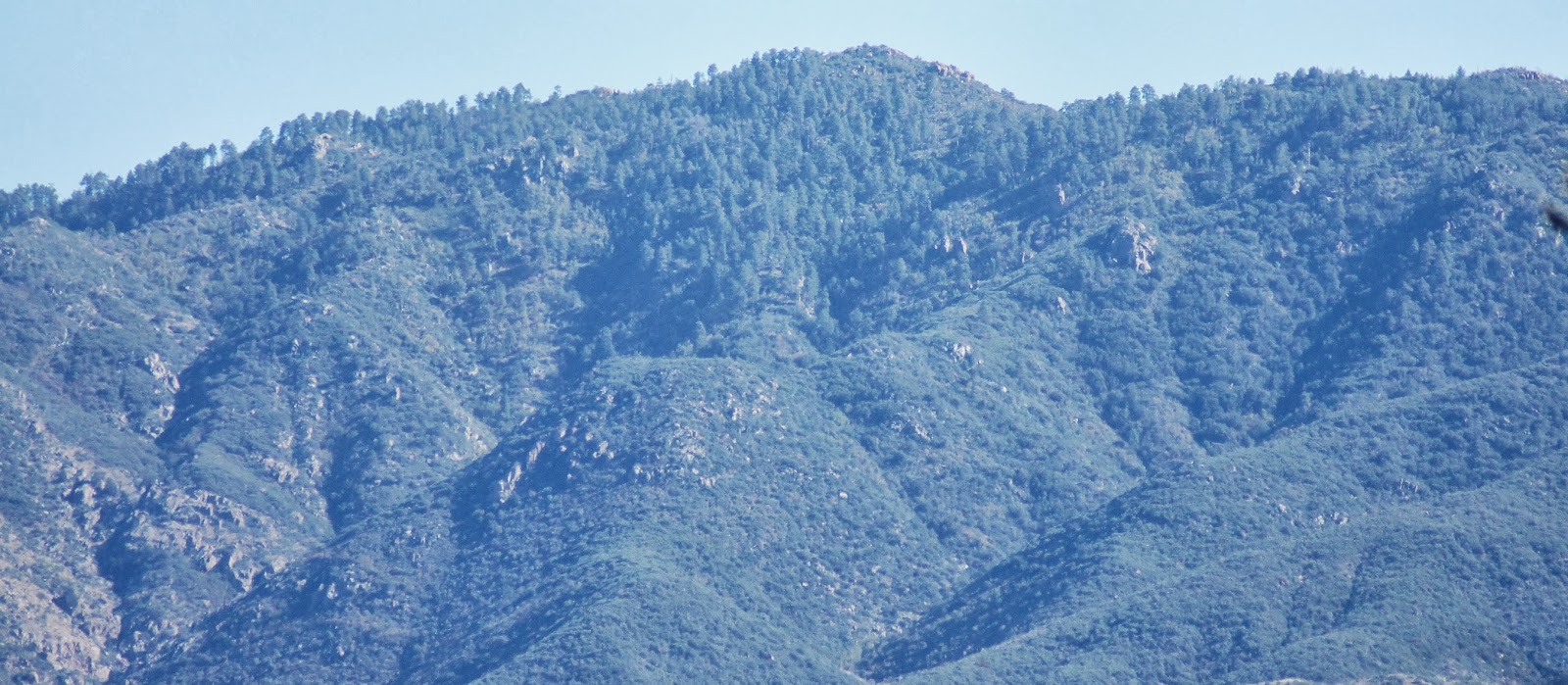
It was another great day of birding and exploring outdoors!  For something slightly but not really off topic:  This is how I get myself into trouble, but it's not really trouble.  Whenever I see a potential birding location I haven't explored, I find a way to explore it.  It's a form of OCD, and I'm not happy until I explore it.  The Mazatzal Mountains (Mt. Ord, Four Peaks, Slate Creek Divide) have a lot of exploring to do, and I have explored a lot of it.  With that being said, there is still more to explore on the Maricopa County side of this mountain range in the higher elevations.  Between Mount Ord and Four Peaks lies this forested mountain area.  It is somewhat limited as shown in this picture, but it is on a north facing slope (birds love north facing slopes).  I know how to access this area by a backroad, and it is now one of my hopeful explorations in the future.  I have been on the road to access it once and was three miles south of the access point, but was out of time for the day and was exploring another awesome Mazatzal Mountain area between Four Peaks and Mount Ord.  Hopefully, this will be next.  Even though I have distant views of this mountain area from Ord and Sunflower, I was able to make out a small stand of Douglas fir also (which I have only seen on Slate Creek).  I've gotta get up there.  Here is a picture of this good looking spot: