Showing posts with label Sinaloa Wren. Show all posts

Monday, March 12, 2018

When Everyone Gets A Lifer

This most recent Friday, March 9th, 2018, I teamed up with my friends Caleb Strand, Mark Brogie, and Ellen Brogie for a birding trip down to several locations in the always anticipated southeastern Arizona.  The primary goal we set for the trip was for Mark and Ellen to find their Rufous-capped Warbler and Black-capped Gnatcatcher lifers.  If we would succeed at finding those two species, doors could possibly open to look for a few other key species in the famous Arizona region.  I don't go to southeastern Arizona very often, but I love it when I do.

Mark and Ellen Brogie are a snowbird couple from Nebraska who have spent the last few months here in Arizona.  They are well known birders in Nebraska.  Mark is Nebraska's top lister and has achieved many great things in Nebraska birding.  Caleb and I were excited to show Mark and Ellen some new birds for their life list, some that they wouldn't ever see in Nebraska.  And if you have read my blog, you all know who Caleb "The Boy" Strand is, he's pretty cool too ;)

The four of us met up very early and left the Phoenix area at 5 A.M. for the bird pursuit.  Our first stop of the day was at the birder tromped Florida Canyon.  Thousands of birders make the climb up this canyon annually to see the coveted Rufous-capped Warbler.  Besides the warbler itself, the flowing stream through Florida Canyon brings a worthwhile experience.  Florida is a narrow canyon and is surrounded by desert and shrubby vegetation.  Groves of riparian trees and Madrean oak fill the canyon in places.  Mark, Ellen, Caleb, and I found ourselves walking up and down the canyon for over an hour without much in the way of bird life to start the day.  Once the sun really hit the canyon, more and more birds would become active.  It took awhile, but after some time, the energetic sounding song of the Rufous-capped Warbler echoed across a side of the canyon.  The four of us pursued the warbler through thick and thin.  Most of it was thick.  We listened to the warbler for a long time while trying to get visuals.  Listening to it was even fun.  After a lot of work and pursuit, the Rufous-capped Warbler eventually sat at eye level and close to Mark, Ellen, and I, giving us great views.  Caleb watched it and listened to it as he scoured a cliff above the location.  It was great to catch up with this bird again, and seeing Mark and Ellen get a lifer the way they did was even better.  After a lot of climbing and bushwhacking only to see the warbler vanish the first few times as we tried to lay eyes on it, resulted in an ending that rewarded us for our efforts.

Rufous-capped Warbler in Florida Canyon.  Pima County, Arizona.  3/9/2018

This Rufous-capped Warbler sang constantly for us once it started singing.  Listening to it before we could finally see it was fun too.


Rufous-capped Warbler is very distinctive among North American warblers.  Its rufous crown and ariculars, striking white supercilum, yellow throat and breast, and long and slender tail easily separate it from others where it has shown up in Arizona and Texas.

Caleb Strand navigating the steep terrain.

Ellen and Mark Brogie enjoying the Rufous-capped Warbler!

After Florida Canyon, we went to Proctor Road near the entrance to Madera Canyon.  Our main target here was Black-capped Gnatcatcher.  It didn't take us long to find a pair of the Gnatcatchers and note their key vocalizations and field marks.  They were moving fast, and it was difficult to photograph them.  

It was awesome that we got Rufous-capped Warbler and Black-capped Gnatcatcher as quickly as we did.  It meant that we could move on to other locations and try for more southeastern Arizona rarities.  The next bird that we opted for was a Sinaloa Wren.  This Sinaloa Wren was found adjacent to the Santa Cruz River along the De Anza Trail stretch just south of Santa Gertrudis Lane.  If we could find it, this would be a third lifer of the day for the Brogies.  Caleb and I had both seen Sinaloa Wren, but only once.  My previous observation, which took place in 2013, contained good audio experience but a horrible view.  Birders have been seeing this wren near a toy children's bicycle left out on the trail.  It took us a few minutes, but we found the bicycle, and ironically, the wren perched right above the bicycle as we were walking up!  The wren quickly went into denser cover.  We would see it on and off after twenty minutes or so of watching.  During that time, I had a few great views of this Mexican rarity, and finally, a diagnostic photograph I have always wanted of it.

Sinaloa Wren!  My first decent photograph.  Santa Cruz River, south of Santa Gertrudis Lane.  Santa Cruz County, Arizona 3/9/2018.

Visually, what makes a Sinaloa Wren?  You can see it in this photo.  The tail is a rufous color, and it contrasts with the bird's brownish back.  Another good indicator are the black-and-white streaks on the cheeks and sides of the neck.  

We also looked for a hoped for one out of five Rufous-backed Robins that were being seen along the trail.  After so much success, we dipped on the robins, which would have been a lifer for Ellen.  We left the Santa Cruz River shortly after to head to Patagonia Lake State Park to chase a mega Arizona rarity that had shown up a few days prior, a Carolina Wren.

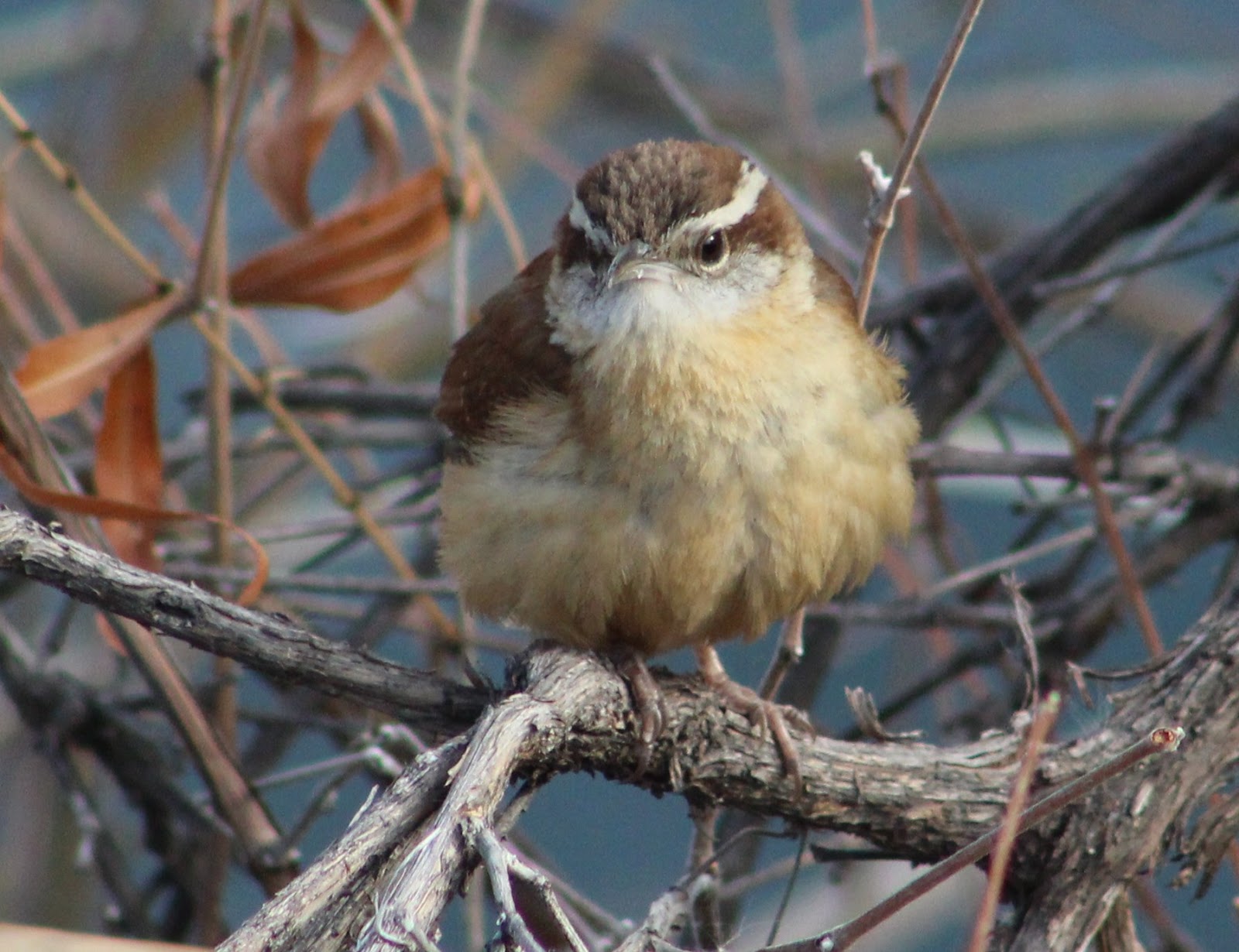
Carolina Wren is a colorful wren on the eastern United States.  While Mark and Ellen have seen this bird, they liked how rare it was for Arizona.  Caleb and I were stoked to chase Carolina, as it would be a life bird for both of us if we could land it.  We arrived at the famous Patagonia Lake State Park around 3:45 P.M., and headed over to the vicinity of the Visitor Center and the eye-catching and high arching pedestrian bridge.  An inlet of the lake flows into this section of the park, and the bridge goes over the inlet.  Tall reeds surround both sides of the inlet.  We walked over the tall and high arching bridge.  Once reaching the west side of the bridge after officially crossing, we heard some noise in the reeds immediately.  While we knew there were plenty of Marsh Wrens and Common Yellowthroats around, we waited to find out what this noise might me.  It was crazy, because it turned out to be that Carolina Wren.  Just like that!  We were in disbelief.  Carolina popped out into the open and gave us great views.  It was a great lifer for me to get, and it has completed my Wren list for the United States and Canada.  A Carolina and Sinaloa Wren both in the same day was truly a lot of fun!

Carolina Wren!  My 540th life bird.  Patagonia Lake State Park, Santa Cruz County, Arizona, 3/9/2018.  Bird was originally found by Matt Brown.

Key field marks for Carolina Wren include long supercillum, bright reddish-brown back, white chin, and all buffy on the front side of the bird.


We closed the day out by hiking along the Birding Trail within Patagonia Lake State Park.  Many birds were active.  We stumbled across a few more Black-capped Gnatcatchers and got to watch and study them further.  What I didn't know was how many different vocalizations they give.  I was impressed when Caleb pointed out those vocalizations to us: one of which sounded like a call that Northern Beardless-Tyrannulet gives, and the other sounded like call the Western Kingbird gives.

Black-capped Gnatcatcher.  Patagonia Lake State Park, Santa Cruz County, Arizona.  3/9/2018.  In this picture, key field marks for this species are the long bill length as well was the black in front of the eye was well as the black stripe above the eye.

The day was a huge success for us.  We had a long drive home and got back to Phoenix late, but it was sure worth the time and fun!  Thanks Mark, Ellen, and Caleb for the great time.

Tuesday, September 17, 2013

A Gift From Mexico

On September 2nd, 2013, Ron Beck discovered a small young wren in Huachuca Canyon in the Huachuca Mountains of Southeastern Arizona that turned out to be the rare in North America SINALOA WREN!  Because this was indeed a small young wren, it was also very drab and rather indistinct.  Luckily, the Sinaloa Wren has a very distinctive song and a different "ratchet" call than the similar Bewick's Wren.  The bird gave both of these evidences and through a few good pictures, some of it's key field marks where shown to rule out other species, such as the Bewick's Wren.  Record wise, this remarkable rarity has been found in North America two previous times before this particular discovery, both in Arizona.  The first one was found at the Patagonia-Sonoita Creek Preserve by Robin Baxter and Matt Brown on August 25th, 2008.  They located the bird by it's distinctive song, which Matt had heard in Mexico numerous times on one of his birding trips.  Matt and Robin were able to find the bird and get photographs to confirm the first Sinaloa Wren in the history of the United States!  The wren continued in the area for almost a year and was very hard to see, due to it's skulking habits.  Many birders had the bird as a heard only.  The Sinaloa Wren even built a few nests and sang relentlessly to attempt attracting a mate.  Had he had been 30 miles south, it wouldn't have been a problem!  Then, on April 14th, 2009, Diane Touret discovered another Sinaloa Wren, this time in Huachuca Canyon.  The bird was photographed and well documented by pictures and song recordings as the first one was.  Four years later, this young bird was then found on September 2nd in Huachuca Canyon once again, giving the canyon 2 of the first 3 records.  As mentioned earlier, if it weren't for voice, this little bird would be hard to identify.

AZFO NOTES:  "Key ID Points for Sinaloa Wren:  It has a pale eyeline, rusty tail contrasting with brown back, gray underparts and a few noticeable streaks on the sides of the neck.  Similar species of wrens with pale eyelines: Bewick's Wren is smaller and slimmer and has a brown tail with white tips.  Eastern Carolina Wren is bright rusty above and bright buffy below.  Mexican/Texas Carolina Wrens are browner above and less buffy below than Easterns but the tail is also browner and does not contrast with the back.  Happy Wren, which occurs almost as far north in Sonora as Sinaloa Wren, has a boldly striped face, bright buffy or rusty underparts and a browner tail.  The song of the Sinaloa Wren is very distinctive and diagnostic.  The third bird that was discovered was young and some of it's key field marks were shown, but were harder to make out than on an adult.  "This is a very dull immature which lacks the characteristic black and white steaks at the side of the neck although a hint of them can be seen.  In addition, the rusty tail does not contrast as much with the back as in an adult.  However, Bewick's Wren would have a thinnner bill and a longer eyeline.  Fortunately, the song of this species is diagnostic and the recordings confirm the ID."

On September 10th, 2013, the Sinaloa Wren continued in the location that it was discovered in Huachuca Canyon originally on September 2nd.   Steve Hosmer and I made the trip down, and we were hoping to see the wren.   It was cooperative for many birders, and has been the easiest of the three Sinaloa Wrens discovered so far.  When driving into Huachuca Canyon, the bird has been in the stream bed by the bridge shortly after the pavement ends on the road when driving into the canyon.  There is a picnic area here, as well as a swing set and campspots.  Steve and I arrived at 7 A.M., hoping to catch a glimpse of the plump little Sinaloan artifact.

Huachuca Canyon


While waiting for the wren, we heard and saw many other birds and cool creatures.  One came in the form of a Montezuma Quail calling from the surrounding grassy hillsides.  We couldn't see the elusive quail, but it was cool hearing it.  Despite the many birds that were around, they weren't very cooperative for photography at all.  Here's a few birds, creatures, and people who were cooperative for the camera.

Acorn Woodpecker

Zena the Malamute

Nashville Warbler

Arizona Sister

Steve Hosmer

There were a lot of other birders present, including expert guide Laurens Halsey. Everyone walked and stood around listening for the bird. At about 7:30 A.M., Laurens got everyone on the bird who was giving it's ratchet call in a dense thicket. We walked up to the thicket. Despite the fact the bird was making a lot of noise, it wasn't immediately showing itself. After awhile, it came out of the thicket and perched briefly in the open. The stubby tail was noticeable even with the naked eye. The bird flew into the area of the stream bed, and briefly delighted us with it's awesome song. Between 7:30 and 11:30, we heard the wren probably 5-6 more times. It still continued to be a skulker, and it was a real challenge getting any sort of a look at it. At 11:00 A.M., I was in the stream bed near the picnic area and away from the other birders. There were dense thickets around me, and I caught movement foraging low. I quickly got on the bird and noticed it was the Sinaloa Wren. There were sticks, small twigs, large twigs, and leaves in the way everywhere were the wren went. It luckily came up into an opening where I got good and clear looks at it for about 5 entire seconds. The 5 seconds beat the .7 tenths-of-a-second looks I was briefly getting a few previous times of the bird. Here I was able to see the bird well. I could make out the faint distinctive lines on the side of it's neck, I saw it's rusty wings and tail. I then got a rather poor picture of the bird. I seriously felt like I was in Sinaloa, Mexico itself!!!! There were also three Bewick's Wrens around, and the differences between the Sinaloa and the plain and gray Bewick's Wren was evident.  It wasn't the nice looking adult Sinaloa Wren, but hey, it's still the species, and a heck of a good ABA rarity and life bird for Tommy.

Sinaloa Wren (my "shots")


After spending 4.5 hours on the Wren search, Steve and I headed for the Benson Sewage Treatment Plant to look for shorebirds.  One of the ponds had great shorebird habitat, and had 2 Pectoral Sandpipers (one of the coolest!), 2 Baird's Sandpipers, and a few Red-necked Phalaropes and a Semipalmated Plover among the more common shorebirds.  It was great to get good looks at Pectoral Sandpiper.  

Pectoral Sandpiper-it looks like a giant compared to these Western Sandpipers it is with!


Baird's Sandpiper w/ smaller Western Sandpipers

What shorebirds can you pick out of this shot?

Benson STP


Steve and I then headed over to Madera Canyon to search for a Beryline Hummingbird that had been visiting the feeders at the Chuporosa Bed and Breakfast.  Well, the hummer called it quits on the location and the last it was seen was the day before we got there.  In over an hour of waiting, the Beryline outwitted Steve and I.  These Yellow-eyed Juncos were very entertaining though!

Yellow-eyed Junco


As the trip came to a close, Steve and I both agreed the day was a great success.  It felt like the three birding stops were so little compared to the distance we traveled-550 miles.  But when one rarity hunts, that is often the case!!  As I always tell my birding buddies: "any day when you get a lifer, it's a great day of birding."