Showing posts with label Indigo Bunting. Show all posts

Sunday, July 30, 2017

Washburn County, Wisconsin: A Great Place For Eastern Birding

Washburn County, Wisconsin, or the State of Wisconsin in general, is an awesome place.  There are many things to do there.  Perhaps Wisconsin is best known for it's epic dairy farms and dairy products such as ice cream, cheese, milk, cheese curds, and more.  Here, four people wander through Shell Lake and Spooner, Wisconsin to get free ice cream that the local banks hand out on summer Fridays.


Wisconsin is also known for it's fishing.  Walleye, Northern Pike, Muskie, Small and Largemouth Bass, you name it!


Another epic thing are water related activities.  Boating.  Rafting.  Canoeing.  You got it!  There are lakes and rivers everywhere.


What's really cool is that I have family in Washburn County, Wisconsin, and that's why I was there.


My Grandma lives in Wisconsin.  Pearl DeBardeleben and my Grandfather, the late John DeBardeleben, resided in the Spooner/Shell Lake area in Washburn County.  For this reason, I've always loved this place.  My aunt Tabby lives here as well as many second cousins and other relatives of my Dad's.  We were here for a family project, and there was a lot of work involved.  The family time was epic.


Wisconsin also has it's good birding too!  And I, Tommy D, love birding in this state.  Lots of birders do too.

Remember my post about Wisconsin's Warblers and the fact that I lifered on three of them during my recent trip:  Blackburnian, Canada, and Mourning Warblers?  I did add another lifer in Wisconsin, and that was a heard-only Black-billed Cuckoo.  My brother Tyler and I went back after I heard it to try and relocate the bird and to get a visual of it, but it simply wasn't meant to be.  With a Black-billed Cuckoo though, I'll take a heard-only.

In Washburn County, there were an assortment of birds away from the life birds.  Many of them were classic birds from the east, and I will feature them on this post.  Whether what I saw or not, it was cool to bird in a County that I've always wanted to bird in.  In the week we spent and in the limited time I had for birding, I recorded 105 species in Washburn County.  And it is a County that is heavily under-birded!

Things got really fun on the drive up and once we entered into Washburn County.  This Bald Eagle was scavenging on a road killed deer.  Ooohs and aaahs filled my family members voices.


The local Brown Thrasher was an awesome sight once we started working.


Sometimes, Sandhill Cranes were seen in the area's fields..


Here's the Eastern Kingbird, a classic eastern bird that haunts roadsides.


Yellow-throated Vireos are fairly common in northwestern Wisconsin.  They are loud and are heard a lot more than they are seen.  A few times on the trip, I found myself face-to-face with one.


Truly impressive were the numbers of the Veery throughout Washburn.  They were everywhere.  And so were their epic songs.


A lone Trumpeter Swan made it's home at a series of wetlands called Tozar Springs just off of the Yellow River.  We drove by this place several times daily, and every time, this Trumpeter Swan was there.


One of the most abundant birds in the east is the Red-eyed Vireo.  You can't go anywhere without hearing one!


An amazing highlight happened when I got to see this Broad-winged Hawk roadside.  It was the first time I've really gotten to see this small buteo well after catching glimpses of a few on this trip and having brief looks at two separate Arizona migrants.


The Song Sparrows in the north look a lot different than the ones in the southwest, that's for sure!


Here's a crappy shot of an Eastern Bluebird, another classic eastern bird.


I heard and saw and few Eastern Towhees on the trip.  One of them was very cooperative for my camera, and these are the best pics I have obtained of this species.


Scarlet Tanagers were pretty scarce while I was up there, but I managed to catch this striking bird at a distance.  After all, this was my 500th life bird which I saw for the first time last year.


This male Rose-breasted Grosbeak in song sure was a welcoming sight.


The cat-like sounding Gray Catbird was very common on the trip.  There were a few times individuals would perch out in the open for me.


Striking male Indigo Buntings were also a common sight, especially along the sides of roads or in forest clearings.  I couldn't go anywhere without seeing these guys.


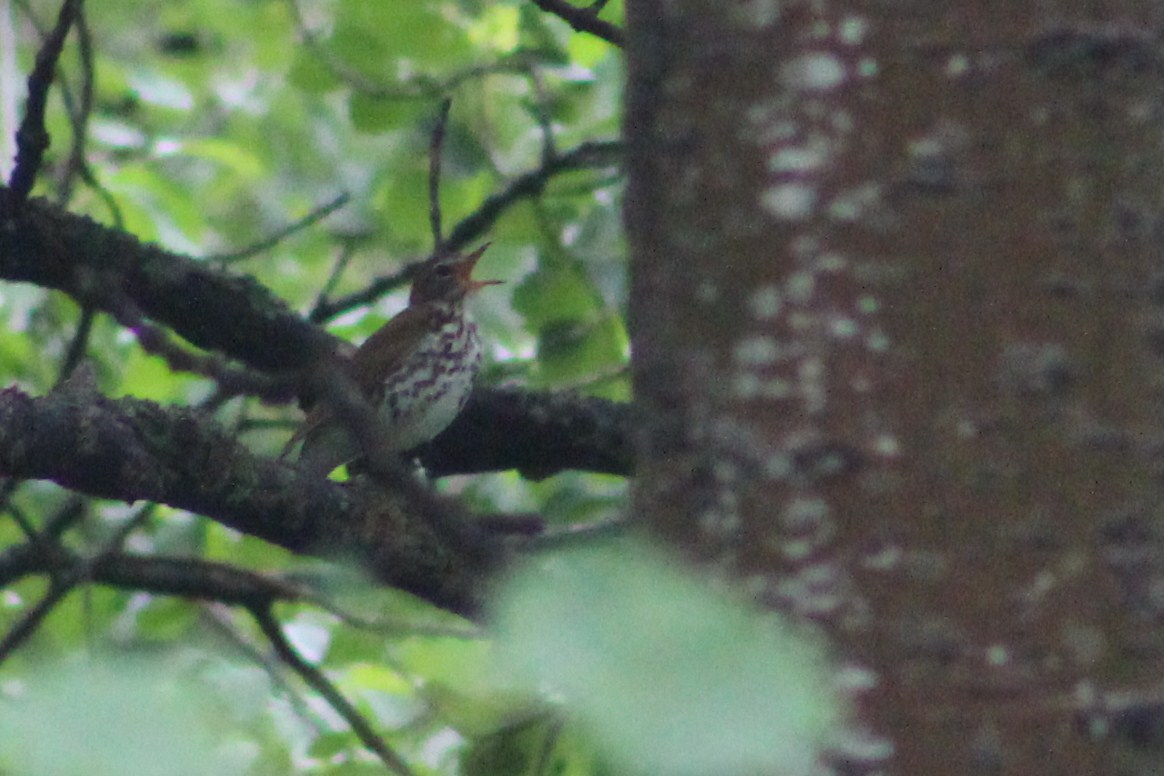
A few times on the trip, I heard the breathtaking song of the Wood Thrush.  This song doesn't sound like anything we should hear on earth, and it all comes from a medium-sized brown bird with black spots on it's front.  Prior to this trip, I caught one glimpse of a Wood Thrush as it flew away from me.  This time, my patience in hoping to see one well prevailed, and I got good looks and decent photographs of this singing male on territory.  These are my first Wood Thrush photographs!


The common and well-known Blue Jay is loud and can be heard everywhere in the East.  Despite the common audio, these birds don't readily show themselves much.  This individual was the only one who gave me a chance to view it on the trip.


This female Yellow-bellied Sapsucker was right outside my Aunt Gretchen and Uncle Larry's cabin.  Another classic bird of the east..


As you can all see in a nutshell, this place is awesome for birding.  If you haven't seen my Wisconsin Warblers post yet, it's two posts back in the archives.  Washburn has it's warblers, and a lot of them at that.  I hope to return to this awesome place again soon for family, for all the fun mentioned above, and of course, for the birds too.

Friday, July 15, 2011

Bushnell Tanks and Mount Ord

Photographic Highlight....a nice male Indigo Bunting!


Hi everyone,

Today on July 15th, 2011, I ventured out to the northeastern part of 
Maricopa County to explore after some of the best areas had been closed 
off because of fire dangers.  I found out they opened the closed areas on 
Wednesday, and I was ready to be back in the area birding again.  More 
than just ready, I was pumped.  I made my inaugural visit to the Bushnell 
Tanks area followed by Mount Ord in my expedition.  

For a first time visit to Bushnell Tanks, I was very impressed with the 
area.  It's across the Highway from Sunflower or better called, the Old 
Beeline Highway.  It's very similiar in ways to Sunflower, only with very 
few willows and cottonwoods, and some mesquite.  Great sycamore habitat is 
the primary habitat here along Sycamore Creek (including old growth 
sycamores).  I enjoyed 40 different species here today, and I certainly 
look forward to birding this spot in the future in what has a lot of 
potential.  Raptor wise this morning, it was similiar to a Sunflower 
morning.  I had two COMMON BLACK-HAWKS here.  One was calling in the 
sycamores while the other was flying around on the hillsides.  ZONE-TAILED 
HAWKS were easily seen, as I found two adult birds as well as a nice and 
close look at a juvenile.  I heard three different COSTA'S HUMMINGBIRDS, 
which this area in general is usually very good for this species.  
Flycatcher wise, BROWN-CRESTED FLYCATCHERS were everywhere, as well as 
CASSIN'S KINGBIRDS with also a single WESTERN KINGBIRD.  Juniper hillsides 
surround this entire area, which is great habitat for GRAY VIREO, in which 
two were singing this morning.  A single BLUE-GRAY GNATCATCHER was also 
present.  Another highlight I had were three INDIGO BUNTINGS singing.  I 
got good looks at two of them, both pure males.  I then found a LAZULI X 
INDIGO BUNTING hybrid, which sang a very odd song.  I headed to Mount Ord 
after birding the Tanks for two hours, forty minutes starting at 5:45 A.M.

I arrived at Mount Ord's side road, 1688 at 8:45 A.M., which is the road 
that runs south into Maricopa County, when one first hits the pines when 
coming up the mountain dirt road.  A CASSIN'S KINGBIRD perched on a fence 
on my way up.  I birded Mount Ord for over four hours all along Road 1688 
as well as the summit area on the Maricopa County side.  Numbers were way 
down today, as a lot of Mount Ord's usual residents were rather quiet.  
Some were still active though to entertain, and maybe I just got here a 
little too late for some of the species.  On Road 1688, I had two ZONE-
TAILED HAWKS soaring overhead throughout the hike.  Woodpeckers today 
consisted of two HAIRY and two ACORN WOODPECKERS, as well as a 
NORTHERN "RED-SHAFTED" FLICKER.  I usually have more Hairys.  ASH-THROATED 
FLYCATCHERS were everywhere, as at the entrance to 1688, I had a family of 
four.  Four WESTERN WOOD-PEWEES were also along the stretch.  In the same 
area, a curious JUNIPER TITMOUSE made a close appearance.  I had more 
WHITE-BREASTED NUTHATCHES this trip, and a heard-only of only one RED-
BREASTED NUTHATCH (I had none on my June trip).  Several PHAINOPEPLAS were 
present along the road, which I never had them this high up on Ord until 
last month.  The usual Warblers were very scarce today, especially on Road 
1688, only singles of GRACE'S, VIRGINIA'S, and BLACK-THROATED GRAY-
WARBLERS, and two PAINTED REDSTARTS.  Four BLACK-CHINNED SPARROWS were 
present (two singing), as well as at least three singing WESTERN 
TANAGERS.  As I moved to the summit of Mount Ord, I still managed to find 
some of the scarce summer species in Maricopa County.  CHIPPING SPARROWS 
were present, as I had a good amount of probably at least ten, I observed 
adult and juvenile birds.  A single HOUSE WREN was present as well as a 
single male WESTERN BLUEBIRD.  VIOLET-GREEN SWALLOWS flew in the sky 
overhead, and there were great numbers of BLACK-THROATED GRAY WARBLERS up 
here in the early afternoon (compared to only one on 1688).  A very 
unusual sighting for me up here came when I found two RUFOUS-CROWNED 
SPARROWS, an adult with a juvenile bird.  They were near the summit at the 
7000 foot range, in the green understory in midst of the pine and oaks.  
I've never had them this high, and it seems like the completely wrong 
place for them.  I also heard an individual singing near the summit in 
appropriate habitat, where the forests end and the hillside is rocky and 
open.  Perhaps the two forest dwelling birds are sick of the summer.  I 
recorded 35 species at Mount Ord, 63 for the day.