Showing posts with label Red-breasted Merganser. Show all posts

Monday, February 15, 2016

Bullhead City to Yuma, Loons to an Oriole

I had to work for 10 consecutive days after getting back from my epic vacation and birding trip to Minnesota.  Other than a quick jaunt up to a park in Surprise only to miss a Barrow's Goldeneye upon the first day of my return, I didn't do any birding during those ten days.  I came down with sickness and spent any mornings I had resting before I had to go to work.  Some birding ideas came around, and they came at the idea of me chasing two birds in the western parts of Arizona.  These two birds, Yellow-billed Loon and Streak-backed Oriole, are two that I have had my chances at chasing in previous years of birding.  Because I love to save money when it comes to birding trips, I don't chase many birds outside of Maricopa County when it comes down to these birds.  I feel like they will show up in Maricopa County again and I'll hopefully get to see them then.  But I've also had that urge and craving for awesome life birds lately.  I'm sure going to Minnesota and racking up 15 lifers over a 4 day span had a little something to do with it.  With some plans made with two great birding buddies, I went after two more life birds this past weekend.  And I was hoping to succeed.  After all, I am closing in on 500 birds for my life list, and that is a very exciting milestone to reach.

The first birding trip was to go after the Yellow-billed Loon.  My buddy Gordon Karre and I headed out to northwestern Arizona and a tiny crack of Nevada for this trip.  We felt like our chances were great, as there where at least two Yellow-billed Loons in the area.  One of these loons toggled between both Arizona and Nevada waters at Davis Dam on the Lake Mohave while the other was also at Lake Mohave but further north at Katherine's Landing.  The latter was being very cooperative for birders, and was often being seen right off of shore.  Gordon and I took advantage of cheap prices for hotels in Laughlin.  Rooms were only 20 bucks, and it was nice to have that advantage to be very close to Lake Mohave to start of the morning of February 12th, 2016.  The hotel that we stayed at was one in a Casino, and it was the first time I've been to a Casino.  I will say though in all honesty, I didn't gamble away a penny.  The Casino had some epic side notes to it, such as a buffet we ate at for breakfast before a five minute drive back into Arizona and into Davis Dam.  With the Casino actually being right along the Colorado River, we took a look outside to see many birds utilizing the Nevada waters and we officially started our Nevada list.  More impressive was this hungry Raccoon walking around and about on boats to search for a breakfast.  I was thrilled at the sight of this animal, and it's an animal I don't see a whole lot of, and one I certainly haven't been able to photograph.


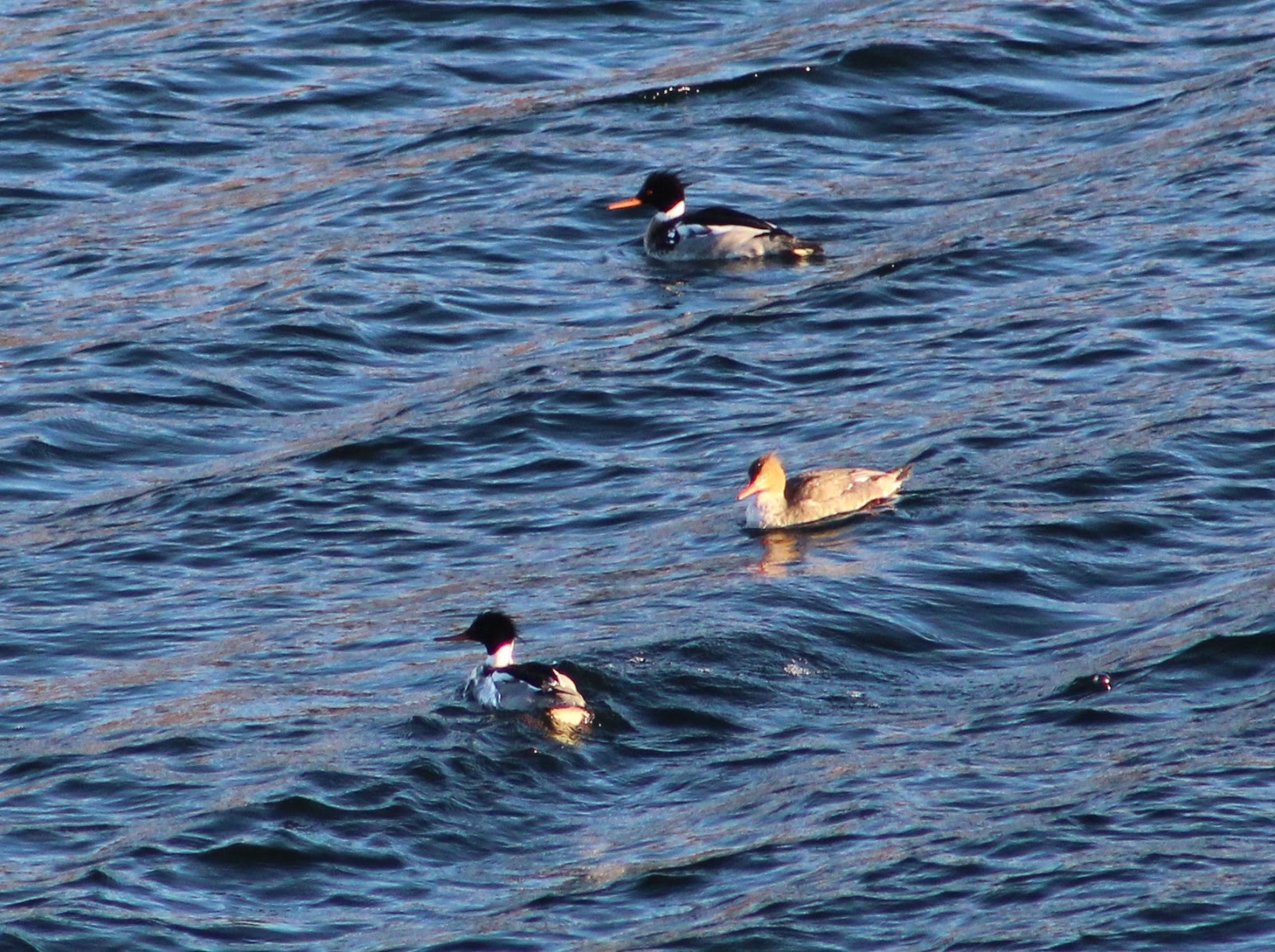
From the Raccoon we moved back on into Arizona to start our Yellow-billed Loon search at Davis Dam on both Arizona and Nevada waters.  As we stepped out of the vehicle, it took me about a minute to luckily locate the Yellow-billed Loon somewhat close by on Arizona waters.  I had it in my scope for close to a minutes worth.  Gordon had time to see it, and then the awesome start had a dramatic drop off.  We realized it was terribly windy outside and as the loon disappeared, so did most of the fun.  Gordon and I could barely stand up straight, yet alone bird.  We were trying hard to relocate our brief look at our loon lifer, but that wasn't happening.  At Stopsign Cove beneath us, we had a few neat birds, including nice looks at male and female Red-breasted Merganser as well as a Common Loon.


Despite the howling winds that were louder than wolves themselves, the sight of Lake Mohave from Davis Dam was quite impressive.  There were masses of birds out on the waters, but Gordon and I struggled to see them well.  But I can honestly say, we were trying hard!


We then headed off to Katherine Landing and walked around in hopes of finding that Yellow-billed Loon, the one that had been so close to shore and friendly to birders.  Despite checking the Landing four times over the course of five hours, that Yellow-billed Loon was a no show.  It was back-and-fourth to Davis Dam and Katherine Landing to search for stuff, as well as a few coves further north on Mohave.  The wind was bad everywhere, but did lit up ten percent at the northern coves and Katherine.  There weren't many birds away from Davis Dam, and one of the standouts was a Redhead who had a Coot swimming up to him in amazement.  "My new buddy is the coolest!"


Gordon and I then ran into fellow birder, Leo Miller.  Leo was after the same target as we were, and the three of us teamed up to look for the Yellow-billed Loons any further.  There were four different loons that were spied out on the lake, and at times, birders were seeing all four species: Red-throated, Common, Pacific, and our coveted Yellow-billed in the same scope view!  With the exception of the Red-throated, Gordon and I did have the other three locked up.  The wind was constantly beyond terrible without any signs of letting up.  Even though we got the Yellow-billed Loon, early, I felt as if we didn't get it because it was short lived.  I asked myself, "How can getting a lifer be disappointing?"  I guess I just hate the wind with a passion.  Without it, who knows how Gordon and I would have fared otherwise.  Back at Davis Dam, Gordon, Leo, and I continued our search for one last time as the wind was truly wearing the three of us out.  As I scanned the lake way out into Nevada waters, that lightning finally struck twice.  I had the loon in my scope!  Leo and Gordon immediately got on the bird as I had it in the scope, and we could clearly see that it was the Yellow-billed Loon.


Luckily, the road along the stretch of the lake traveled north into Nevada, and we got to a point that was close to where I had spied the loon.  The three of us looked until I spied it again, but this time, we had excellent scope views of the bird.  Gordon, Leo, and I were all on cloud nine.  With the wind still howling louder than wolves, I attempted to get a challenging shot off of the Yellow-billed Loon through my scope.  And it worked!


The Yellow-billed Loon made things simple this time around and stayed above the water for a consistent amount of time as we all got to enjoy it.  I can't say how grateful I was to have gotten this look and these shots off of this lifer of mine.  Yellow-billed Loons are casual in Arizona, and they have been seen in western Arizona on the Lower Colorado River more than once since 2009 when I became a serious birder.  This was the first time I've chased one, and boy am I glad I did!


The Yellow-billed Loon is North America's largest loon out of the five species, and is a good three to four inches larger than the second largest and closely related Common Loon.  Yellow-billed Loons breed on tundra lakes and ponds in summer, and in winter they usually prefer inland coastal waters.  Their breeding range is small in the Arctic and Yellow-billed Loons are very scarce and aren't nearly as prominent as the other four loon species.  When a Yellow-billed Loon shows up in chase-able locations in winter that are far south of it's breeding range, many birders seek it out in hopes of a sighting.  


With the wind being terrible, I consider all of these shots to be lucky shots that I took through my scope!


Here is some information on this particular Yellow-billed Loon on the Arizona Field Ornithologists website.  This information explains who found the bird and when it was found, the status of Yellow-billed Loon in Arizona, as well as field marks to separate this bird from other loons:

"This Yellow-billed Loon was found by Lauren Harter on 17 January 2016

There are seven previously accepted records for Arizona, five of those in the Lower Colorado River Valley with an eighth pending from nearby Katherine Landing.

On this bird, the size, shape and color of the bill are diagnostic for Yellow-billed Loon.  Note especially the lack of a dark line on the culmen. On Common Loon in this plumage there is almost always a dark line across the culmen extending almost to the tip of the bill. This bird also has the characteristic pale head and neck of a Yellow-billed and when in relaxed swimming posture holds the bill at an uptilted angle. In some poses there is a sharp peak in the crown, a feature that is probably more prominent in males. The pale edges of the back feathers are characteristic of first winter plumage".


Here are Gordon and Leo celebrating this rare North American bird!


Lake Mohave was a very neat place, I hope to explore it again sometime with it being windless.  As you can see in these pictures, the whitecaps on the water show how windy it was!


Gordon and I had a great ending to a challenging day of birding in the wind.  Thank you Gordon for a fun time!

Up next was Yuma, as my next target lifebird was a Streak-backed Oriole.  I would have my buddy Dominic Sherony with me for this trek, and it would come on February 13th, 2016, a day after the Yellow-billed Loon trek.  A Streak-backed Oriole was reported at Riverside Park near the Yuma East Wetlands on December 24th, 2015 by Jim Taylor.  Since then, dozens upon dozens of birders have staked out this Mexican rarity.  It has frequented a trail along the Colorado River in the Yuma East Wetlands, but also has come into Riverside Park by the Wetlands to feed on fruit that has been growing off of palm trees in the park.  Although this bird spends more of it's time in the Wetlands themselves, it is easier to see as it makes regular visits to Riverside Park during the day.  Sometimes, birders have spent several hours and have missed the bird.  Dominic and I were hoping to be on the fortunate side.  Also, this was a rare occasion while birding with Dominic because it would be a lifer for both of us.  Dominic has seen a lot of birds, but the Streak-backed Oriole would be his first ABA lifer in over three years if we would be successful.  For me, I've had chances to chase Streak-backed Oriole on several occasions before this one.  I decided to save money in hopes that it would choose to visit Maricopa County again.  Like I said earlier, I was craving to see some new birds, and I was at Yuma and near the Yuma East Wetlands in hopes of seeing a Streak-backed Oriole.  


Dominic and I started at 8:38 A.M. and started to wait at Riverside Park.  When it would visit Riverside Park, the Oriole would feed on fruits out of the palm trees there and it would also fly to other trees within the park.  We were watching the palms and other trees at all times, as well as listening for the orioles high pitched "whistle" call as well as the more common and long chatter call.  While we had been waiting for over an hour, I heard that chatter call coming from the river in the distance at 9:56 A.M.  When I went shortly north to try hearing it more, I looked up to see the Streak-backed Oriole flying in the direction of Riverside Park.  I ran to tell Dominic and a couple from California that the bird was probably going to come in at any second to it's favorite palm tree.  As we anxiously watched, the Streak-backed Oriole came into it's favorite palm tree at 9:58 A.M.  And it was quite the sight!


It became the first time that Dominic and I had gotten a lifer at the same time, and this cool-looking Oriole was now eating right in front of us.


In 2006 and in 2007, Gilbert Water Ranch had a Streak-backed Oriole that wintered for two consecutive winters.  Sadly, that was before my hardcore birding time before I knew about the birding listserv and such.  Had I had known about the birding list, that bird would have been on my list long before now!  Hopefully, another one will make it's way closer to me someday.


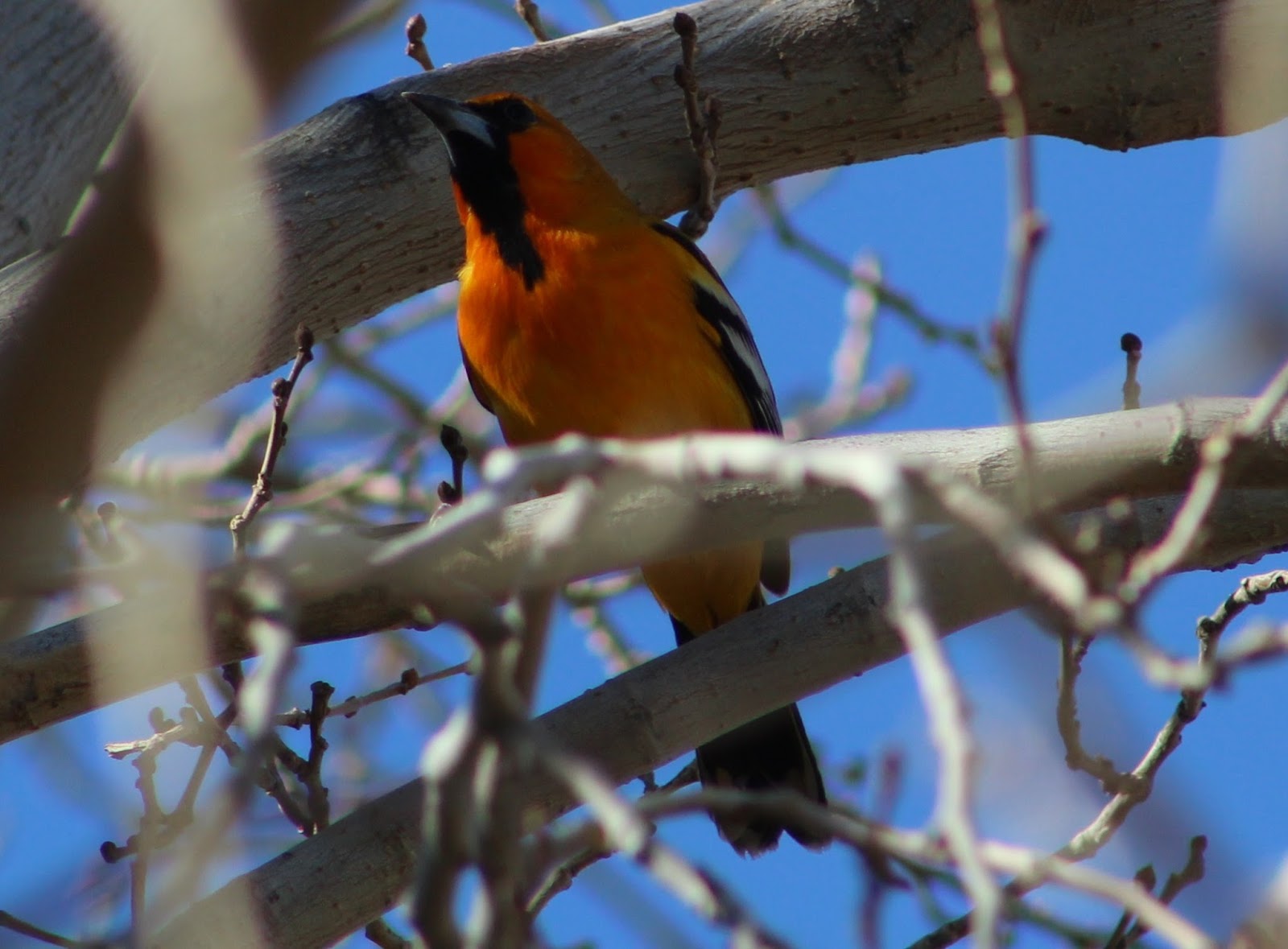
As you can see by these photographs, the Streak-backed Oriole is very well named.  This is an adult male.  And his back is very streaked!


Good field marks for this bird are of course the streaked back, but also the thick and straight bill, black on the lower madible (lower bill), bright orange on the face, and white edgings on the wing feathers.


Streak-backed Oriole has even bred in Arizona before.  Other than that, it's status in Arizona is considered to be a casual fall and winter visitor.  In Mexico and not too far south of the border, this bird is very widespread and common in lowland riparian habitats.


The bird was striking in flight with bright combinations of orange and black.  Seeing the bird flying in was an exciting, as well as the 15 minutes we spent watching it.  Lifer # 494.


Because this bird is cool and with me having several chances to chase other Streak-backed Orioles before this bird, it was awesome to see it for the first time and it seemed like I gained a bird that was overdue in a way.


Dominic and I then headed north of Yuma to explore Mittry Lake.  We wanted to check for a Red-throated Loon that was recently found by Henry Detwiler, as well as attempt at hearing the elusive Black Rail.  Mittry Lake is a neat place, and it was the second time I've visited the location.


Many common waterbirds filled up the lake without any sign of the Red-throated Loon, and a Harrier cruised over the marsh.


Our attempts at Black Rails weren't successful, as expected in mid-day.  We did visit Hidden Shores Golf Course just north of Mittry Lake for awhile.  It was shocking to see a flock of 20 Long-billed Curlews walking around on the golf course!


Here is Dominic enjoying Mittry Lake.  It was the first time he's been to this area.


It was a crazy and fun two days of birding with two consecutive trips falling on two consecutive day to chase two lifers.  I'm glad to have added both Yellow-billed Loon and Streak-backed Oriole to my lifelist, which are two rarities in North America.  It was also cool to bird in these two areas on these two days, as I've never been to the Bullhead City area for birding and I rarely venture into Yuma County.  Thanks Gordon and Dominic for the fun expeditions.

Saturday, March 1, 2014

A Handful of Lifers-California Day Three

I love birding in California!  Dominic and I completed two full days prior to today, March 1st.  And prior to this third day of our trip, I have been able to see 11 different life birds to bring my list up to 444 species.  11 life birds in only two days was rather overwhelming in a good way, and I have been lucky enough to get photographs of 10 out of 11 of those birds.  For this third day, I was hoping to see and add more.  In my birding "career", the first day of the month has always seemed to be a lucky charm for me a lot.  And today is March 1st, so I was thinking and hoping that would be the case.  Dominic and I had a lot planned, and a lot of different birds to see!  And, I'm obsessed with the Heermann's Gull.


Dominic and I were staying just north of San Diego, and had plans to bird much of the San Diego area, as well as bird other locations on the outskirts of San Diego.  I haven't mentioned this yet, but San Diego has horrible traffic.  It's such a busy city and place, I don't think you could ever safely throw a rock without hitting someone.  Luckily, it's been a Saturday, so the traffic isn't as bad.  After a rainy Friday, we woke up to a clear and sunny Saturday to start off.  We immediately decided to go back to La Jolla Point, mainly in hopes of seeing distant pelagic birds from shore as well as a fun sea watch.  After having very limited viability yesterday at sea, it was so nice to get out there to La Jolla Point today to have a chance at seeing distant sea birds.


La Jolla Point is a very popular San Diego destination for many birders, especially the locals who find these amazing seabirds.  As Dominic and I arrived, we found many other birders and we lined up to search the sea.  This included some of San Diego's best birders:  Paul Lehman, Gary Nunn, and Guy McCaskie.  I even ran into birding friend Michael Lester who I've birded with before in Arizona.  Gary Nunn is another friend of mine and used to live in Arizona and I birded with him several times.  Birding can be a very small world, that's for sure.  It was a great time birding with all of these great people in San Diego.  Paul Lehman helped Dominic and I out by giving us directions for many of our hopeful birds, which helped us greatly throughout the day (stay tuned...).   For the next hour, the line of birders stared out at sea with our scopes, and we were hoping to get a sea bird.  Luck soon hit as Paul said Black-vented Shearwaters were flying out in the distance.  Dominic quickly got on them and let me look through the scope as they were flying south.  Although distant, I was able to see this small shearwater clearly, who has very quick wingbeats.  After I got the hang of the bird, I was able to find plenty of the Black-vented Shearwaters flying over the ocean on my own.  The Black-vented Shearwater was my first lifebird of the day, but was also something else more important.  It was my first ever pelagic bird, ever!  I've always stared in my field guide and thought it was pathetic I didn't have a fulmar, jaeger, shearwater, storm-petrel, albatross, or auk.  But today, that all changed with getting to see the Black-vented Shearwaters, about 35 of them in all throughout the morning.  Because they were distant, I didn't even have a prayer of getting any sort of picture off of the shearwaters.  With my pelagic trip getting canceled, I was very thankful to be able to see this bird from land.  From land, we did see many good birds.  Some of them included nice and close flybys of Pelagic Cormorants in flight.


The tide came in very high during the morning, and some of the waves were impressive.  The massive Brown Pelicans weren't intimidated at all by the waves, and would fly right through them.  Well, it seemed that way.


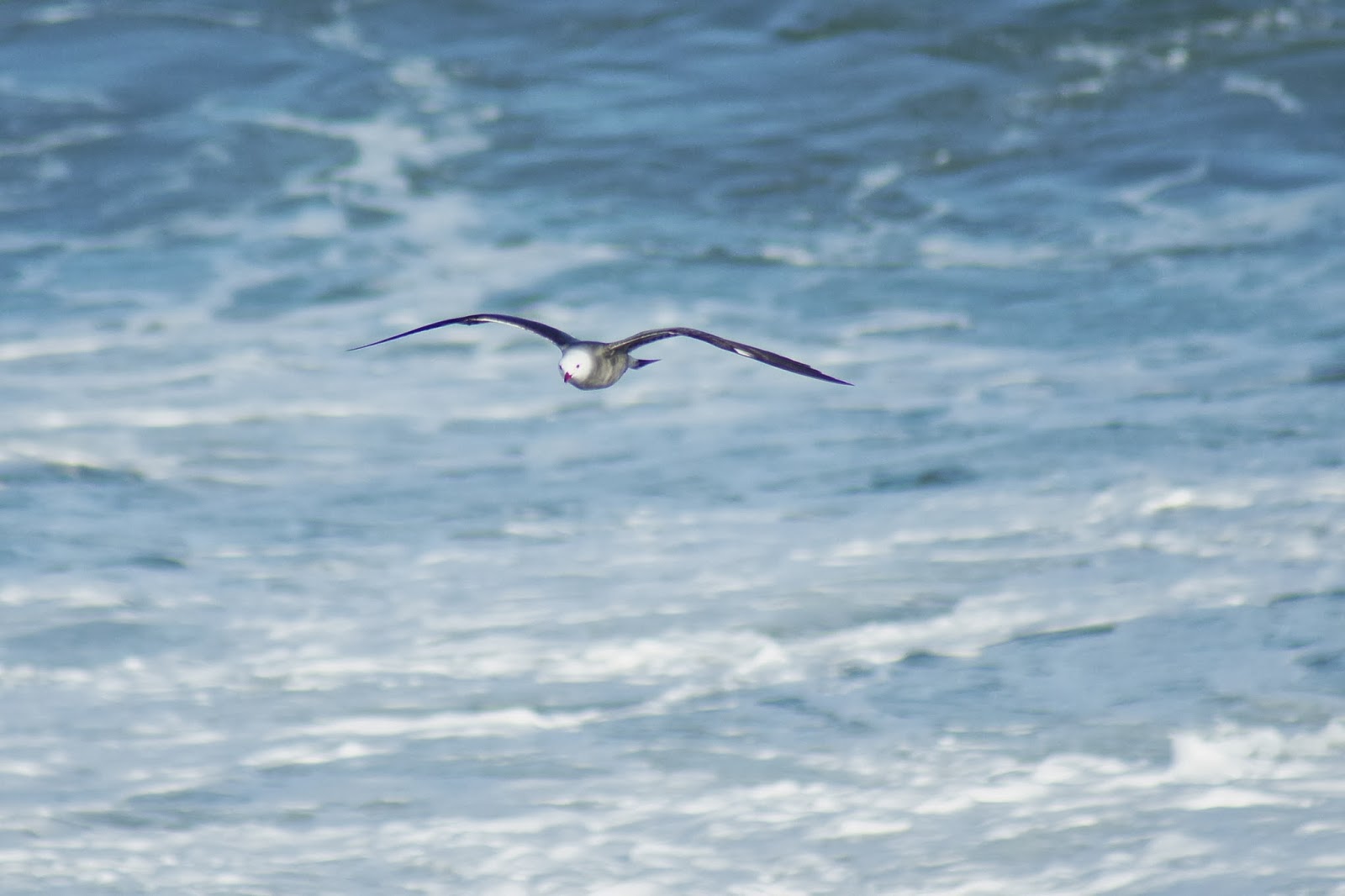
And what's this bird, flyin' on in ;)


In the crowd of birders were two by the names of Matt and Justin, and they were on their way to look for a bird that Dominic and I were wanting to see, another potential lifer for me.  It was the Nelson's Sparrow.  Paul had given directions to us on finding the Nelson's Sparrow, and when Justin and Matt were leaving the Point, Paul told me that's were they were going and Paul suggested that Dominic and I should go quickly after them so we would have a better chance at the sparrows.  The Nelson's Sparrows (3 of them) were found at San Elijo Lagoon north of San Diego, and were consistently frequenting the same location.  When the tide would rise, the sparrows would also rise and would perch up in the open.  Dominic and I decided to head to the Lagoon to look for the sparrows.  The directions from Paul were easy and when Dominic and I arrived and looked down into the Lagoon, we could see Matt and Justin down by the spot.


As Dominic and I made our way down there and got closer to the spot, Matt and Justin were pointing down to the bushes they were behind.  They were saying that the sparrow was right in front of them.  Dominic and I soon got on the bird, even though it was obscured at first.


I was thrilled at the sight of the Nelson's Sparrow!  It is a very pretty bird is also secretive and shy in it's behavior, as it frequents grassy freshwater marshes.  It is very rare in the west, but does winter in California locations in small numbers.  There ended up being three of them in the time we spent looking, and the views ended up being very enjoyable of this awesome bird.


Besides the Nelson's Sparrows, there were other good birds to be seen at San Elijo Lagoon.  Paul Lehman also suggested to us that we look for California Gnatcatcher there as well.  The habitat on the other side of the Lagoon was perfect for the Gnatcatcher.  During the search for the Gnatcatcher, we found some other good birds.  One of them was this "Belding's" Savannah Sparrow.


Another one was this Western Scrub-Day, which is the "Coastal" race of the Western Scrub-Jay  This species has many different subspecies, the one I see in Arizona is the "Woodhouse's" Western Scrub-Jay.


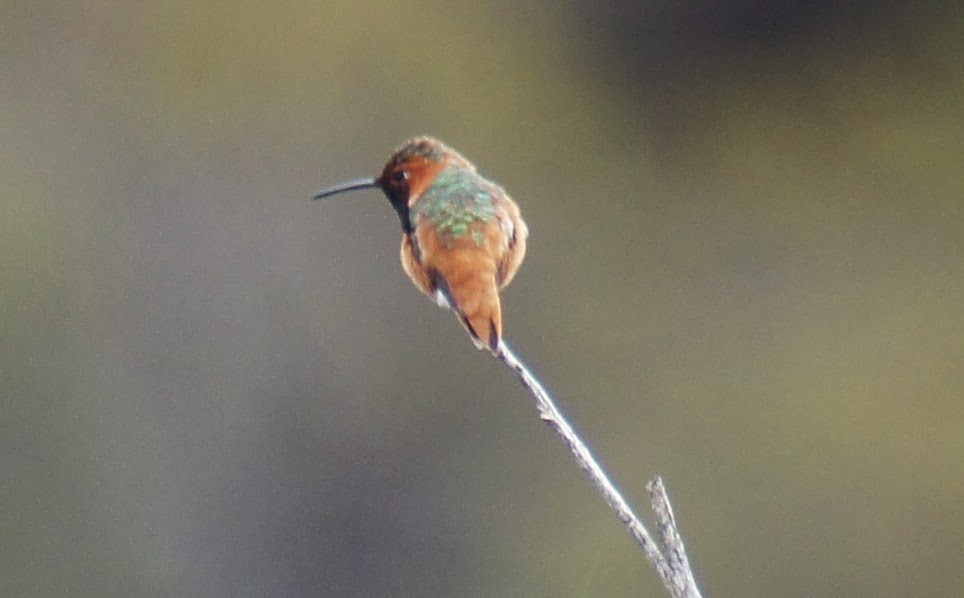
As we continued along the trails looking for the Gnatcatcher, Dominic then spied my third lifer of the day.  I was expecting this bird further into our trip, but not here and not today.  It was an awesome way to get this lifer.  The Allen's Hummingbird!


The Allen's Hummingbird is almost identical to the Rufous Hummingbird, only every male Allen's has green on his back, like this one photographed above.  Another difference in the two species that really nails down the Allen's identification are the narrow outer tail feathers on the bird.  It is a very difficult identification, and sadly, there are some green-backed Rufous Hummingbirds.  This is less than 5 percent of the Rufous population.  So, at this time of year in California, where Allen's is resident along coastal chaparral and it's too early for migrant Rufous Hummingbirds, our identification is lock down safe!


As we enjoyed the Allen's Hummingbird and searched for the California Gnatcatcher for nearly two hours without success, we decided to move on.  Shy Wrentits were singing everywhere and were mostly out of sight, but several California Thrashers were singing out in the open, and they weren't so shy..


We then headed to Mission Trails Regional Park, south of San Elijo Lagoon and east of San Diego.  This location is known to be a productive one for the California Gnatcatcher.  When we got to Mission Trails Regional Park, we looked things over on a map and Dominic had received information from birder Diane Touret for a small location that she had found to be very productive for the California Gnatcatcher.  This was only a fourth-of-a-mile down the street from the visitor center, and we gave it a shot.  Diane had given us many awesome directions and tips for our trip prior to this excursion for the Gnatcatcher, and her streak of great advice continued.  We weren't even walking for a minute until we heard a California Gnatcatcher calling by the side of the trail!  The bird came into view very quickly, and we got to enjoy it up close.  It was my fourth lifer of the day, and it was a great thrill to land it after striking out on it during a two hour search at our previous birding location.  Gnatcatcha yo!


The California Gnatcatcher is endangered due to it's habitat loss in an expanding sea of invading people in California.  It's habitat is crucial for it's survival, which is coastal chaparral and oak habitat.


We then hiked a mile long loop trail at the Mission Trails Regional Park.  This park was very nice, but we were there rather late in the day for good avian activity and we had other places that we needed to bird.


This lone Golden-crowned Sparrow made the quietness a little more interesting.  Surprisingly, this was only the second Golden-crowned Sparrow that we had during our trip.


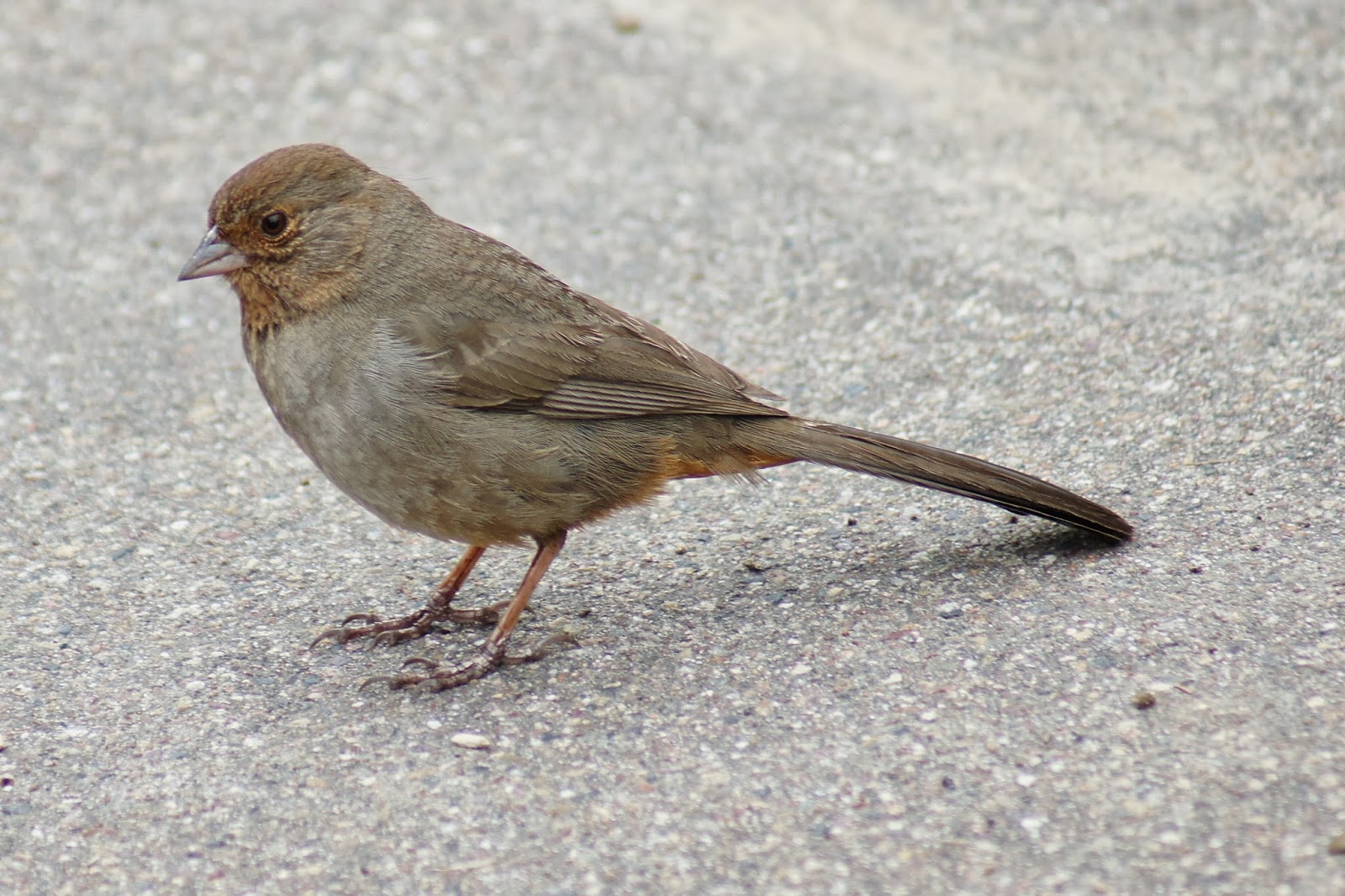
As we were eating our lunch after the short hike in the Mission Trails Park parking lot, this California Towhee also wanted something to eat..


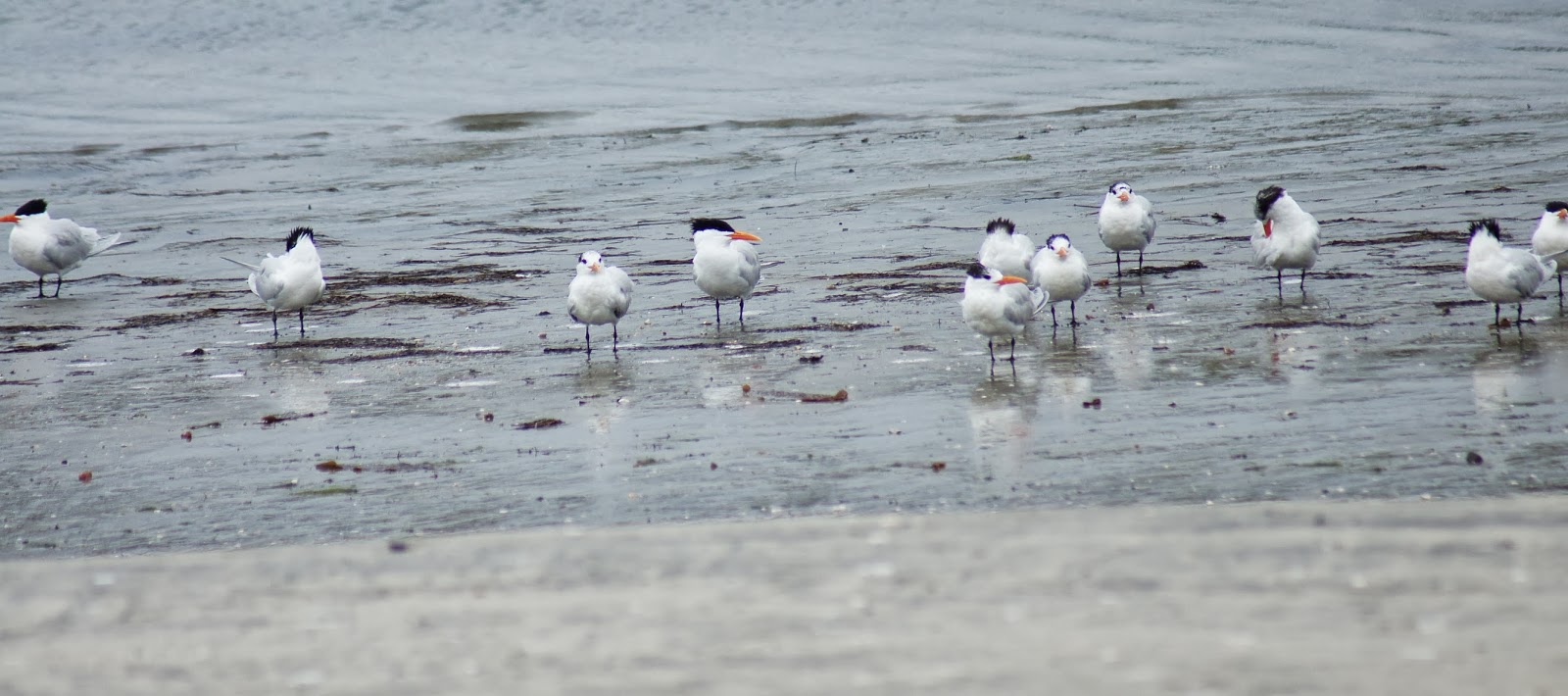
From Mission Trails Regional Park, we then headed back west into San Diego in pursuit of more great birds.  Our first target was the Black Skimmer, which Paul Lehman told us could be found in certain places of Mission Bay.  The Black Skimmer was another potential life bird for me, and I really wanted to see this odd but awesome bird and add it to my life list.  At first, Dominic and I thought finding the Skimmer flock would be easy, but we had to put in a huge effort in order to see them.  However, there were many good birds found throughout Mission Bay in San Diego, and it made the search more enjoyable.  Now, Mission Bay is huge, and it really has an east side and a west side, both of which have extensive waters and beaches.  We decided to cover the east side first.  On one of the beaches that we first pulled up to, I quickly spied a resting flock of Royal Terns.  This was going to be my first time of really getting to study this species up close!


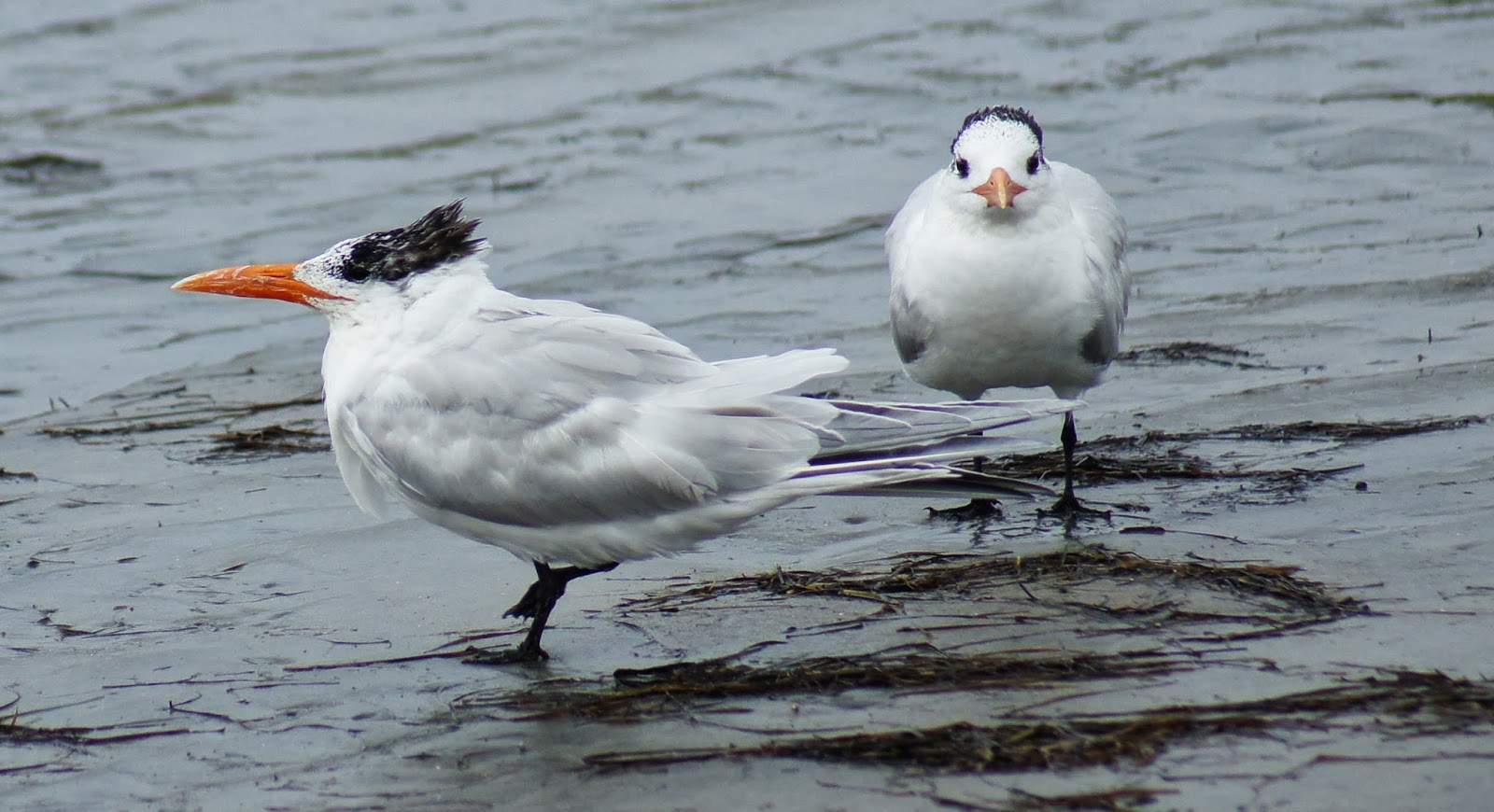
In the Royal Tern flock, there were birds that were already in breeding plumage, and then others who hadn't come into breeding plumage yet.  The Royal Tern sure is Royal, and very loud too.  As I approached the flock, they gave very loud calls and some of them would kick up in flight.  All terns are impressive to watch in flight.


It was really fun to have direct comparisons between the breeding plumaged Royal Terns and the non-breeding Royal Terns.  


Mixed in with the Royal Tern flock was another Heerman's Gull.  On this trip, if a Heerman's was around, I sure didn't pass up many photo opportunities.  I'm sure Dominic got sick of me going after every single Heerman's Gull that I saw.


Also present were many Willets, and boy, they sure do look awesome in flight!


There were also many ducks on the extensive bay, and one of them was this rather distant drake Red-breasted Merganser.  I've seen many Red-breasted Mergansers in Arizona during the winter, but all of them have been female plumaged birds.  This was my first adult male.  California, you are treating me well!


We then continued our search for the Skimmers after searching much of the east side of Mission Bay without success.  It was then on to the west side.  The birds were far more distant on the west side, and I carefully looked at each distant flock for any Skimmer-shaped bird life.  After a big scan, I saw a flock of something that looked good for a Skimmer candidate.  I scoped the birds and they really did look Skimmer shaped, and I knew that was the flock.  The problem was, the were all the way on the very west side of Mission Bay, which would require a detour for Dominic and I in midst of a very crowded city.  Have I talked about the San Diego traffic yet on these posts?  Well, it's absolutely horrible.  I love San Diego, but I would never want to live in it because of the horrible traffic.  Back to the Skimmers, this was pretty much our view of them.


As we started the detour, we knew we were looking at the flock from very far away, and very far away just isn't good enough.  We figured out that the Skimmers were on Ventura Cove, which was a mile away from us.  Dominic and I slowly made our way over to the location....


As we arrived at Ventura Cove, we pulled up to the beach area.  I was very thrilled when we came over the hill, and there was my life bird up close, the flock of the impressive Black Skimmer!


As I mentioned before, the Black Skimmer is a very bizarre and odd bird.  It is a relative of terns, and it's upper mandible is much shorter than it's lower mandible.  This gives the bird it's extra weird look, but it helps it capture it's prey that consists of fish.  It prefers coastal sheltered waters throughout it's range, especially bays like Mission Bay.  Over the next few minutes, I was able to get very close to this awesome bird!


Dominic snapped a memory shot of me with the Black Skimmer flock..


Even with all of the Black Skimmer excitement, there were other cool birds nearby on Ventura Cove also.  This also included the sea goose known as the Brant.  The Brant is a beautiful bird, and one I certainly haven't seen much of at all prior to this trip.  During this trip and especially today, I have been able to see a lot of them.  


Up next, Dominic and I headed back out to Mission Beach Park in search of another potential lifer for me in the form of another rocky shorebird...the Surfbird!  They were reported at a specific rocky jetty that was at the south side of the park.  When Dominic and I arrived, we ran into the same Justin and Matt from earlier in the day, and the four of us quickly found a few Surfbirds out in the jetty.  Although distant, we could see them well.  The Surfbirds were also joined by a few Black Turnstones and a Wandering Tattler.  I managed to get a distant picture of the Surfbird to start things out.


And then with the waves rapidly coming in at times, the Surfbirds would fly closer.  It got slightly better when the bigger waves would come into the rocky jetty.  I guess most living creatures don't like to get soaked.


We all then tried something new to get closer to the Surfbirds.  We decided to pull a Sanderling.  For those who don't know about the Sanderling, it's another shorebird that likes to feed on prey that gets washed up from the tide.  When the waves go back down from shore, the Sanderling runs out and feeds as much as it can before the waves come back in.  When the tide then comes up, the Sanderling runs up the shore as fast as it can to avoid getting wet.  It is hilarious to watch, especially when there are a lot of Sanderlings in one flock.  We decided to do that in order to get closer to the Surfbirds.  When the waves went down, we would run out to take pictures of the Surfbird, and when the would come back in, we would run back out. 


This resulted in better views of my life bird.  I also reached a nice number for my life list with this bird, number 450!  Every 50 is one to celebrate in my opinion as the life list gets higher, and this bird was certainly a great bird to reach that number with.


Other birds along this beach included a curious American Pipit and a cooperative and up close Willet.


Following Mission Beach Park and it's Surfbirds and numerous surfers out on the water, Dominic and I were on one more mission for the day.  It was a different one than I would have expected for this trip, but it was a cool one to close out an awesome day.  We were on an eastern warbler chase, and it was a Bay-breasted Warbler that is being seen at 4510 Executive Drive in La Jolla.  This was another life bird for me, and Dominic and I quickly found the wintering eastern warbler within minutes of pulling up to the spot, which was a business area building with many large trees in front of it.  For being in non-breeding plumage, the Bay-breasted Warbler was actually a pretty good looking bird!


The Bay-breasted Warbler was my seventh lifer of the day!  Getting seven lifers in a day is a rare thing for me now, and my life bird count for the trip is now up to 18 birds!  I saw 6 the first day, 5 the second, and 7 on the third.  For a recap of today, the seven lifers were Black-vented Shearwater, Nelson's Sparrow, Allen's Hummingbird, California Gnatcatcher, Black Skimmer, Surfbird, and Bay-breasted Warbler.  It was so far our most diverse day of the trip, with nearly 90 species recorded.  We also experienced birding in many different SoCal habitats, hung out with some very famous birders, and even went on an eastern rarity chase.  What a memorable day it was.  To close out the day and to celebrate me getting my 450th bird, Dominic kindly treated me to a Swordfish dinner at a very nice restaurant north of San Diego.