Monday, May 18, 2015

Returning to Southern California With Rain and A lot of Birds

In January, birding buddy Gordon Karre and I planned and put in reservations for a May 16th pelagic birding trip out of San Diego, California.  After my pelagic trip got cancelled last year due to dangerous weather conditions to make the ocean waters formidable, I was hoping for that chance to see some of the ocean and it's fantastic birds.  An Albatross was what I was wanting to see more than anything else out on the open ocean waters.  It didn't matter what Albatross it was, I just wanted an Albatross.  Black-footed is the expected Albatross on San Diego waters, while Laysan is accidental.  This post will not include the pelagic trip, but the focal point of the trip was to go on the pelagic birding excursion.  So now I have it all in your heads of what was most important about this trip.  Seabirds and more seabirds!  As Gordon and I are both hardcore birders who get along well, we of course made it an epic trip around the pelagic outing as well.  On Wednesday, May 13th, Gordon informed me about a storm that was coming into San Diego that would bring a lot of rain in on Thursday night and throughout much of Friday.  I was ticked off.  The same thing happened last year when I birded SoCal with Dominic Sherony.  We got drenched the first 2 to 3 days of our 5 day trip.  But it didn't let us stop our birding activities, and we still had a more-than-productive trip.  The winds were too high to bear at times, which is what made the ocean waters too dangerous to venture out on.  But this time was different for Gordon and me.  I looked at the forecast, and wind wasn't a problem, and the weather was to be cleared out by Friday night, the day before our pelagic.  We arrived into San Diego on Thursday night in the rain and we were brainstorming about what to do in the rain all day Friday.  Despite the weather when traveling, we are the rain-or-shine type of birders.  Let me introduce to you all a lifer birding tactic for the both of us-umbrella birding.


Umbrella birding allows one to be hardcore and it's not all that hard.  I found myself holding my umbrella in one hand and my binoculars/camera in the other had while observing and photographing birds during this freaky Friday of May 15th, 2015.  At first Gordon and I took turns holding the umbrella while the other would photograph the birds freely.  And then we graduated into hardcore umbrella birders and we did things ourselves.  The birds we were seeking out first and foremost on the day were two life birds apiece:  California Gnatcatcher and Gull-billed Tern for Gordon and Gull-billed Tern and Yellow-crowned Night-Heron for me.  Two locations would give us these birds, which were both in San Diego:  Mission Trails Regional Park and Tijuana Slough National Wildlife Refuge.  Because California Gnatcatcher is a small songbird and is probably tougher to find later in the day, Gordon and I visited their haunts at Mission Trails Regional Park to start our day out.  We walked up the Deerfield Trail at the Park to look for the small SoCal specialties, which is where Dominic and I had our birds last year.  I felt as if I wanted to see them just as bad as Gordon did, because it was still a bird I had only seen once in my life.  As we walked up the trail, it didn't take us long to find a family group of five California Gnatcatchers.  They foraged around in dense habitat before a male eventually popped up and gave us great views, and Gordon great photo opportunities.  After we moved on, I didn't have any pictures.  And I wanted pictures.  So we went to the car, got our umbrellas, and went back as the rain started to come down hard.  We quickly found the California Gnatcatchers again and Gordon held up the umbrellas over my head while I got a few shots of this limited specialty.


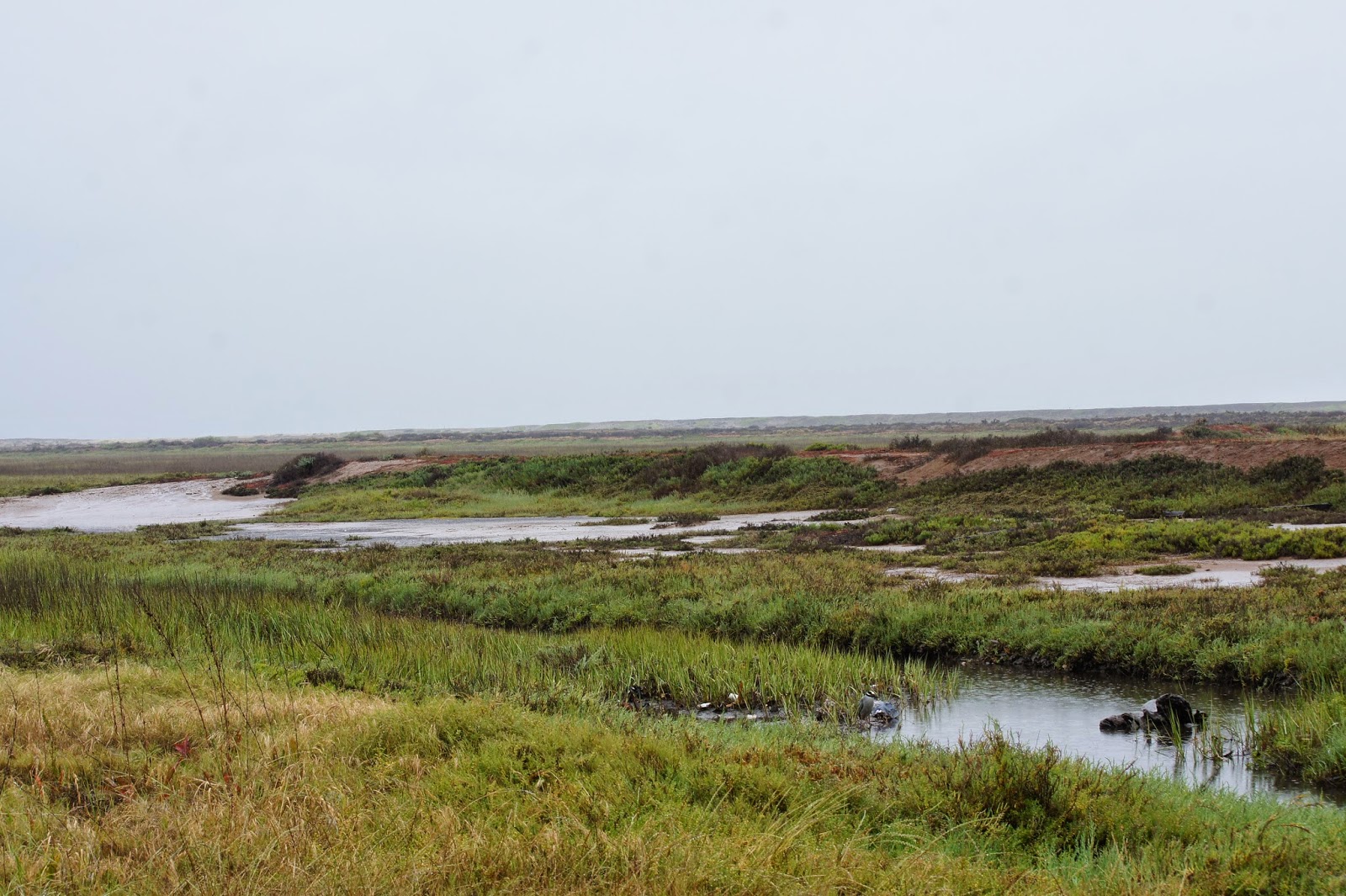
After we were satisfied with Gnatcatcher birding, we headed south to the Tijuana Slough National Wildlife Refuge.  It was here that we were both targeting our lifer Gull-billed Tern as well as my lifer Yellow-crowned Night-Heron.  This location was very neat, and it had a wide variety of birds throughout the duration that Gordon and I hiked and spent six hours at.  The Slough had a visitor center and a wide variety of trails to hike on.  The first bird that we saw was a male Northern Harrier.  There was also a nice habitat selection at this location, but one of my favorites was the Tijuana River running through the area with in midst of the saltmarsh habitat.


After visiting with a friendly lady at the Visitor's Center in the Refuge, we started looking for Yellow-crowned Night-Herons along the water where she hinted for us to look.  And it didn't take us all too long to find one!


The Yellow-crowned Night-Heron is a very cool-looking bird, and it is one I have wanted to see for quite some time.  This area of San Diego has a local breeding population, and in this area of Tijuana Slough is a such example.  Yellow-crowned Night-Herons are mainly a southeastern United States heron, but there is this population in San Diego.  Arizona even has some vagrancy records.


The Yellow-crowned Night-Heron feeds highly on crustaceans and is active mainly at night but is also active often during the day.  With this individual being active, perhaps it was because of the dark clouds and rain.  Gordon and I were able to get up close with this neat bird.  I sat back and enjoyed this lifer for close to twenty minutes, and it was also Gordon's second time ever of seeing the species.  It's almost like we reversed roles with this bird and the California Gnatcatcher.  


And as you all know be by now, I love to get in pictures with birds.  Here is my latest selfie.


After enjoying the Heron, Gordon and I continued south through the Refuge along trails that eventually took us to the mouth of the Tijuana River.  A LOT of birds were out at this productive mouth of the river, and this was the location where someone had reported eight Gull-billed Terns two weeks earlier.  We were hoping there would be at least one of them there.  At this point, the rain had started to pour, and despite having umbrellas, Gordon and I were soon drenched.  From the start of scanning the river mouth, terns were in obvious abundance.


I carefully placed my scope under my umbrella and scanned the terns on the banks of the river mouth.  It didn't take me long to find our lifer Gull-billed Terns, and I had three of them in our scope view.  Gordon and I ended up being reasonably close to the mouth of the river and we were right by a bench overlook.  There was some water and saltmarsh near us, and many terns started to come over and feed by where we were standing.  Several of the Gull-billed Terns came on over and hunted over the saltmarsh near us, giving us good looks.  The pouring rain was evident in this photo as the tern was hunting over the marshy area.


The rain made it rather challenging to fully enjoy this lifer, but we tried our best, and some reasonable shots were obtained out of it.  This tern is the whitest out of North America's tern species and it was once driven to nearly being extinct because of a high demand for their feathers to be used on women's hats.  These terns often still and eat recently hatched chicks from other birds nests and also utilize fields and marshes for hunting rather than open water.  It's main diet consists of insects but it also takes worms, frogs, and crustaceans.  


The Gull-billed Tern show was a neat thing to see, and five other terns in Royal, Caspian, Least, Forster's, and Elegant Terns really made things interesting with six different terns seen in one spot.  Here is a Forster's Tern that hunted over the water nearby us as well as a smaller group of Elegant Terns.  Many Elegant Terns flew over the area throughout the walk.


After Gordon and I headed back to the Visitor's Center we continued to get drenched by the rain.  We made one more pass by the Yellow-crowned Night-Heron who continued to hang around the same spot.  After looking over the rest of the area at the Visitor Center, we headed to a section of the Refuge that went along the coast.  At this point, we were after two endangered targets:  Snowy Plover and California Least Tern.  These two species nest in sensitive areas along the coast and the refuge has built fences around this area to preserve the two species.  As long as people don't go in the fenced area, they are allowed to walk along the outskirts of the area.  This still gives birders good chances to view these species while they are nesting, mating, and raising young.


When we got here, something awesome happened.  The rain stopped and the sun was finally shining through.


Snowy Plovers and Least Terns are both tiny in both of their own family trees.  As Gordon and I walked along the boundaries, we were on the lookout for both species.  Movement in the sand resulted in our first California Snowy Plovers.  


Because Snowy Plovers have young nearby or are about to have young, they have to constantly be on the lookout for predators.


The pictures of the Snowy Plover above is of an adult male, who has dark sides.  The picture below is of a female Snowy Plover, who doesn't have as striking of features.  Gordon found a Snowy Plover nest with eggs on it and this female eventually went over and sat on top of it.  Once she sat down, I didn't want to get any closer than to where I was.


The funnest part of the walk for me came when we started to come upon the Least Tern colonies.  Least Terns were everywhere along the stretch.  They were noisy, hanging out in pairs, fishing, males were feeding females, and they were plain awesome!


Gordon also spied a Least Tern nest.  At times females would leave the nest and go elsewhere, and a lot of times males would come in to feed the females small fish while they were sitting on the nest.


As you can all tell by now, I think the Least Tern is an awesome bird.


As we headed back to the vehicle, we walked along the River and found a Little Blue Heron.  In San Diego, Little Blue Herons are somewhat local and are present in small numbers like the Yellow-crowned Night-Heron.  This is a species I have seen once in my life prior to this day so it was interesting to cross paths with one again.


While watching along the River, two more Little Blue Herons flew in.  One was another adult like the one photographed above and the other one was a younger bird who is molting into adulthood.  


Another highlight along the shore was this Whimbrel.


After spending six hours at the Tijuana Slough National Wildlife Refuge, we headed to the headquarters where we'd kick back before the next day of our pelagic trip.  I took Mark Och's advice and had a spaghetti dinner before the big day.  I was anxious, and I was highly anticipating and hoping for a pelagic.  A pelagic that was free of seasickness and any crap that would go along with it.  After a jaunt we took at looking for Red-crowned Parrots, we called it a day for birding.  We did walk across the street to look at the boat we were going to be taking out on the pelagic, which was the highly talked up Grande.  This 85' boat seemed to be awesome, but that opinion wouldn't be completed until I rode on the boat.  After taking medications for motion sickness, the night came to an end and when I'd wake up, it would officially be pelagic time.  Hopefully Grande pelagic time....

Saturday, May 9, 2015

Good Birds in Glendale

Aside from late night owling, I have been birding very locally a few times lately for a few hours on such mornings in my hometown of Glendale/Peoria.  Birding is usually fun when birding close to home, and during the few times I have gone out lately, that has been the case.  A lot of the birding excitement has come recently from introducing several of my friends from work to the hobby of birding.  A few nights ago, I was joined by 11 people at the Salt River to search for owls.  This included Eric and Skyler Hagg who appeared in my previous post, Steve and Heather Bradford (RN's at the hospital I work at), and Skyler and Eric's family as well as Steve and Heather's family.  Tiny little kids came along too and it was quite the night.  While Elf Owls avoided us, a friendly and cooperative Western Screech-Owl did not, and it pleased the crowd of 12 observers.  I've never took charge of a group this large, and taking photos didn't cross my mind.  I sure wish I had some to go along with the night of owling.  More and more people seem to be finding birding and nature to be more interesting, and I've been fortunate and thankful to be the one to show this stuff off to these awesome people.  Another time I ran into a bird this week was an accident.  While running through town to look into obtaining a current food handlers card, I saw that Skunk Creek in Peoria was developed into a trailhead.  This area has an attractive riparian area that I have always thought would bring in good birds.  Without binoculars or a camera, I got out at Skunk Creek and checked it out.  As I was about to leave, I noticed a Great Horned Owl sitting in a cottonwood tree, and it was then followed by a singing Northern Waterthrush seconds later!  I ran down to the creek and used playback on the Northern Waterthrush, and out it came.  It was probably one of the better birds I have found on "accident" while being on the run.  This post will cover what I have seen lately at my close-to-home Glendale Recharge Ponds, as well as another daytime owl run that I took with my buddy Eric Hagg.


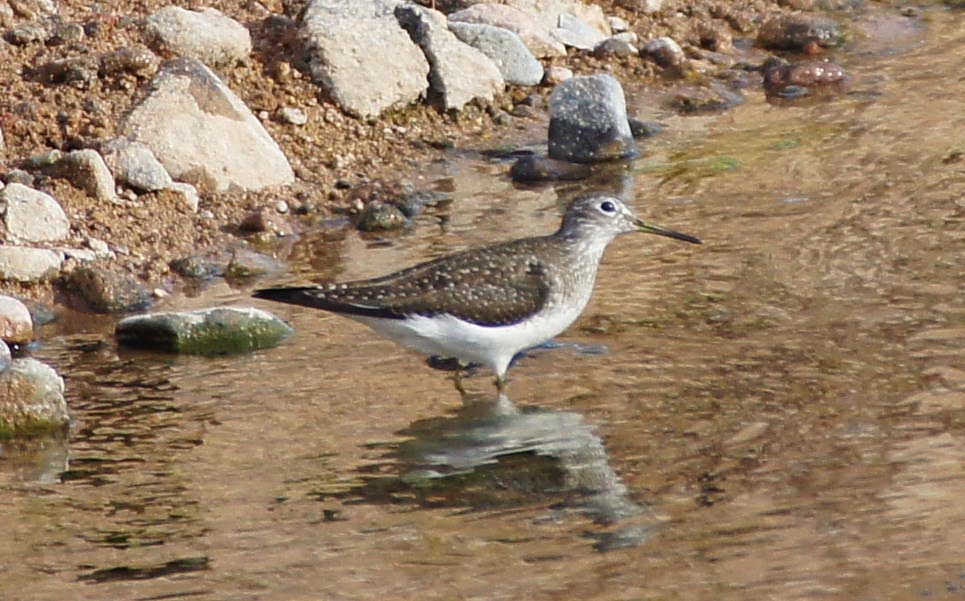
The Glendale Recharge Ponds is a chill place for birds and birders.  It's a fun place for me to meet up with people and enjoy a lot of birds with as minimum of time as possible.  Because I can be at Glendale in 15-20 minutes, I have had a list of 200 species at the ponds for quite some time.  During the last few days, I've added two more, a female Wood Duck and a fly-over male Broad-tailed Hummingbird that Sean Fitzgerald and I heard.  So my home birding location, the Glendale Recharge Ponds, now has a list that stands at 202.  Seeing shorebirds, gulls, terns, and more, at this time of year make Glendale a fun stop!  This Solitary Sandpiper is one such example, which was located by it's loud two-tone call note.


One of the draws here lately has been a few Black-bellied Plovers that have showed up at the pond.  1-2 of them died, and the other two stuck around together for a few days.  One of them was a bright male while the other was more monotone.  The monotone has been around still to this very hour, I think it may call Glendale it's home for a while longer.  Here is Mr. Brightside with a Western and Least Sandpipers, cool looking bird huh?


Mr. Brightside is gone, but here is the cool but more monotone individual, who just cant seem to migrate still.  Hopefully it'll stick around longer.  I was even thinking more in the terms of...forever.


The Black-bellied Plover is a species that I haven't seen much of prior to these individuals showing up.  I only had 3-4 observations for my life previously, so seeing this bright male was quite the highlight for me!


Another cool shorebird that is a little more common than the Black-bellied Plover that shows up at the Glendale Recharge Ponds is the Willet.  It may seem plain, but if you see this bird take flight, look at it's wing pattern.  Then it's not so plain after all...


When I was birding with my buddy Mark Ochs, we stumbled upon a Marbled Godwit.  I think the Marbled Godwit, or just any Godwit in general, lies among my favorites in the shorebird department.  This Marbled Godwit was feasting with Black-necked Stilts.


A bonus surprise at the Glendale Recharge Ponds has been a Great Horned Owl nest nearby, which plenty of birders have been able to enjoy.


American Avocets have been looking nice.


The small Semipalmated Plover is also another one to keep our eyes out for at this time of year.  Mark Ochs and I counted 8 of them in one small area.


And here's another Solitary Sandpiper.  Mark and I found it in the canal which lines the eastern side of the Glendale Recharge Ponds.


As I mentioned earlier, my buddy Eric joined me at the Glendale Recharge Ponds after the big owling excursion.  After showing Eric his first ever selection of waterbirds, I got to show him his first ever Bald Eagle flying over the Glendale Recharge Ponds and seemingly scaring up every bird.  Eric didn't even think it was real at first.  The sight of the Bald Eagle still amazes me today, and it's crazy to see one in the middle of a big city.


Around showing Eric a variety of different waterfowl, shorebirds, and more waterbirds, we focused a lot of the expedition of looking for owls.  I showed him the young Great Horned Owls near the Glendale Recharge Ponds, and they cooperatively sat right out in the open for us.


It was Eric's third owl in just a week's worth of time, and we decided to head a little further south to attempt at seeing Barn Owl and Burrowing Owl.  We decided to try and look for Barn Owls first under a location I have known about for years.  And that location lies under a large bridge in the southwest area of Phoenix.  I've observed Barn Owls under this bridge many times, which they use during a small duration of the year for nesting and raising broods.  As Eric and I started to search the the underneath's of the bridge, I looked on one of the bridge ledges and spied what we were hoping for.  Staring back at us was a brood of four fledgling Barn Owls.


As we were enjoying the young Barn Owls, we eventually noticed that the mother was looking over her young and had an overview of her four fledglings.  The adult female Barn Owl has a buffy breast while the male has a plain white breast.  Despite looking, we failed to find the male, who is usually pretty shy.


After succeeding at finding five Barn Owls, we searched by vehicle for our final owl of the day by driving along agricultural fields and canals in the area.  An awesome thing happened when Eric spied his fifth owl in only a week after never seeing an owl before in his life.  He spied a Burrowing Owl perched on a stump by the road and beat me to finding one.  I'd say Eric is on his way to becoming a good birder!


For the last several years at the Glendale Recharge Ponds, I have seemed to miss the Least Terns that have showed up there after seeing them during the calendar years of 2009 through 2011.  When Eric and I got to the Ponds before our owl search, Eric spied a Least Tern flying southwest that we had brief looks at and never got to see again.  During the next morning, I joined Sean Fitzgerald for a few hours at the Ponds and we were hoping for some interesting birds.  The morning became interesting when we heard a male Broad-tailed Hummingbird trilling overhead.  We then saw from a distance that there were two Forster's Terns over Basin 3, and then Sean spied a single Least Tern.  Once we got closer to the terns, we met up with Moe Bertrand and the three of us enjoyed the two terns species, as well as the continuing Black-bellied Plover.  At first, we had a Forster's Tern drop by, up close and awesome.


The Forster's Tern is rather small/medium sized, and the Least Tern is so small it makes the Forster's Tern look like a giant.


With it's small size, the Least Tern is easily overlooked at times.


Sean, Moe, and I figured out where the Least Tern was feeding at and we spent the following hour waiting for and then watching it catch small fish out of the water.  The Least Tern is the smallest tern in North America, so it is properly named!  I felt very fortunate to see and photograph this bird up close like we did yesterday.


Thanks to my many friends who I have birded with lately!