Hi everyone,
I spent January 17th and 19th birding around Phoenix with Geoff Butcher from Houston, Texas. We had many good highlights during the two birding days that are worth mentioning.
On the 17th, we visited the Arrowhead Lakes Area, Sun City Grand, Encanto Park, and South Mountain Park, and the 19th we also visited South Mountain Park, the Thrasher Spot, and the Arlington/Paloverde Area.
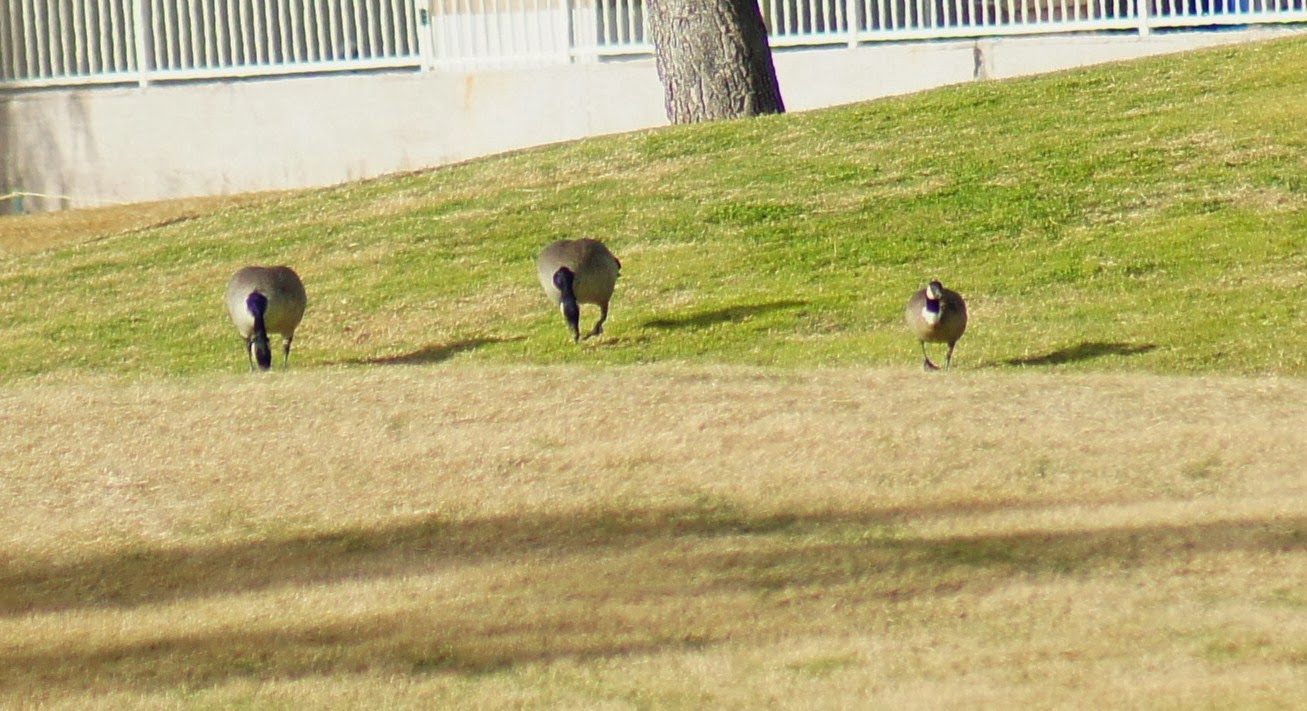
Our first stop was in the Arrowhead Lakes area to look for the Eurasian Wigeon along Arrowhead Loop Road and Quail Avenue in the stream by the school. We arrived there very early and the Wigeon wasn't there at 7:30 A.M. A few American Wigeon flew in, and after ten minutes of waiting, the Eurasian had still not come in and we were thinking he was going to come in very soon. We decided to make a quick stop at Arrowhead Lake at Thunderbird Viewing Blinds Park (where the Lesser Black-backed Gull was seen) as well as Thunderbird Conservation Park and check those locations. Arrowhead Lake was deprived of the usual large numbers of Common Mergansers (who probably hadn't flown in yet either), but did have a flock of Canada Geese. Among the Canada Geese was a CACKLING GOOSE. The Cackling Goose was interesting and had a striking white "neckband". This feature supports Aleutian Cackling Goose strongly, but does occur infrequently in other Cackling Goose subspecies. The bird was photographed and pictures have been sent to AZFO. After spending a quick time at these two parks, we went back down Arrowhead Loop Road and as we were pulling up to the spot we could tell there were more Wigeon that had flown in. This time, the EURASIAN WIGEON was feeding practically on the sidewalk. We spent some time enjoying the bird.
Cackling Goose with Canada Geese
Eurasian Wigeon
After the Wigeon, we went over to Sun City Grand to search for some of the goodies at Desert Springs Golf Course, and we had two main targets to find at this location. One was the continuing GOLDEN-CROWNED SPARROW, who we found quickly among the flock of WHITE-CROWNED SPARROWS. It provided excellent views and field study. After the Sparrow, we headed east along the path bordering the golf course ponds and found two LEWIS'S WOODPECKERS. I had known of there being at least one Lewis's Woodpecker at this location, and it was nice to find out that there are a pair of them. They foraged in palm trees on the north side of the golf course, and also favored a section of palm trees at the eastern-most side of the walking path, on the south side of the path. The woodpecker was Geoff's 500th ABA bird, a very awesome bird to see for that milestone! The female WOOD DUCK also continued in the pond. A few HARRIS'S HAWKS were also present.
Lewis's Woodpecker
Wood Duck
White-crowned Sparrow
Our next stop was at Encanto Park to search for ROSY-FACED LOVEBIRDS. It didn't take long to find them, and they ended up being very cooperative in a quick visit.
Rosy-faced Lovebirds
The "coolest" Rock Pigeon of all time
The final stop for the day on the 17th was at South Mountain Park. We saw a handful of desert birds, with the best being a pair of GILDED FLICKERS close to the road.
The symbolistic Cactus Wren photo
On January 19th, Geoff and I met very early in the morning and headed out in the dark to look for WESTERN SCREECH-OWLS at South Mountain Park. After a few stops, we heard a few Western Screech-Owls calling back-and-fourth. We headed in their direction and were rewarded with incredible and up close looks of the pair sitting together in a tree. It was a great way to start off the morning! GREAT HORNED OWLS were calling from many locations and both BENDIRE'S and CURVE-BILLED THRASHERS were singing away before it got light out.
Western Screech-Owls
After the early morning pre-dawn South Mountain Park visit, we headed out west to the Thrasher Spot, primarily in search of Le Conte's Thrasher and Bell's Sparrow. Luck hit us very quickly as we heard several Sage Sparrow species calling in the brush. Geoff spied the first one at the top of a bush, and that first bird turned out to be a nice BELL'S SPARROW! Despite covering a good distance throughout the Thrasher Spot in two hours, we didn't find anymore Bell's Sparrows among the numerous SAGEBRUSH SPARROWS. Two LE CONTE'S THRASHERS gave us great views quickly into our search for them and we also had a SAGE THRASHER, a calling CRISSAL THRASHER, and a few distant singing BENDIRE'S THRASHERS. A PRAIRIE FALCON also made a low swoop over the location, and gave the birds quite the scare.
Le Conte's Thrasher
We then spent a good amount of time birding in the Arlington/Paloverde/Old US 80 area. In this area, highlights we encountered included WHITE-FACED IBIS, FERRUGINOUS HAWK, SANDHILL CRANES, LONG-BILLED CURLEWS, GREATER ROADRUNNER, BURROWING OWL, BELTED KINGFISHER, plenty of AMERICAN KESTRELS and LOGGERHEAD SHRIKES, a pair of CRISSAL THRASHERS, and a large flock of stunning YELLOW-HEADED BLACKBIRDS.
The army of Yellow-heads!
Sandhill Cranes
Ferruginous Hawk
A stop at Gillespie Dam produced ten or so AMERICAN WHITE PELICANS. After the Dam, we headed over to the Lower River Road Ponds. Highlights in this area included 2 CANVASBACKS, OSPREY, a pair of BALD EAGLES, and YELLOW-HEADED BLACKBIRDS.
American White Pelican
The Snowy and Great-what a size contrast!

Our final stop of the day included another stop at South Mountain Park, this time in pursuit of a wintering Gray Vireo. With great help and directions from Magill Weber, we walked about halfway down the Telegraph Pass Trail. When we got to the immediate location of where the Vireo was being seen, we waited for over an hour and then finally lucked out with the GRAY VIREO, and it was a great way to close out the day. Thank you Magill! For those interested in the Vireo, hike down the rather steep Telegraph Pass Trail for probably a half mile. A wash is on the immediate west side of the trail. We saw the Gray Vireo in the wash close to where a little side trail veers of from the main trail (the side trail heads east). Along this side trail are a few signs saying "area closed behind this sign" and there is also a wooden "fence" running along the side trail. Adjacent to this immediate area, keep an eye and ear out for the Vireo. It was a great few days to be out birding!
Gray Vireo
A mature Elephant Tree. Most of them are 5 feet tall or less. These trees grow fruit that attract wintering Gray Vireos to desert hillsides and washes. They are to thank for wintering Gray Vireos in Arizona deserts!
Good Birding,
Tommy DeBardeleben (Glendale, Arizona)