Friday, September 30, 2011

A Shorebird Parade

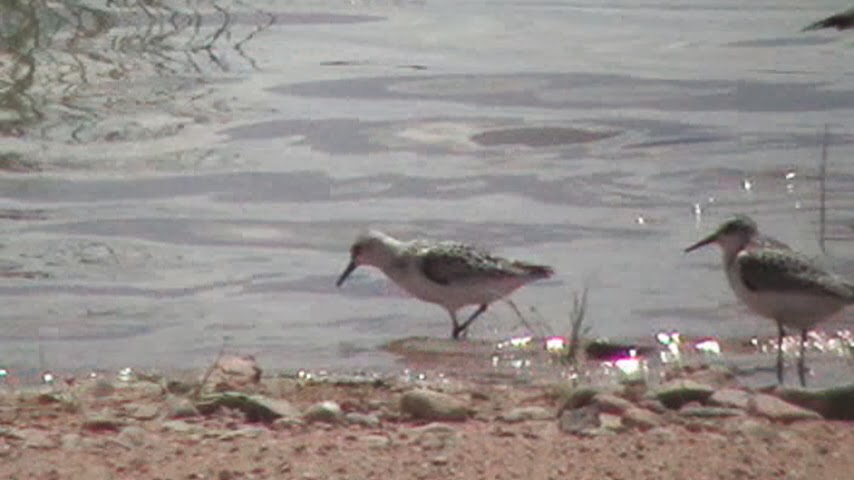
Over the last few years, the Glendale Recharge Ponds have been great for shorebirds.  And luckily, I live very close by to them, so I can bird them whenever I want to.  Over the years, some of the shorebirds I have seen have included the following:


Baird's Sandpiper

Black-bellied Plover


Dunlin


Marbled Godwit


Pectoral Sandpiper


Red-necked Phalarope


Sanderling


Short-billed Dowitcher


Semipalmated Sandpiper


Snowy Plover


Solitary Sandpiper


Wilson's Phalarope


Wilson's Snipe


Willet


Wilson's Snipe


Sanderling


Long-billed Curlew w/ Black-necked Stilts


Lesser Yellowlegs


Marbled Godwit


non-breeding Red-necked Phalarope


Red Knot


breeding Red-necked Phalarope


Friday, August 12, 2011

Five Stripes of Joy and a Heartbreaking Aztec

Hello everyone,

Jim Kopitzke and I explored the areas of Montosa and Miller Canyons today 
on August 12th, 2011 to see some of southeastern Arizona's amazing birds 
and hopefully stake out some of the rarities.

We headed in the direction of Montosa Canyon first.  Along the way, we 
could hear RUFOUS-WINGED and CASSIN'S SPARROWS singing.  

As we arrived in Montosa Canyon by the stream crossing, FIVE-STRIPED 
SPARROW was the first bird we heard singing as we got out of the truck.  
There were a lot of people looking at it, as we quickly got on it 
ourselves.  This bird was certainly the crowd pleaser, who flew around to 
different perches in the entire two hours we birded in the canyon.  It was 
a lifer for me and the second sighting Jim has ever had of this species.  
A lifer doesn't get much more cooperative than this bird was for me, which 
was the main highlight of the day!  Several hundred yards west of the 
first sparrow, we were able to locate a second Five-striped on the south 
side of the road.  Besides the Five-striped, male VARIED BUNTINGS also put 
on a great show, a species I haven't seen often either, especially 
perched.  Other highlights included PACIFIC-SLOPE FLYCATCHER, WARBLING 
VIREO, YELLOW WARBLER, three male WESTERN TANAGERS (in one mesquite), and 
a SCOTT'S ORIOLE singing on a hillside.

Five-striped Sparrow


Next, we went to the upper part of Madera Canyon in search of the Aztec 
Thrush.  Jim has seen Aztec Thrush once before, Tommy, zero.  I have a 
heartbreaking story to tell, you'll all feel sorry for me after this one.  
Jim and I arrived at the Aztec Thrush spot to find out it hadn't been seen 
yesterday (thursday), or prior to the time we arrived on site at about 
10:30 A.M. today.  Nothing was coming into the berry bushes and the spot 
felt dead.  We waited for about two hours until we decided to head back at 
12:30.  RIGHT at 12:30.  The thrush hadn't been sighted in at least a day 
and a half, so we figured it had probably located another delicious cherry 
plant and made it's home there.  The other parts of Madera had awesome 
birds we didn't want to miss either, so we left.  Turns out (see previous 
report) that the thrush was located at 12:35 until 2.  We missed it by 
five minutes.  Enough said, I'm a sucky southeastern Arizona rarity chaser.

On a very positive note, the birds were amazing that we abandoned the 
thrush for.  At Madera Kubo, we had a nice hummingbird show with seven 
different species in a short amount of time.  The star was the continuing 
BERYLLINE HUMMINGBIRD, who came into the feeders very often.  I couldn't 
see enough of that bird.  A single VIOLET-CROWNED HUMMINGBIRD was also 
present.  Several MAGNIFICENT HUMMINGBIRDS were also present as well as 
single BLUE-THROATED HUMMINGBIRD.  Numerous BROAD-BILLED HUMMINGBIRDS were 
also present, as well as a few BLACK-CHINNED HUMMINGBIRDS and a female 
RUFOUS HUMMINGBIRD.  Before we got to the hummingbird spot, a BAND-TAILED 
PIGEON was a nice surprise.  A juvenile PAINTED REDSTART put on a good 
show and seemed like it was starting to learn how to sing.  The last bird 
here at Kubo observed was a great look at a SULPHUR-BELLIED FLYCATCHER in 
a sycamore.  

Berylline Hummingbird


Our last stop of the day was the Proctor Road area, which was birdy even 
at the hotter time of the day.  VARIED BUNTINGS put on a nice show here, 
as one was hoping on the ground literally a few feet away from Jim.  I 
then spied the YELLOW-BILLED CUCKOO lurking in a mesquite that has been 
present in the area for quite some time.  Another cool highlight was a 
HUTTON'S VIREO singing in an oak above us.  The surrounding area was 
filled with the songs of CASSIN'S and BOTTERI'S SPARROWS, which seemed to 
be everywhere.

It was a great day to be in the amazing southeastern Arizona, we recorded 
62 species during all of our stops.  Special thanks to the Five-striped 
Sparrows!  

Monday, August 1, 2011

White Mountain Goodies

The White Mountains are an awesome place to bird.  Here are a few pictures of a recent trip!


Clark's Nutcracker

Gray Jay


Purple Martin


Dusky Grouse


Common Yellowthroat

Friday, July 15, 2011

Bushnell Tanks and Mount Ord

Photographic Highlight....a nice male Indigo Bunting!


Hi everyone,

Today on July 15th, 2011, I ventured out to the northeastern part of 
Maricopa County to explore after some of the best areas had been closed 
off because of fire dangers.  I found out they opened the closed areas on 
Wednesday, and I was ready to be back in the area birding again.  More 
than just ready, I was pumped.  I made my inaugural visit to the Bushnell 
Tanks area followed by Mount Ord in my expedition.  

For a first time visit to Bushnell Tanks, I was very impressed with the 
area.  It's across the Highway from Sunflower or better called, the Old 
Beeline Highway.  It's very similiar in ways to Sunflower, only with very 
few willows and cottonwoods, and some mesquite.  Great sycamore habitat is 
the primary habitat here along Sycamore Creek (including old growth 
sycamores).  I enjoyed 40 different species here today, and I certainly 
look forward to birding this spot in the future in what has a lot of 
potential.  Raptor wise this morning, it was similiar to a Sunflower 
morning.  I had two COMMON BLACK-HAWKS here.  One was calling in the 
sycamores while the other was flying around on the hillsides.  ZONE-TAILED 
HAWKS were easily seen, as I found two adult birds as well as a nice and 
close look at a juvenile.  I heard three different COSTA'S HUMMINGBIRDS, 
which this area in general is usually very good for this species.  
Flycatcher wise, BROWN-CRESTED FLYCATCHERS were everywhere, as well as 
CASSIN'S KINGBIRDS with also a single WESTERN KINGBIRD.  Juniper hillsides 
surround this entire area, which is great habitat for GRAY VIREO, in which 
two were singing this morning.  A single BLUE-GRAY GNATCATCHER was also 
present.  Another highlight I had were three INDIGO BUNTINGS singing.  I 
got good looks at two of them, both pure males.  I then found a LAZULI X 
INDIGO BUNTING hybrid, which sang a very odd song.  I headed to Mount Ord 
after birding the Tanks for two hours, forty minutes starting at 5:45 A.M.

I arrived at Mount Ord's side road, 1688 at 8:45 A.M., which is the road 
that runs south into Maricopa County, when one first hits the pines when 
coming up the mountain dirt road.  A CASSIN'S KINGBIRD perched on a fence 
on my way up.  I birded Mount Ord for over four hours all along Road 1688 
as well as the summit area on the Maricopa County side.  Numbers were way 
down today, as a lot of Mount Ord's usual residents were rather quiet.  
Some were still active though to entertain, and maybe I just got here a 
little too late for some of the species.  On Road 1688, I had two ZONE-
TAILED HAWKS soaring overhead throughout the hike.  Woodpeckers today 
consisted of two HAIRY and two ACORN WOODPECKERS, as well as a 
NORTHERN "RED-SHAFTED" FLICKER.  I usually have more Hairys.  ASH-THROATED 
FLYCATCHERS were everywhere, as at the entrance to 1688, I had a family of 
four.  Four WESTERN WOOD-PEWEES were also along the stretch.  In the same 
area, a curious JUNIPER TITMOUSE made a close appearance.  I had more 
WHITE-BREASTED NUTHATCHES this trip, and a heard-only of only one RED-
BREASTED NUTHATCH (I had none on my June trip).  Several PHAINOPEPLAS were 
present along the road, which I never had them this high up on Ord until 
last month.  The usual Warblers were very scarce today, especially on Road 
1688, only singles of GRACE'S, VIRGINIA'S, and BLACK-THROATED GRAY-
WARBLERS, and two PAINTED REDSTARTS.  Four BLACK-CHINNED SPARROWS were 
present (two singing), as well as at least three singing WESTERN 
TANAGERS.  As I moved to the summit of Mount Ord, I still managed to find 
some of the scarce summer species in Maricopa County.  CHIPPING SPARROWS 
were present, as I had a good amount of probably at least ten, I observed 
adult and juvenile birds.  A single HOUSE WREN was present as well as a 
single male WESTERN BLUEBIRD.  VIOLET-GREEN SWALLOWS flew in the sky 
overhead, and there were great numbers of BLACK-THROATED GRAY WARBLERS up 
here in the early afternoon (compared to only one on 1688).  A very 
unusual sighting for me up here came when I found two RUFOUS-CROWNED 
SPARROWS, an adult with a juvenile bird.  They were near the summit at the 
7000 foot range, in the green understory in midst of the pine and oaks.  
I've never had them this high, and it seems like the completely wrong 
place for them.  I also heard an individual singing near the summit in 
appropriate habitat, where the forests end and the hillside is rocky and 
open.  Perhaps the two forest dwelling birds are sick of the summer.  I 
recorded 35 species at Mount Ord, 63 for the day.


Thursday, June 30, 2011

My first look at a Western Screech-Owl

June 30th, 2011:  Phoenix Mountains Preserve-An expedition in pursuit of my first ever look at a Western Screech

Hey everyone,

I went with my friend, Norman Dong (who is avidly into herps), this
afternoon to explore a very shady area in the Phoenix Mountains close to a
parking lot.  Out of a quick hike I got my first ever look at a WESTERN
SCREECH-OWL!  I have heard Western Screech-Owls plenty of times, but this
afternoon I finally tore that wall down with a perched owl right in front
of me.  We were able to get about six feet away from the bird without it
spooking, which was perched up on rocks in a small and shady cave area.
We watched the bird thirty minutes or so and walked away from the Screech-
Owl still perched in the same spot.  My first look at this bird was what
I've always wanted, an open view without any branches in the way.  I'd
call the owl an "official lifer" now!  I guess we all have overdue birds,
I have my share.

Another standout highlight in the cave was another lifer for me, only from
the reptile department, a TIGER RATTLESNAKE.  It was coiled up peacefully
just below the owl.  We didn't want to spook the owl, so we enjoyed the
snake at a further distance at ten feet away.  Birding/herping in a shady
cave makes any summer day bearable!


Saturday, January 22, 2011

My first two lifers of 2011

January 22nd, 2011-AZ: Salt River Area-BLACK LEGGED KITTIWAKE, GREATER SCAUP, HORNED GREBE, TUNDRA SWAN
Hi everyone,

Today I headed out to the Salt River Area stopping along several sites
along the Bush Highway starting at Saguaro Lake/Butcher Jones Recreation
Area, and then I continued at the Goldfield and Granite Reef Recreation
Areas.

After reading Troy's report yesterday of the Kittiwake, I decided to start
my day off at the lake.  At Butcher Jones beach, I found a female GREATER
SCAUP in the mix of a Lesser Scaup flock to start the day.  I then hiked
on the trail that goes east of the Butcher Jones area along the east side
of Saguaro Lake, which can be reached from Butcher Jones right by the
southeast part of the parking lot.  This trail is amazing, and I enjoyed
the hike as much as the birds.  After two miles or so of hiking on this
trail, I reached Burro Cove, where the BLACK-LEGGED KITTIWAKE continued,
and was viewable from this lookout.  I had rather distant but really good
views where I could clearly see the field marks of the young Kittiwake. 
It flew around often, but most of the time, it sat on the water.  Once you
reach the sign that points in two directions, saying, "Burro Cove-1/4th of
a mile, and Shoreline Access-1/4 of a mile", go to any of these spots and
scan. The Kittiwake was viewable from both of these lookouts.  Before you
reach this sign, there is one other sign that points to Burro Cove
probably 1/2 mile before this sign.  Follow any signs that point to Burro
Cove.  I would highly recommend a scope on this hike to view the waters. 
It took me 40 minutes to an hour to reach this location, and the hike is
moderate.  As I was watching the Kittiwake, I noticed a HORNED GREBE
swimming and diving below the lookout.  A CLARK'S GREBE was in the mix of
WESTERN GREBES from this viewpoint, and there were plenty of EARED and
PIED-BILLED GREBES to give me a five Grebe day.  Other notables on the
hike included an adult BALD EAGLE perched on a cliff, a SORA, and a TREE
SWALLOW.  I ran into Grant and Tyler Loomis and a couple (I wasn't able to
get their names) on my way down the trail, hopefully they had success! 
Thanks to Troy for the awesome find!

Black-legged Kittiwake


I then went to the Goldfield Site next, where I really enjoyed seeing my 
first two HARRIS'S HAWKS of the year.   

My stop at Granite Reef gave me great looks at the TUNDRA SWAN that had been 
present.  There has been some confusion about what Swan species this 
really is.  There are confusing things about it.  Luckily tonight, I got 
good video of this bird, which I will post shortly for opinion.  The Swan 
also vocalized some, which I got on tape, maybe that'll be useful.  The 
voice was more of a honking goose like sound, which would probably support 
Tundra more.  It was present for about an hour before it flew off to the 
northeast up the river, probably to the general area Jay first saw it 
between Granite Reef and Phon D. Sutton Recreation Sites.  

Tundra Swan


It was a great day today, 73 species total for the three areas.  

Good Birding,

Tommy DeBardeleben (Glendale, Arizona)