As some of you have known, I decided to start my own birding guiding business in the fall of 2013. In 2013, things for my business kicked off pretty fast, but due to a mad start of normal birding in 2013, I put the guiding aside until 2014 after leading several tours. I did this so I could finish 2013 up strong, and explore the various and wonderful state of Arizona as I was wanting to, which resulted in me logging a personal high 377 bird species in Arizona for the year. Birding wise for 2014, I said to myself, "It's going to mainly be about the guiding". And in 2014 so far, with almost two months of the year completed, that has been the case. I've spent one entire day in the field this year so far for fun (which is weird for me, and I do miss the fun), and also have driven to a few places before working the full time hospital food service job night shift for a few hours. Other than that, all of my birding has come from guiding. It has been very fun, and my field trips often visit the same locations and areas. Some of my clients have specific targets they want to see, others just want to go birding and are happy with the result, and some just want to see a combination of desert and western birds. Out of the three examples I gave, I love the three species of clients. I love this part time job and business I have started, and all of my field trips have been very pleasant so far. We commonly go to the Thrasher Spot more than any other place, and a handful of other locations southwest of Phoenix. I have a high success rate so far when we have been target birding, 14 out of 15, which is 93.3 percent. That is a number that probably won't stay too high, as target birding may increase. The birds have been very generous so far, but they aren't so generous all the time. There is one bird I could see being a big problem for me and it is a huge concern for my success percentage....the Crissal Thrasher. I've always called the Crissal Thrasher "A butt of a bird". And it's true, they are always the one who are hard to show off, you can't really show them off at all. Because they are a southwestern Thrasher and they are pretty cool, they are going to be a very popular requested bird on my tours. My participants don't quite know much about this pest though. Just look at the Crissal Thrasher, it just looks mean and is one heck of a jerk. A Crissal Thrasher doesn't have any sort of compassion for birders, and it's fierce looking face shows it as it pops off into it's dense habitat right as everyone raises their cameras and binoculars. They give this joyful sounding "cherry-cherry" call note, but that sound is certainly misleading and should really be much more harsh. Recently, one of my clients listed that as a bird she wanted to see. I thought, "oh no, it's gonna be a butt of a bird, as usual". Life as a guide! But the other birds on the list weren't so anal. As a guide, I have the fun opportunity of arranging and organizing tours for my clients, and making up trip itineraries. Some of them require a lot of thought if the client has a huge target list, and others are figured out instantly. One of my favorite target birding exploits came when I took a guy around Phoenix over the course of two days and we went 9 for 9 for his target list. The birds really helped out then. Luckily, he already had a Crissal Thrasher. And it's also fun when people come from the east, and don't really care what they see, because it's all new to them. I could ramble on and on more about my guiding service and experiences so far, but I'll get to the post now, which will kinda show what it's like in my shoes for one day as a guide. Oh, and before I forget, my business is called Tommy's Birding Expeditions. Here is an online and visual business card.
I recently had a kind lady named Linda from Texas contact me, and she went on one of my tours with me, and we had a lot of fun. Linda was a fun client, and was one who had a suggested list of birds she wanted to see, but she also wanted to go to any particular location and was satisfied with the result either way. For my tours, I have two options, a half day option (which covers up to 5 hours), and a full day option (which is 8 hours or more). This time was a half day tour before I had to be at my hospital job at 2:30 P.M., and I attempted to show Linda a variety of desert and western birds that she has never seen before. For the visiting birder who has never visited the southwest, this would be such a fun trip! Sometimes I wish I could be in the shoes of the participants, because seeing new birds is FUN! Linda wanted to see the birds of the southwest, which included the thrashers and other desert birds. Crissal Thrasher was one of them on her list. We decided to head out to the Thrasher Spot, which has seen a lot of me so far this year (8-9 times!). Upon our arrival, a vocal Bendire's Thrasher immediately started the show, and perched up in a mesquite to let everyone know where is was singing and where his territory was. As we watched him through my scope, we were able to get diagnostic views, although they were still distant. I was wanting to show off the Bendire's at a more close range, which I could probably do so if we stopped at the spot I did on Tuesday (see previous post). But minutes later, we luckily stumbled upon another Bendire's Thrasher further back in the area. This guy wasn't shy of us, and was readily gathering nesting material. I love cooperative birds like this!


We also heard a Gnatcatcher calling. In the Phoenix area, we get two gnatcatchers in the winter, the migrant and winter visitor Blue-gray Gnatcatcher, and then the awesome and resident Black-tailed Gnatcatcher. The first gnatcatcher we heard turned out to be a Blue-gray Gnatcatcher, which was shown in it's weaker and not so harsh musical tone and it's white undertail coverts. Linda had never seen a Black-tailed Gnatcatcher before, and we started to keep our eyes and ears out for that one. I then heard one calling and after some scrambling and following the little guy around, he then popped out in front of us and gave us more than we ever could have asked for.


We were then on to search for more Thrashers, and we had three more to look for which were the Sage, Le Conte's, and Crissal Thrashers. Linda specifically mentioned the Crissal as the thrasher she wanted to see. As we continued to bird, a thrasher perched up higher on a mesquite tree turned out to be a Crissal Thrasher! For a split second, I was happy and thought I could show Linda the Crissal. I got my scope on the bird, but the second Linda tried to take a look, the bird flew before she could get her eyes on it well. She still saw the bird, but not the way I wanted her to see it. From it's out of sight location, the Crissal then called out, "cherry-cherry!". Shut up you hypocrite bird! Things then got better as I spied another thrasher atop a salt bush, which was another new one for Linda, the Sage Thrasher. We both got good scope views of the bird, but my camera wasn't focused in on this smaller thrasher so well.

After the Sage Thrasher, we continued to walk around, looking for Sage Sparrow species, Le Conte's Thrasher, and yes....still the Crissal Thrasher. Linda was pleased she caught a glimpse of it, but I wan't pleased. I wanted her to see the Crissal Thrasher well. Despite it is such a jerk, it really is an awesome and freaking cool bird. We managed to find two Sagebrush Sparrows who perched up on salt bushes at a far distance. But with a scope, many things are possible! As things were dwindling down, we were looking at sparrows, which included Linda's first Brewer's Sparrow. And then something happened, Mr. "Cherry-Cherry" came flying in. The Crissal Thrasher flew by us at a distance away and flew into a patch of thick darkness as usual. I was hoping he would briefly pop up again for Linda, and as I walked into the direction he flew, I looked up and saw that he had come up and was perched out in the open. We could see him pretty well from where we were.
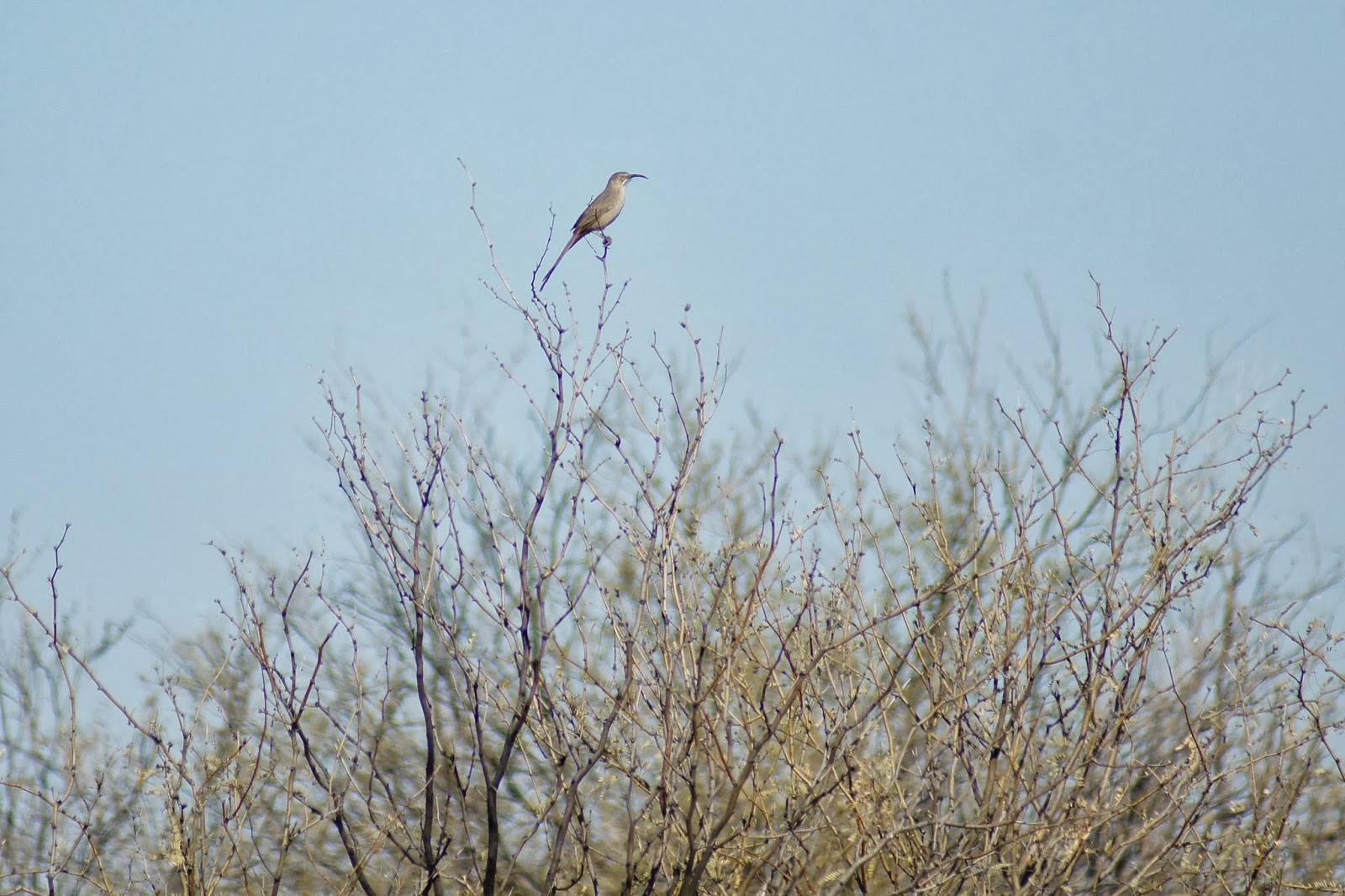
The Crissal Thrasher is always shy and elusive, at least 99.9 percent of the time. As Linda and I watched the bird, he didn't seem to really care, oddly. We slowly walked up to him, and I thought, "could this Crissal Thrasher be the 0.00001 that is different from the rest??".
This particular Crissal Thrasher ended up inviting us into his home. Despite his fierce looks, he was a "cherry-cherry" Crissal Thrasher. I wanted to slap myself in the face as we kept getting closer and closer to this bird. It didn't seem right!
Perhaps this Crissal Thrasher was a bit tired.....
The Crissal continued to be welcoming, and Linda and I walked right up. If a Crissal Thrasher invites you into it's home like this, don't ever say no!
Out of all of my Crissal Thrasher encounters, this was by far the best I have had. As we were watching this bird, a Le Conte's Thrasher was calling in the background. After a search for the Le Conte's, who is just as shy as the Crissal, we were empty on that. But we did get 3 new thrashers for Linda, and other lifers for Linda such as Black-tailed Gnatcatcher, Brewer's Sparrow, and Sagebrush Sparrow. What a fun and memorable stop this was.
Up next, we visited the tamarsisk stand I visited earlier this week with Richard Crossley and two other Tommy's. I wanted to show Linda the Great Horned Owls. Within minutes, BINGO!
We then cruised along the fields of Baseline Road in search of Linda's first Ferruginous Hawk. Another big BINGO!
We then went to the nice Estrella Park to look for desert birds and any other surprises. As we arrived, the handsome Phainopepla flew in front of us, another new one for Linda. The real highlight came as I spied a Vermilion Flycatcher! This was one Linda thought she'd never see, and she was very thrilled at the sight of this spectacular bird. The Vermilion Flycatcher can be very funny at times too, as it hung out on grills, children's playgrounds, and even trashcans. A cool way to get a flashy bird like this for a lifer!
At Estrella, new birds continued to come for Linda, and I was happy I was able to show all of them to her. Some of them I wasn't able to photograph, such as the Rock Wren and striking Lark Sparrow.
 |
| Costa's Hummingbird |
 |
Say's Phoebe
We even had room for one more thrasher for the day, the common Curve-billed. This Curve-billed Thrasher was singing quite the long song, like a CD on repeat.
This pair of Gila Woodpeckers were also fun to observe out of the many birds present at Estrella.
The last stop of our productive day came at a corner, where a small canal-ditch, farm house, and agricultural field made up for the scenery. Along the side of the ditch are mammal-made holes, which is utilized by the small Burrowing Owl. Linda and I pulled up to see this small owl outside of it's hole. The owl was in his mid-day grouchy mood, but I still gave us quite the show. It was another new one for Linda, and was a perfect way to close out the day. During my time working at Tommy's Birding Expeditions, this particular owl has made my participants very happy and has made me look good! Thanks Mr. Burrowing!


This was an awesome tour, and it all took place by the five hour half day tour. There are so many good birds in my guiding region, and days like this make my job fun. The highlights like this seemed endless, and that is what most of the days are like on my Expeditions. I really enjoy helping others find birds that are new for their life lists and seeing their excitement when seeing these birds.
I have missed birding for fun lately and taking long trips! Lord willing, I'll have five straight days to do that next week as I head to California to bird San Diego and beyond. For now, thanks again Crissal Thrasher!
|


