Wednesday, February 19, 2014

More of the West Maricopa!

Hi everyone,

Yesterday on February 18th, 2014, Richard Crossley, Tom Johnson, Tom Reed, and I explored the Thrasher Spot, Baseline Road (for almost 5 miles east of the Thrasher Spot), and the Arlington Area.

At the Thrasher Spot, BENDIRE'S THRASHERS were very vocal and active in multiple locations.  Several LE CONTE'S THRASHERS were also observed, as well as a CRISSAL THRASHER.  In our searches for Sage Sparrows, we only came up with a few SAGEBRUSH SPARROWS.  As we covered the areas where I found Bell's Sparrows in good numbers recently, we couldn't find any Bell's Sparrows.  At this time in past years, I do remember the Sage Sparrows numbers decreasing dramatically, perhaps most of them have moved on?

Bendire's Thrasher.  The loudest of the thrashers.  You always know if a Bendire's is around!

Leconte's Thrasher.  This guy is sly and very shy.  But every now and then, it'll be cooperative.  Thanks to this particular Le Conte's Thrasher, Richard Crossley was able to get the best pictures of this species that he has ever been able to get.


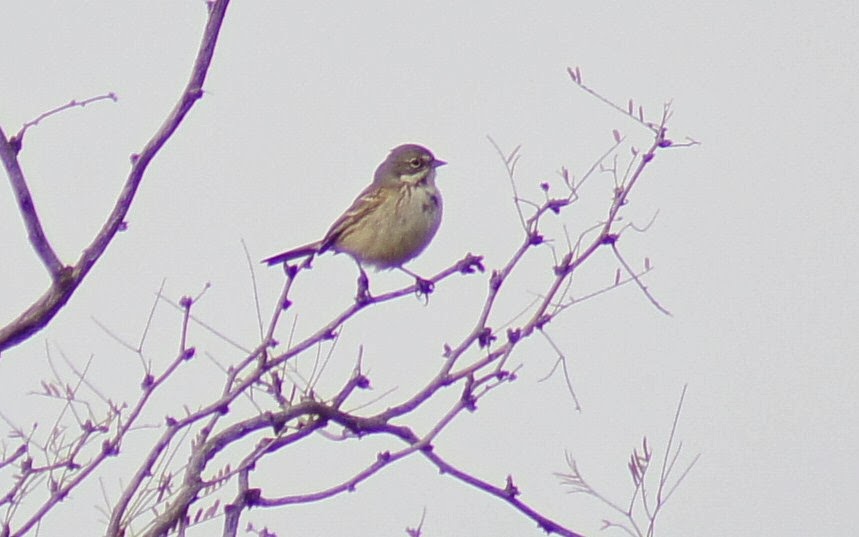
Sagebrush Sparrow, one of the only few that we had.  Is this my last sighing in Arizona until fall of 2014?  Perhaps!


On February 8th, I photographed this Bell's Sparrow at the spot.  Since I'm Cali bound next week, I should be able to see the coastal Bell's Sparrow.  But for the Thrasher Spot, it seems like I may have to wait until October 2014 to see them again.


Richard Crossley at the Thrasher Spot....EPIC!


A mile east of the spot on Baseline Road, we observed a very cooperative BENDIRE'S THRASHER who is probably the most obliging Bendire's I've seen in the field.  Richard and I came here before showing Tom and Tom the bird, and Richard was able to get outstanding photos.  Besides singing away for us on pole wires, he actually displayed a trait I never thought I would see from a Thrasher..flycatching!  The bird jumped up and caught a fly, which the others got very good pictures of!

I'm Mr. Bendire's Thrasher to you!


Richard, Tom, and Tom..enjoying the Bendire's Thrasher.  Three Tom/Tommy's and one Richard..strange mix.  I've never been outnumbered in a group with people who share my same name.


Continuing east on Baseline Road, we stopped at a nice stand of tamarisk at the northwest corner of Baseline and Bruner Roads, where there is also an abandoned building.  I could see this being a good place to stop and check for migrants in season, and it was loaded with Yellow-rumped Warblers.  The main highlight here were 3 GREAT HORNED OWLS utilizing the stand.

Tamarisk stands by deserted places are kinda creepy.  Not for Owls though, like these Great Horneds!


Continuing east on Baseline Road and shortly east of Paloverde Road, we were in search of a dark morph FERRUGINOUS HAWK that I saw in this area a few weeks ago and earlier on this day of the 18th when I was driving to meet my birding party.  We found it perched up on a pole, and were eventually treated to flight views, which Tom Reed got some outstanding flight shots.  This is a very cool bird!  A light morph FERRUGINOUS HAWK was also in the same vicinity.  

The dark Ferruginous Hawk.  According to Crossley, "A dark, Ferrugie!"


Here are a few shots of this same bird from 2/8/14


It was a great four hours of birding in the morning for me!

Monday, February 3, 2014

More Sage Sparrows

Hi everyone,

Today on February 3rd, 2014, Dominic Sherony and I decided to investigate further into the Bell's Sparrow numbers at the Thrasher Spot where I had the four on February 1st, 2014.  We wanted to see how many we could find as well as study the differences between the Sagebrush and Bell's Sparrows.

After starting at 7:30 in the morning and spending 3.5 hours at the Thrasher Spot, we came away successful, and we spent most of our time within the area of where I covered on February 1st.  Today, we came away with approximately 15 BELL'S SPARROWS in this area.  We were rather shocked at the numbers, but these sparrows all came with careful study and observation.  They were well spread out throughout the area, and really favored the noticeable wash that runs north/south through this area.  In means of the wash, they stuck very close to it, and would even perch up very high in the mesquites in the wash.  They were also often found in the creosote bushes closeby to the wash.  In the early morning, the Bell's Sparrows were very skittish, and hard to get close to for the photos we desired.  However, later in the morning from approximately 10:30 through 11 A.M., they sparrows were a little more active and cooperative for viewing.  Most of these sparrows observed were very well marked Bell's Sparrows, and there were some that were confusing.  There were a few Sagebrush Sparrows in this immediate area, but they seemed to be oddly outnumbered by Bell's Sparrows.  If one birds this immediate area, it is quite different in habitat as I mentioned on my post from the 1st.  The creosotes are more condensed, and there are tall lines of trees, which the Bell's Sparrow really seems to like these patches were the mesquite wash and creosote habitat meet.

Bell's Sparrows (usually skittish and pretty distant)


Here is one that seems a little confusing.  Bell's or Sagebrush?


When we went to the south side of the Thrasher Spot on the south side of Salome Highway, we concentrated on looking for Sagebrush Sparrow.  These sparrows weren't as numerous as in most of my previous visits, but we did find a nice clump that held 10-15 SAGEBRUSH SPARROWS.  Also seen were several SAGE THRASHERS, a BENDIRE'S THRASHER, and a heard only LE CONTE'S THRASHER.
Bell's Sparrow "preference?"


"More than often" Sagebrush Sparrow "preference?"


A good approach to searching for the Bell's Sparrows if interested is by parking on the north side of Baseline Road just before it meets up with Salome Highway.  There is a convenient pull off here.  Once parking, follow the dirt path to the west for a rather short distance.  A wash lined with mesquites will be noticeable from this point.  Follow the wash and bird the immediate areas near the wash, and this is where most of these Bell's Sparrows were present.

Another overview map of general Bell's Sparrow locations


These two Sage Sparrow species have certainly been fun to search for so far!

Saturday, February 1, 2014

Bell's Sparrows, Lovebirds, and a cool Woodpecker

Hi Everyone,

This morning I birded with Warren and Iris Woessner and we covered the Thrasher Spot and Encanto Park.  It was a great morning of birding with neat highlights.

Our first stop was at the Thrasher Spot for just over 1.5 hours starting just after 8 A.M.  The primary targets weren't Thrashers, but were the two Sage Sparrow species.  Activity for the Sage Sparrows were surprisingly low for Sagebrush Sparrow, but were ironically very productive for Bell's.  As more and more things are learned about these two species, I may have learned something today about the sparrows within a small area of the Thrasher Spot.

We decided to cover the section of the area that is to the northwest of the intersection, and is on both the north side of the Salome Highway and Baseline Road.  The other section that is on more of the southern side of Salome Highway (Salome runs from southeast to northwest, however), seems to be more of the highly covered spot by birders, at least from what I have observed.  I tend to bird on this side a lot more myself, because it has always been better for thrashers and I rarely go to the other side (and yet rarely see other birders on the other side).  But the area that is to the northwest of the intersection, and is on the north side of both roads, has a stretch that appears to be reliable for Bell's Sparrow.  Every time in the few times I have looked in this section prior to today, I have found a Bell's Sparrow there rather quickly.  When I was here last week, a Bell's Sparrow was the first Sage Sparrow species I observed.  When I was birding with Bob and Janet Witzeman last year, we spent hours looking for Bell's Sparrows on the southern side of the Salome Highway without success.  We made a run through this north side and found a Bell's Sparrow in a very short time length as compared to the time we spent looking on the "usual" side.

With this in mind today, Warren, Iris, and I decided tried our luck at this northwest section.  The activity was slow at first, and the Sage Sparrows we were encountering were very skittish and weren't giving us much to look at at first.  When one finally popped up, I saw that it was a BELL'S SPARROW and I got a good look at it to see it's dark and thick malar as well as it's plain and unstreaked back.  It then went down before I could get the others on it.  The sparrows then continued to be very skittish, and we then found a very cooperative SAGEBRUSH SPARROW.  We were able to study it's field marks at close range.  The sparrows than were very skittish again, until we finally had a nice and extreme BELL'S SPARROW pop up.  It utilized a taller bush (I don't know plants very well) than the usual short creosote bushes I see the other Sage Sparrows typically on.  We then had two more Bell's Sparrows perch up and give us nice identifiable views.  There were at least three Bell's Sparrows in the time frame that we searched in this area, and the first one I observed was probably a fourth.  The majority of the sparrows were very skittish, and out of the ones we could safely identify, it turned out to be 3-4 Bells, and 1 Sagebrush in this area.

Bell's Sparrows (the closest I could get)

1.  This bird was very striking to see through binoculars, but wasn't the closest for pictures.  

2.  This bird is more interesting.  It shows the thick and dark malar but appears to have a little more streaking on it's back than usual.


3.  This bird had it's back turned by the time my camera was ready, which shows it's unstreaked back well.  Our views in the field were better of it's dark malar stripe, which doesn't show well in the pictures. 


What is interesting to me, is that there are sections of the Thrasher Spot that have more open creosote desert, and then sections that are more "thick" that have the vegetation packed in more closely together with taller surrounding trees and bushes.  It especially seems this way where small washes run through the area.  From what I have observed, it seems to me that Bell's Sparrows like the slightly more vegetated areas than the Sagebrush Sparrow does.  Almost every time I have seen a Bell's Sparrow out there, it seems to be in a more vegetated area, where the creosote flats meet up with washes that have taller trees.  They seem to be more skittish than Sagebrush Sparrow, and are a lot harder to approach.  And I have also observed Bell's Sparrows perching higher up on mesquites and taller plants than the low "typical" creosote perches.  The low creosote perches are the main perch, but have seen Bell's Sparrows perch higher than Sagebrush Sparrow.  Sagebrush Sparrows, on the other hand, love the open and are very cooperative often at close range, and I haven't seen them utilize higher perches as much as I've seen Bell's Sparrows use them.  In one of the Facebook groups, we had a discussion on the sparrows and it was very interesting.  Lauren Harter mentioned the Bell's Sparrow having the possibility of being a lot more skittish of the two species, and I think she's right.  I've never had much of an "extensive" Bell's Sparrow study up close out there at the Thrasher Spot in many recent visits as I have had with Sagebrush Sparrow.  And there are Bell's Sparrows throughout the Thrasher Spot, but this just seems to be a more of a reliable spot to find them.  These are just my ramblings on my observations, they may or may not be accurate.  For those interested, I will include pictures and a map overview on my blog of the specific area I am talking about that seems to be productive for Bell's Sparrow.


Other than the sparrows, we enjoyed LE CONTE'S and BENDIRE'S THRASHERS up close and in full song, and ANNA'S and COSTA'S HUMMINGBIRDS were also present.


After the Thrasher Spot, we went to Encanto Park.  ROSY-FACED LOVEBIRDS were easily found in high numbers, especially near the parking lot just west of the Clubhouse.  We were also thrilled to see the LEWIS'S WOODPECKER that was reported yesterday.  It came in very close and landed in one of the oak trees at the clubhouse right above our heads.  A great day to be outdoors!

Lewis's Woodpecker


Lovebirds