Friday, October 18, 2013

A Day of Roadrunners and Two Interesting Sparrows

Hi everyone,

Sorry for this belated report, but I visited birding hotspots southwest of Phoenix yesterday on October 17th, 2013.  It was a good day to be out birding with beautiful weather on top of it.  I visited the Thrasher Spot west of Buckeye, the Arlington Wildlife Area, Gillespie Dam, and Tres Rios Overbank Wetlands.  The Greater Roadrunner was also everywhere during the day, surely a good day whenever that takes place.


My first stop was a two hour search through the Thrasher Spot, primarily to search for Sagebrush and in my hopes Bell's Sparrows.  If one is wondering what these birds are, they were recently split from Sage Sparrow into two species.  Shortly after I started birding, I found a Sage Sparrow species and the first one ironically was a nice BELL'S SPARROW.  It was an extreme individual, and had a thick, dark malar that contrasted with it's gray head.  It's back wasn't streaked either.  The more expected SAGEBRUSH SPARROW was very abundant and seemed to be everywhere.  I'll estimate 25-30 birds.  In the mix of the Sagebrush Sparrows, I managed to find one more Bell's Sparrow.  Although Sagebrush Sparrow was the dominant force of the two birds, it was great to find both of them.  I got photos of both birds, visit my blog at the link at the bottom of my report if interested in seeing them.  In learning about these two species, I read David Vander Pluym's excellent article on these two species and what identification factors to look for when in the field.  David explains it better any time and anywhere than I ever could.  Check out his article at the link below:
http://phainopeplafables.com/2013/08/14/sage-sparrow/

Bell's Sparrow # 1

This shot is poor, but the thick dark malar that contrasts with the head is very evident.

When the bird turned, it's back is shown.  The back that has little streaking is another field mark on Bell's, although it is more of a supporting field mark (Some Sagebrush Sparrows don't have much streaking on back)

This shot shows the malar darkness and thickness well, but the lighting isn't so great.

Bell's Sparrow # 2


Sagebrush Sparrows


Other than searching for the two Sage Sparrow species, I found 2 LE CONTE'S THRASHERS and 1 BENDIRE'S THRASHER.  I located the Le Conte's by it's rather loud call note, which really helps to know when looking for the bird.

Le Conte's Thrasher

Who was patrolling the Thrasher Spot?

A Bendire's Thrasher!


The Thrasher Spot


Up next was the Arlington Wildlife Area and adjacent fields and roads near the location that is managed by Arizona Game and Fish.  As I mentioned earlier, GREATER ROADRUNNERS where everywhere, and I had incredible and up close views of one along one of the roads.

The awesome Greater Roadrunner!


At the wildlife area, the best highlight actually came from a mammal.  I had two large RACCOONS walking on a pile up of logs.  Before I could take a picture, they took off.  Ahh...I wish I had a picture of them!  Bird highlights came from 2 LEAST BITTERNS, a flock of WHITE-FACED IBIS, OSPREY, NORTHERN HARRIERS, VIRGINIA RAILS and SORAS, BELTED KINGFISHER, LOGGERHEAD SHRIKES, and LINCOLN'S SPARROWS to name some out of 43 species in that area.

Loggerhead Shrike


Gillespie Dam held a nice and up close look at a WESTERN GREBE, as well as hearing another LEAST BITTERN.

This Western Grebe at Gillespie put on quite the show!


I got to Tres Rios Wetlands at 1 P.M., and still had a pleasant walk with 66 species recorded even at a later time in the day.  Highlights included the 3 BROWN PELICANS perched together on a structure, calling LEAST BITTERNS, a kettle of BLACK VULTURES, numerous OSPREYS, PEREGRINE FALCON, SORAS and VIRGINIA RAILS, 5 GREATER ROADRUNNERS, 2 BELTED KINGFISHERS, and 2 CASSIN'S KINGBIRDS.  Another good day to be out in the field.

Black Vulture


Belted Kingfisher-female


Peregrine Falcon


Cassin's Kingbird (only my second for Tres Rios)


Northern Harrier

Big Birds:  Brown Pelican, Double-crested Cormorant, and Neotropic Cormorant

And....How about a few more for the road?


Sunday, October 13, 2013

Beeline Birding

Hi everyone,

Yesterday on October 12th, 2013, I headed up into the northeastern part of Maricopa County to explore the areas of Mount Ord and Sunflower.  The latter contained visits to both the Bushnell Tanks and the Old Beeline Highway.  All of these hotspots are accessed off of Highway 87.  It was a pleasant day of birding.

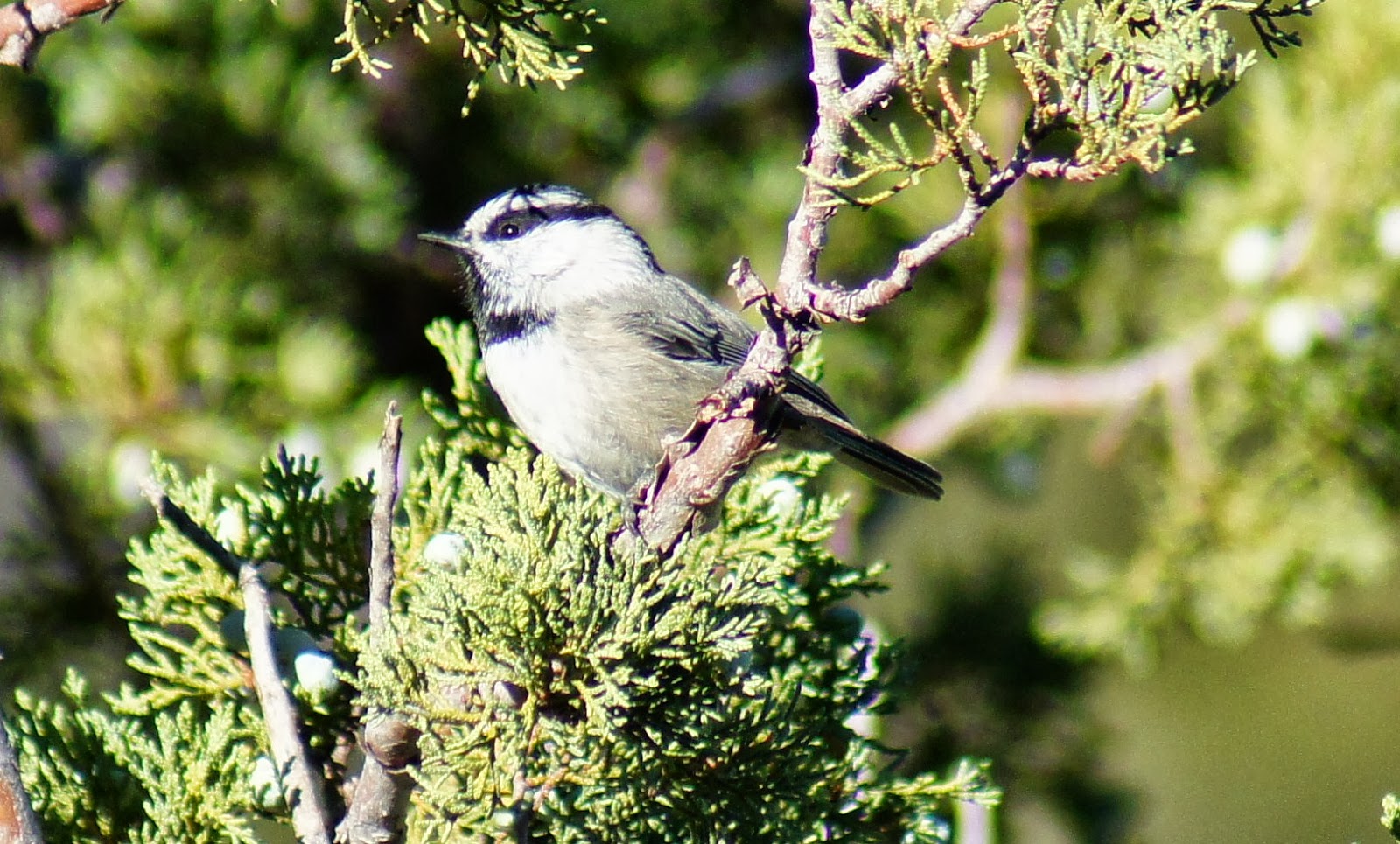
My first stop was at Mount Ord, where I had several good highlights.  This is Maricopa County's easiest "high country" to access, and it is a location favorite of mine.  I spent three hours on Mount Ord, with the entire time being on Forest Road 1688, which is three miles up the road to Mount Ord after turning off from the Beeline Highway (S.R. 87).  My main highlight was detecting at least 10 MOUNTAIN CHICKADEES throughout the two mile hike one way on Forest Road 1688.  These chickadees were mainly in pairs, although I did find three together and one loner.  Other than that, they were in pairs and were well scattered throughout 1688, from the beginning stretches near the water tank and near the end of the two miles.  This was only my second time ever of finding a Mountain Chickadee in Maricopa County, with the last time being a small flock of four near the summit in November of 2011.  Forest Road 1688 is about a thousand feet lower in elevation than the summit of Mount Ord (7,100'), and I found it interesting that chickadee numbers were high like this in the lower forested reaches.  This species is rare in Maricopa County for the most part, this is obviously an irruptive year for the species, who will show up in the lowlands at times too.  It'll be interesting to see when the winter months come, what the chickadee numbers will result in in this region.


Perhaps the bird of the day, was one that tragically got away.  When I was near the end of Road 1688, I heard what I'm sure was probably 99% a Downy Woodpecker.  The bird gave both of it's usual calls a few times and then stopped.  I wasn't able to track it down, whatever was making the calls, but it sounded perfect for a Downy Woodpecker.  Ladder-backed Woodpecker sounds very similar to Downy Woodpecker based on the call notes I heard.  While Ladder-backed Woodpecker is very unusual for this elevation, I did once have one in a forested drainage above 1688 around this time frame of the year in a previous year.  They do show up out of habitat on occasion, which is why I can't call this bird for sure.  If hiking in this area, do keep this possibility in mind.  Downy Woodpeckers are very rare in this area, but have increased in recent years in this area and the county.  There have been 3 or 4 sightings in the last 5 years.

Other than the Mountain Chickadees and very possible Downy, there were some other good highlights on Forest Road 1688.  Another one was a lingering female HEPATIC TANAGER.  This is the latest date I've had this species at Mount Ord (or elsewhere in Maricopa County) in many visits.  I also found 2 PYGMY NUTHATCHES together along this stretch, another species that is uncommon in the County and can be hard to find.  This year, however, has been very good on Mount Ord for the Pygmy Nuthatch.  WHITE-BREASTED NUTHATCHES were very common throughout, and I surprisingly didn't have any Red-breasted Nuthatches.  2 OLIVE WARBLERS were present, and I also found at least 5 BROWN CREEPERS.  I also had several empid highlights which contained a DUSKY FLYCATCHER, 2 HAMMOND'S FLYCATCHERS, and even a GRAY FLYCATCHER that was notably dipping it's tail continuously like a Phoebe would.  Woodpeckers I did find were several HAIRY and ACORN WOODPECKERS, NORTHERN FLICKERS, and a nice male RED-NAPED SAPSUCKER.  A SHARP-SHINNED HAWK was also seen flying overhead.  Other highlights among 28 species that I recorded on Forest Road 1688 of Mount Ord included WESTERN SCRUB-JAYS, BEWICK'S WREN, JUNIPER TITMOUSE, large numbers of WESTERN BLUEBIRDS, and CANYON WREN.  I wanted to go to the summit area of Mount Ord to search for more chickadees and other goodies, but the birding areas nearby along Sycamore Creek were calling my name.

Hepatic Tanager

Hammond's Flycatcher


Pygmy Nuthatch

Ruby-crowned Kinglet

Orange-crowned Warbler

Olive Warbler

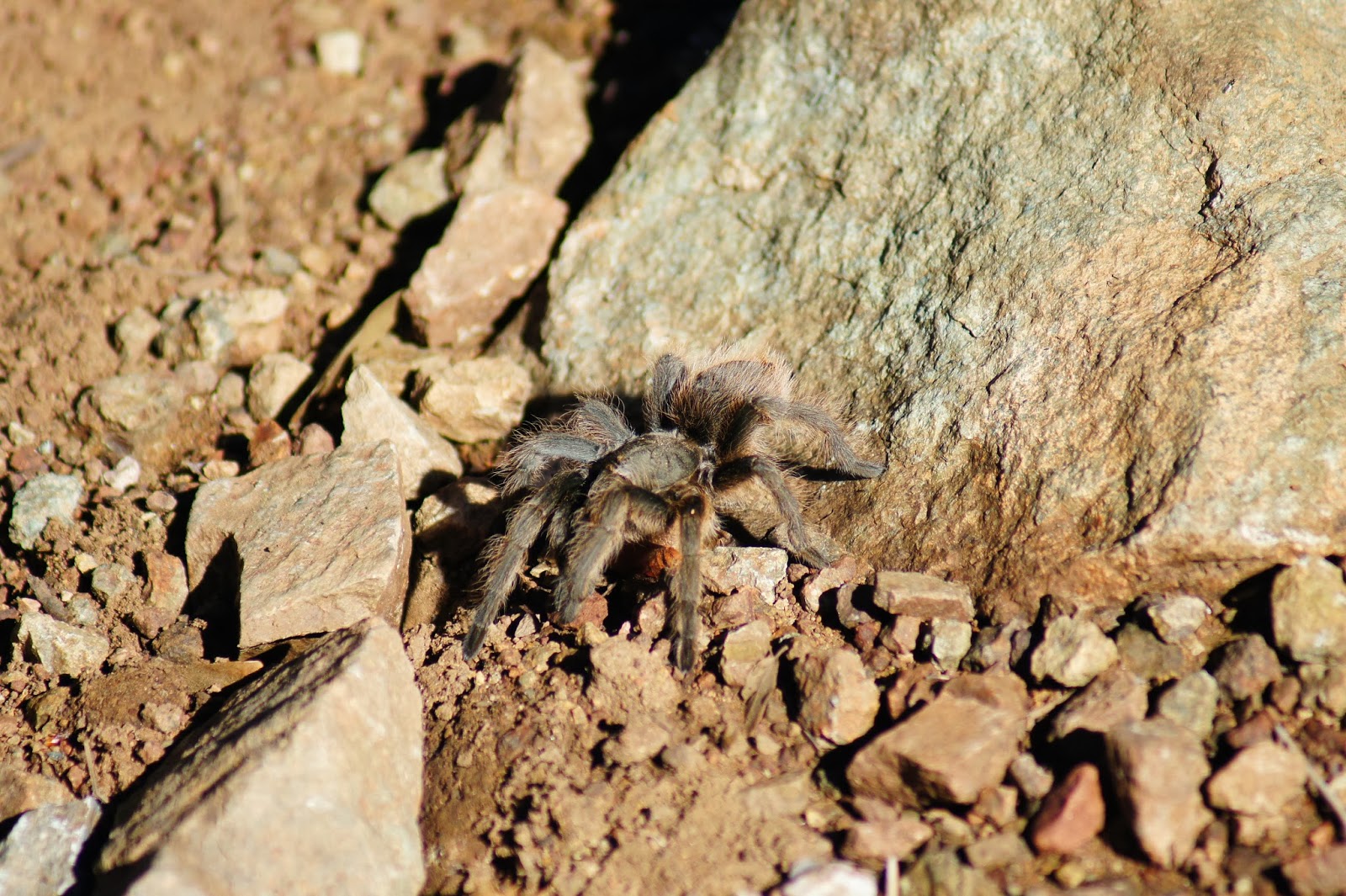
Tarantula


The birding along Sycamore Creek adjacent to Sunflower turned out to be just a notch better than dead, and I was kicking my own butt for not staying at Mount Ord longer.  Lesson learned, bird at the lower elevations first (I already knew that, but for some stupid reason, didn't do it).

At Bushnell Tanks, a few highlights included a nice flock of BUSHTITS, a JUNIPER TITMOUSE, a flock of BRIDLED TITMOUSE, HUTTON'S VIREO, and BLACK-THROATED GRAY WARBLER.

male Bushtit

Juniper Titmouse

White-crowned Sparrow (juvenile)

Sycamore Creek


Walking on the Old Beeline Highway, the main highlight was seeing a TOWNSEND'S SOLITAIRE and hearing at 5-6 of them, both in song and in their unique high pitched callnotes.  I also heard a late SUMMER TANAGER calling along the creek.

Townsend's Solitaire

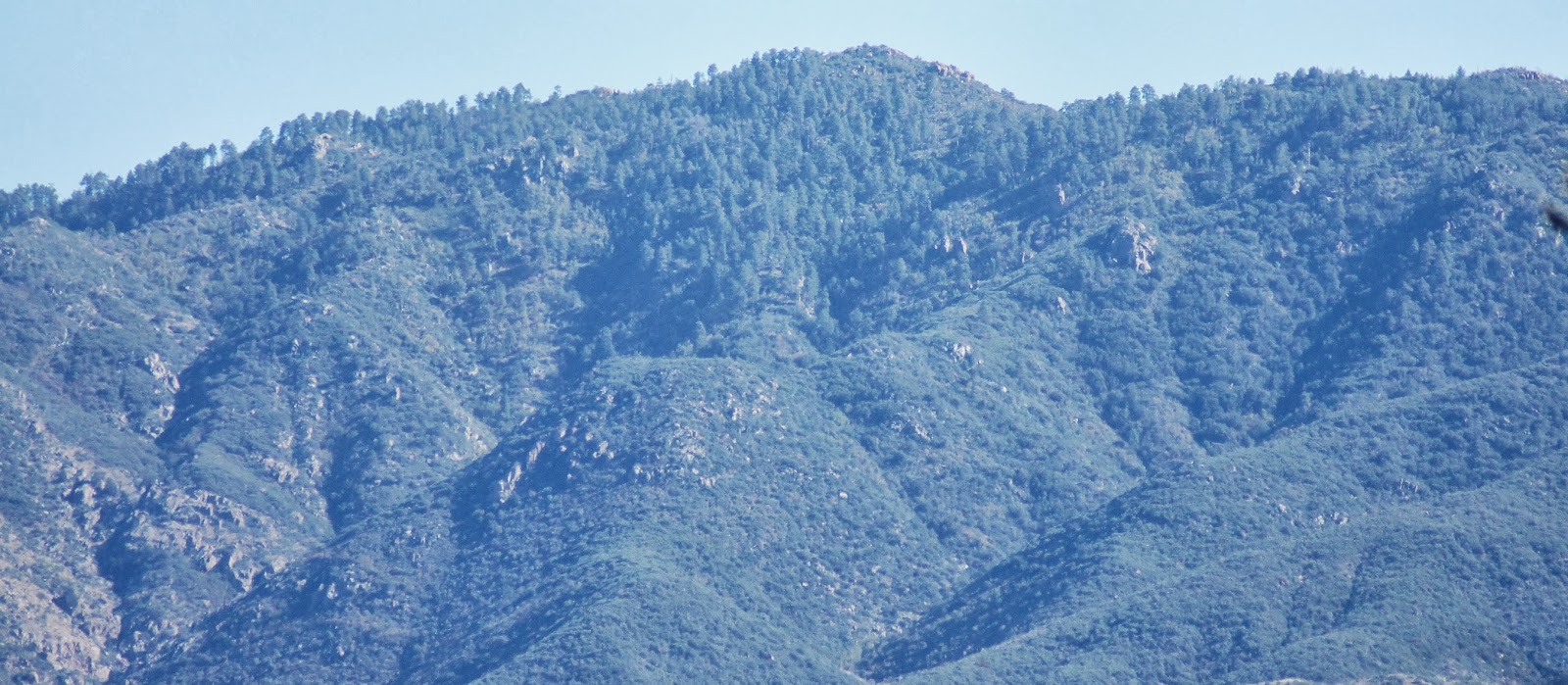
It was another great day of birding and exploring outdoors!  For something slightly but not really off topic:  This is how I get myself into trouble, but it's not really trouble.  Whenever I see a potential birding location I haven't explored, I find a way to explore it.  It's a form of OCD, and I'm not happy until I explore it.  The Mazatzal Mountains (Mt. Ord, Four Peaks, Slate Creek Divide) have a lot of exploring to do, and I have explored a lot of it.  With that being said, there is still more to explore on the Maricopa County side of this mountain range in the higher elevations.  Between Mount Ord and Four Peaks lies this forested mountain area.  It is somewhat limited as shown in this picture, but it is on a north facing slope (birds love north facing slopes).  I know how to access this area by a backroad, and it is now one of my hopeful explorations in the future.  I have been on the road to access it once and was three miles south of the access point, but was out of time for the day and was exploring another awesome Mazatzal Mountain area between Four Peaks and Mount Ord.  Hopefully, this will be next.  Even though I have distant views of this mountain area from Ord and Sunflower, I was able to make out a small stand of Douglas fir also (which I have only seen on Slate Creek).  I've gotta get up there.  Here is a picture of this good looking spot:

Friday, October 11, 2013

Ruddy Ground-Dove searching in Gilbert

Hi everyone,

I visited the Gilbert Water Ranch yesterday on October 10th for three hours of great weather and some awesome birding starting at about 10 A.M.  Once the rain passed, I wanted to get some birding in and I also wanted to search for the Ruddy Ground-Dove.

It didn't take me long to relocate the RUDDY GROUND-DOVE, who was in the middle of a nice sized flock of INCA DOVES.  I could see this dove being hard to find at times, and I observed it from a point that would probably be a reliable place to see it for birders who are wanting to see it.  As Pete has posted, take the pond 4/5 trail south from the junction with the 3/4 trail.  Follow that until you see the three heron platforms on the east side of 4/5.  Once at this point, you are in the right area of where the dove was frequenting.  The dove was hanging out at the very southeastern corner of pond 5.  So, it was adjacent west of the heron platforms and across the path.  From here, continue south on the 4/5 path a very short distance until the path turns to the west and is then on the south side of pond 5.  Right after making this turn, you'll see one of the Water Ranch signs on the north side of the path that says: "Do not drink water or enter the basins, wet or dry".  Walk up to the sign and look beyond it (without going into the basin) and you can easily get a view of the southeastern corner of the basin.  The dove flock was feeding here the entire time I was birding, and the Ruddy Ground-Dove really stood out.  This section of Pond 5 is lined with mesquites, which provide the doves with good habitat to retreat to quickly (there were several raptors flying through the area).  The doves would usually flush to the mesquites closest to them, but would also sometimes flush to mesquites a little west of this sign.  If the doves retreat, they often come right back to feed within a few minutes. 

Despite it being later in the day when I first arrived at Gilbert Water Ranch, it was still very birdy and I managed to record 64 species.  Other than the Ruddy Ground-Dove, other nice highlights included an OSPREY, NORTHERN HARRIER (hunting throughout pond 5 during the day and regularly scaring the doves), COOPER'S HAWK, a WESTERN SANDPIPER mixed in with a flock of Least Sandpipers, a VAUX'S SWIFT at fairly close range flying over pond 5 (my second in two days; photographed), BELTED KINGFISHER, a LADDER-BACKED WOODPECKER, 2 RED-SHAFTED NORTHERN FLICKERS, a PEREGRINE FALCON, 2 ROSY-FACED LOVEBIRDS, VIOLET-GREEN SWALLOWS, a male YELLOW WARBLER who was singing as if he was on territory (odd), a pair of BLACK-THROATED GRAY WARBLERS, BREWER'S, SAVANNAH, LINCOLN'S and WHITE-CROWNED SPARROWS; and a male LAZULI BUNTING.  It was nice to run into Dave Pearson and Aaron on the trail.

It was a great day to be birding, and it had been awhile since I had been to Gilbert Water Ranch.  


 Ruddy Ground-Dove among the Inca Doves


Up close with the Ruddy


 Where the Ruddy Ground-Dove has been hanging out

Green Heron

Snowy Egret

Vaux's Swift

Female Green-winged Teal

 Cooper's Hawk

 Northern Harrier

 Northern Mockingbird