
On November 19th, I decided to go birding at the Lower Verde River to explore a stretch of the river I don't know much about. This location lies south of the Box Bar Recreation Area and Rio Verde Ranch, and there is a lot to explore here. By following Box Bar Road south past the turnoff to the actual recreation site, it leads to a dead end and a parking area. From here, several trails and a wash head east to the Verde River. It isn't a developed recreation site like the Box Bar and Needle Rock Recreation Sites just to the north. In similar ways to those spots, it has impressive stands of cottonwood and willow riparian. Adrian Smith told me about the spot on October 23rd when I ran into him at Box Bar, and we went over to this "new" area he had explored some of a few times. I was impressed from what I saw in the field in the short distance we explored and from the looks of things while viewing the area on Google Maps. It was high on my birding "to do" list, and after a long birding trip to southeastern Arizona on November 18th (will be mentioned in a future blog post), I decided to do something somewhat close to home.
The time in the field was awesome at this new place and the habitat is great. I slowly worked the riparian stands, which are about a mile in length once hiking to the river from the parking lot. Birds were everywhere and numerous, and when I got to the southern part of my route, there was a thick cottonwood, willow, and tamarisk stand that was close to the river and then ended up going right up to the river. When I got to it I heard a big mixed flock of birds, with the most abundant being Yellow-rumped Warblers. However, as I started to scan the first warbler I found was a Chestnut-sided Warbler. At about 9:30, a bright vireo caught my attention. I snapped pictures and it didn't take me long to wonder if it was a Blue-headed Vireo candidate with how bright it was. A dark head that contrasted with a white throat, contrasty white spectacles with the dark head, bright white underneath with lots of greenish yellow on the flanks and vent. While pictures gave off a greenish-yellow, the bird was more in the yellowish category by the looks I had in the field. I took these pictures from 9:33-9:54 A.M., according to the time on my camera.


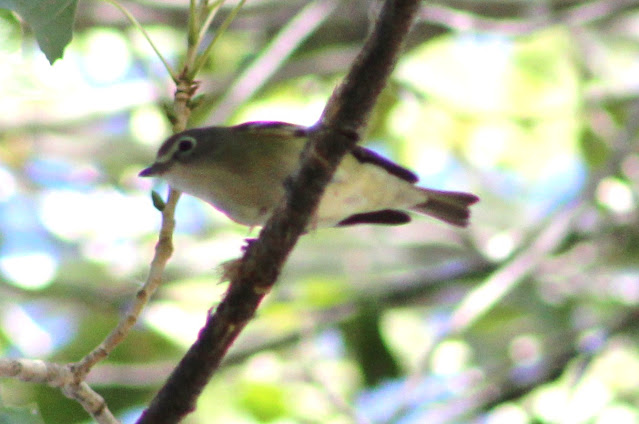


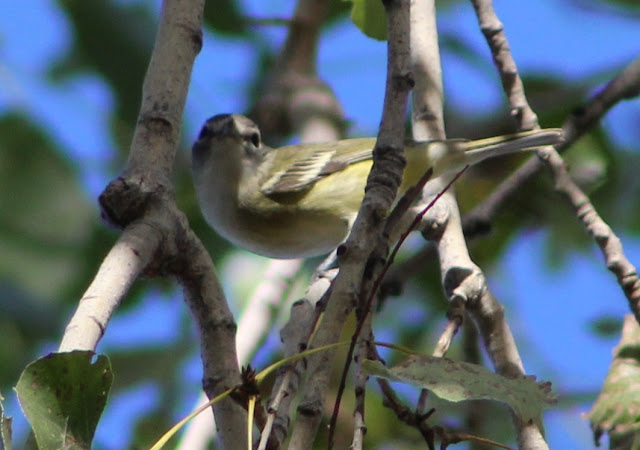


After talking to Caleb, he felt the vireo looked very interesting and was leaning toward Blue-headed. But I needed better shots for sure, as Blue-headed and bright Cassin's Vireos can be indistinguishable. I kept trying and eventually got back on the vireo. This time my looks were closer and better. From 11:02 to 11:09 A.M., I shot these following photos of the bird.


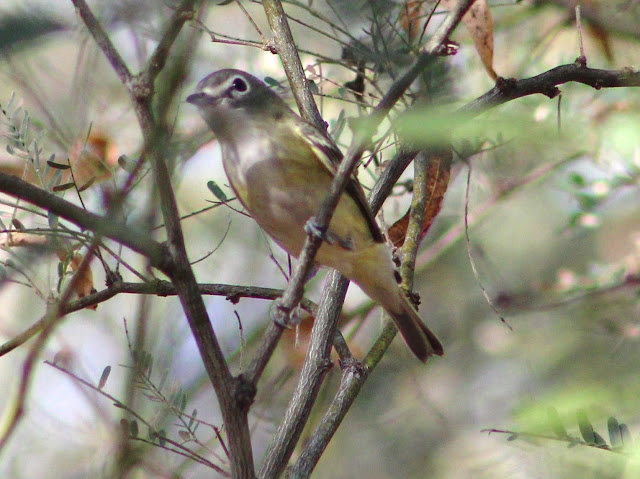


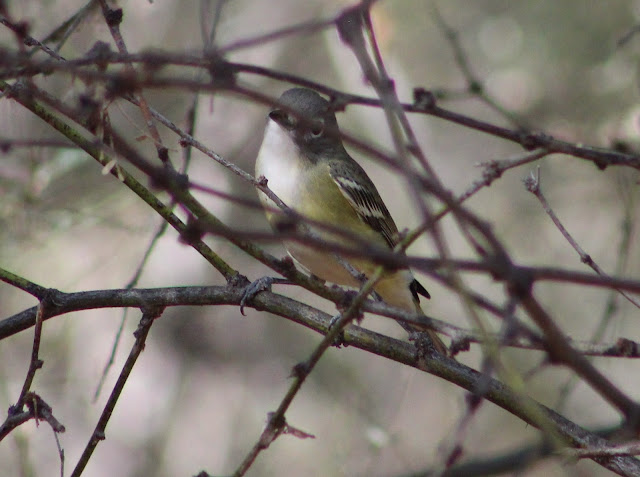


At times when the bird was in better lighting and close to me, I looked at it with my binoculars aside from taking photos. I've never seen a more constrasty vireo in my time of birding in Arizona. It's dark head really constrasted sharply with it's back and white throat and undertail coverts, as well as it's flanks that were more lemon yellow as well as having a slight hint of a greenish tinge at times too. Caleb and others felt that it was a Blue-headed Vireo after looking at a few of the second set of pictures I was able to attain.
Vagrant Blue-headed Vireos in the west as well as vagrant Cassin's Vireos in the east pose major identification challenges much of the time. A bright Cassin's Vireo can look very similar to a Blue-headed Vireo, and some of them have to be UN-identified. It usually boils down to looking at a bunch of features. I read a great article online about Blue-headed VS Cassin's Vireos written by Andy Birch. As I studied his article, among the features my bird does have are: A very dark bluish/gray head area that contrasts greatly with white spectacles around the eye. The head area also constrasts sharply with the throat area, and as well with a lot of white on it's underparts. Yellow flanks and vent area is also good for BHVI, which my bird shows much of the time. At times, it appears to show a greenish tinge to the flanks too. Another aspect is lore contrast with the head color. If the lore appears to contrast and look much darker than the rest of the head, it tends to be more of a Cassin's trait. On this bird the head is so dark that it doesn't contrast with the lores. Another good mark is the contrast of the dark head along with the greenish back, which this bird shows.
This record has been sent to the Arizona Bird Committee, who will make the decision on whether the record will be accepted or not. Hopefully it will be, but a conservative approach has to be done with this species due to such similarity with bright Cassin's Vireos. There haven't been many accepted records of Blue-headed Vireo in Arizona, I believe there have been 5 or 6. There have been suggestive birds that haven't been accepted as well.
On the other hand, many others have chased this bird after my discovery, which is awesome. Not only are more eyes on the bird for more documentation that may show traits I haven't captured, but this new spot is now getting a lot of attention.
Chris McCreedy, Ronnie Reed, Adam Stein, Jeff Ladderud, and Roy Jones were among those who photographed the bird further and had photos to show the features of the bird well.
Jake Thompson and Anne Leight got audio recordings that are posted on eBird, and I eventually got audio too when I went back on November 26th.
When I went on the 26th I wasn't able to see the vireo even though I got recordings, but Chris, Cathy Beck, and Janine McCabe were able to get eyes on it and McCreedy got solid photographs.
McCreedy also talked with Andy Birch, who wrote the excellent blog about Blue-headed and Cassin's Vireo identification. He sent Andy my pictures and his pictures of this Blue-headed Vireo, and Andy said he was ok with it being called a Blue-headed Vireo.
McCreedy also talked with Nathan Pieplow, who is an expert at bird sounds, about the recordings that were obtained. Between Anne and Jake's recordings, Nathan got what was mostly a Blue-headed Vireo vibe. In Jake's recording, some of the phrases of the song sounded a little like Cassin's Vireo in midst of what mostly sounded like the Blue-headed Vireo. The recording wasn't great, and Nathan wasn't sure of what to make from some of the notes. Luckily, when he listened to my recording he was able to conclude Blue-headed Vireo out of it, according to sound.
This vireo has certainly been an interesting one to find and learn about. In the past, I've encountered a few vireos at Hassayampa River Preserve that looked like Blue-headed Vireo candidates and I wasn't able to get close enough to them for any sort of good documentation. Good thing I had the encounter I did with this one!


