Showing posts with label Rufous-backed Robin. Show all posts

Thursday, May 27, 2021

Yellow-eyed Juncos and a few more in Maricopa County

 Following the high amount of time that I spent birding in Mohave and La Paz Counties, I've had to stick closer to home during this last month of May within Maricopa County.  Although I wished several times that I could go back west, I've been glad to get some fun birding reps in in my home county.  The reps were targeted at rare eastern passerines for the most part, as well as the possibilities of Mississippi Kite.  I wasn't able to score on any of those, but I did get a new county bird in the high country.  The bird was surprising and not surprising.

On May 8th, it was Global Big Day, a day when birders from all over the world go out and try their best to find as many bird species as possible.  Some of my friends went all out and traveled as much of Arizona as they could and had an impressive birding day.  Others contributed a few checklists to eBird, and more people did the best they could in one given area or birding location.  There was me too, who had to work.  The me didn't want to bird when work was over.  There is a lazy person at work who doesn't do anything.  It requires me to go to work with two brains, even though I only have one.  When I utilize my one as if I have two, it makes me tired and I'm pretty sure I went home to sit around and watch basketball.  Then I got a few eBird alerts about Yellow-eyed Juncos being reported at the upper elevations of Mt. Ord.  The reports came in from young birder Jacob Bagley who was with a big group of birders up on Mt. Ord for Global Big Day.  This species is one that has had 3 records in Maricopa County in the past: 1 from Seven Springs in 1971, 1 from the high elevations of the Superstition Mountains in 1974, and 1 from this mentioned Mt. Ord place in a similar time frame in 2002.  "No way", I said.  Up at Mount Ord and near it's summit, was where Jacob and his birding group discovered Yellow-eyed Juncos.  They told several other birders about the birds.  Jacob reported 4 YEJU's, and others reported 1-2 birds in the hours and day following the discovery by the group.  With a loaded work schedule ahead of me for the next four days, I wasn't sure how I was going to proceed with seeking out the Yellow-eyed Junco, which was to be a highly wanted Maricopa County life bird.  On Sunday, May 9th, things got crazy again when someone reported a Cape May Warbler at Desert Botanical Garden.  They wrote a perfect description of an adult male of such, but it turned out to be a combination of writing a perfect report by looking over a field guide illustration while wishfully thinking.  When many birders followed up on the report, they all saw a ratty young-looking Hermit Warbler.  Sure enough, the reporter was convinced at first that it was a Cape May.  I didn't make the chase for it, but I did make plans with Caleb Strand, Ronnie Reed, and Jared Conaway to chase the Yellow-eyed Juncos on Mt. Ord on the afternoon of May 10th when I would get off of work.  And "this Mt. Ord place" was sarcastically written, it's one of my favorite birding places and it has been featured on this blog a lot.

My birding party made good timing and got to Mt. Ord right about 4 P.M. on May 10th.  We walked up to the summit of Mt. Ord, which is in both Maricopa and Gila Counties.  There were many active migrants along the way that provided brief distractions.  As we got to the summit of over 7100', we walked between the fire and communication towers and ended up on the north side of the buildings.  Caleb walked ahead of Ronnie, Jared, and I, and right away, he found one of the Yellow-eyed Juncos feeding and foraging on the ground by the buildings.  Well, that's what you call fast!  The bird fed in front of us for some time, and then flushed a few times too.  At one point, it landed in a juniper and sang very quietly for a few minutes.  Caleb quickly pointed out that it lacked rufous on the tertials and wing coverts, a trait that is generally uncommon within the species and that most birds have a strong amount of rufous in those areas.  However, birds in more northerly locations in Arizona will more often show the lack of rufous than the ones in southeastern Arizona.  Our observations of the Yellow-eyed Junco were fairly brief, and further searching didn't produce any more birds.  A few Gray-headed Dark-eyed Juncos were also nearby.  The Yellow-eyed Junco we saw flew in both counties, as the line of both was very close to the observation area at all times.  Our time concluded with birding the summit area of Mount Ord, as well as the beginning stretch of Forest Road 1688.  We had a variety of birds, and it was fun to hang out with Ronnie, Jared, and Caleb.  


Another sighting I really enjoyed in Maricopa County in this past month was when I was birding at the Verde River via the Box Bar Recreation Site.  There were many species present that day, and migrants were moving through.  My highlight came when I saw what appeared to be a small buteo flush from a cottonwood stand and fly a short distance to another set of cottonwoods.  I suspected it was the rare-in-Arizona Broad-winged Hawk, and when I carefully got a clean look at the bird, my suspicion was correct.  It was epic to get a good view of this small raptor through my binoculars and get a few documentation shots before it took flight and flew off further.  It was only my third Broad-winged for Arizona, all of which have been in Maricopa County.  I haven't made it up to the Grand Canyon hawk watch yet, where Broad-winged Hawks are annual in small numbers during their migration.  If I was in the east, I'd be seeing thousands of them in migration, where they form massive kettles.


When I was birding Box Bar further and several hours later, I was stationed out in a cottonwood and willow grove where I usually have good migrant activity, particularly with warblers and vireos.  Standing stationary can have it's positive results, and a shadow over my head turned into the Broad-winged coming in for a landing and perching about 20 feet away from me!  I had a great look with my naked eye, but it didn't take long for the bird to notice me standing there, and as I started to raise my camera it took flight and went a short distance.  From the new distance, I had great looks at the hawk for one more minute before it would fly off and I wouldn't be able to see it again.  


This Whimbrel was fun to see at the Glendale Recharge Ponds, only my 2nd one ever in Arizona and Maricopa County.


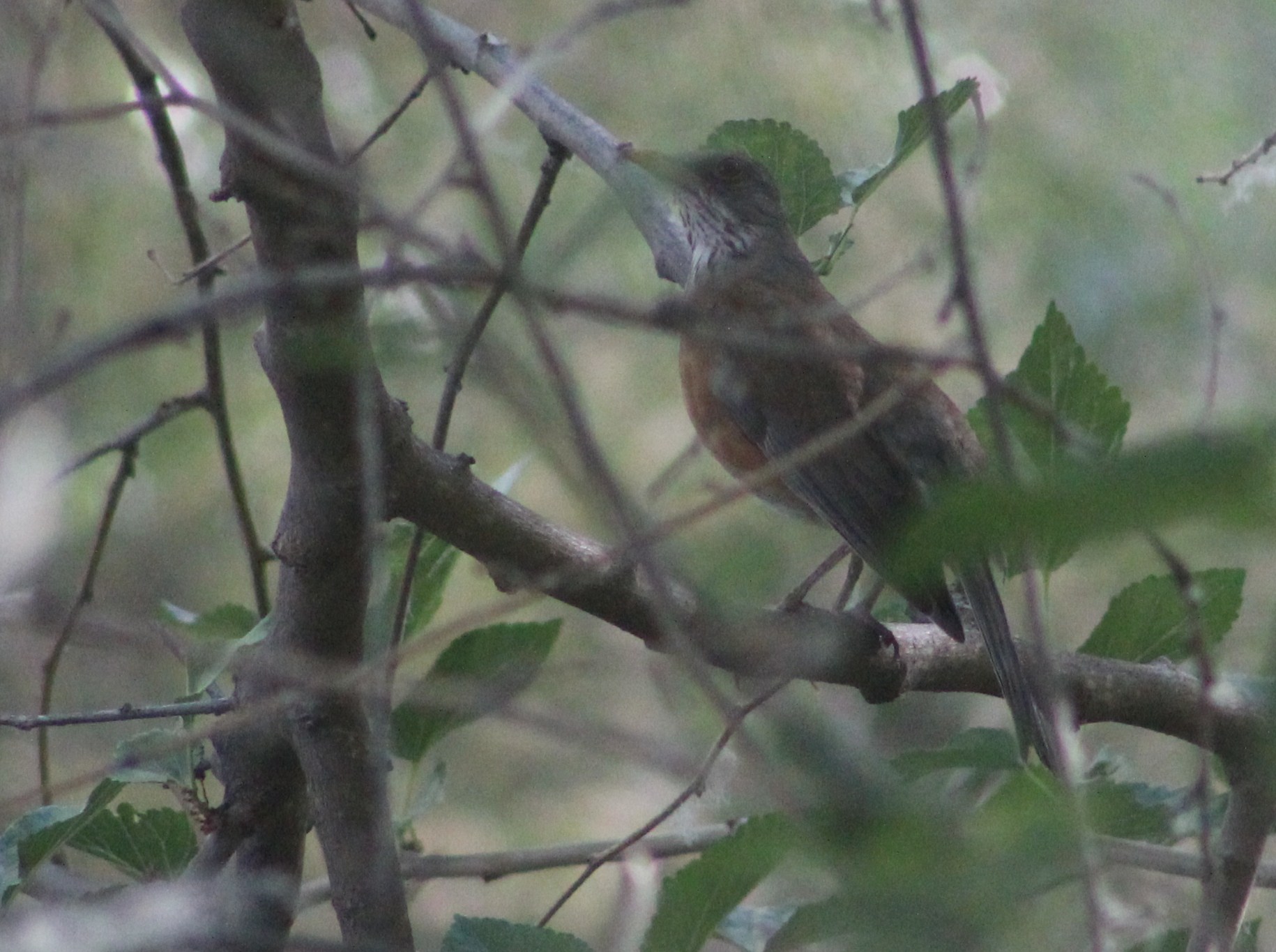
A Rufous-backed Robin has been at the Hassayampa River Preserve for some time now, and it has been continuing well into this time frame.  At times, it has been observed singing.  This species tends to be secretive, and I managed to cross paths with it during one of my several visits to the Preserve.  Like Mt. Ord, the Hassayampa River corridor near Wickenburg is one of my favorite locations to bird in Maricopa County.



A very unexpected sighting for not only Maricopa but for Arizona came when a Brant was found by Tina Bickel and Bob McCormick at Rio Salado Restoration Area in downtown Phoenix.  This bird appeared to be in good shape, but frequented the ponds of the area for about a week.  Many birders got to see this Brant, including myself.  It was a long way from it's usual coastal haunts, and it was the second one I've seen in Arizona (both in Maricopa County).  The location and time of year seemed a little odd, but I did see someone mention that this has happened with Brants before at similar time frames and within a drastic vagrant range. 


Here are a few more sightings I have enjoyed recently.

Summer Tanager

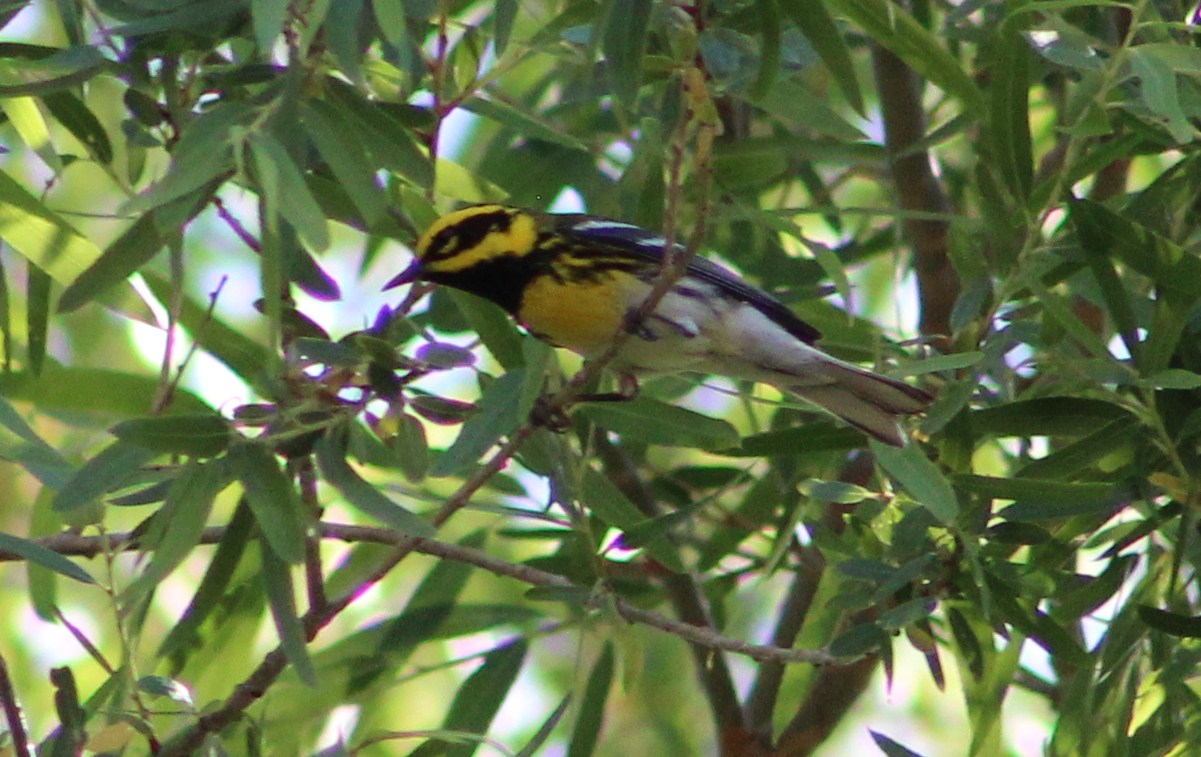
Townsend's Warbler

Western Tanager

Great Horned Owl
 

A few days after the initial Yellow-eyed Junco chase, I went back to Mt. Ord on May 13th to investigate the Yellow-eyed Junco further.  I went to the summit area again after trying to see two calling Northern Pygmy-Owls visually without success, and after some time, located a Yellow-eyed singing.  He was joined by another Yellow-eyed Junco (possibly a female), who fed with him for about a minute.  The two Gray-headed Dark-eyed Juncos joined them too.  I ended up losing the second Yellow-eyed Junco, while the first one stayed put.  It loosely associated with the Dark-eyed Juncos, and I made this written observation:  "Continuing. First located by hearing the bird in song north and just downslope of the towers, not far below the line of white tanks that are on the north side of towers. The ridge and west slope just below this point seem to be a good spot to look. Once I found the bird, it flew down a short distance and landed in a grassy area. Another YEJU joined this bird (male and female possibly), and the two birds interacted by almost touching bodies before foraging and feeding on the ground. Immediately after they were joined by the Gray-headed Juncos who fed too. The Gray-headeds were much more skittish of me, but the original YEJU remained feeding very close to me while I lost sight of the other one. The YEJU and 2 DEJUs moved up and south, where they fed on the north side of the towers by the white tanks, where the 2 species seemed to be loosely associating with each other for feeding purposes. The DEJUs were skittish again and flew off pretty far downslope while the YEJU remained. It eventually moved into a juniper where it sang for some time before moving downslope again. As noted from earlier list, the YEJU (both YEJUs today actually) lacked rufous in coverts and tertials. I saw from pictures that YEJUs from both the Catalina and Pinal Mountains have shown this some too, as opposed to the much larger percentage of birds that have rufous in these areas. The singing bird (who I watched most of the time), sang more loudly the first time I saw it in song, and the second time around it sang more quietly. In the 5-6 times it flew away when I was within close distance, it called once in flight with a few notes as opposed to the DEJUs who called alot every time they took flight. If the YEJU called, it almost always came when it was foraging on the ground. I wasn't able to refind the second YEJU after seeing it briefly".


Maybe we'll have Yellow-eyed Juncos breeding on Mt. Ord, time will tell and follow-ups will be needed later in the summer.  This is a species that I has been on my radar for birds to find in Maricopa County.  It hasn't been a strong suspect, but it hasn't been a weak suspect either.  Yellow-eyed Juncos appear to be expanding their range, how cool.


During my Mt. Ord trips, I also got to know the summit area better, as well as some of the surrounding area.  I made up my own route to take in the future, and maybe it will lead to more Maricopa lifers that I want for the Mazatzals such as Downy Woodpecker.  When I did this hike, it was fun to see a Zone-tailed Hawk cruising along.  It even zipped by me at a very close distance to where I could hear it's wings flap.


Love birding my home county!

Tuesday, November 24, 2020

Chasing a Laughing Gull in Maricopa County

On November 5th, I came went home from a morning of birding at Morgan City Wash.  I was hoping to relocate a Bay-breasted Warbler that had been found nearby.  The bird was no doubt a long shot and I knew it, but I still tried and didn't come up with it.   When I got home I was tired and started to take a nap.  My phone ringing woke me up and I saw that it was Caleb calling.  Caleb said, "I've got a juvenile Laughing Gull at Hidden Lake!".  I woke up very quick and was out the door, on my first Laughing Gull chase in Maricopa County.  

Caleb told me how to access the where he discovered the bird.  I drove to the spot and it wasn't long before I got to see the gull.  It became a Maricopa County life bird for me, and I was pumped.  Mary was right behind me and we enjoyed it together for awhile and Mary captured great photographs as she usually does.  It was awesome to watch this rarity for awhile and observe it flying over Hidden Lake with views of the desert in the background.  


Caleb found the Laughing Gull when he didn't have binoculars and made the call with his naked eye.  Awesome story!  Caleb joined Mary and I, and then Ronnie, Dara, and Ryan joined us shortly after.  Sadly, the Gull seemingly flew off right before Ronnie, Dara, and Ryan came.  We had fun together and hung out at Hidden Lake for awhile.  Hidden Lake is an awesome place, and it is a place Caleb has worked at full time and part time.  They were getting ready for a busy event that they were hosting when the gull showed up, and thanks to Caleb and his boss, Jennifer Mladik, we were able to go.  It was awesome of Jen to open her property up to us, and I'm thankful to her and Caleb for being able to see this rare bird.

And not locating the gull that night turned out to be beneficial for Ronnie, Dara, and Ryan.  It was back at Hidden Lake the next day, and they were all able to not only get the Laughing Gull, but their county Heerman's Gulls too!  HEEG was a county lifer for Caleb too, and it was awesome that he found both of those rare birds (both county lifers for him) while working.  

Other than the Laughing Gull, here are a few more cool birds I've seen lately.  2020's birding continues as being awesome!


Tuesday, October 31, 2017

When Maricopa County Birding Explodes

I haven't birded in Maricopa County as much lately this year.  It seems kinda weird for me to be saying this, and yet, writing this too.  Birding in other counties, especially Gila County, have outnumbered my birding reps in Maricopa County this year.  Exploring is a blast, and it's fun dissecting other counties.  Especially ones that are under-birded, such as Gila County and rarely explored Greenlee County.  Although fun, those counties fade when the idea of a new Maricopa County life bird comes into play.  Because I've spent the last eight years of obsessively birding Maricopa, it's been fun doing Gila County as well as others.  Most of the time, I rarely find a new bird for Maricopa, but when I get that chance...


Earlier this week, word came out that a Prairie Warbler was at Gilbert Water Ranch on Wednesday, October 25th.  The bird was announced on an online forum later on Thursday night, October 26th.  I was amazed by the sighting and photographs, but then I was irritated, because I would have a work shift that wouldn't allow me to get to the bird until the evening of Friday, October 27th.  And when October 27th came around, it was about 7:30 A.M. in the morning when Caleb Strand texted me that it was continuing.  The Prairie Warbler continued throughout the day for many birders and I had to go through work annoyed and wanting to get out there as soon as possible.  Things didn't help when the time had finally come and Brian Johnson told me the bird hadn't been seen in over two hours.  A 50 minute route turned into much longer on the freeway because of an accident.  By the time I got to Gilbert Water Ranch, I had about 20 minutes of light left before it would get dark.  I found my friends Brian Johnson and Muriel Neddermeyer, and they both were waiting in hopes of the bird to show back up.  This was not a good sign for me.  I was angry for the drive and the little time I had left to look.  Since Brian and Muriel were stationed where the bird was being seen at most, I decided to walk further south just "in case".

Truth be told, birders are an interesting bunch.  I'll throw myself on the line for this one.  There was a younger couple taking pictures along the trail, I'll call them John and Jennie.  They had a baby.  I walked by them determined, with tunnel vision, I didn't say anything, and I can remember John looking at me seemingly thinking something along the line like, "Wow, what's with this dude.  He is geared up.  It looks like he has to document some emergency".  After I walked by them and continued past Brian and Muriel further south, it then came to that time where John and Jennie would cross paths with Brian and Muriel.  At this point and time, Brian had just spotted that coveted rarity, the Prairie Warbler.  Seeing that John and Jennie were right there with their child, Brian said, "Don't be alarmed, but I have to yell to my friend".  And perhaps everyone at the Water Ranch heard the scream, "TOMMY!!!!".  As John and Jennie kept walking south past Brian and Muriel and towards my direction, they saw me sprinting by, in my gear and looking more psychotic then ever.  I may have heard John say to Jennie, "Wow, what kind of geek club is this".  Whether he said it or not, they may have thought it.  And honestly, I was laughing brutally at the way I must have looked to these people after the fact.

It didn't matter after my sprint, because I was with Brian and Muriel, and we were all staring at the Prairie Warbler.  It emerged for us at "the buzzer" and the three of us were now in a great mood.  For Muriel and me, it was a life bird overall.  Prairie Warblers are an eastern warbler, mainly in the southeast of the United States.  They prefer brushy and old fields and other open areas.  Adult birds are striking.  In Arizona, this warbler is very rare, and the last known Prairie Warbler in Maricopa County was in the winter of 2005.  Ironically, it wintered for a several months and it was also at Gilbert Water Ranch.  While adult Prairies are unmistakable and striking, first year birds aren't so much.  And this Prairie was a first year.  While first year Prairies aren't as striking, they still have distinctive field marks.  The semi-circle under the bird's eye as well as the side streaking and lack of strong wingbars are other good marks to go by.  This bird is also very yellow below.  Muriel, Brian, and I didn't get any looks or photographs to really brag about as the lighting as quickly fading, but we were content!


The Prairie Warbler became my second addition to my Maricopa County list for the year of 2017, with the first being Dale Clark's epic Royal Tern.  Prairie Warbler was my 385th Maricoper.  Brian Johnson was clutch on this bird, as he spied it with hardly any time left on the clock.  Thanks to Brian and if it weren't for Brian I would have had a frustrating drive home, and then a definite return to Gilbert Water Ranch on the following day.  Here is a Prairie Warbler celebration selfie taken by Muriel!


After our sighting, Muriel and I had minds that thought alike.  The Prairie Warbler was a life bird for her, too.  We both wanted to see it in better lighting, get more extended views of it, and we also wanted to get better photographs.  So we both came back on Saturday, October 28th.  And we both ran into each other and got to the parking lot at the same time.  As Muriel and I worked our way over to the Warbler spot, we ran into Robert Bowker, who had just photographed the bird minutes before we got there.  For the next hour, it was more of a waiting game.  Birders were flocking to the spot.  Everyone was waiting for the Prairie to appear.  Conversations were lit up to shoot the breeze.  One conversation was about warblers.  I remember saying, "Blackburnian Warbler is my favorite warbler".  As we waited, the sun was starting to really hit the Prairie Warbler haunt and we were thinking it would emerge in any moment.  I was walking back and fourth and so were many other birders.  Muriel was with me often, and we went back to the exact spot where we saw the Prairie Warbler the previous night.  A warbler caught my attention who was flitting around and feeding in that exact spot.  Expecting it to be the Prairie, I lifted my binoculars to not see a Prairie Warbler, but to see another rarity and new Maricoper, a Blackburnian Warbler!  My favorite warbler at that!  I was stunned, and I couldn't believe what I was seeing.  Before I had a good look at this Blackburnian Warbler, which was a first-fall bird, I had a brief glimpse of it before I had THE LOOK at it.  The first half-second of the sight had me thinking Townsend's Warbler, but when it popped out into the open I immediately exclaimed to Muriel, "Get photos of this bird, quick!!!".  We both got photos.  Mine were crap, and Muriel's were good.  I couldn't be more thankful that I had Muriel there with me.  She is an excellent photographer, and really documents things well.  Her picture gave us immediate proof without any doubt that a Blackburnian Warbler had crossed our paths.  We made the birding crowd around us aware of the new arrival, as well as the online birding forums.  And sadly, the bird wasn't seen again.  As this Blackburnian Warbler was my 386th Maricoper and was also my first in Arizona, it wasn't a life bird.  Blackburnian Warbler is my favorite warbler because of the striking breeding plumaged males of the species.  Go back to a recent blog I wrote, called Wisconsin Warblers, to see that fun!  Here is what I managed of the Blackburnian, which I consider to be dumb luck and truly being in the right place at the right time!


Tracy McCarthey was another one of the birders on site.  She had a brief look at a warbler she thought to be a Townsend's before Muriel and I had the Blackburnian, but once she saw Muriel's photograph, she knew it was the Blackburnian she had seen.  When Tracy saw it, it was a little further south than where Muriel and I saw it.  When Muriel and I lost it, it kept foraging and heading to the north.  Two new Maricopa Warblers for me 14 hours apart was ridiculous and a sequence that may never happen to me again..

Dozens of birders were at Water Ranch throughout the day.  Right after Blackburnian made it's brief appearance, out came the Prairie Warbler.  Every birder who came that day got to see the Prairie, as it put on a show.


My buddy Mark Ochs came for the Blackburnian and we spent a lot of time searching for it and we hung out with a lot more of our friends.  Dara Vazquez added to the rare warbler fun when she found a Northern Parula!

Outside of these two incredible warblers for Maricopa County, the County has had a lot of awesome birds in the last few weeks.  I will highlight some of them!

Verrado is a spot that is really picking up with birding, thanks to birder Lyndie Warner.  Lyndie has found this place to be a migrant trap, and it certainly is.  Rufous-backed Robin, Varied Thrush, and Lewis's Woodpeckers.  Mark and I made the trip on a break from the Blackburnian search to get these awesome birds.  Sometimes the Rufous-backed Robin and Varied Thrush were seen feeding in the grass side-by-side!


Here is a big clan of birders enjoying the two rare thrushes.  Yours truly documented the birders at this upcoming birding area in Verrado.


My friend Laura Ellis has a backyard in Avondale that is good for birding.  Laura has water features in her yard, many different bird feeders, as well as a lake behind her house.  Recently, she has had two awesome rarities in her backyard.  The first one was a Golden-crowned Sparrow.  The sparrow is a good bird to find anytime and anywhere throughout Arizona.  Then a Dickcissel showed up, which is a big surprise for a yard bird!  Both birds stayed for a good amount of time, and Laura kindly hosted many many birders at her house so they could see her two rarities.  I was one of them, thanks Laura!


Before I went to Verrado on the trip to chase the Varied Thrush, Lewis's Woodpecker, and Rufous-backed Robin, I went a week before that to see the Rufous-backed Robin when it was first found by Lyndie.  The Robin was cooperative for me during the first time I saw it.  After looking for the bird for about thirty minutes, I found it foraging alongside a neighborhood street.  It allowed me to get close and I also got to study it's flight calls when it flew around.  Hearing the Rufous-backed Robin was neat, and it was the first time I got to study any vocalizations of the species.  Here's some photographs from that outing.


The Glendale Recharge Ponds always put up some sort of a good show.  Here's my spark bird with my birding obsession, the Osprey.  If it weren't for the Osprey, I don't know if I'd be a birder!


When a Peregrine Falcon shows up, it usually means turmoil for the shorebirds and ducks.  For me, the Peregrine pursuit can be fun to watch.  After all, it is nature.  Unless there is a rare bird I'm trying hard to find, I don't mind a Peregrine flying around and terrorizing the bunch.  The one photographed below is a juvenile Peregrine of the Tundra race.  This race sure is cool looking!


A Black-bellied Plover had also been frequenting the ponds for some time!


Also recently I enjoyed a few Long-eared Owls somewhere in Maricopa County.  These guys are fun to see, but because they are a very sensitive bird, I will not say where they were seen at.  They do not like people, including me.


Maricopa County is huge!  What other birds are lurking and waiting to be found around the corner?!...