Showing posts with label Cassin's Kingbird. Show all posts

Sunday, June 5, 2016

My North American Migration Count-May 14th, 2016

Yeah, this is a late post.  In fact, there are many more late posts on the way.  I've been very busy so I haven't had the appropriate time for blogging.  On May 14th, 2016, I opted to explore the Bushnell Tanks arm of Sycamore Creek for the North American Migration Count (NAMC).  Bushnell Tanks is a great location, and it is one that is under-birded in general and is also one that I don't take the time to visit as often as I should.  Because of that reason, I decided to bird it hard and carefully count each and every bird in about a five hour duration.

Because I found a way to carefully count birds on this count in a quick manner, I think I can count birds with accurate numbers a lot more now.  And it's actually quite fun.  Here's my list from the count, I'm sure you can find my main highlight pretty quickly:

Beeline Highway--Bushnell Tanks, Maricopa, Arizona, US
May 14, 2016 5:55 AM - 10:35 AM
Protocol: Traveling
2.5 mile(s)
Comments: It's been a long time since I've birded this epic location, so I thought, "Hey, why not do this spot for the NAMC".
68 species (+1 other taxa)

Gambel's Quail 18
Turkey Vulture 5
Cooper's Hawk 1
Common Black Hawk (Common) 2
Broad-winged Hawk 1 Rare but annual in Arizona, especially in spring migration. What caught my eye today was a small buteo flying high with a Cooper's Hawk. I saw how small the bird was and that it had strong black primary tips with black trailing edges on the lower border of the wing. This bird appeared to show both adult and 1st year features from my pictures and the missing primary may indicate molt. The uniform brown coloration and black primary tips and trailing edges on the wings eliminate Gray Hawk. The noticeable white tail band eliminates the larger and longer-winged Swainson's Hawk and the much rarer in central Arizona Short-tailed Hawk (which has never been recorded in Maricopa County). The nearby Cooper's Hawk gave a good size comparison between the two birds. These are horrible photographs, but they do support Broad-winged Hawk. Also note the bird's flat flight dehidral when soaring with the Cooper's Hawk.
Zone-tailed Hawk 3 All from different spots along the old road through the area.
Red-tailed Hawk 1
White-winged Dove 11
Mourning Dove 8
Greater Roadrunner 3
Black-chinned Hummingbird 5
Anna's Hummingbird 1
Costa's Hummingbird 1
hummingbird sp. 5
Gila Woodpecker 25
Ladder-backed Woodpecker 3
American Kestrel 2
Western Wood-Pewee 2
Gray Flycatcher 1
Say's Phoebe 1
Ash-throated Flycatcher 9
Brown-crested Flycatcher 26 Well distributed throughout duration hiked.
Cassin's Kingbird 13 Well distributed throughout duration hiked.
Western Kingbird 3
Bell's Vireo 29
Gray Vireo 5
Western Scrub-Jay (Woodhouse's) 4
Common Raven 5
Northern Rough-winged Swallow 2
Violet-green Swallow 12
Bridled Titmouse 4
Juniper Titmouse 2
Verdin 9
Canyon Wren 2
Bewick's Wren 23
Cactus Wren 10
Blue-gray Gnatcatcher 2
Curve-billed Thrasher (palmeri Group) 1
Crissal Thrasher 1
Northern Mockingbird 5
Phainopepla 23
Orange-crowned Warbler 2
Lucy's Warbler 62 Well distributed throughout duration hiked.
MacGillivray's Warbler 1
Yellow Warbler (Northern) 69
Yellow-rumped Warbler (Audubon's) 6
Wilson's Warbler 3
Yellow-breasted Chat 15
Chipping Sparrow 4
Black-throated Sparrow 11
Lark Sparrow 3
White-crowned Sparrow (oriantha) 2
Canyon Towhee 4
Abert's Towhee 5
Rufous-crowned Sparrow 3
Green-tailed Towhee 2
Summer Tanager 8
Western Tanager 17
Northern Cardinal 17
Black-headed Grosbeak 3
Blue Grosbeak 9
Lazuli Bunting 12
Indigo Bunting 1
Brown-headed Cowbird 9
Hooded Oriole (nelsoni Group) 29 Well distributed throughout duration hiked.
Bullock's Oriole 17
Scott's Oriole 3
House Finch 54
Lesser Goldfinch 43


Yeah, on this count I found a Broad-winged Hawk!  It was only the second time I've ever seen this species.  This bird is turning into a rare but regular migrant in Arizona, particularly in spring.  This bird was a distant soaring sight, but when I saw it through my binoculars I knew it was something good.  Any small buteo in Maricopa County is a good thing to find.  As the Broad-winged Hawk soared with a Cooper's Hawk, I snapped as many pictures as I could before it left my sight.


The black trailing edge to the Hawk's wings, tail pattern, and uniform brown coloration point to Broad-winged Hawk.  It was the first time I've photographed this species, hopefully I'll have a closer chance in Minnesota in the coming week.

Another neat highlight was a total of 5 Gray Vireos.  Whenever I have birded at Bushnell Tanks in spring and summer, a Gray Vireo highlight was usually involved.


Orioles were very common.  I tallied 49 orioles of 3 different species:  29 Hooded, 17 Bullock's, and 3 Scott's.  This rather distant Hooded was my only proof that I actually saw one of them ;)


Two local raptors, Common Black-Hawk and Zone-tailed Hawk are always a big draw in this area.  While in a stand of riparian trees, I had a Black-Hawk fly over me.  In the surrounding hills and such, two Zone-tailed Hawks perched out in the open to give me a chance to snap a few pictures.


Cassin's Kingbirds are another bird I enjoy in this area.


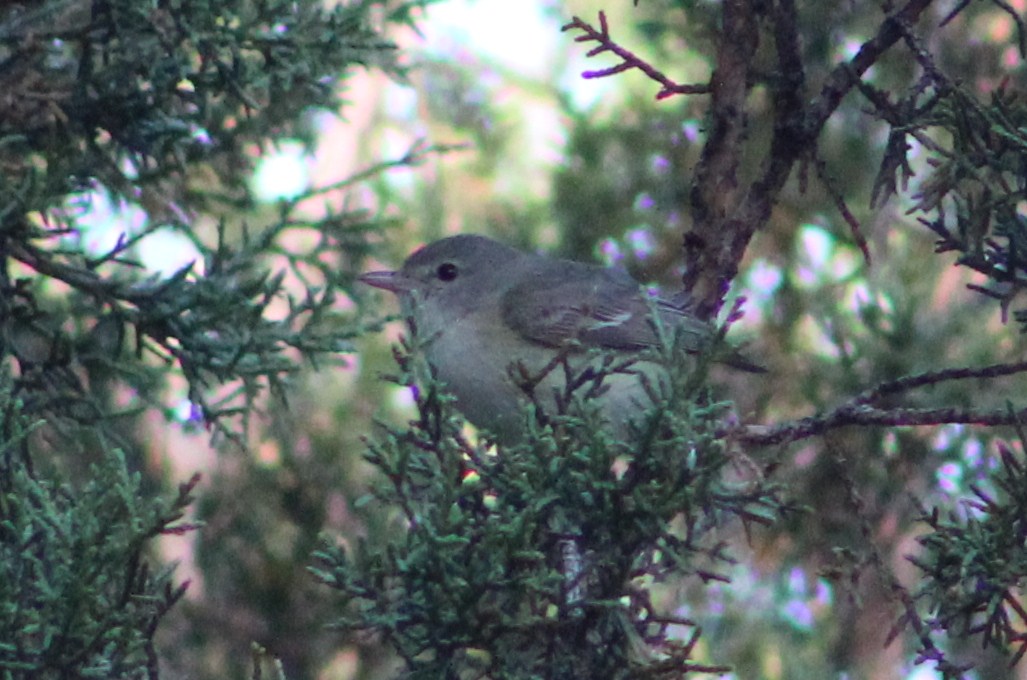
Bell's Vireos too...


Lucy's Warblers and Yellow Warblers were the day's most numerous birds.  Yellow won the fight with 69, but Lucy's was a close second in at 62.  Here are two of the 62 Lucy's.


Less numerous but still in good numbers was another "warbler", the Yellow-breasted Chat.  15 Yellow-breasted Chats are noisy with all the different vocalizations they give.  For a bird that usually skulks, I got my best ever shots of the species.


Black-throated Sparrows and Rufous-crowned Sparrows also highlighted the morning.  68 species total for my count, and a fun morning it was!


Thursday, August 7, 2014

Birding on the Navajo County side of the White Mountains

Navajo County is a county that I haven't birded much of during my time as a birder so far.  My list for the county is just under 100, which also means that I've at least taken a couple of hikes here.  Well, maybe more than that.  My family and I have camped out at Fool Hollow Lake State Park on two different occasions and I have also taken a few other separate trips to the park.  My list from Fool Hollow Lake is "decent" and makes up for most of my Navajo County list.  Some of the northwestern side of the White Mountains are found in Navajo County in fun cities called Show Low and Pinetop-Lakeside.  These cities are about 45 minutes to an hour west of Greer, and similar habitat is nearby too.  This makes for great birding opportunities also, although it is more crowded than the Greer atmosphere.  When I do bird this west side of the White Mountains, I usually go to Fool Hollow Lake.  But this time, on July 30th, 2014, I went to a different spot, which is called Billy Creek.


Billy Creek is certainly off of the beaten birding path, and I have never heard of it before this trip despite the fact I have been to Pinetop many times.  As you can see, Billy Creek doesn't have much of a source of water.  There were puddles in some places.  But both sides of the creek are surrounded by tall ponderosa pine and Gambel's oak forest.  It made for an excellent birding location.  When a Hermit Thrush greeted me as I arrived at the Billy Creek trailhead, I thought that it was a good start to my birding outing.


I started to get a few new birds for my small Navajo County list, that will hopefully bring my list in this County to at least 100.  I don't know how many new birds I added to this small list, I do know of at least a few so far.  And this Red-faced Warbler along Billy Creek was one of them.


Now Billly Creek doesn't really have a trail running through the creek itself, despite the fact there is a nice trail system that heads in multiple directions from the trail head at the parking area.  From the parking space at the lot, one can take trails above the Creek.  I actually had a target bird here, and a good one.  Birder George West, who summers in Pinetop, has found a family of Northern Goshawks at this location from 2009 to 2011 before their nest blew down.  While George thought they left, he recently discovered a juvenile in the area and suspected the Goshawks may have just switched locations.  Birding friend Mary Williams came up here the day before I was here, and was able to see two young Northern Goshawks.  With Mary observing the birds the day before, I felt my odds were good.  And greatly, they were good odds.  It didn't take long before I heard one of the juvenile Northern Goshawks screaming, and one of them came flying right in.  I didn't have to do any chasing or bushwhacking to see it.  And I was only 10-15 minutes into my search.  Not bad statistics for a NO GO.  


The bird flew in and I got to see it and take pictures of it.  And things did get better from here.  But first, lets go over the field marks of a juvenile Goshawk.  Obviously and first and foremost, this bird is nowhere as cool looking as an adult Northern Goshawk would be.  But because it is a Goshawk for the fact, it is cool regardless.  It does have that fierce and awesome look to it too.  Young Goshawks can be easily confused with young Cooper's Hawks or other brown toned raptors in North America.  It all comes down to shape and genus features of accipiter.  With young Northern Goshawks, they are very heavily streaked from upper breast down to the vent area.  A young Cooper's Hawk wouldn't show this much streaking.  While there is size overlap sometimes, a female juvenile Goshawk will usually stand out easily in it's large size.  Like adult Goshawks, juveniles also have a prominent supercilium or "eyebrow".  These photos show that feature.  But what really nails this sucker down as a Goshawk is by looking at it's tail.  See the tail bands?  Look how sloppy they look!  They are uneven, messy, and all over the place.  You would think they would line up at some point, but the fact is, they never do!  In other hawks of the Goshawk's genus in North America, Accipiter, the Sharp-shinned and Cooper's Hawks have tail bands that are straight and neat.  I haven't seen juvenile Goshawks up close like this before, with an extended study period.  This bird was quite vocal, and it's sibling started to be very vocal too.  Before I knew it, the sibling Northern Goshawk also flew in, and I had two young hawks to keep track off.  Both of them flew in good range over my head, something I wasn't able to capture a photo of.


During the previous day, I was hiking with my Dad and brother Tyler.  I explained to them how I don't see Northern Goshawks, my favorite bird, very often at all.  So this was a treat.  I also told them I have seen more Black Bears than Northern Goshawks, oddly.  I guess those stats show that the Northern Goshawk isn't seen very much, and that it is quite the no go.  Sometimes it seems that animals or birds overhear our talking.  As I was walking up the creek, I spooked up a foraging Black Bear.  He ran away rather quickly, and I don't have a picture to show for it.  But he was there, and it was awesome to see it.  And so the Black Bear took another tally over the Northern Goshawk, once again!  When I caught up to the hawks, they weren't very scared of me.  Sadly, the lighting wasn't the best as I got very close.  The sky had hit an overcast moment.  Ah, you gotta take what you can get a lot of the time with photos.  As with most juvenile birds, they don't spook as easily as an adult would.  These young Goshawks were honestly quite fearless.


The Black Bear ran into the same direction as to where the juvenile Northern Goshawks were flying.  I tried following the bear without success, and it's probably not a wise thing to do in the first place.  I was by myself however, and if the bear decided to do a 360 degree turn in the wrong direction, I would be in trouble.  The bear was rather small though, so he wasn't one that intimidated me by any means.  But any bear is strong for that matter.  During the last time I was able to view the young Goshawks when they were up and perched was very awesome.  The lighting improved a notch and one of the birds sat up in a very nice photogenic view.  Both birds were very vocal, and I was just hoping that one of the adults would come flying on in.  


The young Northern Goshawk isn't so fierce right now like it's parents.  In another year or so, it'll be a very mean, fierce, and determined to make it's name known wherever it decides to live.  It'll be feared by every bird and mammal in the forest that it is capable of preying on.


After the juveniles eventually started flying more and circling over the area, I lost them and wasn't able to hear them after awhile.  I think they went further north into the area.  I then spent another hour walking along Billy Creek for a possible attempt of locating one of the adult Goshawks.  George said the nest was on the south side of the creek in previous years before blowing down.  When he saw a juvenile Goshawk on the north side of the creek this year, he assumed they built their nest at a different location within the vicinity.  As I walked along the north side of the creek, I didn't find any of the adults, but I think I found the new nest they built.....


Finding the probable nest for the Goshawks concluded my time at Billy Creek.  Perhaps I will return earlier in the year next year to try and see these adult birds.   Plus, I need to visit the White Mountains at more random times of the year rather than the time frame of late July-early August.  After hiking at Billy Creek, my next stop was at the excellent Woodland Lake Park in Pinetop.  The water levels of the lake were very low and it was quite sad to look at.


Most importantly, the lake levels didn't affect the abundance of bird life that was present at Woodland Lake Park, even when it was midday.  During the stop at Billy Creek and at my stop at Woodland Lake Park, I managed to bring my Navajo County list from 93 to 100!  A singing Common Yellowthroat in the reeds along the lake gave me the hundred mark for my 11th county in Arizona, only four more counties to go before I have 100 in all of them!  Woodland Lake Park is a well known place to see the attractive Lewis's Woodpecker.  On this visit, I saw plenty of them, but only one of them was in range for a good photo.


This was the particular distance of most of the Lewis's Woodpeckers.


There were a lot of American Crows around also, and a lot of those crows were noisy juveniles.  They made quite the racket, and they wouldn't stop begging their parents for things.  


The Pinetop and Show Low area is also a great place to observe Cassin's Kingbirds.  Several of these noisy birds were around Woodland Lake Park also.  They are usually heard before they are seen, as they give their loud, two-syllable call, "Que-beer".  This individual was very cooperative and let me get in range for these photos.  


Woodland Lake Park is also home to another species I was targeting for this area, the Purple Martin.  The Purple Martin is significantly bigger than any other regularly occurring swallow in North America, and out of the regularly occurring swallows in Arizona, the Purple Martin is the one I get to see the least of.  I wanted to change that today and spend time with this awesome bird.  When I started to walk around Woodland Lake, I was hearing Purple Martins and was seeing them every now and then.  After reaching the southern limit of the lake, I heard a big flock of them consistently calling from a specific location.  I looked in the distance and could see the Purple Martins landing on and flying around several big light posts.  After walking over to the light post, I stood under the incoming Martins, and they were fun to watch!


What was so interesting about these light posts to the Purple Martins?  I don't know, don't even ask!  It was probably a good feeding or resting spot away from their cozy cavities.


I was able to see a male and female pair in cavities of one of the many tall dead snags around Woodland Lake.


After watching the Purple Martins, it was time to head back into Greer.  I consider my Navajo County mini-exploration on this outing to be success.  I found the Goshawks, I reached 100 for my Navajo County list, and I explored some of Billy Creek, which was the first time I have ever been to the location.  Billy Creek goes for a long distance, and there is a lot of room for potential beyond the limited stretch that I covered.  There is a lot more to explore in the White Mountain region of this county, and hopefully I can explore more of it in the future!

Tuesday, May 6, 2014

Crazy Birding on Mount Lemmon

It was May 3rd, 2014.  For the North American birding world, it was a big day for the big days.  As many knew, Team Sapsucker was out in the field, attempting an insane Big Day in two states:  Arizona and California.  I had read about this expedition of insane greatness for quite some time on eBird, but I never payed attention to it too closely.  They did have an incredible record last year in Texas, as they recorded 294 species in a 24 hour time period.  I had forgotten about their Big Day and I never really read about it too closely about their specific whereabouts.  But I did know that it was going to take place very soon.

Meanwhile, I'm part of an epic birding group and team collectively known as the Phoenician Kingbirds.  Founded by my great friend Mark Ochs of Gold Canyon, Arizona, the Phoenician Kingbirds are truely an amazing group to be a part of.  There are very few of us and some of our Kingbirds were missing on this day of May 3rd, but all you really need is two.  To recognize a Phoenician Kingbird in the field, just look for someone with regular birding equipment plus a Burger King crown.  And Mark is the true Phoenician Kingbird.  I'm nowhere as cool as he is.


The two Phoenician Kingbirds, Mark Ochs and I, decided to go bird at Mount Lemmon.  We had a lot of birds that we wanted to see, especially an adult Short-tailed Hawk that had been sighted near the summit of Mount Lemmon in the town of Summerhaven.  Much of this area had sadly burned down from a devastating fire.  Good habitat still remains on Mount Lemmon.  The drive to Mount Lemmon results in passing through many different habitat zones, from sonoran desert all the way up to spruce and fir forests.  Mark and I originally had the thoughts of having sort of our own "Big Day" by covering the plethora of habitat zones at Mount Lemmon and seeing the outstanding variety of birds that are found in the varied habitats.  But once we got up to the firs and pines, we didn't really want to come back down from the heavenly heights.  Mount Lemmon is part of the Santa Catalina Mountains, and is the highest point at 9157 feet.  The Short-tailed Hawk certainly loves the heights, and Mark and I immediately began our search for the Arizona rarity.  I've seen two Shorties in Arizona so far, including one that I spied for my group in the Chiricahua Mountains last year.  It's one that has eluded Mark.  We were seeing plenty of hawks, just not Short-tailed Hawks.


We started to scan the ridges in Summerhaven for the Short-tailed Hawk.


The hawk was taking it's sweet time, but there were many other birds to enjoy.  We even found a different kind of Kingbird, which is known as the Cassin's Kingbird ;)


The high pitched trill-like noises from the male Broad-tailed Hummingbird seemed to be everywhere in Summerhaven.  And we got to see several of them at eye level too.


The Western Tanagers have arrived in Arizona for the breeding season through some of fall.  Gosh, they are cool!  At Lemmon, they were very common in numbers during the early hours.


Back to the Short-tailed Hawk search, Mark and I then stayed near the Mount Lemmon summit and scanned from several lookout vistas.  One of them had a great great view, and I had a brief glimpse of a medium-sized raptor flying about eye level in the distance.  It remained a mystery.  Mark and I decided to wait at this spot for awhile, with our Burger King crowns on.  All of a sudden, a vehicle full of birders pulled up.  They all ran out of the vehicle at high speeds and started calling out birds as if they were in a hurry.  Mark and I then realized who they were and said, "Hi, Team Sapsucker!!".  


Mark and I knew what they were doing, and knew they wouldn't be alongside us long.  But that didn't stop Mark from saying, "Well, were the Phoenician Kingbirds".  Some of Sapsucker knows who Mark is, and they did have smirks on their faces.


Team Sapsucker and the Phoenician Kingbirds, what a crazy combination.  And thirty seconds later, off the Sapsuckers went in the pursuit and the Kingbirds stayed in their pursuit.  The Sapsuckers had an entire day ahead of them, and were going to end up on the Pacific Ocean by the end of the day.


The Sapsucker Team but no Shorty yet.  Odd.  From many different viewpoints, the beautiful scenery of Mount Lemmon was shown.  Despite the fire, this is still a very awesome place.


While Shorty continued to be a no-show, plenty of other birds where high-shows and were on the go.  The forests were dripping with Red-faced Warblers.  This special bird is always worth a trip.


The Yellow-eyed Junco was a very numerous and abundant bird too.  Probably the most abundant bird on Mount Lemmon.


Summerhaven had plenty of their own Spotted Towhees.  There were many birds present, but I wasn't able to get photos of most of them.  Also present were a few Evening Grosbeaks, which I missed by a few seconds.


Mark and I enjoyed the higher elevations of Mount Lemmon a lot, so we decided to bird in the higher elevations for the remainder of the day rather than turn it into a Big Day of our own and visiting all of the different habitat zones.  From the summit, we did go down the mountain for a few, stopping at the pleasant Rose Canyon and Rose Canyon Lake to bird for a few hours.  


The Rose Canyon Lake Area is quite the draw for flycatchers and warblers, who seemed to be singing from every ponderosa pine tree.  This area has a ridiculously stupid day use fee, so Mark and I parked off of the Catalina Highway and simply walked in.  Ponderosa Pine makes up most of the habitat here along Rose Canyon Road, but there is also some oak and Douglas fir mixed in.  Shortly after walking on the road, we heard one of our favorite songs, "Jose Maria".  We tracked the song down and found the singer near the top of a pine tree.


The Greater Pewee is among my favorites of the southern Arizona birds, and it's song makes it a fun species.


 The Greater Pewee is usually a tree top lover and it really doesn't venture to the lower branches too often.  But when this guy got tired of singing and was wanting to eat, he came down much lower.  I was busy adjusting my camera when I took this shot.  It's better than nothing, but once I got it to where I wanted it, the Greater Pewee took the high flight once again.  I came close to having an excellent photo opportunity, maybe next time!


Rose Canyon also has a small population of the limited and very small southeastern Arizona Empidonax, the Buff-breasted Flycatcher.  This is the northern limit of this species breeding range, and Mark and I found two different singing birds during our time here.  One of them was extremely cooperative and easy to view.  These flycatchers are very small, but are also loud for a tiny fellow.  It is also a species Mark and I enjoy, and don't get to see very often.


Whether if I was in front of or in back of this bird, it was cooperative and fearless of me for a few minutes.  While most Empidonax flycatchers are very difficult to identify, the distinctive buffy breast make this smallest flycatcher in it's complicated genus one of the easiest to identify.


I don't really like to use the word "cute" to describe things, but that is what the Buff-breasted Flycatcher is, it's cute.  This tiny little flycatcher is 5 inches in length, and has a wingspan of an entire 7.5 inches.  Don't bother telling him this, cause he feels like he's is a wing-spreading giant in his world.


Rose Canyon is for sure very flycatchery.  We also had a few Dusky-capped Flycatchers as well as a migrant Olive-sided Flycatcher.  We also stumbled across this young Cooper's Hawk hunting and exploring by itself in the woods.


Mark then spied a Zone-tailed Hawk, a neat addition to the day.  We then headed back up to the summit area to look for the Short-tailed Hawk more.  Once again, we didn't have a Shortie, but we did once again have a few of these....


Once we reached Summerhaven, we were then stuck up there once we heard of a bad traffic accident further down on the highway.  The accident closed the highway down for a few hours.  After hearing several questionable stories of Short-tailed Hawk sightings that seemed to be light-morphed red tails from other birders, Mark and I struck out on Shortie for good.  But we did enjoy more forest birds up top, including those Red-faced Warblers while sitting in the car.  We also enjoyed a good bite of pizza in Summerhaven.  The birds of the day went out to the cool flycatchers, the Buff-breasted Flycatcher and the Greater Pewee.  It was once again another great Phoenician Kingbird classic expedition.  Thanks Mark!  And once again, another sighting of the day was Team Sapsucker.  The Phoenician Kingbird in a frame with Team Sapsucker members...freaking awesome.