This past July 31st and August 1st, my Arizona county birding continued. I chose to finally take the Coconino County trip I had been wanting to do. The goal was to get to 200 species or more for the County, and more importantly, to bird and get to know an area I haven't birded a whole lot of myself. Before July 31st, I sat at 193 species for Coconino, and with two days of birding and with some very easy targets, I figured reaching that mark for the County was inevitable for the short-sighted upcoming. If a Maricopa County Streak-backed Oriole hadn't interrupted me earlier on, that Coconino trip would've been a productive one. This trip turned out to be one of the funnest camping trips I've taken in 2020, and the story will not only include birds, but some impressive beasts too.
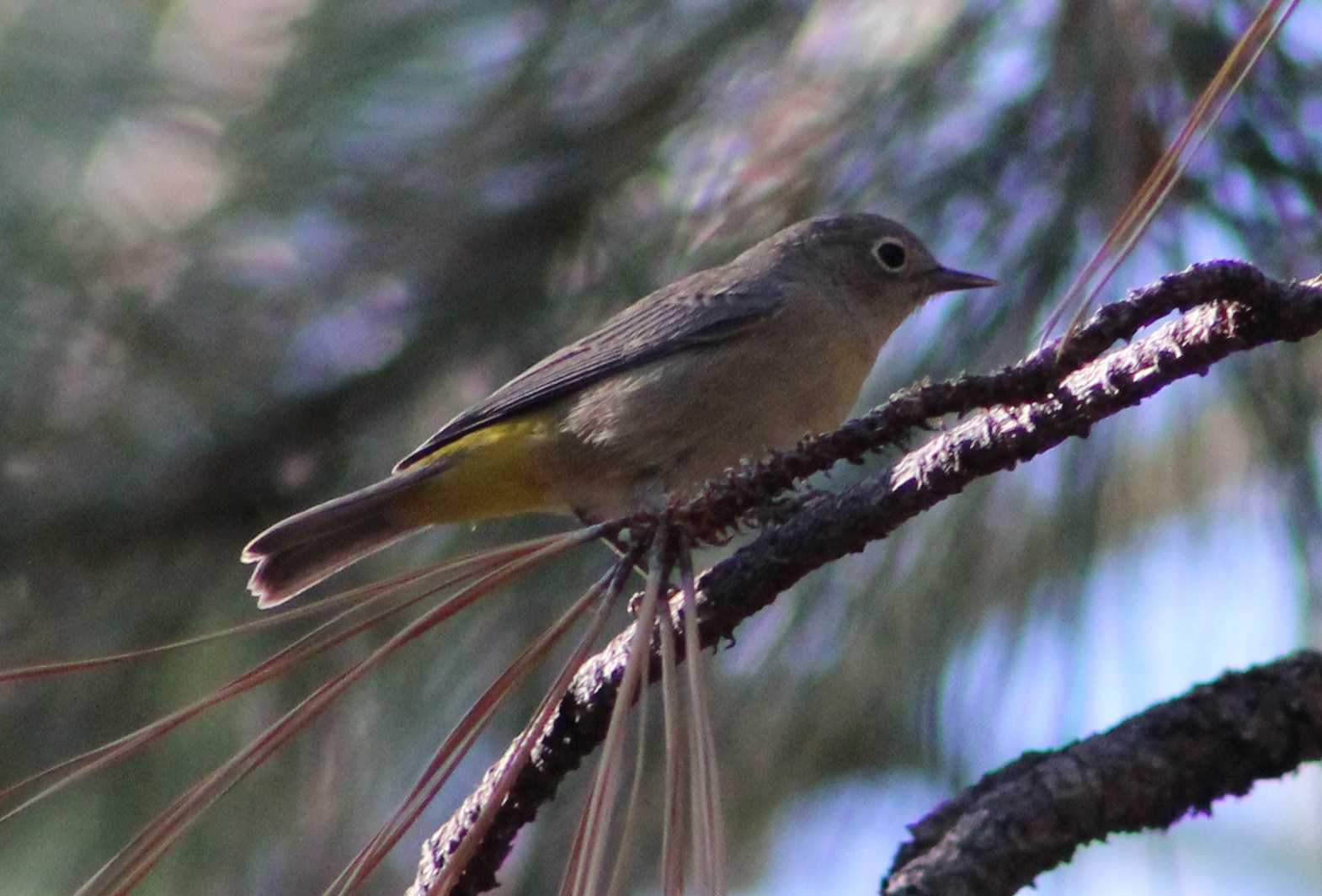
On July 31st, I left Peoria extremely early and headed up Highway 87 northwest of Payson and toward Mormon Lake. As I passed the small town of Strawberry and went over the Mogollon Rim and into Coconino County, I birded within forests of oak and pine. It didn't take me long to see a fun assortment of forest species typical of pine and oak, as well three Coconino lifers in Mexican Jay, Olive Warbler, and Greater Pewee. The mentioned species are scarce in Coconino, especially Mexican Jay and Greater Pewee.


After birding pine and oak forests, it was time to bird lakes that are surrounded by pine and oak forests. Two such lakes in Coconino near Flagstaff are Mormon and Ashurst Lakes. At Mormon Lake I scanned a vast distance provided by two convenient overlooks. Hundreds of Elk utilized the marshes below and two more Coconino lifers made their way onto the journey, which were Black-throated Sparrow and Great Egret. Ashurst Lake was after Mormon Lake, and this smaller lake can be dynamite. It has had a share of awesome rarities over the years, including Long-tailed Jaeger. For me it gave me three Coconino lifers: Double-crested Cormorant, Lesser Yellowlegs, and Baird's Sandpiper. The Lesser Yellowlegs became my 200th bird for Coconino, which made Coconino the 11th county I've reached 200 or more species in. I also found a rather-early Merlin briefly frequenting the side of the lake that I spent most of my time birding at.


Near Mormon Lake at a pond that is called Fulton Pond was this Willet that I went on a ten minute chase for when I saw that someone reported it on eBird. Always a solid bird to get on an Arizona birding outing.
Neotropic Cormorant is increasing rapidly in Arizona. The lakes of Coconino County is part of that, and as I made my way to a location east of Flagstaff, Walnut Canyon Lakes held a few of these small cormorants as I made a small side stop to look for them and any other birds that could be present.
East of Flagstaff were a few tanks out in some very barren country that held sagebrush desert habitat. Bendire's Thrasher has been found in the area, and I thought that it would be a fun bird to look for in Coconino. I didn't find Bendire's Thrashers, but they were replaced by a few Bendire's Thrashers in Anderson Canyon which held good habitat. The area also gave me two more Coconino lifers, which was Eastern Meadowlark and this Common Nighthawk.

Before I knew it, it was getting to be much later in the day and I was heading back west toward Flagstaff. I decided I would camp out near Flag along Shultz Pass Road. Once I found a campspot, and had a good hour and a half of daylight left and hung around the campsite. I picked a spot along a canyon that I thought looked like excellent habitat for Spotted and Northern Saw-whet Owls. When it got dark the night was lit up by a brilliant full moon. I stood and listened for that Spotted Owl that I was expecting to hear. Within minutes, a female Spotty barked several times and gave her contact call to who was either her mate or her young. Throughout the night and early morning of August 1st, I would hear her bark at random times. I big part of me wanted to visually search for her in the canyon, but I decided to let her be. A mountain lion also crossed my mind...

The Spotted Owl was the bird of the trip, and it became my 207th bird for Coconino County. On the morning of August 1st, I made my way northwest of Flagstaff to bird the area of Wilson Meadow, Hart Prairie, and Little Spring. These locations are highly reputed for birding. En route I encountered this bull Elk.
I got to Wilson Meadow and walked the area for about a mile. It is an epic meadow that intersects right with the Hart Prairie location, and I loved birding it. There were an assortment of high elevation birds in the area, and three more Coconino lifers in Wilson's Warbler, Lincoln's Sparrow, and Dusky Flycatcher. I really enjoyed seeing numbers of MacGillivray's Warbler and Green-tailed Towhee.


After Wilson Meadow, I realized I could only go into the Hart Prairie Preserve with some sort of reservation. Oh well, it gave me more time to explore Little Spring. I knew that Little Spring be awesome based on the things that I have heard about it, and I made my way to the location. I parked along the forest road nearest Little Spring and hiked up the trail to the Spring. The area was awesome, and I found myself starting to look for Spotted Owls within the dense coniferous and aspen forest. As I got to Little Spring itself, I heard some heavy crashing in the woods nearby. I figured it was an Elk. Without thinking much about it, I looked ahead of me on the trail, and I knew the shape in front of me that was standing on a log. I had it's attention, and it was no Elk.

They all say you should yell "hey" or something like that to let a bear know you are coming down the trail. I guess it didn't make any sort of difference. This Black Bear didn't care. In fact, he started to walk in my direction.
I walked away from the Bear, and I continued to follow. After looking at him carefully, I could tell he wasn't going to be any sort of threat to me. I walked back up the trail and the bear and I shared space within close proximity of each other. For a few seconds I got a little nervous and told him to get lost. He looked at me and showed his teeth while standing his own ground, almost as if he was saying, "look dummy, I'm on a hike too, just like you are". After that, the bear foraged and I birded.
I continued up the trail beyond Little Spring where the bear was. After going another fourth-of-a-mile, there was another freaking Black Bear! It was standing up on a slope almost motionless at first and was staring at me.
Arizona used to have a lot of Grizzly Bears too before they were extirpated. If we still had Grizzly Bears in Arizona, I think I'd buy a freaking gun.
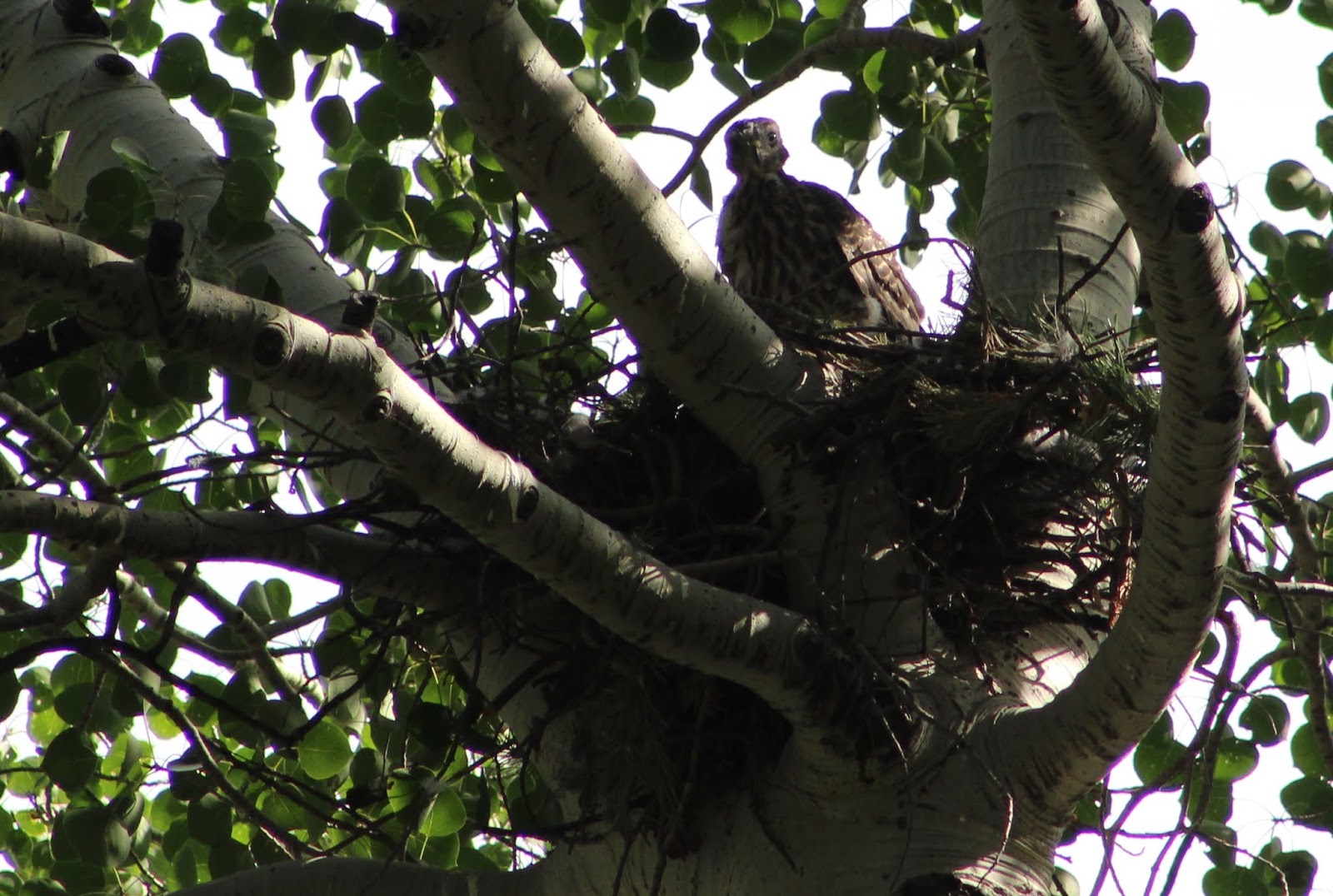
After I found the second Black Bear, I heard more bear-like crashing in the woods further up the trail. I wondered if it was a third bear. I was a little nervous about the mystery, but I kept going. Further up the trail, I heard a Northern Goshawk start screaming. I looked up where the screams were coming from and I saw what appeared to be a nest near the top of a tall aspen tree. The bird called again and I couldn't see it. From the angle I was at, the nest didn't look too impressive and I wondered if by chance that I had a Steller's Jay imitating a Goshawk. After some searching, I didn't know what to think. The bird sounded like it was just above me, but I didn't see anything. However, I eventually went to the other side of the nest and it looked like it was in better shape from the other side. After raising my binoculars, I found a young Goshawk sitting on the nest. And the adult, the Gray Ghost, was nowhere to be seen.


The Goshawk nest was amazing to see. After waiting for about two hours, the adult only came in once for a brief perch before it flew into the forest. It played it's "Gray Ghost" nickname out well. I showed a few hikers the Goshawk nest and they thought it was cool, and they told me they saw a careless Black Bear along the trail not far down from where I saw mine. It was obvious the bear didn't care about having people around. When I came back down from the trail again, we had another close visit with each other.


After spending the morning and early afternoon at Wilson Meadow and in the deep woods by Little Spring, I ventured over by Ashurst and Mormon Lakes before heading home. At Ashurst Lake, I was pumped to get three more Coconino additions: Forster's Tern, Western Sandpiper, and the pretty rare Semipalmated Sandpiper. The latter was the one I found first, and when I was about to leave, the tern flew in and while I was documenting the tern, I managed to find a few Western Sandpipers (which I didn't see despite scanning the shore carefully on previous scans).
Mormon Lake was too windy to bird as I passed by, but I did stop at that Fulton Pond again. I obtained two more Coconino lifers here which came in the form of several Bank Swallows and this Wood Duck.
I really got to explore Coconino County well on this trip, and a lot of it took place around the Flagstaff area. My list went from 193 to 217 species, which equaled out to 24 additions. I was happy with what I got, and I didn't think I'd get that many. It was a great trip, and it was great to explore many new locations that I had never birded before. Getting 200 species in a county is a fun thing to do, and to do that one has to do a considerable amount of exploring in each county. It also paves the way for future birding trips and itineraries. Stay tuned for more Arizona county birding, which results in explorations that I love to take.