The Whooping Crane is a bird that is both fragile and strong. Standing tall at five feet, it is North America's tallest bird and it has an impressive wingspan of over seven feet. It is also one of North America's most endangered birds, and was once on the brink of extinction. Josh, Evan, and I really wanted to have the chance to possibly see one. Necedah National Wildlife Refuge held that chance for our trio on June 12th as we got into Wisconsin.

Necedah National Wildlife Refuge is located in the heart of central Wisconsin in Juneau County. This Refuge was established in 1939 to serve as a breeding ground for birds and to benefit other wildlife. The name Necedah comes from the Ho Chunk tribe, which means, "land of yellow waters". In our visit to the refuge, I didn't notice a lot of yellow in the water if any, but the name goes along with the yellowish water that is stained by minerals in the soil. I don't care about names really, I'm just shooting up a small breeze. Most importantly, Necedah has birds, and Necedah doesn't just have birds, it has a lot of birds! With 44,000 acres of land taken up by the Refuge, the habitats that are found within Necedah include savanna, prairie, wetland, and forest. There are many trails running through the Refuge, and it takes birders through the heart of an essential area. Well over 200 species of birds have been documented here, but we were mainly after one of those species, the Whooping Crane. While Whooping Cranes are seen often at Necedah, such a bird is never a given for detection. And if detected, sightings here are often at the other side of the refuge where the most powerful of powerful spotting scopes are needed. To be honest, I thought there was a half-chance our search would look a lot like this.

And then there was another half-chance also. That was the other half of the Crane search, and the half that would show us jumping up-and-down in celebration. After we arrived at the Refuge after a drive that went on for a long long time, Josh and I started to look over maps and decided we would scout the area out before we did any major hiking or Whooping Crane searching. We entered Necedah on Sprague Mather Road, which runs east-west through the north-central part of the Refuge. After driving through dense pine forest, we came upon an open marshy area that had big pools of open water and some lakes. At this point, a side road veered north to a trail head and we were now officially between two water bodies called Goose Pool and Sprague Pool. And then Josh said, "Is that one?". To the right of us on the north side of Sprague Pool was a big white bird......
We lifted up our binoculars and saw everything that we wanted to see. A Whooping Crane...already!
Josh had spied the Whooping Crane, and I felt bad for his fist after our fist pump. I was very appreciative, that's all. The crane was simply feeding out in the open meadow in front of us. Most of the time, birds like this come at the middle or the end of a story. It's not often that you are lucky right away like we were this time. That's what makes birding fun, a variety of stories. Necedah has it's Whooping Cranes, but it is also a very big area!
The three of us took some time to enjoy the Crane from a distance. Our binocular views were solid and our camera shots were decent considering the Crane was pretty distant for photos.
Here's an shot of the area with my lense zoomed out. A large white bird stands out like a sore thumb.
As I was focused on this one Whooping Crane, it didn't occur to me to look around and check for others nearby. Evan stood next to me and looked at the Crane. Luckily Josh is smarter than I am and looked around for that reason. Seconds later, "Hey, over here!". I looked behind me to see that Josh had another Whooping Crane right there behind our vehicle. It was just past a bend in the water flow!
The bird was just standing there, all along! Wow.
This second Whooping Crane allowed us to get some excellent views and and good photographs to go along with it. As we felt blessed enough with the first bird, the second bird was more than what we could have asked for!
After watching this second bird for awhile, it then stopped, spread out it's body and wings, and let out it's noisy bugle call. It was really neat to hear this Crane give this vocalization. I did have trouble focusing on the crane because I had to use manual focus. In the viewfinder, it can be challenging to line things up perfectly.
The Crane then took flight, and the three of us got to see this massive bird's seven foot wingspan at a close range. It continued to bugle as it flew, and it joined the original bird that Josh found.
For some more factoids on the Whooping Crane, these birds travel in family groups year round. As I mentioned earlier that they are one of North America's most endangered birds, the population of 200-300 birds in the wild really shows it. In 1941, the population got as low as 15 birds.
For field marks on this bird, the red crown, red malar, all white body and black wingtips in flight make this bird very distinctive. The Wood Stork may look similar in flight at only a quick glance, but has a completely different neck length, a much longer bill, and much more extensive black on the wings than a Whooping Crane does. Plus, the Wood Stork is ugly and the Whooping Crane is good-looking.

At Necedah National Wildlife Refuge, these birds are part of a reintroduction. So far, the reintroduction has been successful and these cranes have bred and have successfully raised chicks in the wild. The Wisconsin population of Whooping Cranes migrates to Florida. A few years prior to this year, Whooping Crane populations as reintroduction efforts weren't considered to be a substantial population of wild cranes outside of the birds that are found in Alberta, Canada, who migrate south to saltwater marshes to winter in Texas. As birds who have been introduced have bred in the wild and their populations are growing, the ABA (American Birding Association) has changed some listing criteria. A few years ago, they added populations of such birds like the Whooping Crane, Aplomado Falcon, and California Condor to the ABA list who are now breeding in the wild through recovery efforts. As I list with ABA criteria in mind, all I can say is I'm glad they changed things up so I can count these birds on my list. However, it would be very fun to see the Alberta/Texas birds someday knowing they are part of that original population.

Josh, Evan, and I sure felt lucky to be able to see this bird knowing that at one point we could just as easily only ever seen it in the extinct species section in a field guide. Today, the Whooping Crane population is obviously doing a lot better, and hopefully, those numbers will continue to grow.
As we quickly found our target bird, it was then time to head out of bird rich/birds everywhere Necedah. We still had more birding to do. Here are some pictures of the area that the crane was in. Awesome huh!...
I'm entirely joking. The fun at Necedah was just getting started.
In flew our second Crane species of the day, the Sandhill Crane.
And away flew our first mimid of the day, a Brown Thrasher.
And then came my second lifer of the day, an Eastern Towhee! Eastern Towhees are very common in eastern North America, and are the eastern counterpart of our western Spotted Towhee. The Eastern Towhee sings a well known song that birders interpret as, "Drink-your-teeaaaa". As Josh drove through the Refuge, the songs and calls of the Eastern Towhee grew to be quite common. Funny thing was, we took a trail north of where we had our views of the Whooping Cranes. We tried for about twenty minutes to see the first Eastern Towhee we heard singing before we saw it. By the end of our outing there was no need to ever worry if we'd see one or not. Eastern Towhee and Spotted Towhee were once a con specific Rufous-sided Towhee before they were split and each went their own separate way.

The two "Rufous-sided Towhees" look very similar to one another. While Spotted Towhee is well named and has white spots on it's black wings, the Eastern Towhee has a white "patch" at the base of it's primaries which is quite a striking field mark.
We continued exploring throughout the Refuge. The many roads went through an awesome amount of habitat. Necedah is a place where one can easily spend an entire day of birding.

At one point, we stopped along the road to listen to a song we heard. While listening, things got exciting as I heard the song of a Golden-winged Warbler! The Golden-winged Warbler's main song is a fine-tuned and high pitched "Bee-buzz-buzz-buzz...". The first note is the highest note of the Golden-winged Warbler's song, and the three following notes are lower in pitch than the first and are exactly the same as one another. I freaked out and told Josh I heard the song, and right as we got out, Josh spied a Veery sitting in a bush just feet away from the vehicle. Right before Josh and I were about to get killer photographs of the Veery, it managed to sneak away. But my lifer Golden-winged Warbler sang once more, and we had to get some good looks at it! After a short wait, we caught sight of the warbler, which was my third life bird of the day.

This is a male Golden-winged Warbler. Females are similar but aren't as strikingly marked as the males are and have lighter field marks. Because this bird hybridizes frequently with the similar and very closely related Blue-winged Warbler, traits to look for in identifying a pure Golden-winged Warbler include: a bright yellow forecrown, black throat and ariculars, a bright yellow wing-panel, gray back, and an unstreaked pale gray and white overall (Sibley). A bird with another striking feature not lining up with these key Golden-winged Warbler traits may very well be a hybrid.
While Evan slept in the car, Josh and I were treated to a show by observing this male Golden-winged Warbler. Golden-winged Warblers prefer small patches of dense brush, stands of small young trees (especially aspen), and weedy areas within forest edges. This warbler was another big warbler highlight for me on the trip, and it became the third lifer in the warbler family.
Golden-winged Warblers are declining in their total population because of habitat loss, which is due to human expansion. This lifer was one that I found myself really enjoying and every warbler lifer made things get better and better.
Josh and I had to stand in some thick and tall grass while looking at the Golden-winged Warbler, where obnoxious bugs were almost everywhere. A tick on my neck later in the day likely came from the observation of this warbler. But it was worth it and lifer warblers always bring fun to the table. As we continued on to bird and explore Necedah, we came to a stretch of oak savannah habitat, where Josh said is a great place to look for Red-headed Woodpeckers.
It didn't take long for Josh to spy a Red-headed Woodpecker.
And then another...
And another!
We had entered into a Red-headed Woodpecker colony, and over a short stretch, we had counted at least 12 birds conservatively. There were probably a lot more. Most of the time, Josh, Evan, and I were enjoying the woodpeckers while driving slowly along the road. Who knows how many we would have detected if we were actually walking around through the habitat. As I lifered on this bird in East Grand Forks, it was cool to see them again up close and in high numbers. The look of this bird in flight is very different from anything else in North America.
Woodpeckers are a fun family to enjoy. During some of our observation, pairs of these woodpeckers or perhaps males fighting over territory and females seemingly had it out for each other. Josh and I observed a pair fighting or doing whatever when two Red-headed Woodpeckers slowly fell to the ground together, appearing to have violent intentions.
We then went to the Refuge's headquarters where there is a visitor center, interpretive plazas and other stuff, hummingbird feeders, and boardwalks. It was really pretty cool. At this point, we had about an hour's time left for birding at Necedah before we had to leave to get dinner and scout for the following day's target bird. The visitor center was pretty neat, and according to eBird, I saw that Whooping Cranes were sometimes observed from the lookouts within the immediate area. When we got there, we looked out to see two more of our tall white birds in the distance...
Yeah baby! And our Whooping Crane count was up to four. Here's a zoom up. You can clearly tell from here....
As we walked around the trails near the visitor center, we saw a few cool birds. One of them was this low foraging Yellow-throated Vireo. This Vireo was a constant vocalizer almost everywhere we went on this trip. The problem was that they sing very high in the trees and it's hard to get a visualization of this bird that isn't a tree topper. When we had this bird foraging low beneath our eye level, I got a little nervous when trying to photograph it because I wanted to seize the chance. And I fared pretty well in the end!
A flash of black and orange indicated the Baltimore Oriole was coming in to the area too.
You know what was weird about the first half of the trip? Other than detecting a few heard-only call notes, I didn't have any other hummingbirds on the trip. And the Ruby-throated Hummingbird is supposed to be an easy and common bird to see in these parts. I found myself scratching my head throughout the trip wondering where all of the hummingbirds were. It was weird, and Josh and I couldn't figure it out. And then there was that one feeder at the visitor center. As we stood there listening and trying to find an elusive American Bittern who was calling from a nearby marsh, a male Ruby-throated Hummingbird finally showed up for me. It became my 24th life bird of the trip, and my fourth life bird that was seen at Necedah.

The Ruby-throated Hummingbird is obviously a well named bird. As being the only regularly occurring hummingbird in eastern North America, this bird is very popular. The male's ruby throat is something that is highly appreciated. It felt funny to me thinking that these hummingbirds would be conspicuous throughout our trip and to then realize they wouldn't be common at all but rather hard to find. The cool thing about this sighting is that it came when I was consumed with a lot of other birds during the time he flew in. Regardless if the species is common or not, all you need is one..

The Ruby-throated Hummingbird is very similar to the western counterpart of itself, the Black-chinned Hummingbird. Both birds show a black chin and have a black "masked" look surrounding their eye and extending behind their eye (in good lighting). They also are green in coloration on the head and back and below the gorget of the bird, a striking white upper breast with the white extending down to the belly and underparts. With males of these two species, they are easily separable in good light by the color of their gorget. Black-chinned is a purplish-blue and Ruby-throated is you know....ruby.
Being from Arizona I am blessed with how many hummingbirds are in my home state. Ruby-throated has shown up only occasionally and is considered casual/accidental in Arizona. Seeing my first "eastern" hummingbird was a real treat!
A White-tailed Deer crossing the road in front of me was pretty cool too, even though they were more numerous than birds!

Something else cool happened when I detected a calling Yellow-billed Cuckoo in some trees near us. Josh and Evan were ahead of me, but I called for them to listen and the bird continued to call. This was a lifer for Josh! We searched and searched for the Cuckoo without any killer visuals, but from time-to-time, it would vocalize. At one point, the bird flew right over our heads and into a section of willows along a riparian area. Josh searched hard for it and saw a bird briefly that was skulking around that was probably the bird. That's the way that cuckoos are, they are secretive and are tough to see. There was actually a Cuckoo on this trip that was one of my most hopeful targets and what would be life bird for me, the Black-billed Cuckoo. But it remained hidden when I was around and never even spoke once. As I mentioned earlier in my posts, you win some and you lose some, that's what makes birding fun. As for Necedah National Wildlife Refuge, it treated us very well. What an epic place..

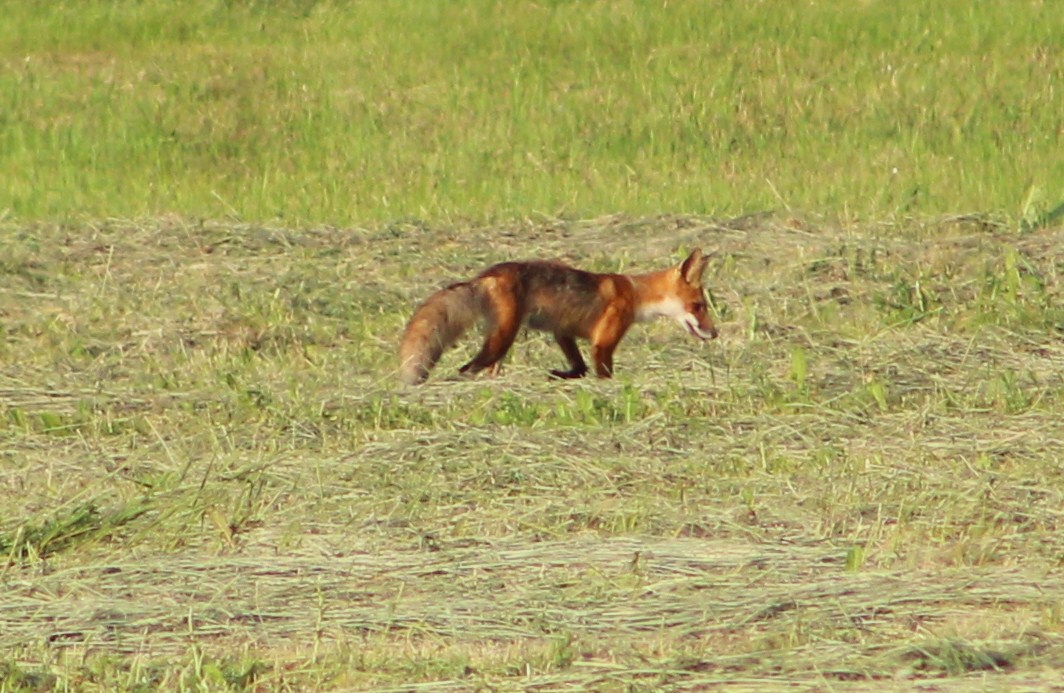
To close out this section of our day, on the way to Wisconsin Rapids, where we would stay, Josh, Evan, and I were treated to this Red Fox hunting out in a field. After seeing my first Red Fox in the very northeastern tip of Arizona crossing the road briefly, it was cool to see this one hunting and taking his time. There wasn't one hair of care on the Fox's behalf about us watching it. Stay tuned for at least three more posts from this epic trip.