Showing posts with label Zone-tailed Hawk. Show all posts

Saturday, September 3, 2022

I think I Have A Great Crested Flycatcher!...

 I woke up early today, September 2nd, and had a mission in front of me, a hardcore one.  The root of the mission was to bird along Sycamore Creek via the Old Beeline Highway north of Sunflower.  I had a strong urge in my gut to come here, and a strong urge to bird the surrounding area such as the juniper, chaparral, and pinyon-pine covered slopes, as well as Mt. Ord.  A big reason is because there is interesting movement from Jays in the last week.  Woodhouse's Scrub-Jays have been overly numerous, and Pinyon Jays are showing signs of irrupting into lower elevations this fall as well.  A few days ago, Jake Thompson had a big flock of Pinyon Jays moving around in the town of Duncan.  For today, I wanted to place myself in a position where I could possibly get them if they were to move through, as Pinyon Jay would be an incredible species to land in Maricopa County.  Clark's Nutcrackers have been reported in a few areas too that are lower-than-usual for them.  So today would be an approach that I like to call "combo birding".  It's awesome, and it not only gives you a chance at a great diversity of species, but it also give you more of a chance to find unusual species at key times of the year during migration.  My plan for today was to stand stationary at a few stops along the Old Beeline to listen for interesting species (alright, to listen for Pinyon Jays!) at dawn, bird along Sycamore Creek early, make a few stops in pinyon-pine and juniper after Sycamore Creek, and then go to Mt. Ord.


After turning onto the Old Beeline Highway west off of Highway 87 (signed off as "Sycamore Creek", adjacent to Mt. Ord, just north of mile marker 222", I pulled off at a few pull outs along the road that gave good views of the surrounding area and habitats.  I made two stationary stops, starting just before 6 A.M. and lasting close to 6:25.  I didn't have any Pinyon Jays, but there were many Woodhouse's Scrub-Jays, a Gray Flycatcher, and Gray Vireo still hanging around, and a good number (5) of Crissal Thrashers.  As I made my way to Sycamore Creek I was surprised to see an Osprey perched on a snag along the side of the road.

I arrived at Sycamore Creek via the Old Beeline at 6:31, as the sun was coming out, and there was clear weather.  As I had the vibe that it was going to be a productive morning with good numbers of birds, I slowly made my way south along the old paved road as it paralleled the creek (which is pretty dry right now).  Birds were indeed numerous and it took my awhile to get to the old and abandoned Sunflower Workstation.  As I was about to get there, I heard this rising and upslurred "wheeiiep" call that immediately struck me as being a Great Crested Flycatcher.  I listened closely and heard the bird again.  Wheep!  I stilll thought the same thing.  Even though I could hear the calls pretty well with my own ears, I knew that my phone wouldn't be able to record the calls from where I was, and I moved forward while listening carefully.  The call continued to come, and I knew I had to record the bird.  Great Crested Flycatcher is extremely rare in Arizona with 4 state records, and Maricopa County is without a record.  The last record was also in the month of September, but it was back in 2010.  Knowing this in the back of my mind made my heart beat pretty freaking fast, and luckily I got to a point where the bird was loud enough and close enough for my phone to pull off a recording.  The bird called three times while I recorded and as it was much closer, I now wanted to get my eyes on the bird.  It continued calling as I edged closer, and I got to a spot and expected to see it.  I looked a few feet too high on the juniper slope it was no calling from, and at the last second I saw it sitting on a branch.  It flew right when I was about to react by looking through my binoculars or trying to get off a pictures.  What I did see though was important, I saw that it was a Myiarchus flycatcher.  I stood on the road and played calls for Great Crested Flycatcher and it went completely quiet on me.  For a few minutes I looked up on the juniper slope it was calling from, hoping to detect it again.  All of a sudden it/a Myiarchus flycatcher flew out from the slope and past me and toward the riparian along Sycamore Creek before landing high in a tree.  I did get the vibe of a bright yellow frontside on the bird that contrasted well with a dark upper body and face area as it flew by.  When the bird landed, I had it in view from quite a distance and unfortunately, it had it's back to me.  Pictures that I took were worthless.  The bird dropped down into some thick riparian along Sycamore Creek.  I investigated further by using playback of an owl mob.  Lots of birds came in, and it was frustrating when an Ash-throated Flycatcher was one of those birds that came in.  It was around 7:18 when I heard the Great Crested/Mystery Flycatcher, and I looked around the area for close to an hour without any further luck on it.  I let the birding community know what had happened via the Group Me text messaging application in our group, "AZ Rare Birds.  Limited service prevented me from being able to send my audio recording of the bird to Group Me, but I was able to send the audio through Messenger to Caleb Strand, Nolan Walker, and Kadynn Hatfield.  All three of them, who are great birders, agreed taht it sound good for Great Crested Flycatcher. And sadly, I couldn't find or hear the bird again.  What was important was I saw a Myiarchus giving the call, which matched Great Crested more than anything and it's one competitor would be even rarer in a Nutting's Flycatcher.  I decided to put it on my list for the day and submit it as Great Crested Flycatcher, and if my recording wasn't good conclusive enough then I would chance my observation. 

Poor shot of the bird

Aside from the Great Crested Flycatcher madness, this area was spectacular for birding.  I detected a diverse 65 different species, and there were several other highlights that were very fun.  Close to my starting time, a Golden Eagle flew pretty low overhead, and I reacted late to blow my chance at getting a photograph.  2 Common Black-Hawks were present, and I got great views of a juvenile (which I think are cool-looking), and 2 Zone-tailed Hawks were also present.  A Great Horned Owl flushed from a wash I walk down while I followed the creek.  UP to 3 Gray Vireos were still present here, as all of them sand from the hillsides.  At least 20 Woodhouse's Scrub-Jays were along the route, probably many more (and I still did listen for those longshot Pinyon Jays!).  3 White-breasted Nuthatches seemed like a solid count for the elevation and with it being this early into gall.  Migrant warblers and vireos were pretty numerous, and I managed to find a Black-and-white Warbler foraging with a mixed feeding flock.  From where I parked, I walked south for over a mile, and ended not far north of the barricade to the Sunflower community.  Aside from birds were a few herds of Javelina.  When I walked back north, I took my time as I walked through the area where I had the Flycatcher.  No more extended luck, and it was a little discouraging.  It was getting hot out toward the end, and after about 5 hours, I called it a birding day.  I almost went to Mt. Ord, but I decided not to as I was getting tired.  As I have work tomorrow, this Flycatcher may have to be in the hands of other birders who might chase.  Almost definitely so...

juvenile Common Black-Hawk


Zone-tailed Hawk

Woodhouse's Scrub-Jay


Bushtits


Virginia's Warbler

Wilson's Warbler


September 3rd, 2022:  The Best "Vicarious" Birding Of My Life

After the field yesterday, things got interesting for me.  All I thought abot was the Great Crested Flycatcher.  My recordings were ertainly intriguing to others.  Dave Stesjkal, a great birder, said of my recordings, "that they sounded like Great Crested to him over the next closest candidate for him, the Nutting's Flycatcher.  Caleb, a great birder, said too that I should partially consider a certain call from Orange-billed Nightingale-Thrush.  While that would be a thousand times more rare, I still wouldn't put an Orange-billed Nightingale-Thrush as impossible for Maricopa County and there's a chance that species could show up anywhere in Arizona.  The calls he referred to are similar, but would come across differently than a Great Crested Flycatcher in the field.  Plus I saw a Myiarchus giving the calls.  I was a bit discouraged, and hoped that people would go out and look for the bird.  After all, it seems to me like a bird with 4 Arizona records would attract a bit of a birding crowd. 

Early today, things got really interesting when Chris Benesh, a great birder, put the recordings from my bird (via eBird checklist upload) and compared it's sonogram with actual sonogram of the calls of Great Crested Flycatcher, Ash-throated Flycatcher, Brown-crested Flycatcher, and Nutting's Flycatcher.  He made it into a table, and mine matched almost perfectly with Great Crested Flycatcher!  The other ones weren't really even close at all.  Chris posted this before it was light out, and I knew that at least three birders in Ronnie Reed, Dara Vazquez, and Benjamin Guo, were going out to look for the bird.  During all of this time, I was at work, and was checking my phone regularly.  At 7:23, a great message came into Group Me from Dara:  Tommy's GCFL continues this morning.  It gave it's distinctive loud rising weep call.  Ben Guo recorded further audio.  Got good views of bolder plumage color than ATFL or BCFL with bright lemon belly rising high on chest.  Relocated initially in oak grove on west side of research station, then flew to sycamore and chaparral ridge on east side of canyon".

"Hell yes", I replied to the message.  I was stoked, I wanted to do backflips in front of all the hospital staff I was working with and patients who I was serving food to.  In the field, Dara and Ben located the bir barely south of where I originally found it, and Ronnie rolled up just in time to hear the bird too.  (We call him "Roll Up Ronnie" for a reason!)  Ronnie texted me not long after that Ben obtained diagnostic photographs of the bird too.

Birders asked if anyone had gotten pictures.  I took awhile, but Ben put 6 decent photographs and a sound recordinga much better than mine that showed the spectogram very clearly.  And Ben's photos, I practically had a heart attack when I saw them.  They were good documentation shots and they clearly showed a bright yellow belly-underparts extending up to upper breast, dark gray upper breast and lower face, extensive orange base to otherwise larger, sturdy black bill, brown on top of heard, and tons of rufous in the tail.  "Dang, a Great Crested Flycatcher, wow!", I thought.  And then I reminded myself I found the freaking thing 24 hours earlier.

I was obvious to everyone my bird is a Great Crested Flycatcher, Arizona's 5th and Maricopa County's 1st.  It is my 485th bird for Arizona and 409th for Maricopa County.  For Maricopa County overall, I think it's the 463rd bird.  Funny thing is, Tyler Loomis found my Maricopa nemesis-a Downy Woodpecker-while chasing the Great Crested Flycatcher.  Hopefully it sticks around!

Thursday, May 27, 2021

Yellow-eyed Juncos and a few more in Maricopa County

 Following the high amount of time that I spent birding in Mohave and La Paz Counties, I've had to stick closer to home during this last month of May within Maricopa County.  Although I wished several times that I could go back west, I've been glad to get some fun birding reps in in my home county.  The reps were targeted at rare eastern passerines for the most part, as well as the possibilities of Mississippi Kite.  I wasn't able to score on any of those, but I did get a new county bird in the high country.  The bird was surprising and not surprising.

On May 8th, it was Global Big Day, a day when birders from all over the world go out and try their best to find as many bird species as possible.  Some of my friends went all out and traveled as much of Arizona as they could and had an impressive birding day.  Others contributed a few checklists to eBird, and more people did the best they could in one given area or birding location.  There was me too, who had to work.  The me didn't want to bird when work was over.  There is a lazy person at work who doesn't do anything.  It requires me to go to work with two brains, even though I only have one.  When I utilize my one as if I have two, it makes me tired and I'm pretty sure I went home to sit around and watch basketball.  Then I got a few eBird alerts about Yellow-eyed Juncos being reported at the upper elevations of Mt. Ord.  The reports came in from young birder Jacob Bagley who was with a big group of birders up on Mt. Ord for Global Big Day.  This species is one that has had 3 records in Maricopa County in the past: 1 from Seven Springs in 1971, 1 from the high elevations of the Superstition Mountains in 1974, and 1 from this mentioned Mt. Ord place in a similar time frame in 2002.  "No way", I said.  Up at Mount Ord and near it's summit, was where Jacob and his birding group discovered Yellow-eyed Juncos.  They told several other birders about the birds.  Jacob reported 4 YEJU's, and others reported 1-2 birds in the hours and day following the discovery by the group.  With a loaded work schedule ahead of me for the next four days, I wasn't sure how I was going to proceed with seeking out the Yellow-eyed Junco, which was to be a highly wanted Maricopa County life bird.  On Sunday, May 9th, things got crazy again when someone reported a Cape May Warbler at Desert Botanical Garden.  They wrote a perfect description of an adult male of such, but it turned out to be a combination of writing a perfect report by looking over a field guide illustration while wishfully thinking.  When many birders followed up on the report, they all saw a ratty young-looking Hermit Warbler.  Sure enough, the reporter was convinced at first that it was a Cape May.  I didn't make the chase for it, but I did make plans with Caleb Strand, Ronnie Reed, and Jared Conaway to chase the Yellow-eyed Juncos on Mt. Ord on the afternoon of May 10th when I would get off of work.  And "this Mt. Ord place" was sarcastically written, it's one of my favorite birding places and it has been featured on this blog a lot.

My birding party made good timing and got to Mt. Ord right about 4 P.M. on May 10th.  We walked up to the summit of Mt. Ord, which is in both Maricopa and Gila Counties.  There were many active migrants along the way that provided brief distractions.  As we got to the summit of over 7100', we walked between the fire and communication towers and ended up on the north side of the buildings.  Caleb walked ahead of Ronnie, Jared, and I, and right away, he found one of the Yellow-eyed Juncos feeding and foraging on the ground by the buildings.  Well, that's what you call fast!  The bird fed in front of us for some time, and then flushed a few times too.  At one point, it landed in a juniper and sang very quietly for a few minutes.  Caleb quickly pointed out that it lacked rufous on the tertials and wing coverts, a trait that is generally uncommon within the species and that most birds have a strong amount of rufous in those areas.  However, birds in more northerly locations in Arizona will more often show the lack of rufous than the ones in southeastern Arizona.  Our observations of the Yellow-eyed Junco were fairly brief, and further searching didn't produce any more birds.  A few Gray-headed Dark-eyed Juncos were also nearby.  The Yellow-eyed Junco we saw flew in both counties, as the line of both was very close to the observation area at all times.  Our time concluded with birding the summit area of Mount Ord, as well as the beginning stretch of Forest Road 1688.  We had a variety of birds, and it was fun to hang out with Ronnie, Jared, and Caleb.  


Another sighting I really enjoyed in Maricopa County in this past month was when I was birding at the Verde River via the Box Bar Recreation Site.  There were many species present that day, and migrants were moving through.  My highlight came when I saw what appeared to be a small buteo flush from a cottonwood stand and fly a short distance to another set of cottonwoods.  I suspected it was the rare-in-Arizona Broad-winged Hawk, and when I carefully got a clean look at the bird, my suspicion was correct.  It was epic to get a good view of this small raptor through my binoculars and get a few documentation shots before it took flight and flew off further.  It was only my third Broad-winged for Arizona, all of which have been in Maricopa County.  I haven't made it up to the Grand Canyon hawk watch yet, where Broad-winged Hawks are annual in small numbers during their migration.  If I was in the east, I'd be seeing thousands of them in migration, where they form massive kettles.


When I was birding Box Bar further and several hours later, I was stationed out in a cottonwood and willow grove where I usually have good migrant activity, particularly with warblers and vireos.  Standing stationary can have it's positive results, and a shadow over my head turned into the Broad-winged coming in for a landing and perching about 20 feet away from me!  I had a great look with my naked eye, but it didn't take long for the bird to notice me standing there, and as I started to raise my camera it took flight and went a short distance.  From the new distance, I had great looks at the hawk for one more minute before it would fly off and I wouldn't be able to see it again.  


This Whimbrel was fun to see at the Glendale Recharge Ponds, only my 2nd one ever in Arizona and Maricopa County.


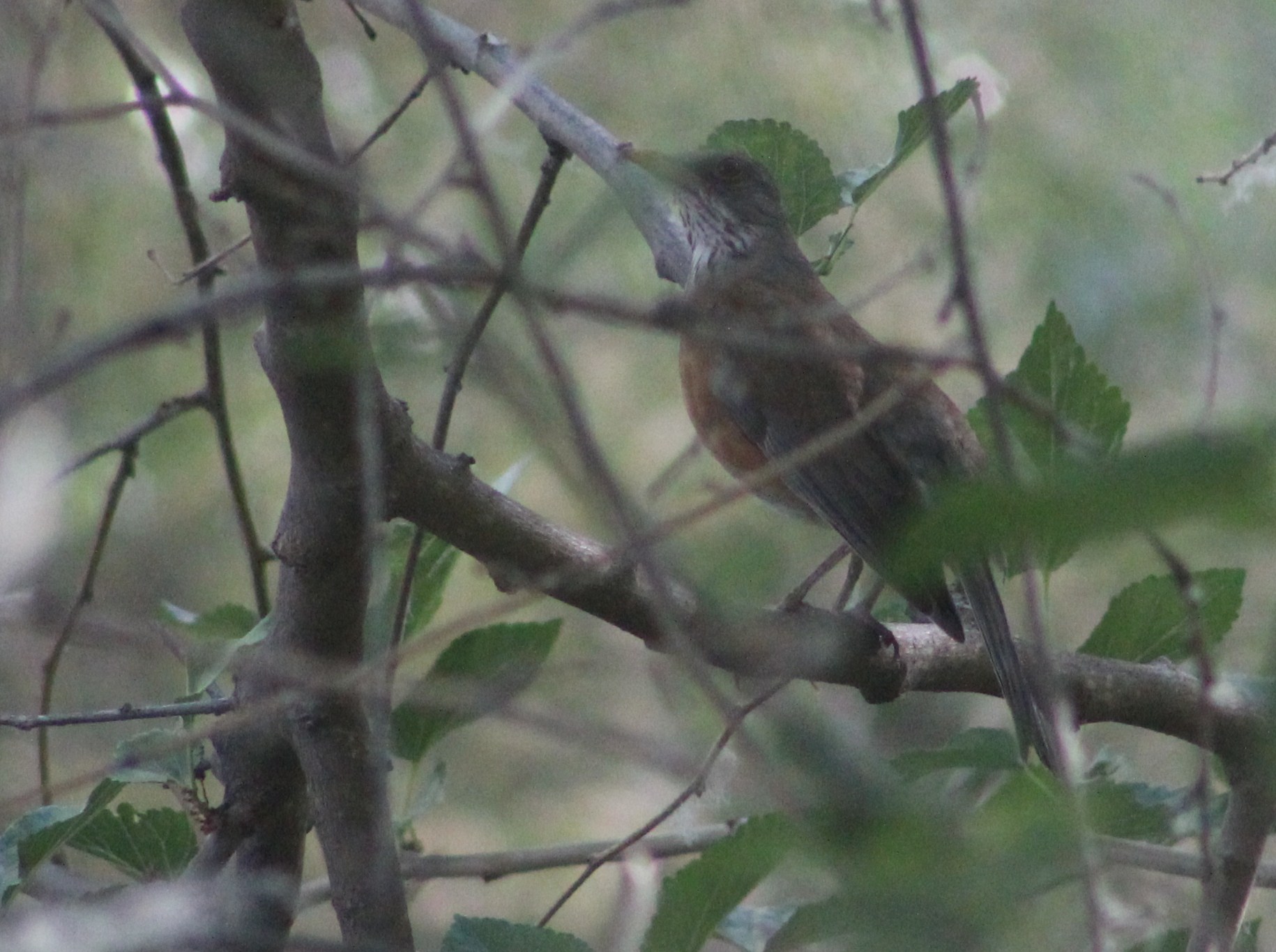
A Rufous-backed Robin has been at the Hassayampa River Preserve for some time now, and it has been continuing well into this time frame.  At times, it has been observed singing.  This species tends to be secretive, and I managed to cross paths with it during one of my several visits to the Preserve.  Like Mt. Ord, the Hassayampa River corridor near Wickenburg is one of my favorite locations to bird in Maricopa County.


A very unexpected sighting for not only Maricopa but for Arizona came when a Brant was found by Tina Bickel and Bob McCormick at Rio Salado Restoration Area in downtown Phoenix.  This bird appeared to be in good shape, but frequented the ponds of the area for about a week.  Many birders got to see this Brant, including myself.  It was a long way from it's usual coastal haunts, and it was the second one I've seen in Arizona (both in Maricopa County).  The location and time of year seemed a little odd, but I did see someone mention that this has happened with Brants before at similar time frames and within a drastic vagrant range. 


Here are a few more sightings I have enjoyed recently.

Summer Tanager

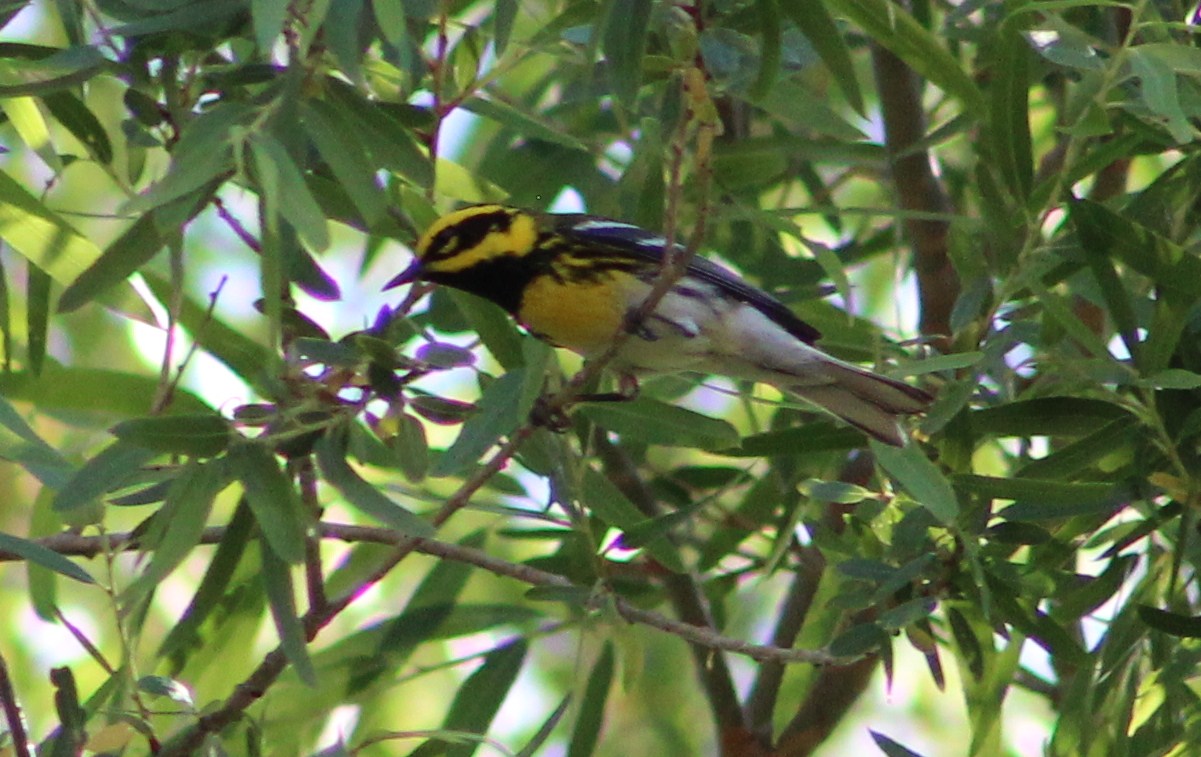
Townsend's Warbler

Western Tanager

Great Horned Owl
 

A few days after the initial Yellow-eyed Junco chase, I went back to Mt. Ord on May 13th to investigate the Yellow-eyed Junco further.  I went to the summit area again after trying to see two calling Northern Pygmy-Owls visually without success, and after some time, located a Yellow-eyed singing.  He was joined by another Yellow-eyed Junco (possibly a female), who fed with him for about a minute.  The two Gray-headed Dark-eyed Juncos joined them too.  I ended up losing the second Yellow-eyed Junco, while the first one stayed put.  It loosely associated with the Dark-eyed Juncos, and I made this written observation:  "Continuing. First located by hearing the bird in song north and just downslope of the towers, not far below the line of white tanks that are on the north side of towers. The ridge and west slope just below this point seem to be a good spot to look. Once I found the bird, it flew down a short distance and landed in a grassy area. Another YEJU joined this bird (male and female possibly), and the two birds interacted by almost touching bodies before foraging and feeding on the ground. Immediately after they were joined by the Gray-headed Juncos who fed too. The Gray-headeds were much more skittish of me, but the original YEJU remained feeding very close to me while I lost sight of the other one. The YEJU and 2 DEJUs moved up and south, where they fed on the north side of the towers by the white tanks, where the 2 species seemed to be loosely associating with each other for feeding purposes. The DEJUs were skittish again and flew off pretty far downslope while the YEJU remained. It eventually moved into a juniper where it sang for some time before moving downslope again. As noted from earlier list, the YEJU (both YEJUs today actually) lacked rufous in coverts and tertials. I saw from pictures that YEJUs from both the Catalina and Pinal Mountains have shown this some too, as opposed to the much larger percentage of birds that have rufous in these areas. The singing bird (who I watched most of the time), sang more loudly the first time I saw it in song, and the second time around it sang more quietly. In the 5-6 times it flew away when I was within close distance, it called once in flight with a few notes as opposed to the DEJUs who called alot every time they took flight. If the YEJU called, it almost always came when it was foraging on the ground. I wasn't able to refind the second YEJU after seeing it briefly".


Maybe we'll have Yellow-eyed Juncos breeding on Mt. Ord, time will tell and follow-ups will be needed later in the summer.  This is a species that I has been on my radar for birds to find in Maricopa County.  It hasn't been a strong suspect, but it hasn't been a weak suspect either.  Yellow-eyed Juncos appear to be expanding their range, how cool.


During my Mt. Ord trips, I also got to know the summit area better, as well as some of the surrounding area.  I made up my own route to take in the future, and maybe it will lead to more Maricopa lifers that I want for the Mazatzals such as Downy Woodpecker.  When I did this hike, it was fun to see a Zone-tailed Hawk cruising along.  It even zipped by me at a very close distance to where I could hear it's wings flap.


Love birding my home county!

Thursday, August 15, 2019

In The Gila: You Can't Win If You Don't Play

When Arizona birders hear the other-worldly calls from the Buff-collared Nightjar right after dusk, it usually comes from canyons in the southeastern part of the state.  Aside from Arizona birders, birders from many corners travel to witness this bird as the United States' range of the Nightjar is more knowingly restricted to these few Arizona canyons.  Over the years, this bird has shown that it has a high ceiling of showing up elsewhere and further north in Arizona into ranges outside of the typical canyons near the Santa Rita Mountains and California Gulch areas.  Last year, a Buff-collared Nightjar was sound recorded and eBirded in northern Pinal County, close to it's junction with Gila County and at the base of the foothills to the Pinal Mountains on the south side of Globe.  Just as nightjars are cryptic creatures of the night who would require a maze to locate if they didn't vocalize, it seemed as if a remarkable eBird record was just as fleeting on every level.  I never heard one person talk about this record.  Not one.  To me, a species of interest like this, a regional specialty, would qualify for a louder broadcast.  I never knew about it.  Thankfully Caleb Strand is a good buddy of mine, and he brought the record to my attention.  I was blown away, and Caleb made a good point that the species has to be somewhere in Gila County during certain years.  Looking at the eBird range map of Buff-collared Nightjar also showed records of birds in Aravaipa Canyon from Pinal County.  These records showed a handful of observers, but the knowledge of the observations were ones that still eluded me until a Caleb-inspired-research.  Between the bird near the southern base of the Pinal Mountains (which was less than a mile away from Gila County) and Aravaipa Canyon, Caleb and I looked over maps at habitat that looked considerable for additional records of the bird in Gila County.  The Boy and I made it a goal that we would find a good area or two and try to pull up a remarkable record of our own for Buff-collared Nightjar. An equal thrill of finding one would be it being a first Gila County record, a county that is well under the usual radar for the bird.  We were well aware that there was a much better chance of striking out rather than succeeding when looking for a species like this, but it was a worthy goal to us.  Caleb and I had the mindset of, "You can't win if you don't play".  The thought process stays true to the hobby of birding.  For great discoveries to happen, one has to put the work in for it.  I found myself planning a trip with Caleb over the days of July 18th and 19th, where we would be trying for not only a remote Buff-collared Nightjar, but for other birds that are scarce in Gila County that one wouldn't get if they didn't put the times in for.  You can't win if you don't play!

Buff-collared Nightjars are obviously named if you see one in the field or take the more likely route of looking in a field guide or simply going to Google.  These birds are at the very northern limit of their range in Arizona, and seeking them out in new places in places where they haven't been discovered yet is always of high interest.  Even though the nighjars are found in a variety of habitats further south throughout their main Mexico distribution, they are tied into a much more limited habitat choice in southern Arizona.  Most records come from dry canyon bottoms above 3000' and up to 4500' in midst of steep surrounding slopes within deserts or along drainage areas that feature some riparian habitats that have mesquite, hackberry, and oak trees nearby.  Caleb set his eyes on a place that is called Ranch Creek.  The creek is east of Globe and is on the western edge of the San Carlos Indian Reservation.  Looking at maps, Caleb realized that the habitat and elevations were similar to the habitats where Buff-collared Nightjars are typically found in southeastern Arizona.  While I had some places in mind south of Globe along State Highway 77, this place that Caleb had located seemed like a better option.

July 18th was an odd day.  Caleb and I planned to trek over to Ranch Creek after I would get off of work in the afternoon.  It was a Thursday, and for some odd reason I thought I had to work early in the morning that day.  I went into work only to find out that I was off for the day and that I mis-read my schedule, and by the time I told Caleb I actually had the day off, he made plans for the first half of the day.  That point in time was one of my dumbest, but in the early afternoon, we made our way towards Globe and Ranch Creek.  After purchasing recreational permits for the Indian Reservation, we made our way south down a rough road that eventually paralleled Ranch Creek for most of it's entirety.  Ranch Creek Road got rougher and rougher as we continued south.  Caleb's Suburu has a lot of muscle to it and can endure a lot of rough terrain.  Whenever we would cross a dry Ranch Creek, I was concerned for the vehicle.  It got to a point where Caleb parked the car and we would decide to walk south for up to three miles to explore the creek.  In the beginning stretches of the creek and it's riparian habitat of sycamore, cottonwood, and willow, we were greeted by a Zone-tailed Hawk.

Zone-tailed Hawk

Seeing Ranch Creek in person was better than it was on Google Maps, and Caleb was absolutely right that the habitat looked great for the potential in Buff-collared Nightjar.  We thought it also looked great for Varied Bunting, a species that we would have have had a much better chance at finding in the early morning hours or in the middle of a good monsoon season.  Northern Beardless-Tyrannulet was another bird that we thought would be present as we came up upon stands of healthy mesquite bosque with surrounding hackberry and desert vegetation along the sycamore and cottonwood riparian habitat in the creek.  It didn't take long before we heard the distinctive call of the tiny flycatcher, and it was a Gila County lifer for Caleb.  Ranch Creek was a fun place to bird during the remaining hours of daylight, and we had a variety of birds that included Cooper's Hawk, Vermilion Flycatcher, Cassin's Kingbird, Brown-crested Flycatcher, Bushtit, Woodhouse's Scrub-Jay, Bridled and Juniper Titmice, Crissal Thrasher, Canyon and Rock Wrens, Canyon Towhee, Hooded Oriole, Lucy's Warbler, Yellow Warbler, Summer Tanager, Blue Grosbeak, Rufous-crowned Sparrow and most of the common Sonoran desert birds.  Caleb also flushed up a surprise in his first Barn Owl for Gila County.

Cooper's Hawk

Zone-tailed Hawk

Ranch Creek Scenes


After a good hike, we returned to the vehicle at dusk.  Caleb planned it out perfectly (so did the rough road too, I guess) that we would go through what looked to be the best habitat for any potential Buff-collared Nightjars on our return drive north and out of Ranch Creek.  Common Poorwills didn't hesitate to sound off immediately as it got dark.  From the start, Caleb played the calls of Buff-collared Nightjar out loud by placing a speaker on his vehicle.  The sound carried for distance aplenty, and we hoped it would be answered.  We made stop after stop, and we weren't able to locate any Buff-collared Nightjars in close to two hours of nocturnal birding.  Neither of us had hopes that went too high for the species, but at the same time, it was extremely awesome to try.  It was also great to explore a new area that has probably rarely ever been birded.  You can't win if you don't play, right?  On the other hand, we did detect 12 Western Screech-Owls, 2 Great Horned Owls, an Elf Owl, and 4 Common Poorwills.  The first former of those night birds had several individuals that wanted to chill with us and perhaps they had always wanted to see a Buff-collared Nightjar in Gila County too.

Western Screech-Owl


Kangaroo Rat

Elf Owls were present at our camp out along Highway 77, south of Globe and north of the small town of Winkelman.  July 19th was the day, and we planned to venture south along the Gila River north of Winkelman before looking for Gila County rarities in Mississippi Kite, Black Vulture, and Varied Bunting and we would then visit the high elevations of the Pinal Mountains in the second half of the day.   Before the temperatures in this lowland habitat would hit triple digits, we birded along the recreation sites and riparian habitat at the Gila River.  Gray Hawks were a cool highlight, as was a heard-only Willow Flycatcher and Yellow-billed Cuckoo.  We didn't detect any Varied Buntings, which I've only found once along this stretch in 2017.

Gray Hawk

Summer Tanager 

In Gila County, Black Vulture and Mississippi Kite are two "you can't win if you don't play"-kind've-birds.  There are several records of Black Vulture in Gila County, most of which are from the town limits of Winkelman or just barely north of Winkelman while birders have been traveling on Highway 77.  I had tried for the bird a handful of times, and it managed to elude me.  Mississippi Kite is one that used to be reliable in Gila County in the town of Winkelman, especially on the public golf course in town.  From what I've heard, birders in the past used to be able to see the kites pretty easily, and often at times without having to get out of their vehicles.  Since then, they have declined in the area, but have been recorded breeding just to the south along the San Pedro River adjacent to the town of Dudleyville.  Looking at eBird, the last Gila County sighting of the kite was from Ed Dunn in June of 2015.  I still think the Kites visit the area, but are a species one has to make regular visits for in order to obtain a sighting.  Our stakes were definitely higher to see a Black Vulture out of the two, and as we got to Winkelman mid-morning, Winkelman Flats Park was our first visit.  Immediately after turning onto the entrance road to the park, I saw that three vultures were perched up on a large tree.  The left was a Turkey Vulture, and the other two were shaped differently, had gray heads that had bare skin that extended further down to the neck, and longer legs.  I freaked out and knew that we had landed our Gila first Black Vultures!

Black Vultures (Gila County #312)

Most of the Turkey Vultures in the area had started to lift up and start their morning soaring, but the Black Vultures weren't in any rush to start their soaring.  As Caleb and I observed them, they did fly away from us a few times to land on nearby perches.  It's been awhile since I've been pumped up to see a Black Vulture, but a Gila County Black Vulture is a Gila County Black Vulture...


This Tropical Kingbird was also nearby.


Our next birding stop was in high and cool elevations of the Pinal Mountains.  We started off in the Pioneer Pass half of the range, and we were impressed with the area.  It was my first time visiting Pioneer Pass, and we had close to 40 different bird species in the places that we stopped at, and that included a handful of Yellow-eyed Juncos.  We tried for a Sulphur-bellied Flycatcher that was found by Paul Wolterbeek while he was birding along Trail 200 a few weeks prior to our visit.  The Flycatcher eluded us, but what we were really searching for in the Pinals was Short-tailed Hawk.  Short-tailed Hawks are for sure "you can't win if you don't play-kind've-birds too, and Caleb and I climbed up Trail 196 in Pioneer Pass to get to an elevated viewpoint to scan the ridges for any raptors.  This small buteo was one that had eluded Caleb prior to our July 19th visit to Gila County.  We didn't find one at Pioneer Pass in our long shot attempt, but after Pioneer Pass we went over to the area of Pinal Peak, west of Pioneer Pass where the Short-tailed Hawk was more likely.

Juv. Yellow-eyed Juncos


Caleb and I were convinced we were searching for an active Shorty, especially since Dave Pearson and his birding group had seen an individual earlier in the season prior to our visit.  Even though the hawk was one I chased and got to see in the Pinals last year after Jeff, Dara, and Laurie had discovered two remarkable individuals, I was extremely pumped for Caleb to have the chance at seeing one.  I was rooting for Caleb, because it was a life bird to be for him.  When we got close to Pinal Peak, Caleb got excited as he saw a raptor that had a great initial impression.  But all it was was a Swainson's Hawk taunting Caleb.

Swainson's Hawk

The odds seemed to be against us after the Swainson's Hawk gave us a fool, and it's a raptor that usually sticks to lower elevations in mid-July.  Caleb laughed it off, and said that it was a perfect way to start our Short-tailed Hawk search in this upper part of the Pinals.  In the past, Caleb had looked many times in southeastern Arizona mountains and scanned ridges for Short-tailed Hawks without any success.

After we started scanning Pinal Peak for about ten minutes, Caleb spied two smaller raptors in the distance and further west of the towers of Pinal Peak.  They were harassing a Red-tailed Hawk.  Looking at their proportions, Caleb was convinced that they were a pair of Short-tailed Hawks.  We rushed over to get closer to spot where the hawks were at, and luckily, Caleb was able to get on them again and confirm that they were Short-tailed Hawks.  In all of the times that Caleb has scanned for this bird, it was freaking awesome to see him come away with not one, but the Pinal Mountain pair.  The behavior of the Short-tailed Hawks resulted in the birds coming after other raptors when they would fly over a specific part of the mountain.  It suggested nesting behavior, and there is probably a nest somewhere within that area where we observed them.  After a patient wait, one of the Short-tailed Hawks flew over at a fairly close range.

Short-tailed Hawk!

Caleb "The Boy" Strand right after getting his lifer STHA

The Pinals came through big time, and it's pretty rare to see Caleb get a life bird in Arizona these days.  Before leaving the Pinals, we made a last stop at a line of hummingbird feeders that are managed by a friendly couple who reside in a cabin near Pinal Peak.  We got to see Rivoli's and Calliope Hummingbirds during our quick visit among numbers of Rufous and Broad-tailed Hummingbirds.

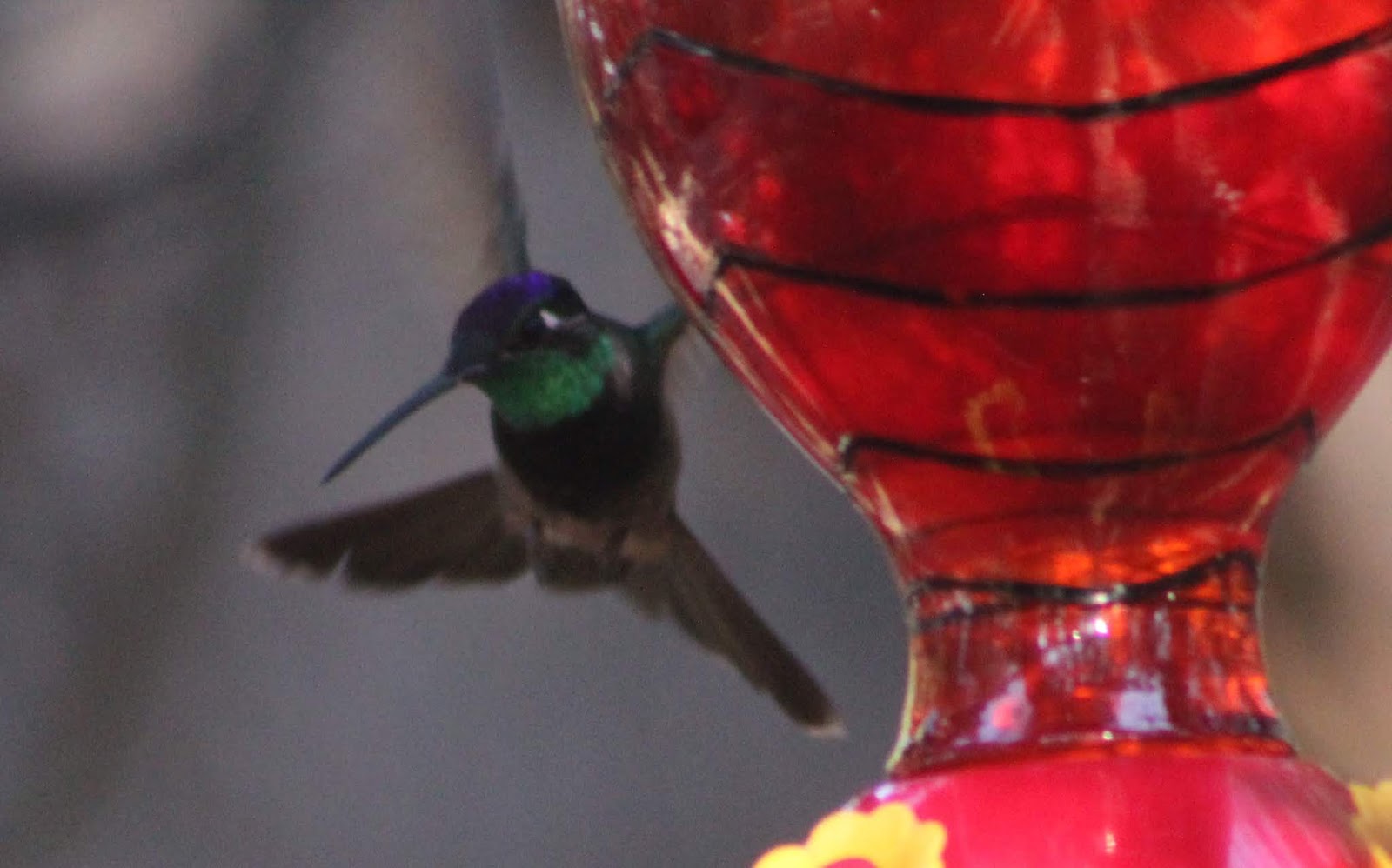
Rivoli's Hummingbird


Searching for uncommon and rare birds as target birds is a fun way to bird, and it pays off when success is a conclusion.  In the future of my Gila County birding, I hope to make continued reps to search for the possibility of Buff-collared Nightjars.  There's also rare grassland birds one can expect in the winter, and those Mississippi Kites.  And I still need a Northern Goshawk for Gila...