Tuesday, December 13, 2016

Maricopa Madness: The Push to 325

I've been exhausted lately.  Days and days have been spent in the field for my Maricopa County Big Year.  I'll go birding before work and I'll go birding after work.  I'll bird all day on days off.  We last left off with my additions of Northern Parula to the Big Year and then a remarkable discovery at Veterans Oasis Park in Chandler, my lifer Groove-billed Ani.

About a week after the Groove-billed Ani excitement in Chandler, Gordon Karre and I made a trip up to Slate Creek Divide on November 23rd to try and find some key high elevation birds for our Maricopa County Big Years.  Yes, that's right, Gordon is doing a Maricopa County Big Year too.  We found plenty of key birds.  A painful miss was a heard only woodpecker that was very likely a Downy Woodpecker.  How likely?  Well, the only other thing it could have been was a Ladder-backed Woodpecker.  There have been a few times where I have found Ladder-backed Woodpeckers in higher elevations, even higher in elevation that at Slate Creek Divide.  Although we couldn't find the likely Downy, the Douglas fir stands at Slate Creek harbored my 318th year bird in a flock of Golden-crowned Kinglets.


Later that day on the 23rd, a Ruddy Ground-Dove was reported at Celaya Park in Tempe by Dave Hawksworth, a visiting birder from New Mexico.  While Gordon's house was only minutes away from this park, he went to investigate the report and found there was a Ruddy Ground-Dove present on the 24th, which was Thanksgiving Day.  I rushed to the park and Gordon kindly waited for me to get there.  Just before I got there, a group of kids playing basketball flushed the Ruddy Ground-Dove.  Gordon was furious.  With basketball being an equally big passion of mine as birding is, I couldn't get mad at the ballers.  While waiting, Dave Hawksworth joined us and soon after, Inca Doves started to fly to the ground.  Eventually, the Ruddy Ground-Dove joined the Incas and became my 319th bird of the Big Year.  Thanks Dave!


In Mesa on November 26th, Jack Sheldon found a Harris's Sparrow coming to his yard to feed at his feeders.  On the 27th, Gordon Karre, Barb Meding, and I all got permission from Jack to look for his sparrow.  With me having to be at work by 1 P.M., I chased the sparrow after 11 A.M. which would only give me 30 minutes to look.  Jack and his wife were very accommodating to us and kindly let us peek over their wall.  Several neighbors of Jacks became very concerned and were considering calling the police as I learned later.  But with 10 minutes left on the clock, the Harris's Sparrow made it's appearance to be my 320th bird.  It was awesome, thanks Jack!


You might be wondering what happens on days in between of when I get year birds.  You can consider those days as searches and strikeouts.  Still good birding though!

As December rolled in, the first excitement came on the 2nd.  A Tundra Swan was reported in Sun City West, and Melanie Herring found a Ross's Goose at Lower River Road Ponds near Buckeye.  Ross's Goose was the last easy bird I needed for my Big Year.  I decided to make a loop out of Lower River Road Ponds and Sun City West after work that day.  Arriving at the Lower River Road Ponds, it didn't take me long to find the Ross's Goose, who was with 2 Snow Geese.  It's fun to save a bird with the number of 321 later in the year like this Ross's Goose.


The Tundra Swan was interesting to say the least.  It showed up at a golf course in Sun City West and was hanging out with a golf course pet Mute Swan.  I didn't know what to think of the Tundra's origin, but I did not think it was wild at first, not even a slight chance.  However, both of it's hallux were intact and I also remember having a Tundra Swan in this area several years back.  The one several years back was said to be wild by Sun City residents, as it would stay the winter and leave in the spring.  Turns out this bird is that same bird, and the residents said it had just returned for the winter again, and it leaves in spring.  Thanks to Chris Rohrer and Magill Weber, they were able to lock down this information.  This bird seems like a wild bird so I decided to count it, even though it is very used to people.  A lot of winter waterfowl will eventually become used to people when they winter here.  But this is flat out weird..


On December 3rd, Troy Corman found a Hooded Warbler at Seven Springs Wash and it was a nice adult male bird.  With me having work the next day on December 4th, I decided to go for the warbler before work where it would be one of my longer chases during the Big Year on a work day.  Ironically, I was about to walk down Seven Springs Wash in the previous week and I decided not to.  The Hooded Warbler is one I had only seen once in my life prior to this chase, and it was a female at Morgan City Wash in 2009.  The first Hooded Warbler eluded my camera, which made me want to see this bird even more and get a photo of it.  I walked through the canyon at Seven Springs Wash slowly and because the sunshine hadn't hit the area where the warbler was on my way down the canyon, I would walk back up canyon and move even slower when birds would become more active.  This technique worked out well for me as I discovered my 323rd year bird for Maricopa County, a Pacific Wren!  The tiny bird was located by it's distinctive double-call notes, which sound reminiscent to that of a Wilson's Warbler.
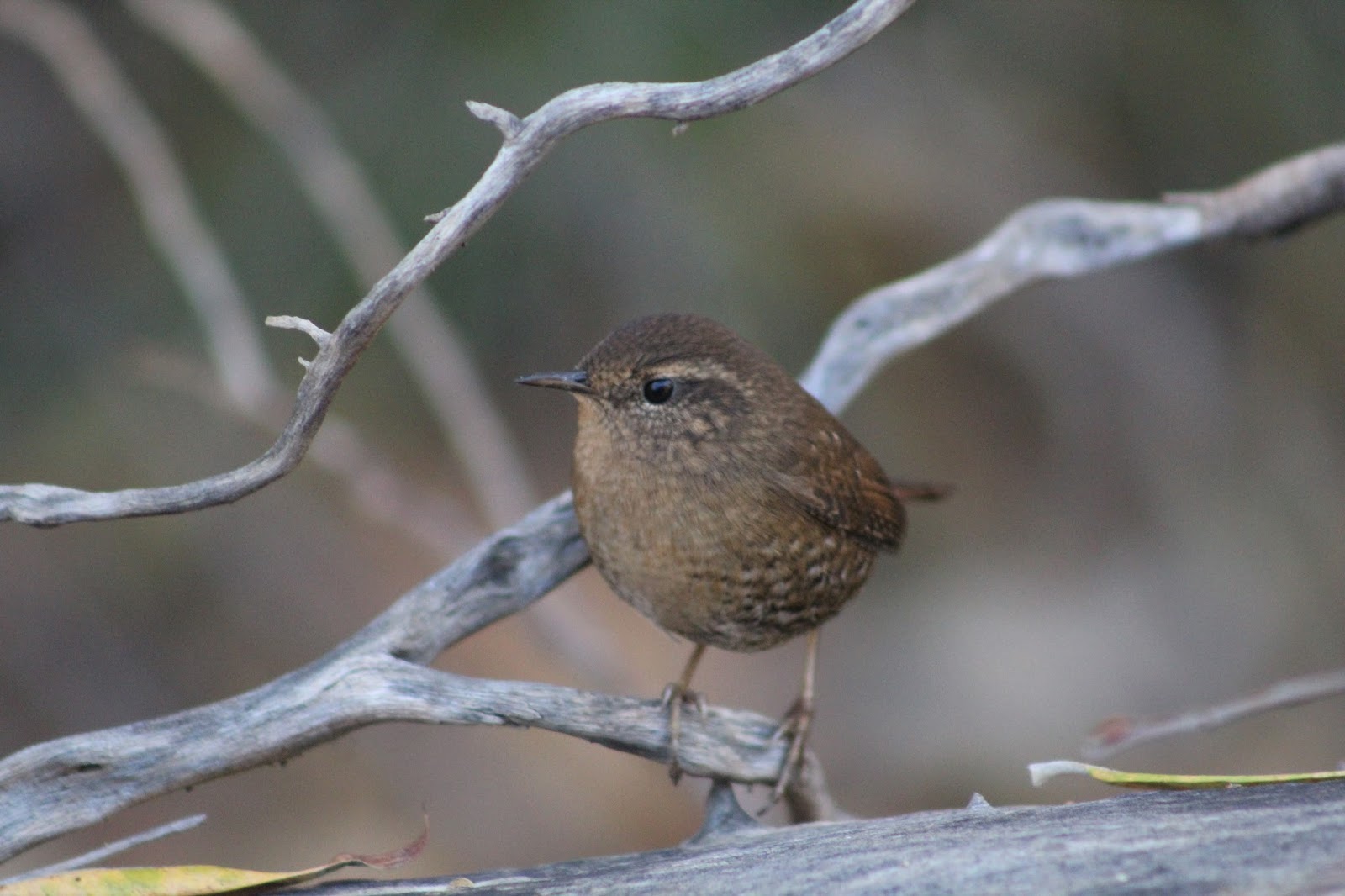


Pacific Wren seems to be a lot more rare in Maricopa County than the extremely similar Winter Wren that it has recently been split off from.  I've found 4 Winter Wrens this winter and this Pacific Wren was in no doubt overdue.

While the Pacific Wren had made my trek, I was still hoping to find the Hooded Warbler.  I moved up the wash as slow as I could and listened carefully for it's call notes.  When I came across a loud spring of water flowing through the wash, I had the feeling to walk away from the loud noise.  As soon as I got away from it, I heard the call note of the Hooded Warbler!  I rushed in the direction of the call and was able to spy the bird.  I performed my own victory dance before getting down to business.  While the Hooded Warbler turned out to be very skittish, it took me awhile to finally snap a few pictures of it.  This sighting was epic for me, as I hadn't seen a Hooded Warbler since the year of 2009.  Thanks Troy!


Following December 4th and already having 4 year birds to start December, the reality of the game set in as I searched and searched for more year birds throughout the entire following week without any additions.  In places I have been to lately, awesome birds were found.  A few days after I was on Mount Ord, Charlie Babbitt found a Downy Woodpecker in the same area I was birding.  Jeff Ritz found a stunning Lesser Black-backed Gull at Glendale Recharge Ponds, the closest hotspot to my home.  It didn't stick around very long.  On Saturday the 10th I went to Lake Pleasant, but windy conditions made viewing difficult and I didn't have a lot of patience.  Caleb went there later in the day and found a Long-tailed Duck flying south over the lake!  I wondered if I had overlooked the duck earlier in the morning.  Long-tailed Duck is a species that dives a lot, and with the constant waves that were created by the wind, it would be very hard to pick a bird like that out.

Something crazy happened though on the 11th, and several Long-tailed Ducks were found in Arizona.  Luckily Louis Hoeniger was at Glendale Recharge Ponds and he discovered a Long-tailed Duck there in Basin 5.  Ironically, I got to see my first ever Long-tailed Duck here in 2013 on Christmas Eve, in the same exact basin.  I was at work when the bird was found, and fortunately, the bird was still there when I arrived to become my 325th bird!  The Long-tailed Duck is quite the stunning duck, especially an adult male.  This one at Glendale dove constantly, and would only surface for about 3-5 seconds before diving under water for longer periods of time.  Thanks Louis!


As I write here on December 13th, I have roughly 18 days left in 2016 to add more birds.  330 would be a great number to hit, but at this point, I will say that 325 was what I've been shooting for.  There's a lot of hardcore birding left, and there is a lot of potential for many more birds.  Stay tuned for more..

Sunday, November 20, 2016

Maricopa Madness: The Big Year's New Groove

My Maricopa County Big Year this year has been a blast.  It has also been tiring.  My work schedule makes it possible for me to bird on days that I have to work.  Most of my shifts are from 1 P.M. to 9:30 P.M., which gives me time in the morning to get a satisfying amount of birding in.  Add that in with two days off and were looking at some intense stuff.  Most days I take my work clothes with me birding and go straight to work from the field.  It gets tiring, but if I want to succeed at a certain goal I have in mind, I have to go all out.  This is a new groove that is hard to stop doing, even if I want to stop doing it.  As October saw a plethora of birds find me and my Maricopa County year list at an exciting and rapid pace, the November pace has slowed down...a lot.  I had a goal going into November to rack up at least 8 year birds for my Maricopa list to bring that total to 320.  Last post I had added Winter Wren, Fox Sparrow, and Golden-crowned Sparrow to get the number to 315 after breaking my previous record of 313.  I've been hoping to add more and more, but I've been striking out a lot lately too.  This is a stage in the game where things will be very challenging, and the "easier" additions are diminishing.

On November 16th, I had the gut to go out to the Lower Verde River and search throw the riparian forests at the Box Bar and Needle Rock Recreation areas.  I had eastern warblers on the brain for this trip, especially some of the more regular ones that show up such as Northern Parula and Chestnut-sided Warbler.  As a week had nearly passed since my last year addition for November, I was hoping to get back into the swing of things.  Box Bar had me bored to tears, and Needle Rock did at first too.  As it was nearing noon at Needle Rock, I was tired and exhausted and I was getting ready to throw in my effort and go home to sleep.  I was standing along a point at the Verde where I couldn't really go any further unless I wanted to swim down a rapid river.  Despite my tiredness, I realized there was a mixed flock of birds feeding.  One low forager caught my attention, and woke me up..


Northern Parula, welcome to the Maricopa County Big Year of 2016!  One of my favorite warblers...


The remainder of the 16th was spend further exploring the Verde and Lake Pleasant.  My tiredness caught up to me on the way home, where I had to pull off the road to sleep for about 40 minutes.  I felt like a new creation when I woke up, and I woke up to a text from Susan Fishburn talking about a Groove-billed Ani being found.  After going online and scouring eBird, Facebook, and the Listserv, I couldn't find anything about an Ani.  Susan than sent me an email that came in from Jim Burns, that apparently made it to only a few people subscribed to the Listserv, and it didn't actually make in onto the Listserv itself.  Jim Burn's friend found and photographed a Groove-billed Ani at Chandler's Veterans Oasis Park on the previous day on November 15th around noon.  I re-forwarded his message to the List, and it officially made it through that time.  As Groove-billed Ani is a great rarity in Arizona, it would undoubtedly bring in a crowd of birders.  For me, it was a potential life bird, which would be new for me in all categories.  At this point I didn't matter that it could be my 317 Maricopa County year bird, I wanted it for a life bird.  My search would be put on hold though, as November 17th feel on a day that I had to work in the morning.  As I worked, I got a text from Gordon Karre just after 7 A.M. that the Ani had already been relocated.  Reports came through in the morning from plenty of excited birders who were seeing this spectacular rarity.  I made plans to chase the bird after I got off of work at 2:30 P.M.  Would my chase be successful?.....

I arrived at Veterans Oasis Park in Chandler around 3:20 P.M. where I found Jeff Ritz in the parking lot saying that he was searching for several hours without any luck.  Knowing that Groove-billed Ani can be sneaky and secretive, I still had my mind in a positive frame thinking that I was going to see the bird.  Jeff and I joined forces and started searching, and we were quickly joined by Mark Ochs, Tyler Loomis, Babs Buck, and Laura Ellis for the remainder of the day.  The Groove-billed Ani started off by giving us a long search.  The six of us circled the large basin's vegetation many times of where the Ani had been seen the most.  This was at the northeast side of Veterans Oasis Park.  Many raptors were flying around throughout the afternoon, and they were probably keeping birds down.  As the light was fading gradually, Tyler's eagle eye came through, spying the Ani.  I was behind the group when I heard Mark say, "Ani!  Tyler's got it!".  We all quickly walked up to see the Groove-billed Ani quietly and calmly foraging in dense hop bushes around the perimeter of the northeast basins at the park.


Our 1.5 hours of searching prior to our sighting became awesome in a split second.   The Groove-billed Ani put on a show for us while sneakily foraging and feeding through the dense hop bushes while regularly perching relatively out in the open.


Groove-billed Ani is a casual visitor to Arizona, usually in either the summer time frame or in the late fall time frame.  Maricopa County has had it's records over the years, with the last being in Gilbert Water Ranch in 2005.  In the last five years, southeastern Arizona's counties have had several Groove-billed Anis and Apache County's Wenima Wildlife Area even had a discovery.  Before Gilbert Water Ranch, one had been found at Dean and Beloat Riparian Area in Buckeye as well as Tres Rios Wetlands.  My Grandpa, who loved nature and birds, even had the Tres Rios vagrant pointed out to him while he was on a walk there in either 2000 or 2001.  I'm glad it was now my turn to see this bird, one that I've been hoping would show up one of these upcoming years.  It became my 531st life bird overall, most importantly my 382nd Maricopa County bird, and least importantly (but still epic), my 317th Maricopa County Big Year bird.


The Groove-billed Ani is easily told apart from others as an Ani by it's short parrot-like bill and black coloration.  The very similar Smooth-billed Ani will probably never occur in Arizona.  The Groove-billed Ani, although very similar looking to Smooth-billed, has more skin around it's eye, more noticeable parallel "grooves" on it's upper mandible which Smooth-billed Ani won't show, and Groove-billed Ani also has a straighter and less-angled shape of a lower mandible than Smooth-billed Ani does.  Groove-billed Anis feed on a variety of insects, seeds, and fruit in dense bushes within riparian and brushy areas and it my also be found in scrubby countryside.  This bird is gregarious in it's normal range, and travels in family groups, where birds will help each other find food.


Our Groove-billed Ani must have wandered away from it's family or needed it's own adventure.  It acted tame around us and gave us a "front row" ticket to the show.  Behind the Wedge-rumped Storm-Petrel, this bird is easily my 2nd favorite out of the 7 additions I have now added to my Maricopa County life list this year (others have been Hudsonian Godwit, Black Skimmer, Blackpoll Warbler, Thick-billed Kingbird, and Wild Turkey).


What else will Maricopa County bring for me in 2016?  I know there will be more year birds.  7 Maricopers this year has been more than expected, I can't ask for anymore (although another one would be epic!).

How much did I really enjoy the Groove-billed Ani?  Well, on Friday, November 18th, I had to go back to Chandler's Veteran's Oasis Park to enjoy it again with another crowd of birders...


Thursday, November 10, 2016

Maricopa Madness: A New Record

You know what can really be frustrating when your doing a County Big Year and when your about to break the record?  The answer is silence from the birds you need.  And not just silence from ones you need, they are the ones that others find and you chase them only to miss them.  Once the Winter Wren tied my record on November 2nd at 313 bird species for Maricopa County, I was anxious to get that 314.  In the course of a week, I made 6 attempts in 6 chases at that potential record breaker.  3 times I fell to an American Bittern at Hassayampa River Preserve.  This bird would work it's schedule and would show itself on days that I wouldn't be there, or at times just hours or less before or after I would leave.  One came from a hypothetical White-winged Scoter at Lake Pleasant.  The other came from a Ruddy Ground-Dove in a backyard.  Finally, I missed an Eastern Phoebe in Phoenix, one that has a tendency to be chase able.  These birds excited me and each would have been great for 314, but as things go in a Big Year, it's always unpredictable and you never know what may happen.  But 0 for 6 over a week.  At least the company has been good with the birding buddies that I have.

One huge plus during the week of strikeout after strikeout was getting to photograph my first Maricopa County life bird of this year, a Wild Turkey.  I wasn't able to photograph the Wild Turkeys in the Reavis Ranch area of the Superstition Mountains because of how wary they were.  A second observation of Wild Turkey at Sunflower was great but that Turkey was also too afraid of me for me to be able to snap off a documentation photograph.  But the third Wild Turkey observation came for me this year at Hassayampa.  It was mind blowing to me that after not recording a Turkey in Maricopa County ever prior to 2016, that I have now had 3 sightings in 2016 alone.  This one that I got to document at Hassayampa was very wary too, luckily I spied it at a good distance away.


Caleb Strand spied this Red-shouldered Hawk soaring over the Hassayampa.  One of our neatest hawks.


Gordon Karre and I searched for White-winged Scoters and Surf Scoters at Lake Pleasant.  We didn't get to see any Scoters, but Gordon added several birds to his Maricopa County year list that day.  Two recent additions to my Big Year, the Red-necked Grebe (far left) swam past a flock of Red-breasted Mergansers.


On the Eastern Phoebe chase in Tolleson, Gordon and I searched and searched only to miss the Eastern Phoebe.  But two Merlins were a decent consolation.


November 9th came around, a week after I tied my record and of course, a week full of six strikeouts that would have broken the record.  I had some decisions to make on the 9th, but I decided to go after an easier target and form up a good day plan that would mix together a variety of habitats to give me a shot at discovering several year birds.  That easier target was the Fox Sparrow, and I went to Rackensack Canyon north of Cave Creek to attempt that.  Rackensack Canyon is the best spot to see Fox Sparrows in Arizona, and shortly into my search, I found myself looking at my record breaker, the 314!


More than one Fox Sparrow showed itself at Rackensack, and by the end of the walk I had 5 individuals.  And there are many more to arrive at this spot where they spend the winter.  One time I had a count of 15 birds.


The rest of the 9th was spent searching and then striking out on a Black-legged Kittiwake found at Lake Pleasant by Caleb.  Luckily, Lindsay Story discovered a Golden-crowned Sparrow at Phon D. Sutton Recreation Site along the Lower Salt River.  This GCSP was a probable returning bird that spent last winter at Phon D. Sutton and was in the same area as this one.

I went to the Salt River today on the 10th in pursuit of the Golden-crowned Sparrow.  If I could land it, I would set another new record for myself at 315 Maricopa County year birds.  I got to Phon D. Sutton before the sun was up, and so did Barb Meding.  Barb and I searched the usual spot without any luck.  An hour went by, and the sparrow was a no show at it's usual spot.  I decided to work my way around the surrounding area to listen for call notes from Zonotricia sparrows.  Luckily, I found the Golden-crowned bird and was able to bring Barb into the desert so she could see it too.  After I initially refound it, I had to refind it again.  Luckily, the bird appeared for Barb and me, and it was relatively out in the open.  This was a perfect look, one that we were hoping for!  And my 315th year bird for Maricopa County was the Golden-crowned Sparrow.


At Phon D. Sutton, I also found another Winter Wren.  This one showed itself well, unlike the previous one that was a heard only.  Now if only I could find it's brother the Pacific Wren...


The Salt River was also home to this super tame Greater Roadrunner.  I even got within feet of this bird, and selfies were included!


We have 7 weeks left in 2016.  What else will show up in Maricopa County during the remainder?...