Tuesday, October 8, 2013

The Local Birding Channel

Most birders have a local hotspot they visit more than often.  I sure do.  It's like our local television stations in a way!  In this case, it's Tres Rios Wetlands and Glendale Recharge Ponds for me.

Let's start with a few highlights I've had at Tres Rios as of late!  Here's the latest from my "Local Birding Channel".

Northern Harriers are starting to increase in numbers...


Despite it's name, this Night-Heron is flying during the day.  Would that make him a hypocrite?


The most amazing show of sight are the Yellow-headed Blackbird flocks.  Come extra early so you won't miss it!


Ospreys have increased in numbers also.  Watch for them where there are any bodies of water.


A Greater Roadrunner was seen perched on a fence.  How odd is that?


Casual at Tres Rios, this Rock Wren was found at Tres Rios's only formation of rocks.  You can't miss the rock peninsula!


The Peregrine Falcons are cool as ever.  Keep your eyes peeled overhead!


Black Vultures are abound in large numbers!  Keep an eye out for them in the farm area just northeast of Tres Rios.  


To change the channel from 3.1 to 3.2, we now stop at the Glendale Recharge Ponds..a rather ugly but mecca of a birding location.  Large bird numbers congregate whenever these large basins carry water.

The Least Sandpipers are lining the ponds right now.  Despite it's name, the Sandpiper itself doesn't feel like it's the Least.  It's the smallest sandpiper in the world, and they are certainly one of the most common in Arizona.


A lone Western Grebe has been chillin at the ponds.  He is bigger than most.  Here, he is joined by a female Cinnamon Teal. 


Black-necked Stilts and American Avocets are both around---you can't miss em!


The Avocets are especially cool!


Don't forget to tune into your Local Birding Channel!  In other words, don't forget to go birding at the awesome locations near you.  Tommy D..out.

Returning to Prescott

It had been awhile since I had been to Prescott last.  But last week, that all changed, and I made two trips to Prescott.  On one of the trips, I was joined by my birder friend Steve Hosmer.  I went there based around trying to relocate a Mississippi Kite that was lingering in Chino Valley both times, without success.  Oh well!  But the Prescott area held awesome birding experiences.  I added 7 new birds to my Yavapai County list also.  This isn't a long post, more of one to show a few picture highlights that I was able to capture.

This is Watson Lake, neat looking huh?  It is a location where I find a lot of goodies whenever I visit the Prescott area.


This Cassin's Vireo likes Watson Lake too, and there are a lot of things in the lakes riparian area to keep the curious vireo busy.


I then spied a male Red-naped Sapsucker, who gave me good binocular views and no pictures for the camera.  This Bewick's Wren however was somewhat cooperative....


The marsh of Watson Lake was full of birds.  Yellowthroats, Soras, you name it.  This young Cooper's Hawk was hoping to show off his hunting skills..


He then spied something in the marsh and failed at his attempt.  He's still young and has a lot to learn.


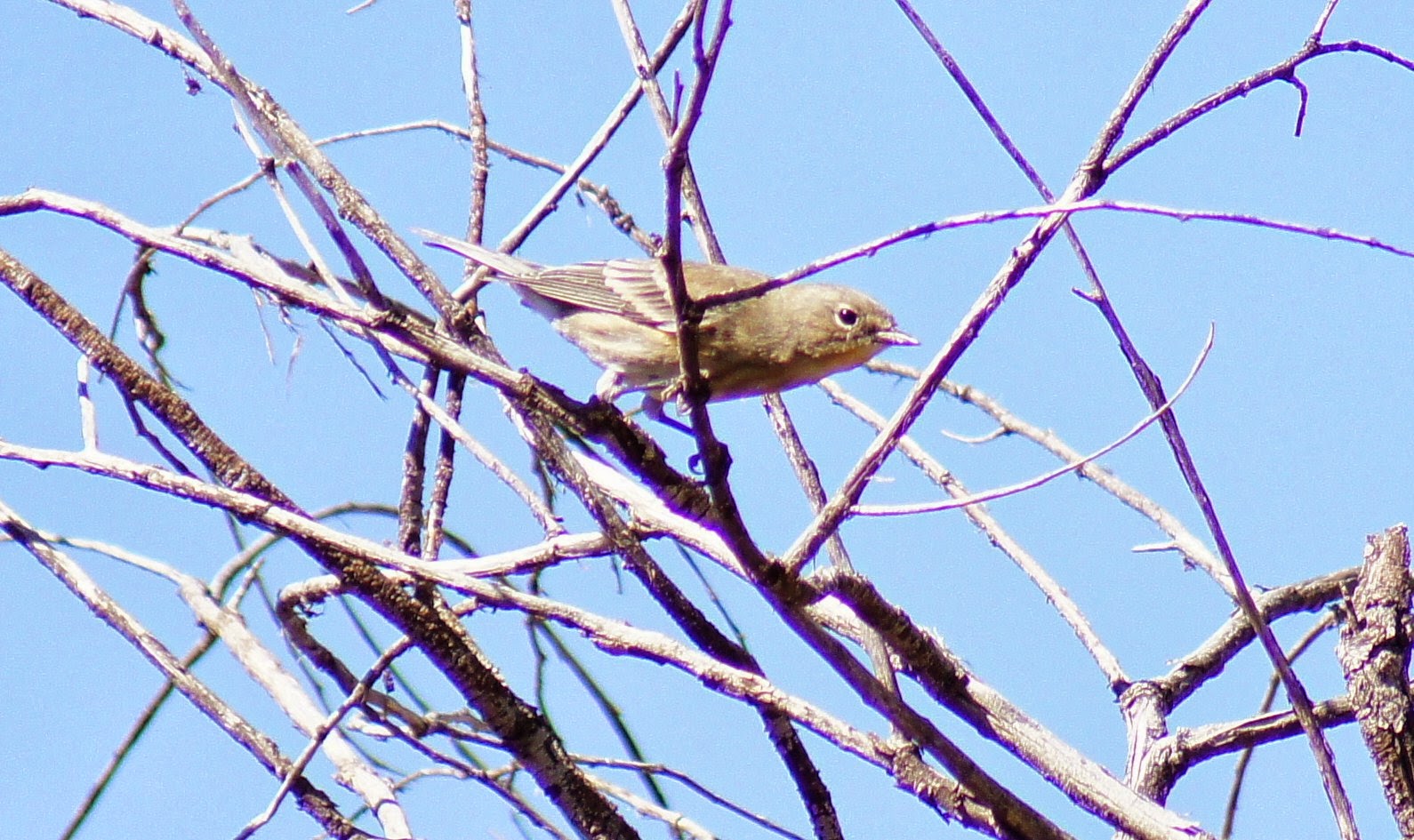
This dull Yellow-rumped Warbler had a very dull but somewhat funny sense of humor.  He flew out of the marsh and right up to me.  Perhaps he was the young Coop's miss..


Western Meadowlarks also sang in the nearby open fields.  Meadowlarks are always a treat, and they don't come close often.  Perhaps these meadowlarks that line Watson Lake are pretty used to people walking the Peavine Trail?


The majestic Bald Eagle took a soar overhead Watson.....


Also present was a late migrant, the well known Mr. Vermilion..


Immediately neighboring Watson is the equally birdy and attractive Willow Lake.  These two lakes provide some of the best birding in the state of Arizona based on bird abundance.  When I got to Willow, a Caspian Tern flew over the lake.  He had a line of Northern Pintails to stare down at..


When Caspian landed, he landed with two other Caspians, and a handful of other birds, including the obvious American White Pelican.  How many species can you identify from this picture?


Besides water, Willow has great surrounding land habitat.  Any day when a Crissal Thrasher pops up in front of you is a good one!


This young Red-tailed Hawk was one of many Red-tails in the immediate area..


When Steve and I were walking through the "Cottonwood Peninsula" at Willow Lake (true to it's name, it has many large cottonwoods), we spied a neat shape in the trees.


It was the awesome Great Horned Owl!  It was very tolerant of our presence!


While Willow and Watson Lakes are a mile high in elevation, I still retreat to higher elevations when I am finished birding them.


Gorgeous huh?  If anyone disagrees, shame on you!  This is the southern stretch of Walker Road, between mile markers 8 through 11.  This is one of my favorite high elevation areas to bird in Arizona, and this peaceful getaway is very birdy, especially in spring and summer.  This Acorn Woodpecker lives here year round and was having the time of his life gathering acorns for the upcoming winter.


This young Hermit Warbler was along the path.  It was a new Yavapai bird for me.  There was also a male Townsend's Warbler present and several Olive Warblers.


Western Bluebirds were very common, and as always, very awesome!


The most-common bird was the Mountain Chickadee.  These little guys were everywhere, and they proudly proclaimed they were the tiny but mighty individuals in a large city in the trees of Walker.


On Walker Road, all three Nuthatches were present to make things as nutty as possible.  Seeing all three nuthatches at once is something I always enjoy!


As I phished away, these bird flew in and quickly came into the rescue.  Mountain Chickadees, the three nuthatches, as well as the warblers, it was fun to watch.  I won't ignore the signs to Mountain Chickadee City ever again, cause these guys were ferocious.  But luckily for me, I'm a human and not a Pygmy-Owl.  The chickadees would've ransacked an owl.

Winter is approaching us fast, and it is an awesome season for birding.  Don't forget to store up food in your hidden holes and shelves to keep yourself from starving to death when the Phoenicians and other Arizonians get snowed in.  Heck, even the Acorn Woodpecker knows that.  He may look like a doofis, but he's really pretty smart.


This concludes my Prescott post.  I hope to return to Prescott again soon.  Prescott summed up:  "Where seldom is heard, a discouraging word, and the birding is awesome all day".

Monday, September 30, 2013

A Morning Up Close with a Swainson's

A pair of Mississippi Kites chose to breed in a rural neighborhood area in the summer of 2013.  This area is a very rare occasion to see this species in, and it was in the Chino Valley north of Prescott.  While they were discovered and all of Prescott's birders were able to see this Mississippi Kite pair and they young they hatched, I was sitting in Phoenix...broke.  I haven't seen Mississippi Kite much at all, two times in my life to be exact..with the most recent being in June of 2010.  Well, one of the Mississippi Kites decided to stay longer than usual, as a group of Yavapai County birders came and saw the bird in the same place as it was being seen during their breeding duration.  I saw the report and came up to Chino Springs in hopes of finding one after I thought I missed my chance.  Spoiler alert, well...I drove up and missed the Kite after nearly three hours of searching for it.  Maybe it did head south as it should have by now, or maybe I just missed it.  Despite the disappointing miss, I surprisingly did have something that made my search very enjoyable.  In fact, it was awesome.  It came in the form of a raptor.  Speaking of raptors, I saw plenty of other raptors that seemed like everything else besides the Mississippi Kite.  Every medium-sized raptor made me jump, but after awhile, I got used to the Kite not being around.

The sun was in my eyes as I arrived, and I noticed a raptor flying in my direction as I was looking into the sun.  It wasn't my wanted Kite, but it is probably one of the best looking hawks in North America.  It almost seemed like this raptor knew my situation, and this was his way of saying good morning.  And he made an epic appearance...


This is a Swainson's Hawk.  While I walked around the fields and neighborhoods of Chino Valley looking for the Kite, there were at least four of these handsome raptors, and they really made it a fun morning.  But one of them was particularly cooperative.  At first, he soared up high and flew around for awhile.  Chino Valley was cold at first, but once it warmed up as the sun rose, the Swainson's wanted to have a taste of the warmth. 


After getting in a tussle with another Swainson's Hawk, he decided to come in for a landing after an unsuccessful attempt at a small critter he was preying on in the field.  His landing happened to be pretty close to me!


I was amazed at the sight of the hawk!  So close!  We decided to have a staring contest....


Over the next ten minutes, I probably snapped 100 photographs of the Swainson's Hawk, who didn't even care that I was 20 feet away...


Studly raptor huh?  I think so!  Swainson's Hawks are a variable raptor, having three distinct color morphs.  This one appears to be the intermediate morph.  When the hawk and I parted ways, it left me with the best looks I've had of this species up close!

Besides the Swainson's Hawk, here are a few other birds that were present in the Chino Valley.

Vesper Sparrow

Cassin's Kingbird

And non-bird-wise, here's a few Pronghorn Antelope