Tuesday, September 17, 2013

A Gift From Mexico

On September 2nd, 2013, Ron Beck discovered a small young wren in Huachuca Canyon in the Huachuca Mountains of Southeastern Arizona that turned out to be the rare in North America SINALOA WREN!  Because this was indeed a small young wren, it was also very drab and rather indistinct.  Luckily, the Sinaloa Wren has a very distinctive song and a different "ratchet" call than the similar Bewick's Wren.  The bird gave both of these evidences and through a few good pictures, some of it's key field marks where shown to rule out other species, such as the Bewick's Wren.  Record wise, this remarkable rarity has been found in North America two previous times before this particular discovery, both in Arizona.  The first one was found at the Patagonia-Sonoita Creek Preserve by Robin Baxter and Matt Brown on August 25th, 2008.  They located the bird by it's distinctive song, which Matt had heard in Mexico numerous times on one of his birding trips.  Matt and Robin were able to find the bird and get photographs to confirm the first Sinaloa Wren in the history of the United States!  The wren continued in the area for almost a year and was very hard to see, due to it's skulking habits.  Many birders had the bird as a heard only.  The Sinaloa Wren even built a few nests and sang relentlessly to attempt attracting a mate.  Had he had been 30 miles south, it wouldn't have been a problem!  Then, on April 14th, 2009, Diane Touret discovered another Sinaloa Wren, this time in Huachuca Canyon.  The bird was photographed and well documented by pictures and song recordings as the first one was.  Four years later, this young bird was then found on September 2nd in Huachuca Canyon once again, giving the canyon 2 of the first 3 records.  As mentioned earlier, if it weren't for voice, this little bird would be hard to identify.

AZFO NOTES:  "Key ID Points for Sinaloa Wren:  It has a pale eyeline, rusty tail contrasting with brown back, gray underparts and a few noticeable streaks on the sides of the neck.  Similar species of wrens with pale eyelines: Bewick's Wren is smaller and slimmer and has a brown tail with white tips.  Eastern Carolina Wren is bright rusty above and bright buffy below.  Mexican/Texas Carolina Wrens are browner above and less buffy below than Easterns but the tail is also browner and does not contrast with the back.  Happy Wren, which occurs almost as far north in Sonora as Sinaloa Wren, has a boldly striped face, bright buffy or rusty underparts and a browner tail.  The song of the Sinaloa Wren is very distinctive and diagnostic.  The third bird that was discovered was young and some of it's key field marks were shown, but were harder to make out than on an adult.  "This is a very dull immature which lacks the characteristic black and white steaks at the side of the neck although a hint of them can be seen.  In addition, the rusty tail does not contrast as much with the back as in an adult.  However, Bewick's Wren would have a thinnner bill and a longer eyeline.  Fortunately, the song of this species is diagnostic and the recordings confirm the ID."

On September 10th, 2013, the Sinaloa Wren continued in the location that it was discovered in Huachuca Canyon originally on September 2nd.   Steve Hosmer and I made the trip down, and we were hoping to see the wren.   It was cooperative for many birders, and has been the easiest of the three Sinaloa Wrens discovered so far.  When driving into Huachuca Canyon, the bird has been in the stream bed by the bridge shortly after the pavement ends on the road when driving into the canyon.  There is a picnic area here, as well as a swing set and campspots.  Steve and I arrived at 7 A.M., hoping to catch a glimpse of the plump little Sinaloan artifact.

Huachuca Canyon


While waiting for the wren, we heard and saw many other birds and cool creatures.  One came in the form of a Montezuma Quail calling from the surrounding grassy hillsides.  We couldn't see the elusive quail, but it was cool hearing it.  Despite the many birds that were around, they weren't very cooperative for photography at all.  Here's a few birds, creatures, and people who were cooperative for the camera.

Acorn Woodpecker

Zena the Malamute

Nashville Warbler

Arizona Sister

Steve Hosmer

There were a lot of other birders present, including expert guide Laurens Halsey. Everyone walked and stood around listening for the bird. At about 7:30 A.M., Laurens got everyone on the bird who was giving it's ratchet call in a dense thicket. We walked up to the thicket. Despite the fact the bird was making a lot of noise, it wasn't immediately showing itself. After awhile, it came out of the thicket and perched briefly in the open. The stubby tail was noticeable even with the naked eye. The bird flew into the area of the stream bed, and briefly delighted us with it's awesome song. Between 7:30 and 11:30, we heard the wren probably 5-6 more times. It still continued to be a skulker, and it was a real challenge getting any sort of a look at it. At 11:00 A.M., I was in the stream bed near the picnic area and away from the other birders. There were dense thickets around me, and I caught movement foraging low. I quickly got on the bird and noticed it was the Sinaloa Wren. There were sticks, small twigs, large twigs, and leaves in the way everywhere were the wren went. It luckily came up into an opening where I got good and clear looks at it for about 5 entire seconds. The 5 seconds beat the .7 tenths-of-a-second looks I was briefly getting a few previous times of the bird. Here I was able to see the bird well. I could make out the faint distinctive lines on the side of it's neck, I saw it's rusty wings and tail. I then got a rather poor picture of the bird. I seriously felt like I was in Sinaloa, Mexico itself!!!! There were also three Bewick's Wrens around, and the differences between the Sinaloa and the plain and gray Bewick's Wren was evident.  It wasn't the nice looking adult Sinaloa Wren, but hey, it's still the species, and a heck of a good ABA rarity and life bird for Tommy.

Sinaloa Wren (my "shots")


After spending 4.5 hours on the Wren search, Steve and I headed for the Benson Sewage Treatment Plant to look for shorebirds.  One of the ponds had great shorebird habitat, and had 2 Pectoral Sandpipers (one of the coolest!), 2 Baird's Sandpipers, and a few Red-necked Phalaropes and a Semipalmated Plover among the more common shorebirds.  It was great to get good looks at Pectoral Sandpiper.  

Pectoral Sandpiper-it looks like a giant compared to these Western Sandpipers it is with!


Baird's Sandpiper w/ smaller Western Sandpipers

What shorebirds can you pick out of this shot?

Benson STP


Steve and I then headed over to Madera Canyon to search for a Beryline Hummingbird that had been visiting the feeders at the Chuporosa Bed and Breakfast.  Well, the hummer called it quits on the location and the last it was seen was the day before we got there.  In over an hour of waiting, the Beryline outwitted Steve and I.  These Yellow-eyed Juncos were very entertaining though!

Yellow-eyed Junco


As the trip came to a close, Steve and I both agreed the day was a great success.  It felt like the three birding stops were so little compared to the distance we traveled-550 miles.  But when one rarity hunts, that is often the case!!  As I always tell my birding buddies: "any day when you get a lifer, it's a great day of birding."

Sunday, September 8, 2013

The Booby of Lake Havasu

This is Lake Havasu, Arizona.  Well, half of it is in Arizona.  The other half is in California.  Throughout the duration of the Lake, the line for the two states is in the center.  This can be quite confusing for the birder.  It confused me a little.  It's one of those things where if you see a bird in the center, it is quite tempting just to count it for both states.  But this is really being at the western-most limit of Arizona, and the Lake itself is scenic and quite beautiful.  It attracts hordes of boaters, drunks, and swimmers annually, and it also attracts hordes of different waterbirds.  The later is the reason I intend to visit the lake.  On September 7th, 2013, there was a very rare Arizona bird out on the lake, as well as a few other rare Arizona birds.  I joined two of my birding friends for the trip northwest of us to Lake Havasu to chase the bird, where we met up with two of Arizona's best birding experts (who are also my good friends!)

Lake Havasu


Two weeks ago, I went to southeastern Arizona to chase a Blue-footed Booby who was frequenting Patagonia Lake State Park.  At that time, I also knew of another Booby that was found in this area.  It was the Brown Booby.  And yes, these birds have a weird name.  It's the second Brown Booby found in Arizona this year, and it was just hanging out off of a state park along Lake Havasu called Windsor Beach for most of it's time.  I wanted the bird bad, because Boobies are cool and really don't show up in Arizona very often.  Boobies are rarities on an ABA birding scale in general, with the Brown Booby being the most "common" at a Code 3 (which is still rare).  Arizona wise, both species are great finds and are eye/listing candy for any hardcore Arizona birder.  My friends Laurence Butler and Magill Weber felt the same about the Brown Booby as I did, so the three of us said:  "How about we join forces and look for this Booby together, so we can have two Boobies for Arizona".  Great minds sure do think a lot.  After got the Patagonia Lake Blue-footed Booby at three different times, we decided to get the Brown.  In fact, here is Laurence Butler himself and Magill Weber herself as we arrived at Lake Havasu to scan the Lake.

Laurence Butler and Magill Weber searching for a Booby

After scanning the lake for awhile from a high elevated point overlooking the lake known as Pittsburg Point, we didn't have the Booby.  We did find quite a few loons while scanning, including a nice Pacific Loon among the Common Loons.  Without our expert birding friends who were about to join us, we probably weren't gonna get much.  Our expert birding friends have pretty much defined birding in this area of Arizona, known as the Lower Colorado River Valley.  They have found an endless amount of rarities in this area, I mean, an endless amount.  It seems like that list grows daily.  If Batman and Catwoman were birders, I think these two people would replicate that.  As you can tell by reading this, I am very fond of these two awesome people.  I'm talking about the epic Lauren Harter and David Vander Pluym.  And they always show up with an awesome appearance.  

Lauren Harter and David Vander Pluym

Out of the many rarities that Lauren and David have found up here, they have included Brant,Glaucous Gull, Lesser Black-backed Gull, Little Gull, all three Jaeger species, Buff-breasted Sandpiper, Blackpoll Warbler, and many others.  Their best find was probably a Nutting's Flycatcher south of Lake Havasu in the area of the Bill Williams National Wildlife Refuge.  The Nutting's Flycatcher, a Mexican vagrant, attracted thousands of birders during the winter that it was discovered.  It then surprisingly returned and was found with a second Nutting's Flycatcher.  The two flycatchers bred and produced young.  Not only did David and Lauren find the ABA Code 5 Nutting's Flycatcher for many happy birders, but they also found one of the most remarkable discoveries in Arizona birding history with the discovery that the birds bred.  I think they might have changed the Code 5 to an ABA Code 4 for the Nutting's Flycatcher!  Recently, when David was scanning Havasu, he spied a Brown Booby.  That is the same Brown Booby that we were after, and another rarity on the discovery list of David and Lauren.  As David and Lauren arrived on spot, they quickly spied the birds out on the lake and identified them from 10 miles away like it was nothing.  After 20 minutes of scanning, Lauren spied our target Brown Booby in the distance on it's favorite buoys off of Windsor Beach.  Because the bird was distant, we made our way to Windsor Beach in hopes of getting closer.


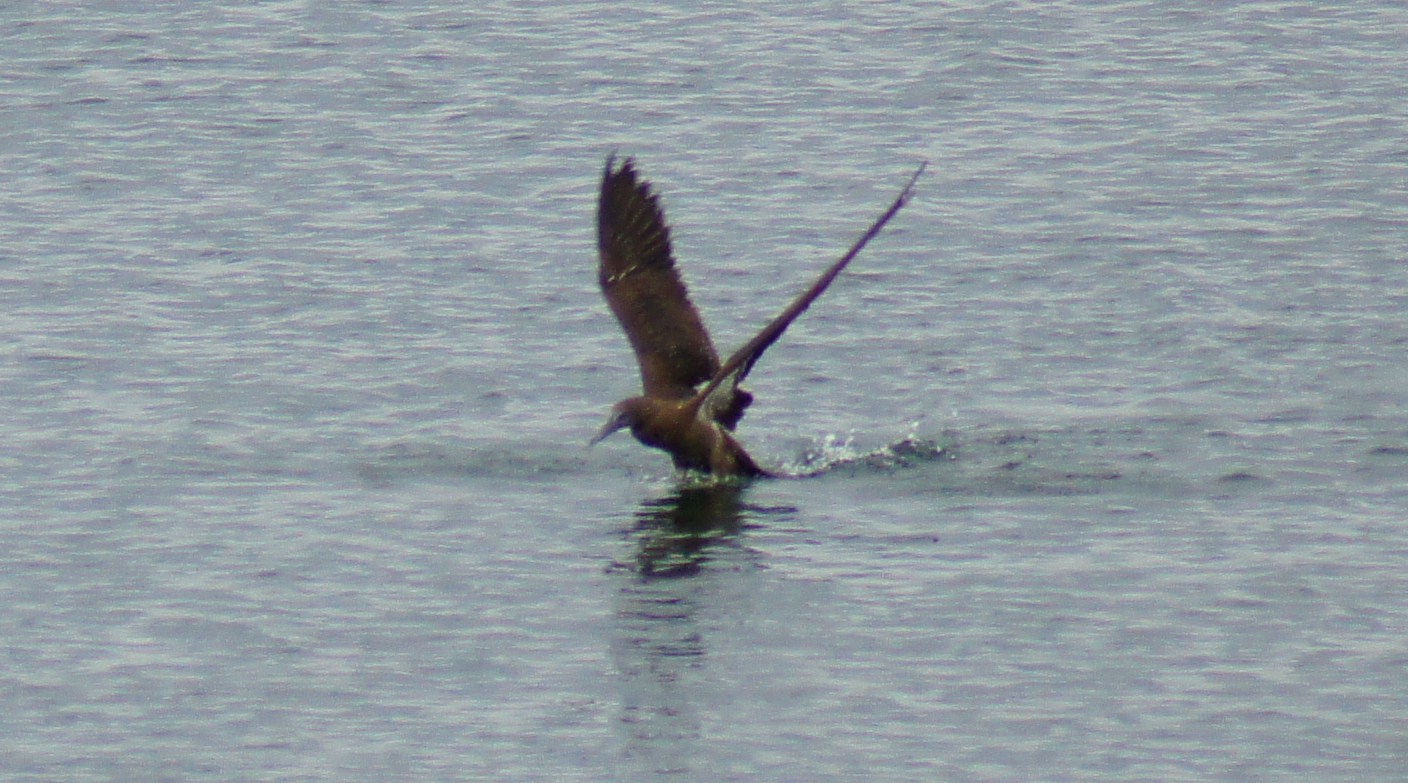
The Brown Booby is similar in it's behavior to the Blue-footed Booby.  Both dive and feed on fish, and are very tolerant of human life.  The Booby buoys were fairly close to the shore, and as we approached the Brown Booby, we were able to view it extremely well.  It fished a few times, but most of the time, it sat on the buoys.  

Brown Booby


This Brown Booby is a juvenile bird.  The key field marks to separating this bird from other boobies is the fact that it's back and tail are a dark brown overall, it's tail is completely brown, and it also has white underwing coverts.  

The Brown Booby and it's favorite Buoy


The Booby flew by us at close distances a few times....


The Brown Booby made my day, it was of course a lifer for me.  It was ABA # 423 and Arizona # 410 to be exact, and was a great memory I won't forget.


Besides the Brown Booby, a few other cool highlights made their way to Windsor Beach.  One struck me as very odd at first when I first saw it swim in.....

I knew it was grebe-like, but I wasn't expecting it to be what it really was at first.  I though it was some strange "albino grebe".  When Lauren looked at it, she said it was a baby Clark's/Western Grebe.  I was amazed at the sight of it.  The bird was by itself and was following Mallards along the shore.  It was obviously abandoned and was trying to survive on it's own.  On Lake Havasu, most of the large breeding grebes are Western and most of the ones south of Havasu on the Bill Williams are Clark's.  So Lauren said this was most likely a Western Grebelet.  

Western Grebelet


This Common Tern also made a nice appearance along the shoreline.  I have only seen one Common Tern prior to this bird.

Common Tern w/Ring-billed Gull

Here's a Common Tern (left) and a Forster's Tern (right) flying side-by-side.


A few California Gulls

Ring-billed Gulls

As we scanned, David and Lauren also spied another nice rarity in Arizona, the Red-necked Grebe.  It was very far out on the lake, but we got to see it take flight.  It's very distinctive in flight, and it's features were evident at a long distance away.  


We birded in several other areas during the rest of the day, such as Rotary Park, the Bill Williams Refuge, and the Ahakhav Tribal Preserve.  It was a great day, and Magill, Laurence, and I tallied 96 species for the day between all the stops.  An extra special thanks goes out to Lauren and David for birding with us!  To close out this post, here are a few more pictures of Lake Havasu, known as Arizona's "West Coast".